
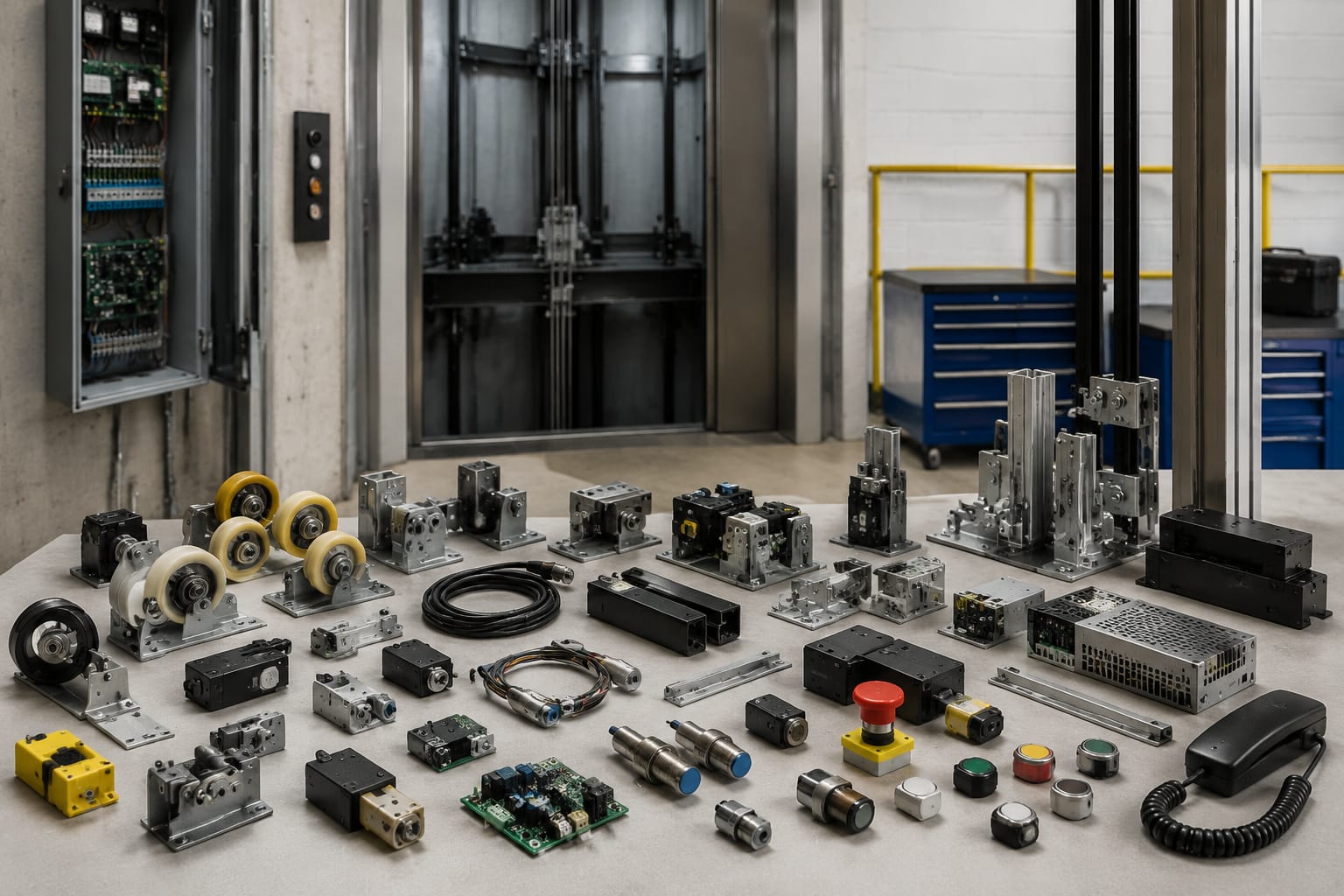
Elevator accessories are the electrical, electronic and mechanical parts that support the safe, reliable operation, monitoring, use and servicing of a lift. They range from levelling sensors and landing buttons to door rollers, guide shoes, lubrication devices and inspection tools.
For maintenance contractors and sourcing teams, the important distinction is that an accessory is rarely interchangeable merely because it looks similar. A correct purchase depends on the lift make, controller interface, mounting arrangement, dimensions, electrical ratings and the function the part performs in the system.
What qualifies as an elevator accessory?
An elevator accessory is a component used with the lift system but is not necessarily one of the major assemblies such as the complete traction machine, lift car or controller cabinet. In practice, the term covers a broad range of replacement and upgrade items.
Typical elevator accessories include:
- Position, levelling and safety switches
- Proximity sensors, magnetic sensors and vane-operated devices
- Car operating panel buttons, landing call buttons and key switches
- Floor indicators, direction arrows, displays and gongs
- Intercom units, alarm buttons, emergency lighting and fans
- Door contacts, rollers, skates, hangers, guides and restrictors
- Cabin mirrors, handrails, protective fittings and ventilation components
- Guide shoes, oil cups, lubrication felts and rail-cleaning items
- Inspection, adjustment and maintenance consumables
Some parts are universal in principle but still need dimensional checks. For example, a cabin fan may be selected by voltage, mounting cut-out, airflow requirement and noise expectation. By contrast, a door vane, encoder, levelling sensor or display board is usually much more dependent on the original equipment design.
For B2B buyers, grouping accessories by function makes sourcing easier. It helps separate a small electrical fault from a door-mechanical issue, and it also prevents an unsuitable substitute from being included in a spare-parts order.
Electrical switches and sensors
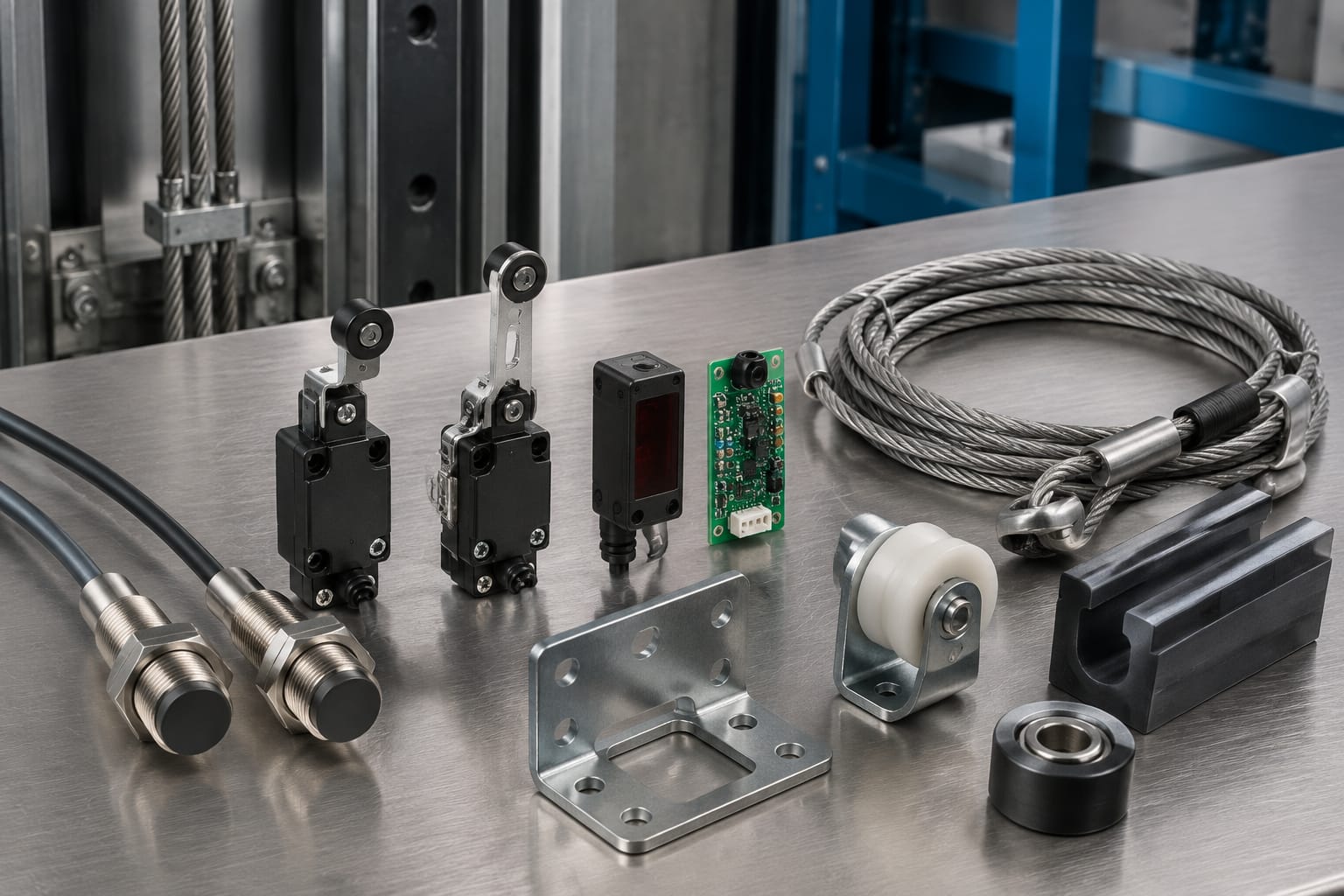
Electrical switches and sensors tell the elevator control system where the car is, whether a door is closed, whether a safety condition is satisfied, or whether a movement-related event has occurred. They are small components, but their selection requires care because an incorrect signal can lead to unreliable operation or prevent the lift from running.
Levelling and position sensors
Levelling systems help the lift stop accurately at a landing. Depending on the installation, the arrangement may use magnetic strips, vanes, inductive sensors, photoelectric devices or other switching methods. The sensor must match the original sensing principle and the physical arrangement installed in the hoistway or car.
When replacing a levelling device, confirm:
- Original part number and lift manufacturer reference
- Sensor type and operating principle
- Supply voltage and output configuration
- Cable length, connector type and pin arrangement
- Mounting holes, bracket shape and sensing face position
- Required distance from the magnetic strip, vane or target
A sensor with the correct connector can still be unsuitable if its switching distance or output logic differs. Before ordering, compare the old unit's label and take clear photos of the connector, bracket and installation orientation.
For systems using a rod-style levelling switch, review the physical form and application details before considering a replacement such as this Otis cigarette rod levelling sensor switch. The product name alone should not be treated as proof of compatibility.
Door and safety-related switches
Door circuits use several switches and contacts to verify that landing doors and car doors are correctly closed and locked before normal travel. These items can include door lock contacts, car-door contacts, limit switches and auxiliary contacts. Their condition directly affects lift availability, but diagnosis should establish whether the fault is in the switch, wiring, alignment or mechanical engagement.
A like-for-like replacement should be checked for:
- Contact arrangement: normally open, normally closed or changeover
- Rated voltage and current
- Connector, terminal and wiring arrangement
- Actuator style, travel and contact operating point
- Mounting pitch and enclosure dimensions
- Door operator or lock compatibility
Do not bypass a safety-related switch to keep a lift in service. A bypass can conceal the actual fault and can create an unsafe operating condition. Fault finding and replacement of safety-circuit devices should be undertaken by competent personnel following the equipment documentation and site procedures.
Turning and movement detection switches
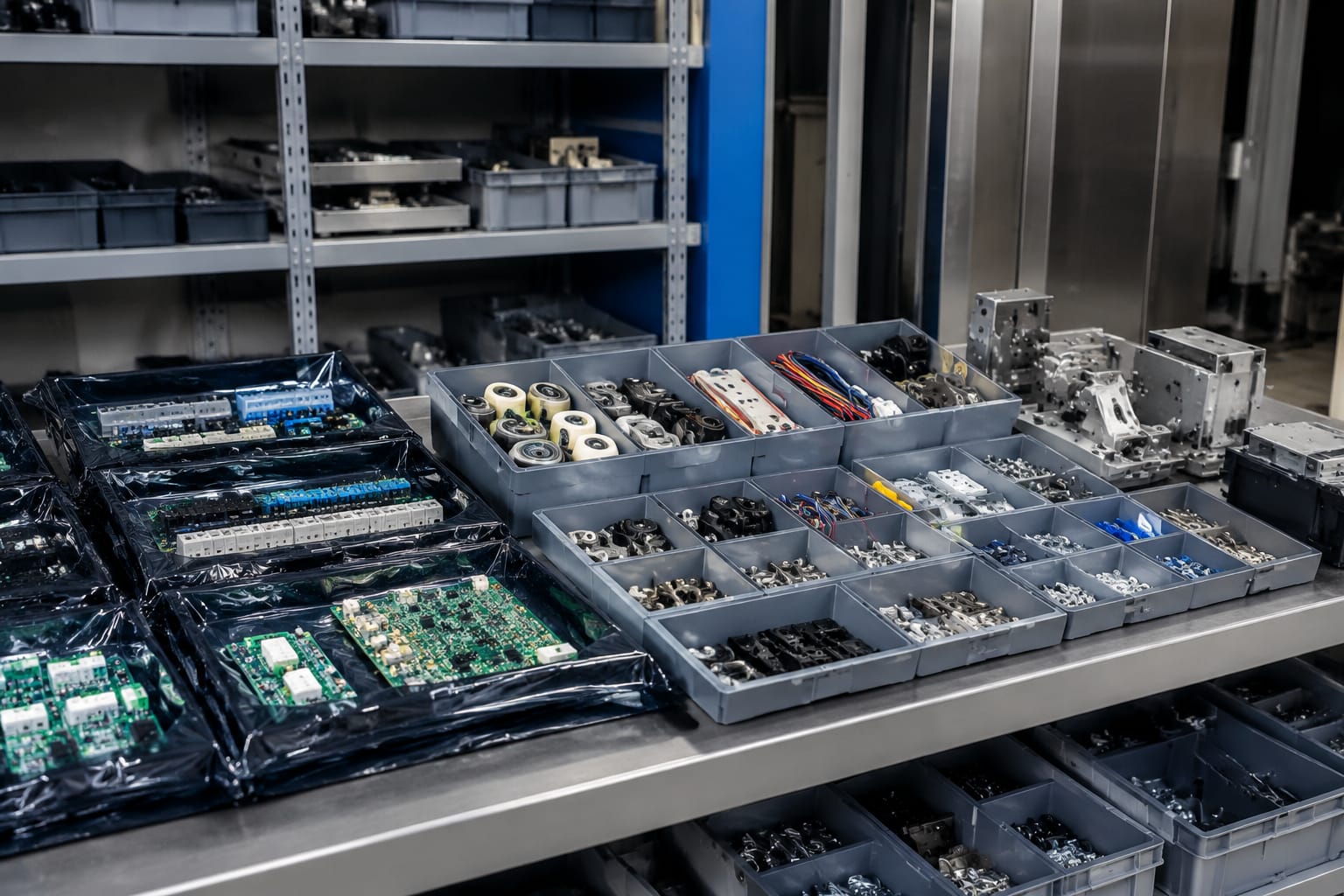
Some installations use dedicated switches to detect a component's rotation, travel or operating position. These may be associated with particular drive, door or escalator arrangements. The mechanical target, actuation direction and wiring requirements are as important as the part's external appearance.
For example, a Mitsubishi elevator turning detection switch should be assessed against the existing assembly, including its mounting and signal requirements. A switch intended for a different application may fit physically but operate at the wrong point.
Buttons, displays, and communication parts
Passenger-facing elevator accessories must work reliably, remain legible and suit the original system interface. They also affect the everyday usability of the lift, particularly in residential buildings, hospitals, commercial premises and public-use properties.
Buttons and key switches
Car operating panels and landing stations can contain floor buttons, door open and close buttons, alarm buttons, attendant controls, fire-service controls and key switches. Replacement buttons are often selected by visual style first, but the electrical and mounting details are more important.
Check these points:
- Cut-out diameter and panel thickness
- Button shape, bezel finish and illumination colour
- Contact block configuration
- Lamp or LED voltage, if illuminated
- Terminal style and wiring access
- Engraving, Braille requirement or floor marking
- Compatibility with the existing panel board or controller input
A button assembly may include separate mechanical, contact and illumination sections. When only one section has failed, confirm whether a component-level replacement is available and suitable. Replacing the full unit can be sensible where matching parts are difficult, but it should not alter the intended operation of the panel.
Indicators, displays and audible devices
Floor indicators, car position displays, hall lanterns, direction arrows and gongs provide travel information to passengers. Their compatibility is commonly governed by the communication protocol, supply type and panel layout.
Before sourcing a display or indicator, record:
- Number of floors and display format
- Segment, dot-matrix, LCD or other display technology
- Serial communication arrangement or discrete wiring
- Supply voltage and connector details
- Faceplate size, mounting method and visible window dimensions
- Direction-arrow arrangement and required sounder function
A replacement display can show incorrect information if its floor mapping or controller communication does not match. Avoid choosing solely by the screen dimensions or a similar-looking front plate.
Communication and emergency fittings
Common communication accessories include intercom handsets, speaker units, microphones, emergency alarm buttons, alarm bells and emergency lights. The selected item should be compatible with the building's intended rescue communication arrangement and the car's available power supply.
For emergency lighting, verify battery configuration, charging arrangement, lamp or LED module type, fitting size and mounting. For an alarm or intercom component, check wiring terminals, line type, call station arrangement and whether the component is part of a proprietary system.
Door and cabin accessories
Door equipment experiences frequent movement and is a regular focus during lift maintenance. Cabin accessories, meanwhile, should be selected for fit, durability and passenger use without compromising access to essential equipment.
Door accessories
Elevator door accessories can include:
- Door rollers and roller guides
- Hangers and suspension components
- Door skates or vanes
- Sill guides and bottom shoes
- Door contacts and lock accessories
- Restrictors and door operator fittings
- Light curtain components and mounting parts
- Buffers, rubber stops and fasteners
Door rollers and guides need the right diameter, groove profile, bearing arrangement, mounting bore and offset. A part that is only approximately the same size may cause noise, poor door alignment, dragging or premature wear.
For light curtains and other entrance-protection devices, match the opening height, beam arrangement, cable routing, controller interface and door operator application. Installation geometry matters: a compatible electronic unit can still be unsuitable if the profiles cannot be mounted in the correct position.
Cabin accessories
Cabin accessories may include handrails, mirrors, ventilation grilles, fans, emergency lights, ceiling fittings, COP faceplates, protective cladding and display surrounds. These items can be selected as part of a refurbishment, but the practical fit remains important.
Consider:
- Cabin wall construction and available fixing points
- Weight added to the car, especially for larger refurbishment items
- Clearances around doors, panels and inspection access points
- Electrical load for lighting or ventilation upgrades
- Cleanability and resistance to the building's expected use
- Fire and building requirements applicable to the installation
Do not obstruct car-top access, emergency fittings, door clearances or equipment panels while adding cabin features. Modernisation work should be planned around the existing lift design rather than treating the cabin as an isolated interior space.
Guide, lubrication, and mechanical items
Mechanical elevator accessories control movement, reduce friction or support the condition of moving parts. Their wear rate depends on traffic, alignment, environment, maintenance quality and the condition of associated components.
Guide shoes and related parts
Guide shoes keep the car and counterweight aligned with the guide rails. Depending on the lift design, they may use sliding inserts, rollers or a combination of elements. Replacement selection depends on the shoe assembly, rail profile and operational duty.
Check:
- Car or counterweight application
- Guide rail size and profile
- Sliding or roller-guide design
- Shoe body dimensions and fixing arrangement
- Insert material and replacement method
- Adjustment range and clearances
A guide shoe problem may appear as vibration, noise or uneven ride quality, but the root cause could also involve rail condition, rail joints, fastening, alignment or roller adjustment. Replacing the shoe alone will not correct every ride-quality issue.
Lubrication accessories
Lubrication items can include oil cups, wick assemblies, felts, brushes and mounting components used to apply lubricant to guide rails or other designated points. Use only the lubricant type and quantity specified for the equipment. Excess lubricant can attract dust and create contamination, while insufficient lubrication can contribute to noise and wear.
When ordering lubrication parts, check the reservoir shape, cap arrangement, wick dimensions, mounting position and whether the part is intended for the car or counterweight. Also inspect the associated shoe and rail surface; a replacement felt cannot compensate for dirt, damage or incorrect adjustment.
Other mechanical service items
Mechanical accessory orders may also include fasteners, springs, clips, rubber buffers, retaining rings, adjustment hardware and protective covers. Small hardware deserves the same identification discipline as larger parts. Thread size, material, tensile class, coating, length and clearance can all affect suitability.
Where a part participates in a safety-critical assembly, do not substitute general hardware without confirming the original specification and the equipment manufacturer's requirements.
Maintenance and service accessories
Maintenance accessories support inspection, cleaning, adjustment and minor replacement work. They should help technicians work accurately, but they are not a substitute for proper diagnosis or authorised procedures.
Useful categories include:
- Inspection lamps and suitable replacement lamps
- Car-top or pit lighting accessories
- Cleaning materials for approved applications
- Tags, labels and wiring markers
- Terminal accessories and cable-management items
- Door adjustment hardware
- Replacement covers, guards and enclosures
- Lubrication consumables specified for the equipment
A service stock list should be based on the actual installed lift population. For a contractor maintaining several makes and ages of equipment, separate commonly used consumables from make-specific electronic boards, sensors and door parts. This reduces both emergency-order delays and the risk of holding slow-moving, incorrect stock.
Keep records of parts fitted, faults reported, controller details and part-number changes. Those records make the next purchase faster and reveal recurring failures that may require an engineering review rather than another replacement part.
In mixed vertical-transport portfolios, identify parts by equipment type as well as brand. A device labelled for an escalator should not be assumed suitable for a lift. For example, an Otis escalator chain break switch requires application-specific verification.
Check model, dimensions, and ratings
The most dependable way to source elevator accessories is to verify the existing component against the equipment documentation and the physical installation. A disciplined check is more valuable than a broad description such as “door sensor” or “lift button”.
| Check area | What to record | Why it matters |
|---|---|---|
| Equipment identity | Lift make, model, controller and installation details | Identifies the likely component family and interface |
| Part identity | Part number, revision, label data and manufacturer marking | Distinguishes similar-looking variants |
| Physical fit | Length, width, diameter, hole pitch, offsets and connector location | Prevents mounting or clearance problems |
| Electrical characteristics | Supply voltage, current rating, contact type, output and wiring | Protects circuit compatibility and intended operation |
| Functional arrangement | Sensing method, actuation direction, travel and operating point | Ensures the part performs the required task |
| Environmental fit | Location, temperature exposure, dust, moisture and vibration | Helps select a suitable construction and enclosure |
| System interface | Connector, pin-out, communication method and software dependency | Avoids displays, sensors or boards that cannot communicate |
Photographs are useful, particularly for connectors, mounting brackets and labels. Include a scale reference in photographs of mechanical parts. Measure the old part with suitable tools rather than estimating from an image.
For electrical accessories, isolate power and follow applicable safety procedures before inspecting terminals or removing components. Where the original part has been modified or the label is unreadable, compare the installation with wiring diagrams, controller documentation and known-good parts from the same lift group.
Avoid compatibility and ordering mistakes
Most ordering errors arise from incomplete identification, not from a lack of product choice. The following checks reduce rework, return handling and service disruption.
Do not order from appearance alone
Different revisions can share the same housing, button face or bracket while using different circuits, connectors or mounting positions. A clear front photograph is not enough. Obtain label photographs and measurements from several angles.
Do not treat the lift brand as the complete specification
A manufacturer may use multiple part families across controllers, door operators and installation periods. Stating only the lift brand and approximate age can lead to an unsuitable match. Provide the controller type, existing part number and functional location.
Confirm whether the failure is electrical, mechanical or adjustment-related
A door not closing may result from a worn roller, misalignment, contaminated sill, failing contact, damaged cable or door operator setting. A levelling issue may involve the sensor, vane position, magnetic strip, wiring or controller input. Replacing one visible part without diagnosis can leave the original fault unresolved.
Check revisions and paired components
Some accessories must be used with a matching bracket, connector harness, receiver, controller board or software setting. Ask whether the proposed replacement requires related components or a configuration change. This is particularly relevant to displays, light curtains, sensors and electronic door equipment.
Specify quantity and handedness
Door parts can be left-handed or right-handed, and one landing can require a different arrangement from another. Record the number of doors, panels, openings and affected floors. For rollers, guides and shoes, clarify whether the quoted quantity is per car, per door panel or per individual component.
Protect traceability
For important parts, retain the purchase record, product label and fitting date. If the replacement does not operate as expected, this information helps identify whether the issue is incorrect application, installation, adjustment or a component fault.
A useful purchase request contains the equipment details, old part number, photographs, measurements, electrical data, quantity, operating location and the reason for replacement. Kelevator supplies multi-brand elevator spare parts for B2B importers, distributors, maintenance contractors and OEM buyers; providing this information supports a more precise part-matching discussion.
FAQ
Are elevator accessories the same as elevator spare parts?
Elevator accessories are generally a category within elevator spare parts. The term often covers smaller functional, passenger-facing, service and mechanical items, while spare parts can also include major assemblies and larger replacement units.
Can universal lift accessories be used on any elevator?
No. Some accessories may be broadly adaptable, but the physical dimensions, electrical ratings, interfaces and intended function must still be verified. Safety-related and controller-connected items need especially careful matching.
Which details should be sent when requesting an elevator accessory?
Send the existing part number, equipment make and model, controller information where relevant, clear photographs, dimensions, connector details, electrical ratings, quantity and the part's installed location. State the fault or replacement reason where known.
Should an old accessory always be replaced with the same part number?
The original part number is the best starting point, but a replacement may be a revised or superseded version. Confirm that any alternative has the required functional, physical and electrical compatibility before fitting it.
Start by making an accessory identification sheet for each requirement, then compare the proposed part against the installed component and equipment documentation. This approach helps maintenance teams and buyers source the right elevator accessories with fewer compatibility issues.
Related product references
For practical catalog examples related to this topic, review [cigarette rod leveling sensor switch OTIS elevator parts lift accessories lift accessories](/products/cigarette-rod-leveling-sensor-switch-otis-elevator-parts-lift-accessories-lift-accessories/), [Elevator turning detection switch Mitsubishi lift parts](/products/elevator-turning-detection-switch-mitsubishi-lift-parts/), and [Escalator chain break switch OTIS elevator parts lift accessories](/products/escalator-chain-break-switch-otis-elevator-parts-lift-accessories/). Confirm the exact model, dimensions, ratings, and connectors before ordering.