
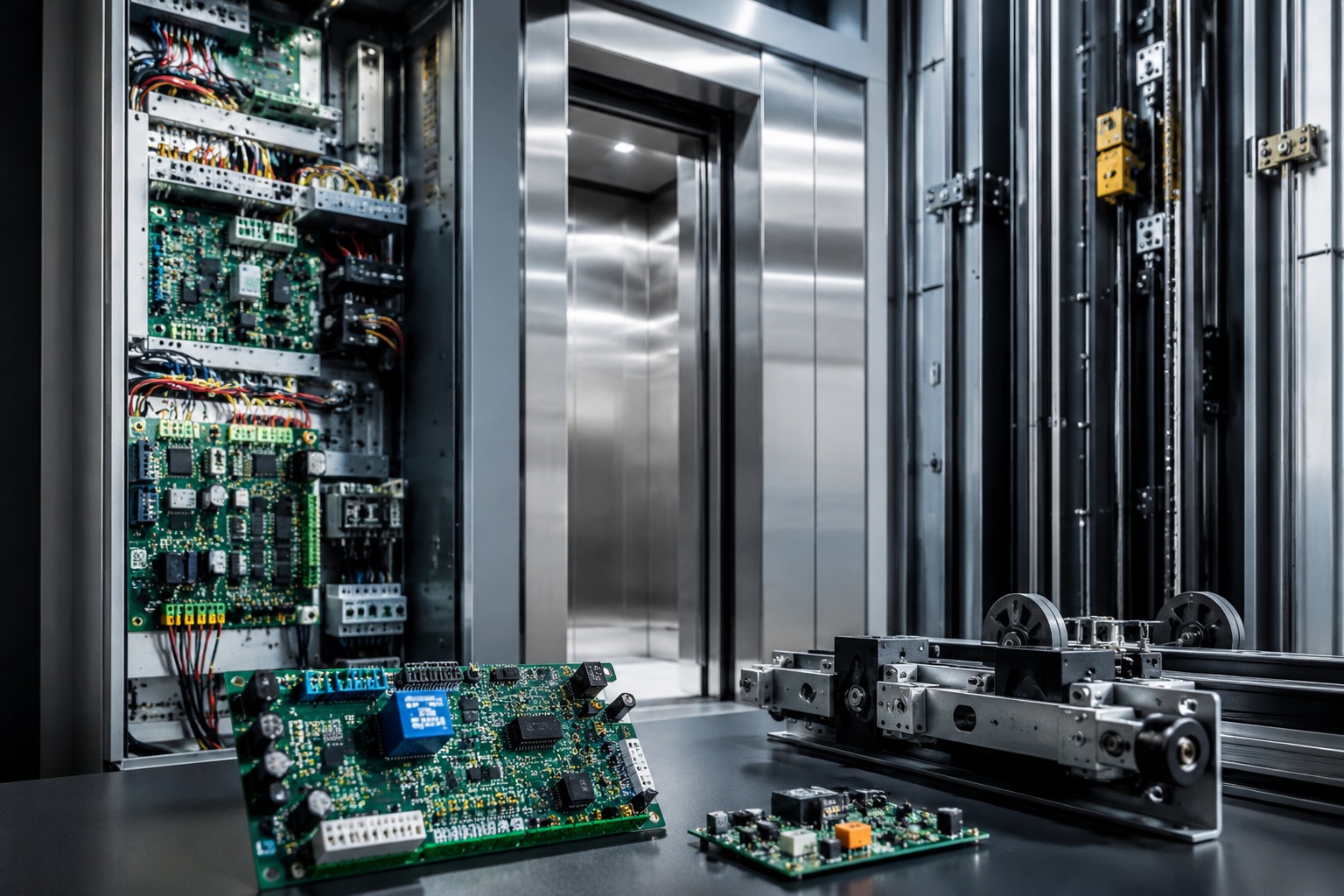
In India, elevator control boards are among the most critical components affecting ride quality, door response, floor leveling, call registration, fault logging, and overall service reliability. When a lift begins to show irregular behavior, the controller motherboard, communication board, expansion board, or related electronic modules are often checked early in the troubleshooting process. A failed or unstable board can create symptoms that look mechanical at first, such as door reopening, missed landings, or sudden shutdowns, but the root cause may actually be power conditioning, damaged I/O channels, processor instability, faulty relays, degraded capacitors, or corrupted program parameters.
For maintenance companies, building owners, modernization contractors, and regional distributors across Mumbai, Delhi NCR, Bengaluru, Hyderabad, Chennai, Pune, Ahmedabad, Kolkata, Kochi, and Surat, the practical challenge is not only identifying the defective board but also sourcing the correct replacement quickly and safely. In a market like India, where imported elevator parts move through trade hubs such as Nhava Sheva, Chennai Port, Mundra Port, and ICD networks serving inland industrial cities, model verification, anti-static packaging, transit protection, and post-installation commissioning are just as important as the board itself.
This guide gives a direct and practical answer: if a lift repeatedly trips, loses commands, displays intermittent communication alarms, or behaves differently after power fluctuations, the control board system should be inspected methodically rather than replaced blindly. Technicians need to confirm the fault, compare part numbers and software families, assess whether a refurbished board is reliable enough, package electronics correctly for shipping, and carry out full commissioning after replacement. For branded equipment such as Hitachi and Toshiba, board family matching is especially important because a physically similar module may still be incompatible due to firmware, I/O layout, connector mapping, or system generation.
India’s elevator market continues to expand with residential towers, mixed-use developments, metro-linked commercial buildings, hospitals, hotels, factories, logistics parks, and modernization of older installations. This means demand for control boards is growing not only in Tier 1 cities but also in Tier 2 and Tier 3 markets where service teams need dependable spare parts support. Buyers today increasingly prefer suppliers that can help with model matching, electrical inspection, stable sourcing, protective packaging, and responsive communication rather than simply quoting a low price.
Below, we explain the common signs of board failure, how trained technicians isolate the fault, what buyers should know when purchasing Hitachi control boards or Toshiba motherboard assemblies, why refurbished parts require disciplined testing, what ESD-safe shipping standards matter, and what commissioning steps reduce callbacks after installation.
Common Signs of Lift Control Board Failure
Control board failure does not always appear as a completely dead elevator. More often, it causes intermittent or confusing symptoms that come and go with temperature, vibration, humidity, poor earthing, or unstable incoming power. In many Indian buildings, especially where voltage fluctuation, generator changeover, dust, heat, or moisture exposure are present, electronic stress can build up over time.
Typical symptoms include random shutdowns, floor calls not registering, the car stopping between floors, repeated door nudging or reopening, loss of inspection control, hall lantern failure, fault codes related to communication, inaccurate car position signals, and restart issues after a power cut. In machine-room-less systems and modern microprocessor-based lifts, even one unstable signal path can affect several linked functions.
| Symptom | What It May Indicate | Why It Happens | Risk Level | Immediate Check | Typical Next Step |
|---|---|---|---|---|---|
| Lift does not respond to calls | Input channel or CPU issue | Damaged I/O circuit, loose terminal, software lockup | High | Verify supply and input status LEDs | Check board logic and connector integrity |
| Doors reopen without obstruction | Door signal processing fault | Noisy input, damaged relay, communication error | Medium | Check door controller interface | Trace board-side input behavior |
| Random fault trips | Processor instability or power conditioning issue | Capacitor aging, heat stress, voltage spikes | High | Inspect power section and error logs | Bench test suspect board |
| Car stops at wrong floor level | Encoder or position processing fault | Signal filtering error, damaged port, poor grounding | High | Check encoder input and shaft signals | Compare board readings with actual travel |
| Display blank or flickering | Communication board or output stage issue | Connector oxidation, low-voltage rail instability | Medium | Measure DC output rails | Check display communication path |
| Lift fails after mains return | Startup circuit or parameter corruption | Power event stress, memory issue | High | Review boot sequence | Reload parameters or replace board |
| Intermittent rescue function failure | I/O or safety chain interpretation issue | Partial relay failure or unstable firmware state | Critical | Audit rescue input/output logic | Detailed functional diagnosis |
The table above shows that board-related faults often overlap with sensor, wiring, and interface issues. This is why good troubleshooting starts with symptom grouping rather than immediate board replacement. A lift that shuts down in summer afternoons may be suffering from heat-related component drift. A lift that fails only during generator transfer may have a weak power section. A lift that works after tapping the cabinet may have cracked solder joints or loose backplane contacts.
In Indian coastal regions such as Chennai, Visakhapatnam, Kochi, and Mumbai, corrosion on connectors and terminals can accelerate board instability. In dusty or high-vibration industrial sites near Pune, Sanand, Sriperumbudur, or Faridabad, contamination and cabinet stress can affect electronics faster than in clean commercial buildings. Therefore, environmental context matters when judging control board health.
How Technicians Diagnose Board Faults
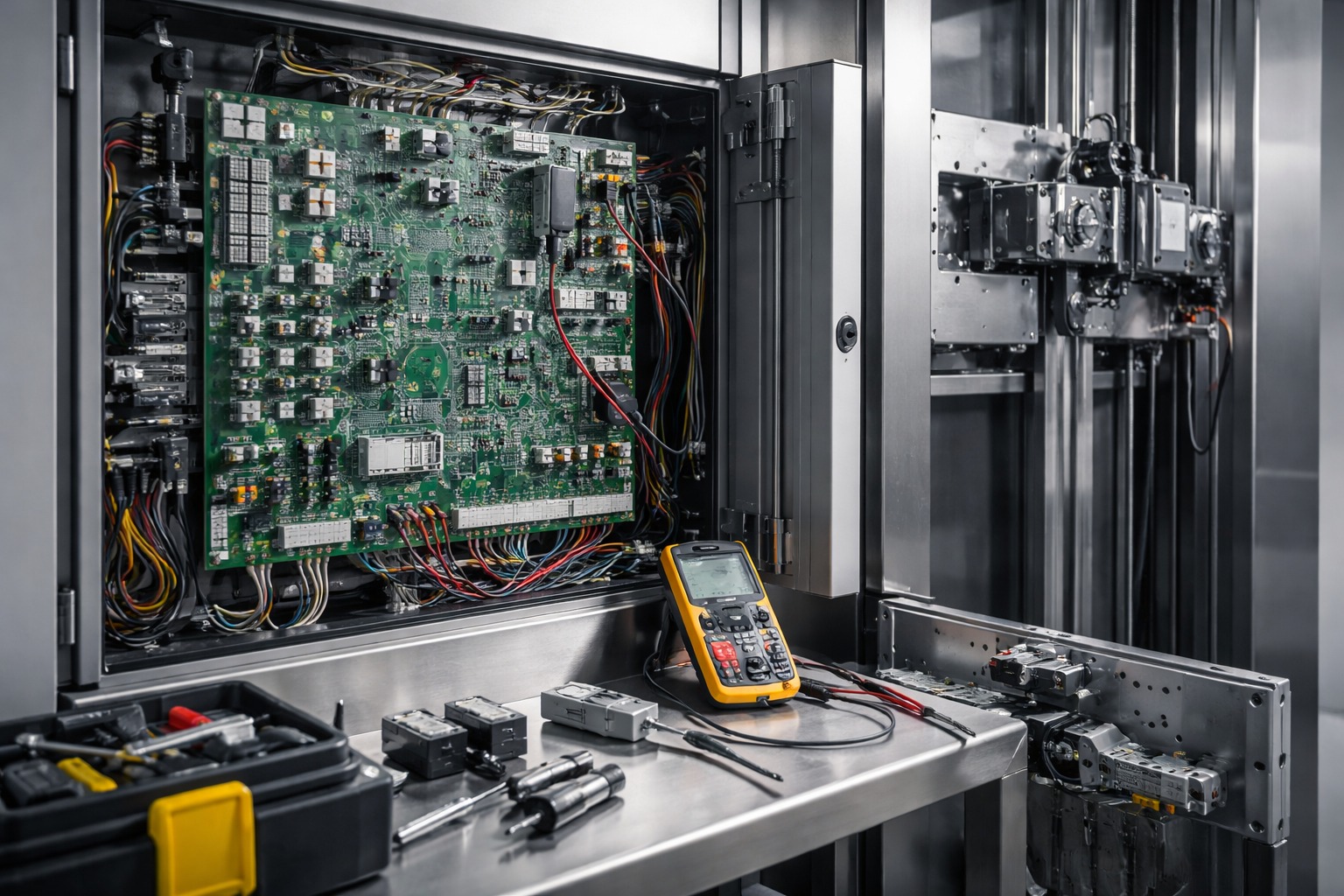
Professional diagnosis follows a sequence: confirm the complaint, read fault history, inspect power quality, isolate input and output conditions, compare actual field signals with expected controller logic, and only then decide whether the board is defective. Good technicians avoid replacing boards based solely on one alarm code.
First, they review the lift’s fault logs and maintenance history. Recurring alarms tied to communication timeout, safety chain drop, floor position mismatch, or drive enable failure can narrow the search. Second, they inspect the cabinet for heat discoloration, swollen capacitors, dust buildup, oxidation, insect ingress, moisture marks, burnt relays, and unstable power supplies. Third, they measure control voltages under live operating conditions, not only at idle.
Technicians then check whether the board is receiving correct inputs from door locks, limit switches, encoder circuits, inspection stations, safety devices, and communication lines. If the board sees wrong data, the board may not be faulty at all. Wiring breaks, ground leakage, sensor misalignment, and damaged harnesses can produce identical symptoms. Output testing is equally important: a command issued by the software should appear as the correct relay, transistor, or communication response at the output side.
| Diagnosis Step | Purpose | Tools Commonly Used | Expected Finding | If Abnormal | Decision Impact |
|---|---|---|---|---|---|
| Read error history | Identify repeated patterns | Controller menu, service tool | Consistent event record | Mismatch or random alarms | Suggests unstable electronics or power issue |
| Measure power rails | Confirm healthy board supply | Multimeter, oscilloscope | Stable DC voltage | Ripple or sag | Check PSU before replacing board |
| Inspect connectors | Rule out contact faults | Visual inspection, continuity test | Clean and firm connection | Oxidation or looseness | May resolve issue without board change |
| Verify input status | Confirm board sees field signals | I/O monitor, meter | Inputs change correctly | Frozen or noisy inputs | Possible input channel fault |
| Check outputs under command | See whether board reacts correctly | Test lamp, meter, service mode | Correct switching action | No output or erratic output | Possible output stage failure |
| Cross-test with known-good board | Final confirmation | Compatible spare board | System recovers | Problem remains | Fault lies elsewhere |
| Review parameters/software family | Avoid mismatch diagnosis | Parameter sheet, firmware label | Correct version match | Version conflict | Prevents wrong replacement conclusion |
A practical field rule in India is to document everything before removal: terminal positions, DIP switch settings, software labels, jumper positions, address coding, and communication cable locations. This reduces installation errors later, especially when emergency downtime pressures are high in hospitals, offices, and residential towers.
For elevator maintenance firms handling mixed-brand inventories, sourcing partners who understand board families can save significant time. For example, some buyers looking for a Hitachi lift control board need assistance matching not just the visible label but also generation code, connector layout, and application within the controller. Accurate identification is often more valuable than fast shipping alone.
The growth trend above reflects a broad increase in demand for electronic spare parts driven by modernization, higher urban density, and increasing expectations for uptime across Indian commercial and residential properties.
Hitachi Control Board Sourcing Considerations
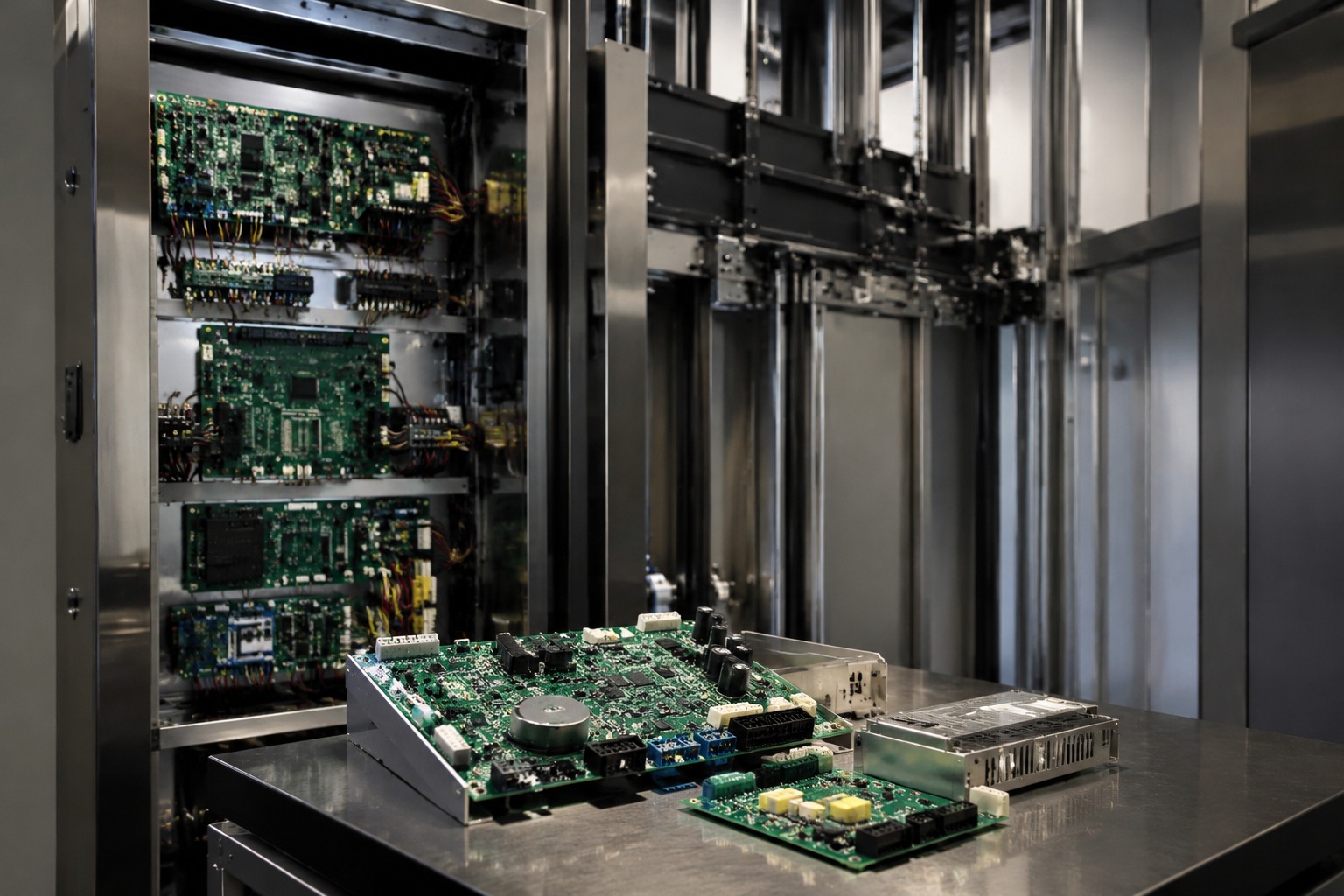
When sourcing Hitachi elevator control boards, buyers should treat part matching as a technical exercise rather than a simple catalog purchase. The same lift model family may use different board revisions depending on year of manufacture, project specification, communication architecture, and modernization history. In India, many lifts have undergone partial upgrades over time, so the installed board may not be the original one delivered with the lift.
Key sourcing checks include exact part number, board revision, serial label data, connector arrangement, firmware family, mounting dimensions, and the board’s role in the system. A main control board, expansion board, communication board, display interface board, or power conditioning module may all be described informally as a “control board,” but their functions differ significantly.
Another important issue is whether the board is new, refurbished, repaired, or pulled from dismantled equipment. Buyers should ask for test status, appearance condition, packaging method, image verification, and compatibility confirmation. For critical installations in metro cities where downtime penalties are high, a fully verified unit is often worth more than a lower-cost but uncertain alternative.
Strong suppliers support customers with photo-based verification, part number matching, and inspection records. Their technological capabilities matter here: experienced teams identify board families, cross-check visible labels against hardware layouts, and review electrical characteristics where necessary. This reduces the chance of receiving a board that looks similar but fails during installation due to hidden incompatibility.
| Sourcing Checkpoint | Why It Matters | Common Buyer Mistake | Recommended Action | Risk if Ignored | Best for India Buyers |
|---|---|---|---|---|---|
| Exact part number | Primary compatibility reference | Ordering by brand only | Match all label characters | Wrong board received | Share clear label photos |
| Board revision | Different revisions may vary | Ignoring suffix codes | Confirm hardware revision | Connector or firmware mismatch | Ask supplier to verify revision |
| Function in system | Main board differs from expansion board | Calling every PCB a motherboard | State actual application | Incorrect module purchase | Send cabinet location photo |
| Firmware family | Affects communication and logic | Assuming all same-shape boards work | Check firmware or parameter notes | Startup failure | Request version confirmation |
| Condition grade | New and refurbished carry different risks | Buying on price alone | Ask for test proof | Early failure or no-boot issue | Prefer verified stock |
| Transit protection | Electronics are static-sensitive | Accepting normal carton packing | Use ESD-safe packing | Damage during shipping | Specify anti-static handling |
| Lead time and customs route | Affects downtime | Ignoring logistics planning | Plan via major ports and inland dispatch | Extended shutdown | Choose responsive supplier |
In practical terms, Indian buyers often benefit from advance spare planning for high-rise residential and premium office buildings. Keeping key boards identified in advance shortens outage time when a failure occurs. This is especially useful in dense urban areas such as Gurgaon, Noida, Mumbai, Bengaluru, and Chennai, where lift downtime affects tenant satisfaction and maintenance response metrics.
Toshiba Motherboard Replacement Notes
Toshiba elevator motherboard replacement requires the same caution as other branded systems, but technicians should pay particular attention to board family consistency, communication structure, and whether the board is a main controller or auxiliary expansion module. It is not enough to match size and connector count. Many field issues arise because a visually similar board is installed without confirming its exact role, code, or software relationship with the rest of the system.
Before removal, technicians should record all settings, cable positions, and parameter references. If the lift uses additional expansion modules, those connections should be marked carefully. During replacement, cabinet cleanliness, grounding, terminal tension, and connector seating are important. Once installed, the board should not be judged healthy only because the display powers up; full function verification is required.
Buyers seeking a Toshiba elevator motherboard should provide all visible labels and cabinet photos wherever possible. If the application involves distributed I/O or a secondary interface, a Toshiba elevator expansion board may also need checking at the same time, because a failed auxiliary board can mimic main board problems.
From a manufacturing capability perspective, dependable parts suppliers add value by maintaining disciplined inspection workflows before dispatch. This may include visual inspection for physical damage, connector condition checks, packaging control, model tagging, and batch-level handling procedures. Even when a supplier is not the original OEM, process consistency helps reduce mismatch and transit-related failures.
| Replacement Point | What to Verify | Why It Is Important | Frequent Field Error | Recommended Practice | Outcome Benefit |
|---|---|---|---|---|---|
| Label and code match | Part number, revision, series | Ensures compatibility | Matching by appearance only | Document every board marking | Lower installation risk |
| Connector mapping | Terminal and socket position | Avoids wrong wiring | Assuming cable lengths prove position | Mark all harnesses before removal | Faster reassembly |
| Parameter backup | Stored logic/settings | Preserves operating behavior | Replacing without saving data | Copy parameters when possible | Reduced recommissioning time |
| Expansion board status | Companion module health | Related failures can coexist | Replacing only main board blindly | Test linked boards too | More accurate root-cause repair |
| Grounding and earthing | Noise and surge control | Protects electronics | Ignoring cabinet earthing quality | Confirm grounding integrity | Improved long-term stability |
| Startup sequence | Boot behavior and fault codes | Validates installation | Stopping after power-on only | Observe full initialization | Early detection of mismatch |
| Functional ride test | Travel, doors, calls, leveling | Confirms system performance | Skipping final traffic simulation | Run multiple test cycles | Fewer callbacks |
For India’s busy residential communities and commercial towers, replacement timing often happens under pressure. Yet hurried installation without a structured verification process increases the chance of repeated shutdowns. It is more efficient to spend extra time on part confirmation than to repeat service visits.
The bar chart highlights where electronic spare demand is strongest. High-rise residential buildings remain a major driver due to volume, while hospitals and office towers place especially high value on uptime and fast service restoration.
Why Refurbished Boards Need Careful Testing
Refurbished elevator control boards can be a practical solution when new stock is unavailable, long lead times threaten downtime, or the equipment generation is older. However, refurbished does not automatically mean reliable. The quality difference between a carefully tested board and an unverified used board can be substantial.
A proper refurbishment workflow should include cleaning, visual inspection, connector evaluation, replacement of failed components where necessary, electrical stability testing, burn-in or load simulation where possible, and confirmation that there are no hidden cracks, carbonization marks, or unstable repairs. If only cosmetic cleaning is done, the buyer bears a much higher field risk.
Environmental history matters too. A board removed from a humid, corroded machine room or a cabinet exposed to dust and heat may look acceptable but still have reduced life. Aging electrolytic capacitors, weakened solder joints, relay wear, and contamination can cause intermittent faults that appear only after installation.
This is where service capability becomes important. Reliable suppliers communicate clearly about condition status, testing approach, and available model confirmation support. Responsive teams help customers evaluate whether a refurbished board is suitable for a given application or whether a new or original unit is the safer choice for a critical site.
| Refurbished Board Check | What Good Testing Includes | Why It Matters | Warning Sign | Buyer Question to Ask | Operational Impact |
|---|---|---|---|---|---|
| Visual condition | Check burns, corrosion, cracks | Reveals past damage | Heavy residue or repairs | Are close-up photos available? | Predicts hidden reliability issues |
| Connector quality | Inspect pins and sockets | Prevents intermittent contact | Loose or oxidized contacts | Were connectors inspected? | Reduces signal loss risk |
| Power stability | Test voltage behavior | Detects weak supply section | Ripple under load | Was electrical testing performed? | Avoids random resets |
| Functional I/O check | Verify input/output response | Confirms logic operation | Partial channel failure | Were key functions simulated? | Improves first-time installation success |
| Thermal behavior | Observe heat rise | Exposes unstable components | Overheating zones | Was any run test done? | Prevents early field failure |
| Repair traceability | Record replaced parts if any | Shows process control | No testing record at all | Can test status be confirmed? | Supports risk-based buying |
| Packaging integrity | ESD-safe preparation | Protects tested condition | Loose non-ESD packing | How will it be packed? | Avoids damage in transit |
For older lifts in established neighborhoods of Kolkata, Chennai, Mumbai, and Delhi, refurbished boards may be a realistic route for keeping equipment operational while planning a longer-term modernization. The key is disciplined screening. A board that has been carefully checked and packed can support uptime, but one that is merely “used and available” can create more downtime than it solves.
ESD Packaging and Shipping Requirements
Electrostatic discharge is a serious but often underestimated risk in elevator electronics logistics. A board may leave the supplier in good condition and arrive in India appearing undamaged, yet still fail because of inadequate anti-static handling or poor shock protection. ESD damage is especially problematic because it may be latent, causing intermittent or delayed field failure.
Proper packaging should include anti-static shielding bag protection, cushioning that immobilizes the board, connector protection, moisture-conscious wrapping when needed, and a sturdy outer carton. For higher-value or fragile assemblies, double boxing can improve survival during long transit routes. Labels indicating static-sensitive handling are useful, but physical protective measures matter more than labels alone.
Shipping requirements also depend on route. Air shipments for urgent breakdown support may involve repeated handling at export and import terminals. Sea-linked supply chains feeding Indian ports such as Mumbai, Chennai, Mundra, and Kolkata require attention to vibration, compression, humidity, and storage conditions. Inland dispatch to cities such as Jaipur, Lucknow, Indore, Nagpur, Coimbatore, and Bhubaneswar may add another handling layer.
Professional suppliers often integrate packaging discipline into their operating process rather than treating it as an afterthought. This reflects both manufacturing and service maturity: accurate labeling, model matching, protected packing, and fast response reduce avoidable loss before the part even reaches the site.
The area chart shows a realistic market shift: Indian buyers increasingly value tested condition and proper packaging over simply obtaining the lowest upfront price. This is especially true for critical building operations where one failed shipment can extend downtime by days.
Commissioning Steps After Board Replacement
Replacing the board is only part of the job. Proper commissioning is what determines whether the lift returns to stable service or generates new callbacks. A disciplined post-installation process should confirm power supply health, boot sequence, parameter integrity, safety input recognition, communication links, door operation, travel performance, leveling accuracy, car and hall call response, and fault-free cycling.
Before energizing, technicians should inspect connector seating, wire tension, earthing, cabinet cleanliness, and correct module position. If parameters must be loaded or adjusted, those steps should be completed according to the control logic family. After startup, the lift should be tested first in controlled service modes, then in normal automatic operation.
Door cycles deserve close attention because many apparent “board faults” after replacement are actually caused by unresolved door interface or signal issues. Travel tests should include both short and full runs, up and down direction, multiple stops, and monitoring under actual building load if possible. In high-traffic sites like malls, hospitals, and office towers, soft faults can appear only after repeated cycles.
| Commissioning Step | What to Check | Why It Matters | Pass Criteria | If Failed | Field Benefit |
|---|---|---|---|---|---|
| Pre-power inspection | Wiring, connectors, grounding | Prevents immediate damage | No loose or incorrect connection | Correct before energizing | Safer startup |
| Initial power-up | Boot indicators and display | Confirms basic board activity | Normal startup sequence | Check supply and compatibility | Early issue detection |
| Parameter verification | Configuration and settings | Maintains operating logic | Correct values confirmed | Reload or adjust data | Stable operation restored |
| Safety input check | Door locks, limits, chain signals | Critical for safe service | All safety states recognized | Trace field wiring or I/O | Compliance and reliability |
| Door operation test | Open, close, reopen behavior | Most frequent service complaint area | Smooth and consistent operation | Check interface and signals | Reduces passenger complaints |
| Ride and leveling test | Travel, stopping accuracy | Confirms motion logic health | Stable run and level stop | Review feedback inputs | Better ride quality |
| Multi-cycle trial | Repeated operation under load | Finds intermittent problems | No recurring alarms | Extended diagnosis required | Fewer repeat visits |
For sites with preventive maintenance contracts, it is wise to document the replacement date, board code, commissioning observations, and any parameter changes. This improves traceability for future service teams. It also helps building owners compare the reliability of different sourcing options over time.
India Market Outlook, Applications, and Supplier Comparison
The Indian market for elevator control boards is shaped by three major forces: new urban construction, modernization of aging installations, and stronger expectations for uptime in premium properties. Residential towers drive volume, while hospitals, hotels, commercial complexes, educational campuses, and industrial buildings increase the need for dependable spares and faster repair cycles.
Application patterns vary. In luxury residential towers in Mumbai or Gurugram, downtime immediately affects resident satisfaction and facility reputation. In hospitals in Delhi, Chennai, or Bengaluru, reliability is mission-critical. In industrial and logistics facilities around Pune, Ahmedabad, or Chennai’s manufacturing corridors, service continuity influences operations and manpower movement. In all these cases, the control board is central to system logic and fault behavior.
Buyers in India increasingly compare suppliers not just on price but on model matching, inspection discipline, response time, packaging quality, and documentation support. Local stock may offer speed, but international sourcing can broaden availability for older or less common models. The best choice depends on project urgency, budget, and required confidence level.
The comparison chart illustrates why specialized supply partners are often preferred for elevator electronics. The difference is less about selling a PCB and more about reducing mismatch risk, transit damage, and installation uncertainty.
Our company’s role in this market is practical and focused. On the technological side, we support customers with model matching, brand-specific part identification, and compatibility review for elevator control boards and related spares. On the manufacturing and handling side, we emphasize stable quality inspection, organized product identification, and protective packing suited to electronic components. On the service side, we work with maintenance firms, distributors, building owners, and modernization contractors to respond quickly, reduce downtime pressure, and improve confidence in replacement part sourcing.
Beyond control boards, many customers also need coordinated sourcing for inverter and frequency converter parts, door operator components, door locks, light curtains, guide shoes, oil cups, sensors, encoders, power supplies, buttons, COP panels, intercom parts, and other lift accessories across brands such as Hitachi, Toshiba, KONE, Mitsubishi, and more. In real service environments, this broader support can simplify planning and reduce fragmented procurement effort.
Looking toward 2026 and beyond, several trends are likely to shape the market in India. First, modernization demand will increase as older buildings seek better ride quality, lower downtime, and smarter diagnostics. Second, sustainability pressure will grow, encouraging repairable, testable, and properly handled electronics rather than uncontrolled disposal. Third, policy and compliance expectations around safety, documentation, and service traceability are likely to become stronger in organized building management. Fourth, digital diagnostics, remote fault interpretation, and better inventory visibility will make technical sourcing more data-driven. As a result, buyers will increasingly prioritize suppliers who can combine responsive service with technical discipline.
FAQ About Elevator Control Boards
1. How do I know whether the control board is actually faulty?
A fault code alone is not enough. The board should be checked alongside power supply stability, input signals, output behavior, wiring condition, connector health, and parameter integrity. Cross-testing with a known-good compatible board is often the best confirmation.
2. Can a board failure look like a door or sensor issue?
Yes. A defective input channel, noisy communication circuit, or unstable output stage can produce symptoms that resemble door lock faults, sensor errors, or position issues.
3. Is it safe to buy a refurbished board?
It can be a sound option if the board has been properly inspected and tested, especially for older systems with limited new-stock availability. Ask about condition, test status, and packaging.
4. Why is exact part number matching so important?
Because boards from the same brand may differ in revision, firmware family, connector arrangement, or function. Similar appearance does not guarantee compatibility.
5. What should be shared with the supplier before ordering?
Part number labels, clear photos of the board, cabinet position, connector views, error information, and if possible the lift model and application. This improves model verification.
6. Are anti-static bags really necessary for shipping?
Yes. Elevator boards are static-sensitive. ESD-safe packing helps prevent invisible damage that may only appear after installation or after a short period in service.
7. What if replacing the board does not solve the problem?
Then the root cause may lie in wiring, power supply, grounding, sensor inputs, communication lines, drive interface, or parameter mismatch. A structured diagnostic review should continue.
8. Which buildings most urgently need quick board replacement support in India?
Hospitals, commercial towers, high-rise residences, hotels, logistics buildings, and premium mixed-use developments usually face the strongest pressure to restore service quickly.
9. Is it better to keep spare boards in stock?
For high-traffic or critical buildings, pre-identifying and planning key spare boards can reduce downtime significantly. This is especially useful where imported parts may take time to arrive.
10. What should be done after installation?
Complete commissioning: verify power, parameters, safety inputs, door operation, travel, leveling, communication, and repeated cycle performance before returning the lift to normal service.
In summary, elevator control board troubleshooting in India is not just about replacing a failed electronic card. It is about understanding symptom patterns, diagnosing accurately, sourcing carefully, protecting the part during transit, and commissioning thoroughly. Whether the requirement involves Hitachi or Toshiba systems, new or refurbished stock, urgent replacement or planned modernization support, the most reliable results come from disciplined technical matching and dependable supply execution.