
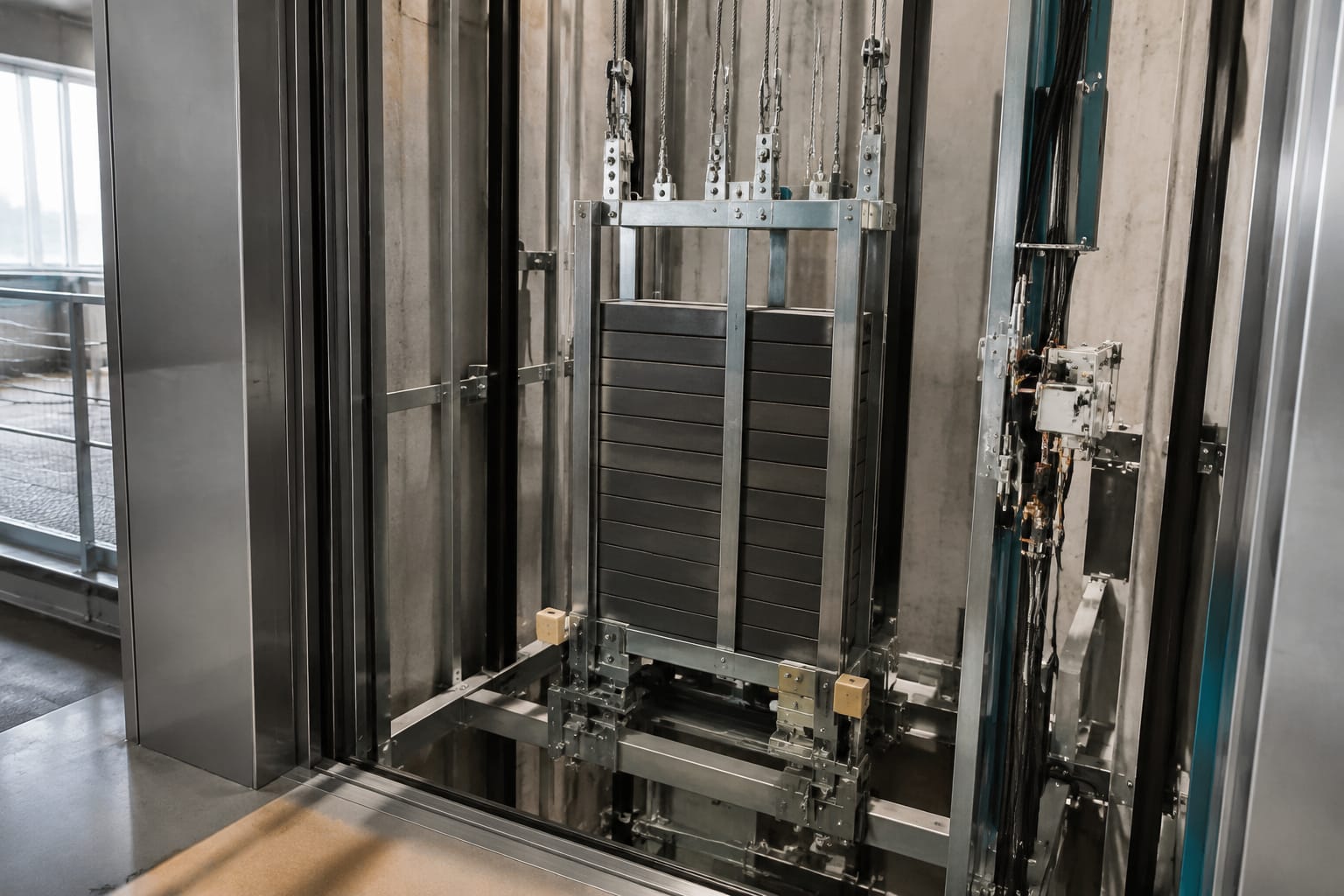
An elevator counterweight is the weight assembly that balances the lift car and part of its rated load in a traction elevator. By reducing the unbalanced load on the traction machine, it helps the system move efficiently, maintain rope traction and control the car reliably.
A complete counterweight system is more than stacked metal blocks. Its frame, filler weights, guide shoes, rail arrangement, suspension connections and bottom-of-shaft clearance all need to suit the specific lift design. For maintenance and modernisation work, replacing a worn component without confirming these interfaces can create a serious safety risk.
Why traction elevators use counterweights
In a conventional traction lift, the car and counterweight are connected by suspension ropes passing over the traction sheave. When the car goes up, the counterweight goes down; when the car goes down, the counterweight rises.
The counterweight is generally selected to balance:
- The empty car weight
- A defined proportion of rated passenger or goods load
- The mass assumptions specified by the original lift design
The exact balancing ratio is not a universal field setting. It depends on the lift's rated load, car dead weight, roping arrangement, drive and manufacturer design. It must therefore be confirmed from the lift documentation or by a competent engineer before weights are added, removed or changed.
What the counterweight achieves
A correctly configured elevator counterweight:
- Reduces the motor torque required for normal travel
- Helps preserve suitable traction between ropes and the sheave
- Limits unnecessary energy use during typical trips
- Supports stable acceleration and braking performance
- Reduces mechanical loading compared with moving the full car mass without balance
It does not make the lift safe by itself. Overspeed governors, brakes, safety gears, buffers, limit switches, door systems and the controller each have separate roles. A counterweight that is poorly guided, inadequately retained or wrongly weighted can undermine the performance of the broader system.
Counterweight frame and filler weights
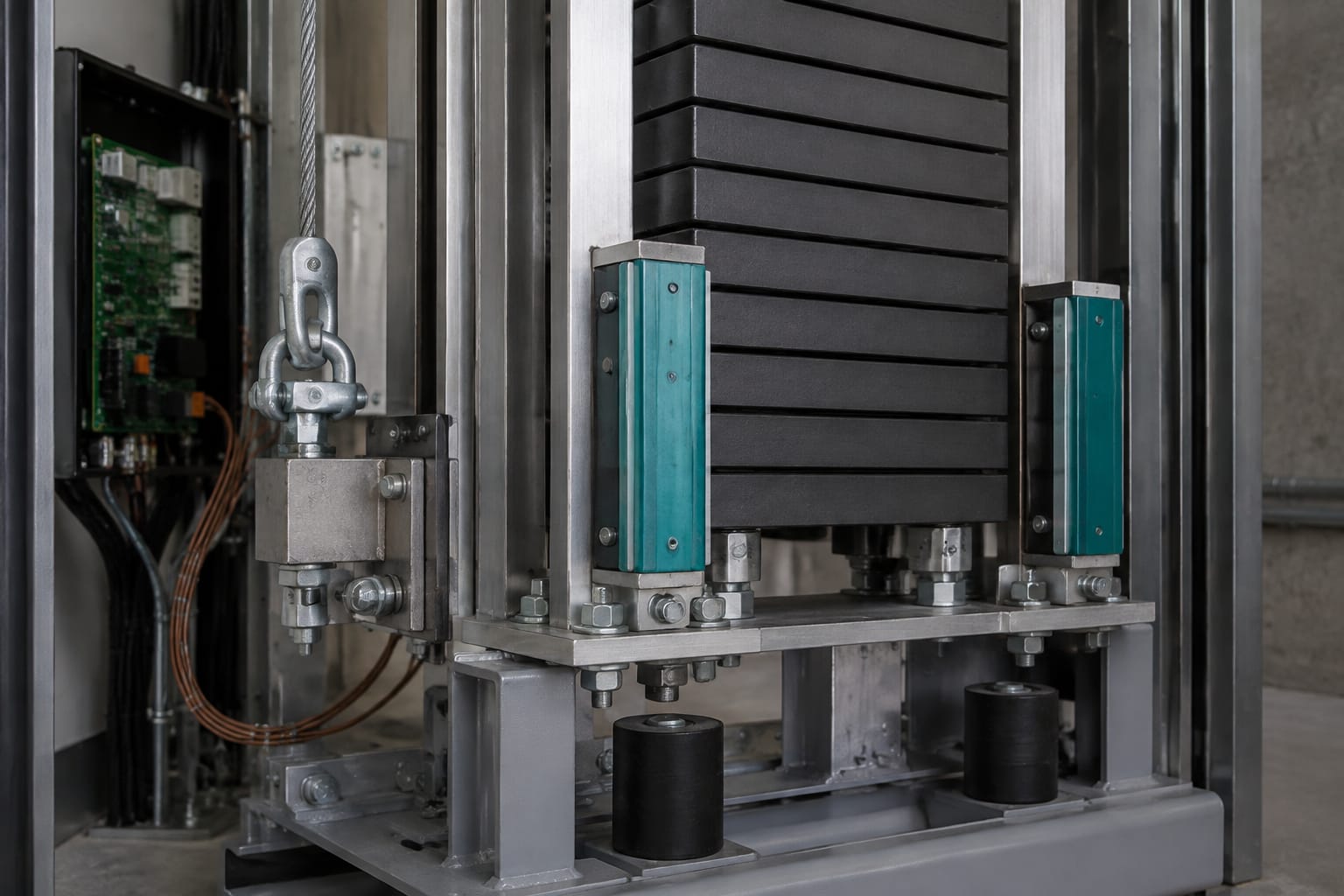
The counterweight frame, sometimes called a counterweight sling, is the structural carrier for the filler weights. It transmits load to the suspension system and keeps the stacked weights in a controlled arrangement while travelling alongside the car.
A typical frame includes vertical stiles, top and bottom members, suspension connection points, and a means of retaining the filler weights. Its geometry must match the shaft layout, rail centre distance, car-to-counterweight relationship and suspension arrangement.
Filler weights
Filler weights are individual blocks or plates installed inside the frame to achieve the required counterweight mass. They may be cast iron, steel or another manufacturer-approved material and shape. Their dimensions, mass per piece and locating features vary widely.
When assessing filler weights, confirm:
| Check | Why it matters |
|---|---|
| Weight per piece | The final balance calculation depends on actual mass, not the number of blocks. |
| Length, width and thickness | Incorrect dimensions may prevent proper stacking or retention. |
| Slot, hole or interlocking profile | Features must engage correctly with the frame and retaining arrangement. |
| Material and condition | Damaged, cracked or heavily corroded weights should not be assumed fit for reuse. |
| Frame capacity | The frame and its retaining components must be suitable for the assembled mass. |
| Original balance requirement | Weight changes require a design-based assessment, not trial-and-error adjustment. |
A common mistake is treating all counterweight blocks as interchangeable because they look similar. A small difference in thickness can leave inadequate room for a retaining plate. A different profile may allow lateral movement inside the frame. Even a minor mass variation becomes significant when many blocks are fitted.
Retention is a primary concern
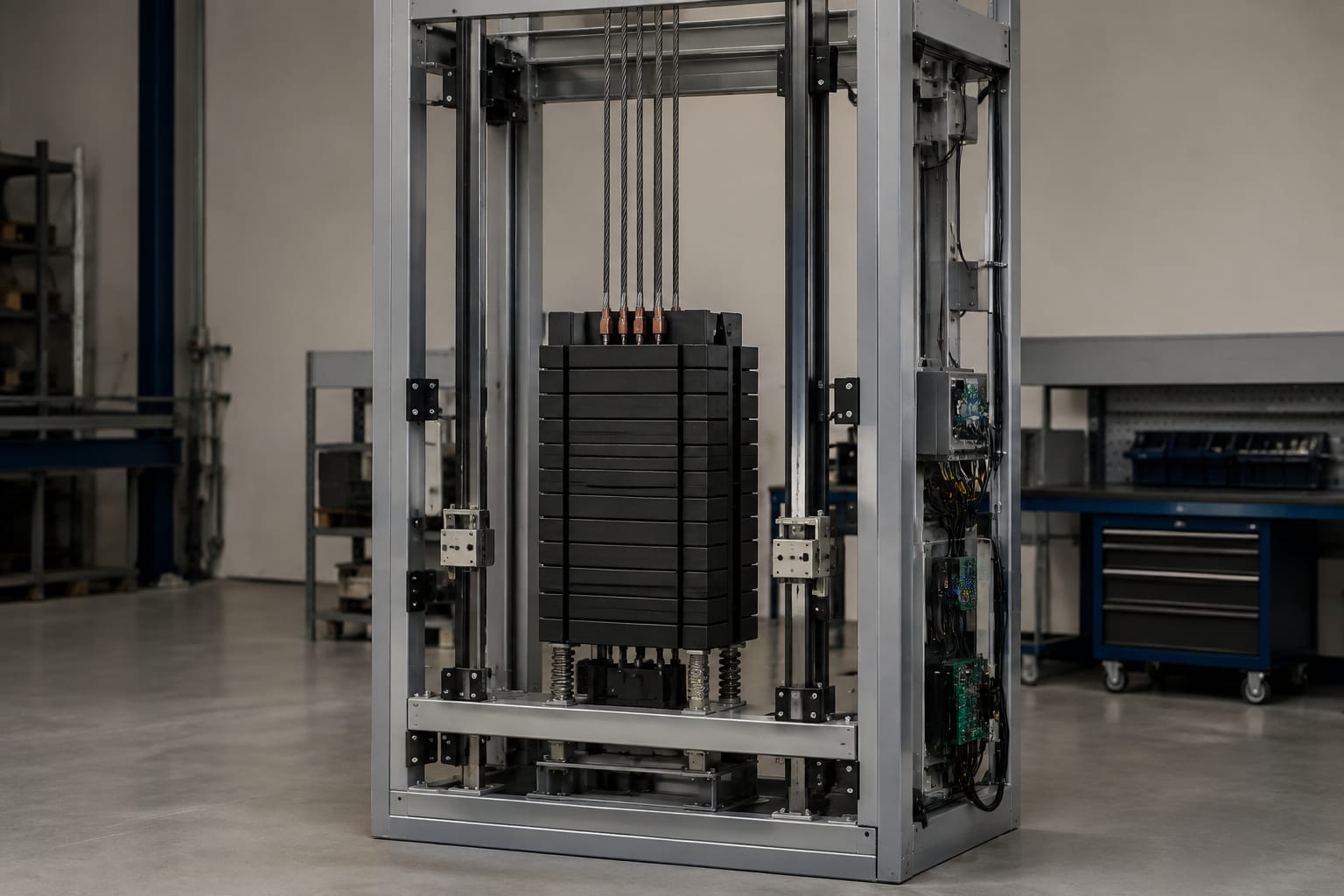
The filler weights must remain secured during normal travel, levelling, emergency stopping and maintenance activity. Depending on the design, retention may involve end plates, rods, clamps, keepers or other purpose-made components.
Do not improvise with loose packing pieces, site-made restraints or unsuitable fasteners. A loose filler weight can damage rails, shoes, ropes, buffers or shaft equipment, and may create a falling-object hazard.
Guide shoes and guide rails
Counterweight guide shoes keep the frame aligned with its guide rails. They prevent excessive side movement and help the assembly travel smoothly through the shaft. Most installations use sliding guide shoes with replaceable liners, although roller guide arrangements are also used on some systems.
The guide rails provide the vertical path. Their rail profile, fixing, joint alignment and condition directly influence shoe wear and counterweight motion.
Sliding shoes, liners and boot styles
For sliding guide shoes, the liner is the sacrificial running surface between the shoe body and rail. It may be designed as a boot, insert or lined channel. The correct item depends on the rail section and shoe construction, not only on the lift brand.
Useful compatibility details include:
- Rail face and rail-head dimensions
- Shoe body style and fixing method
- Liner profile, including W-type or M-type designs where applicable
- Liner material and intended operating conditions
- Counterweight frame and rail clearances
- Manufacturer part number, drawing or a clear sample measurement
For example, buyers comparing replacement guide-shoe liners can review counterweight hollow rail W boot toe boot linings against the measured shoe profile rather than selecting only by visual appearance. Where the shoe uses a different profile, M-type boot linings for counterweight hollow rails are a separate compatibility category.
Rail condition affects replacement-part life
Replacing worn liners without checking rail condition can lead to rapid repeat wear. During inspection, look for:
- Rail-head scoring, pitting or corrosion
- Misaligned or stepped rail joints
- Loose rail brackets or fixing concerns
- Build-up of unsuitable lubricant, dust or debris
- Uneven shoe contact marks
- Unusual noise, vibration or lateral movement during travel
The appropriate lubrication practice depends on the original equipment design and shoe material. More lubricant is not automatically better: excessive or incompatible lubricant can collect contamination and affect running behaviour. Follow the equipment manufacturer's maintenance instructions.
Compensation and suspension connections
The counterweight's suspension connection depends on the lift's roping arrangement. In common traction layouts, the ropes connect the car and counterweight over the traction sheave. The frame's upper connection points, shackles, rope terminations and equalising arrangements must be assembled exactly as designed.
On taller travel installations, compensation means may be used to account for the changing mass of travelling ropes or cables. These can include compensation chains, ropes or associated devices. They are system-specific and should not be selected merely by car capacity.
What to verify at the connections
A maintenance inspection should consider:
- Condition and security of rope termination hardware
- Alignment of suspension points and equalising components
- Wear, deformation or corrosion at connection points
- Correct seating of ropes in the sheave and pulleys
- Evidence of rope slip, uneven tension or abnormal wear
- Condition and routing of compensation equipment where installed
Counterweight work can affect rope tension and balance. Any adjustment that changes suspension geometry, number of filler weights or roping condition should be followed by the prescribed checks and tests by qualified lift personnel.
Clearance and retention considerations
A counterweight requires adequate running clearances throughout the shaft, particularly near the top and bottom terminal areas. These clearances are part of the lift's designed safety space and cannot be judged solely by watching ordinary travel.
At the bottom of the shaft, the counterweight approaches its buffer system. At the top, the car and counterweight positions must maintain the required safety distances for the installation. Changes to car weight, counterweight mass, buffers, rails, shoes, suspension components or terminal stopping behaviour can affect these relationships.
Areas that require careful review
Before modifying or replacing counterweight components, verify:
- The original lift drawings, maintenance records and rated-load information.
- The total counterweight mass and approved filler-weight configuration.
- The frame dimensions, frame capacity and all retention hardware.
- Rail size, rail alignment, shoe type and running clearance.
- Buffer type, position, condition and engagement path.
- Suspension arrangement, rope condition and termination configuration.
- Top and bottom terminal clearances under the specified inspection conditions.
Clearances and safety spaces are not suitable for estimation from generic online dimensions. Applicable local requirements, the original manufacturer data and the competent person's assessment govern the work. This is especially important in modernisation projects where car interiors, doors, machines or controllers may have been changed over the lift's life.
Common wear and inspection findings
Counterweight faults often begin as minor running issues. Identifying the pattern early can prevent secondary damage to rails, ropes and shaft equipment.
| Finding | Possible causes | Appropriate response |
|---|---|---|
| Uneven liner wear | Rail misalignment, shoe set incorrectly, frame skew | Check rail line, shoe adjustment and frame condition before fitting new liners. |
| Cracked or loose liner | Ageing material, impact, incorrect fitment, debris | Remove from service as appropriate and confirm the correct replacement profile. |
| Metal-to-metal rubbing | Liner worn through, liner missing, shoe damage | Investigate promptly; inspect rail face and shoe body for consequential damage. |
| Counterweight noise or vibration | Rail joints, loose weights, worn shoes, inadequate clearances | Identify the source during controlled inspection; do not assume lubrication will resolve it. |
| Loose filler-weight retention | Missing, damaged or incorrectly fitted retainers | Treat as a safety concern and restore the approved retention arrangement. |
| Corroded frame members | Shaft moisture, poor ventilation, long-term neglect | Assess loss of section, fixings and connection areas; replace components where integrity is uncertain. |
| Buffer contact marks | Terminal overrun, setup issue, reduced clearances | Examine buffers, limits, controller settings and clearances as a system. |
Visual checks are useful, but they do not replace the required maintenance procedures, electrical isolation practices or statutory examinations applicable to the installation.
Replacement-part identification
Correct identification starts with the actual interface, not a broad description such as “counterweight shoe” or “lift weight block”. Multi-brand spare-part sourcing is practical only when the buyer provides enough information to establish fitment.
For a guide shoe liner or boot, collect:
- Lift make, model and installation details where available
- Original part number and manufacturer drawing, if available
- Clear photographs of the complete shoe and the removed liner
- Rail dimensions and shoe opening dimensions
- Overall liner length, width, wall thickness and fixing details
- Whether the part is for the car or counterweight
- Sample quantity and required quantity
- Any observed failure mode, such as cracking or unusual wear
For counterweight frames or filler weights, also document the frame layout, available stacking space, individual weight dimensions, individual mass, retaining method and total required counterweight mass.
Some parts are marketed as suitable for major makes, but suitability still needs verification against the specific assembly. For applications using an auxiliary rail arrangement, an auxiliary-rail counterweight guide boot may be relevant only after the rail and shoe interface has been checked.
Questions B2B buyers should ask
Maintenance contractors, distributors and sourcing teams should confirm:
- Is the part identified by drawing, sample or original part number?
- Does the supplier state dimensions, material or interface details needed for comparison?
- Is the item intended for the relevant rail profile and shoe construction?
- Are retaining accessories, fasteners or matching liners required separately?
- Will a sample inspection be needed before a larger procurement order?
- Who is responsible for engineering approval and site fitment?
Kelevator supplies multi-brand elevator spare parts to B2B importers, distributors, maintenance contractors and OEM buyers. For a counterweight-related enquiry, a complete identification record helps compare the offered part with the lift's installed component and reduces the chance of a mismatched order.
Safety precautions for counterweight work
Counterweight work should be performed only by trained, authorised lift personnel using the site-specific safe working procedure. The counterweight can move unexpectedly if the car is moved, the brake is released, ropes are disturbed or the system is not correctly isolated.
Key precautions include:
- Isolate the lift and prevent unintended operation before entering the shaft or pit.
- Use lockout and warning arrangements in accordance with the site's procedure.
- Confirm car and counterweight positions before working near either assembly.
- Do not stand beneath, climb on or work under an unsecured counterweight.
- Secure filler weights and frame components before removing retention hardware.
- Use suitable lifting equipment and rated handling methods for individual weights and frames.
- Keep tools and loose materials controlled in the shaft and pit.
- Maintain communication between personnel at the machine room, controller and shaft work area.
- Inspect buffers, pit access, lighting and safe standing space before work begins.
- Restore all guards, retainers and safety devices, then complete the prescribed functional checks before returning the lift to service.
Never use the car roof, pit or shaft space as an informal storage area for counterweight blocks or removed components. Temporary placement can obstruct travel paths or introduce a falling-object risk.
FAQ
How heavy is an elevator counterweight?
There is no single standard weight. The required mass depends on the car weight, rated load, balance ratio, roping arrangement and original system design. Individual filler weights are also not interchangeable by count alone because their dimensions and mass vary.
Can filler weights be removed to reduce motor load?
Not without an engineering assessment. The counterweight is set to achieve a designed balance. Removing weights can alter traction, ride performance, stopping behaviour and safety clearances.
When should counterweight guide-shoe liners be replaced?
Replace them when they are cracked, excessively worn, loose, missing or allowing metal-to-metal rail contact. Investigate the rail and shoe alignment at the same time, as new liners may wear quickly if the underlying cause remains.
Are counterweight guide shoes the same as car guide shoes?
Not necessarily. While the basic function is similar, shoe dimensions, rail interfaces, loads and mounting arrangements can differ. Identify the exact shoe and rail profile before ordering replacements.
For replacement planning, start by recording the fitted part number, rail and shoe dimensions, photographs, and the lift's original configuration. These details allow a competent lift professional or spare-parts supplier to assess compatibility without relying on appearance alone.
Related product references
For practical catalog examples related to this topic, review [Counterweight Hollow rail W boot toe Boot lining lift parts elevator accessories](/products/counterweight-hollow-rail-w-boot-toe-boot-lining-lift-parts-elevator-accessories/), [Counterweight hollow rail W M type boot lining lift accessories elevator spare parts](/products/counterweight-hollow-rail-w-m-type-boot-lining-lift-accessories-elevator-spare-parts/), and [Auxiliary rail guide boots counterweight hollow rail W boot head boot lining suitable for Mitsubishi Otis elevator accessories](/products/auxiliary-rail-guide-boots-counterweight-hollow-rail-w-boot-head-boot-lining-suitable-for-mitsubishi-otis-elevator-accessories/). Confirm the exact model, dimensions, ratings, and connectors before ordering.