
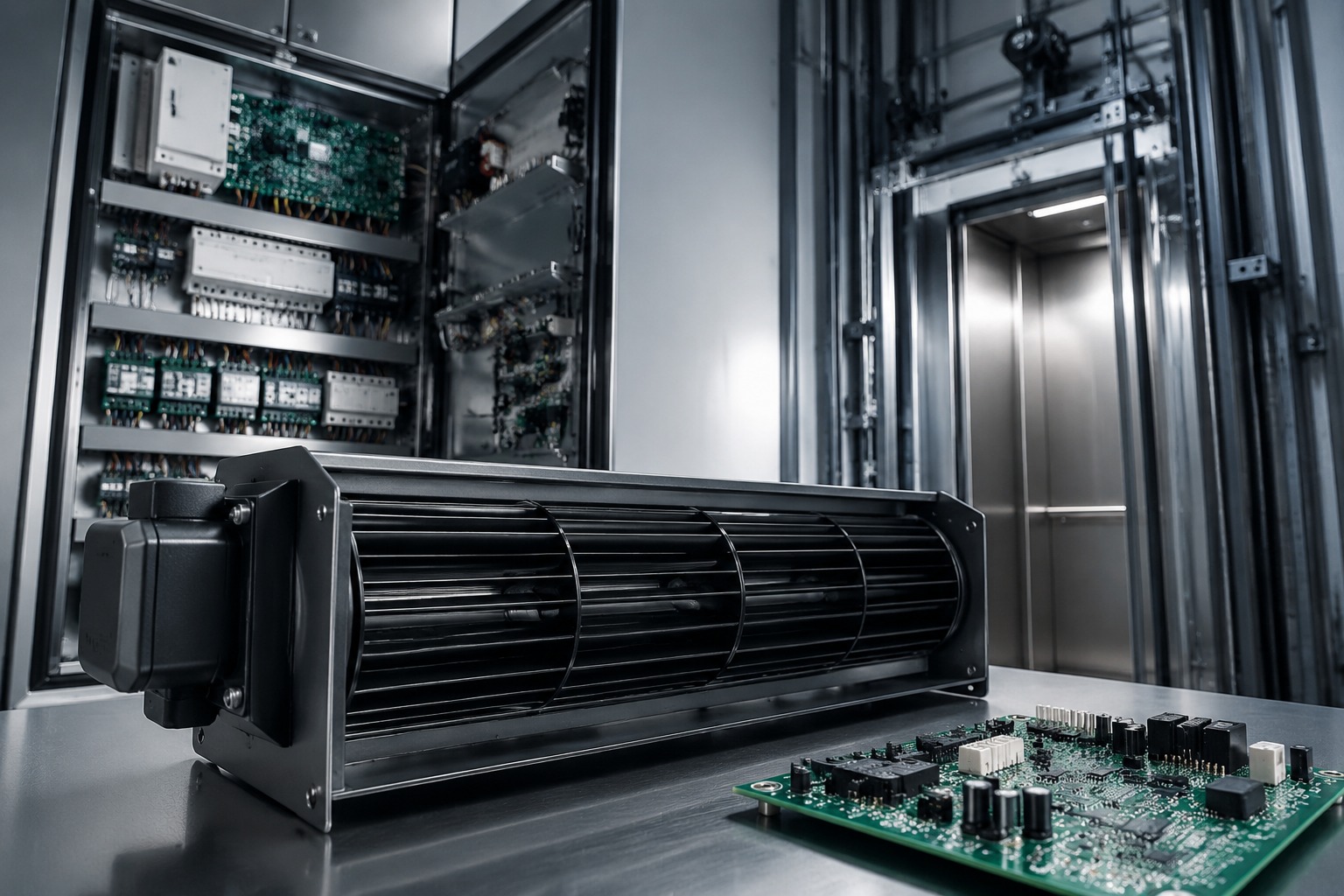
Elevator fans play a direct role in passenger comfort, controller reliability, and uptime. In India, where lifts often operate through high ambient temperatures, dust, monsoon humidity, and long daily duty cycles, the right cabin or cabinet fan can reduce heat buildup, limit nuisance trips, and extend the life of sensitive components. For maintenance companies, distributors, building owners, and modernization contractors, choosing the correct fan is not only about fitting dimensions. It also involves airflow, voltage compatibility, mounting, noise, vibration, wiring safety, and replacement intervals.
This guide explains where cross flow fans are used in elevators, how they compare with axial fans, how to choose voltage, size, and airflow, and what to check when replacing inverter cabinet cooling fans. It also covers practical installation tips for Indian sites in Mumbai, Delhi NCR, Bengaluru, Chennai, Hyderabad, Pune, Ahmedabad, Kolkata, and rapidly growing tier-2 cities where modernization demand is rising across residential towers, hospitals, metro stations, hotels, offices, and industrial campuses.
For buyers looking for replacement options, a cross flow fan for elevator applications is commonly selected for cabin air distribution, while a lift axial fan is often suitable for localized cooling or general ventilation. For control system heat management, an inverter control cabinet fan is widely used where inverters, power supplies, relays, and control boards generate concentrated heat. If a project requires another matching size or configuration, a second option for a horizontal cross flow fan for lift spare parts may fit modernization work where the original model is no longer easy to source.
In practical terms, a properly selected fan improves ventilation comfort in the car, stabilizes cabinet temperature, helps avoid thermal derating, and supports longer service life for electronics and insulation materials. This matters especially in Indian buildings near coastal trade hubs such as Nhava Sheva, Chennai Port, and Mundra, where corrosion risk and dust contamination can affect equipment, and in inland high-traffic commercial complexes where elevators see repeated peak-hour loading.
How fans improve ventilation comfort and component life
Elevator fans serve two different but related purposes. First, they improve the passenger environment by circulating air inside the car. Second, they remove heat from cabinets housing drives, inverters, controllers, and power electronics. Heat is one of the main causes of accelerated aging in electronic assemblies. Poor ventilation can increase the temperature of printed circuit boards, capacitors, IGBT modules, transformers, and power supplies, leading to intermittent faults or shutdowns.
In the cabin, air movement improves perceived comfort even when the air-conditioning system is absent or limited. In many mid-rise residential and commercial buildings across India, cabin fans are still essential because the car may have little natural ventilation when doors are closed. In cabinet applications, good airflow reduces hot spots, especially near VVVF drives and braking resistors. This becomes important during summer conditions when machine rooms or shaft-adjacent cabinets may already be exposed to elevated ambient temperatures.
| Fan Application | Main Purpose | Typical Mounting Area | Benefit | Common Risk if Missing | Typical User Concern |
|---|---|---|---|---|---|
| Cabin cross flow fan | Even air distribution | Car top or ceiling panel | Better passenger comfort | Stuffy cabin feeling | Low noise and steady airflow |
| Cabin axial fan | Simple ventilation | Car ceiling vent area | Compact and economical | Uneven airflow pattern | Basic replacement availability |
| Inverter cabinet fan | Heat extraction | Drive or control cabinet | Protects electronics | Overheating trips | Correct voltage and airflow |
| Controller panel fan | Component cooling | Controller enclosure | Longer board life | Thermal stress on PCB | Dust filter maintenance |
| Machine room exhaust fan | Ambient heat removal | Wall or louver opening | Supports room ventilation | High room temperature | Weather and dust ingress |
| Shaft-adjacent cabinet fan | Localized cooling | Landing or shaft cabinet | Stable temperature | Condensation and dust buildup | Durability in harsh conditions |
The table above shows that not every elevator fan does the same job. A cabin fan should be judged mainly by airflow distribution, noise level, and fitment. A cabinet fan should be judged by thermal performance, voltage, dust resistance, and service life. Confusing these purposes can lead to wrong selection and repeat replacements.
Where cross flow fans are used in elevators
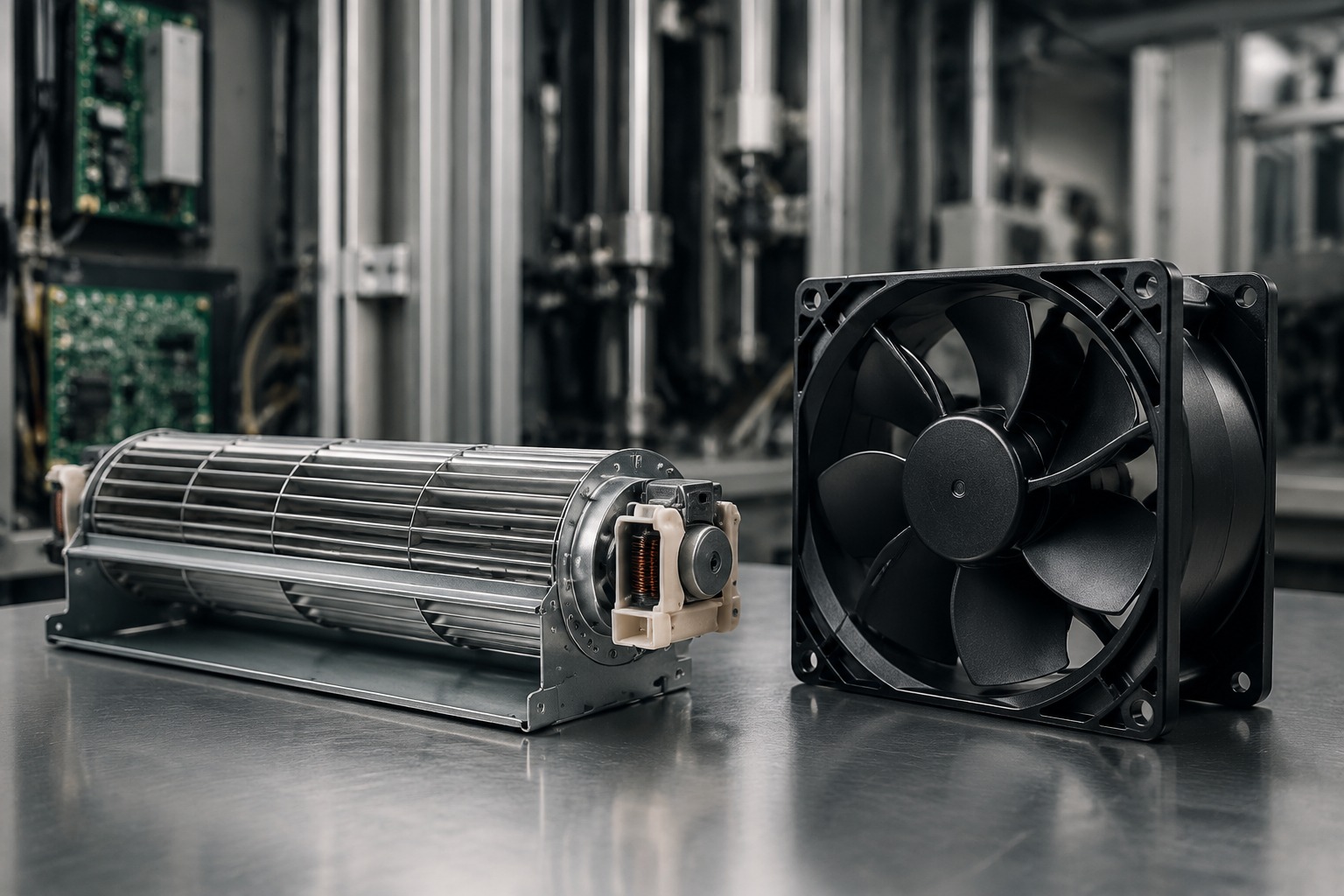
Cross flow fans are widely used in elevator cabins because they provide a long, uniform curtain of air rather than a concentrated jet. That makes them well suited to car tops and ceiling assemblies where designers want airflow to spread across the passenger area. In many lifts, especially in residential towers and office buildings, the long slim shape of the cross flow fan allows installation behind a decorative grille or within narrow spaces where an axial fan would not distribute air as evenly.
In elevator applications, cross flow fans are commonly used in:
- Passenger lift cabins in apartments and commercial buildings
- Hospital lifts where smoother airflow is preferred over a sharp air blast
- Hotel lifts where cabin comfort and lower noise matter
- Modernization projects where slim fan geometry helps reuse existing ceiling layouts
- Premium installations where visual integration with the ceiling panel is important
- Some control enclosures requiring elongated airflow across a wider section, though this is less common than axial use
Across India, cross flow fans are especially popular in modernization projects in Mumbai, Pune, Bengaluru, Chennai, and Hyderabad, where older lifts are being upgraded without fully redesigning the car interior. If the original fan model is obsolete, technicians often look for dimensionally compatible alternatives with matching voltage, mounting, rotation, and airflow characteristics.
| Elevator Location | Why Cross Flow Fan Fits | Space Condition | Air Pattern | Noise Expectation | Replacement Priority |
|---|---|---|---|---|---|
| Passenger car ceiling | Long narrow housing suits panel layout | Limited depth | Wide and even | Low to moderate | Exact dimension match |
| Hotel lift cabin | Comfort-focused airflow | Concealed behind trim | Gentle distribution | Low noise preferred | Appearance and comfort |
| Hospital elevator | Stable airflow over stretcher area | Broader cabin | Uniform along length | Quiet operation | Reliable continuous use |
| Residential high-rise | Easy retrofit in cabin ceiling | Compact panel opening | Balanced | Moderate | Cost-effective sourcing |
| Office tower modernization | Reuses existing slim vent design | Restricted mounting points | Linear airflow | Controlled acoustics | Compatibility with old setup |
| Luxury residential car | Discreet integration with interior | Decorative ceiling space | Soft and continuous | Very low preferred | Finish and performance |
The key idea is that cross flow fans are chosen not simply because they move air, but because they move it in a distributed way. That gives a better cabin feel and more elegant integration in the lift ceiling.
The chart above reflects a realistic market trend: demand for elevator ventilation replacement parts in India is rising with modernization, denser urban occupancy, and growing attention to preventive maintenance. This trend is visible in metro-linked development corridors and IT parks where uptime requirements are strict.
Cross flow fan versus axial flow fan
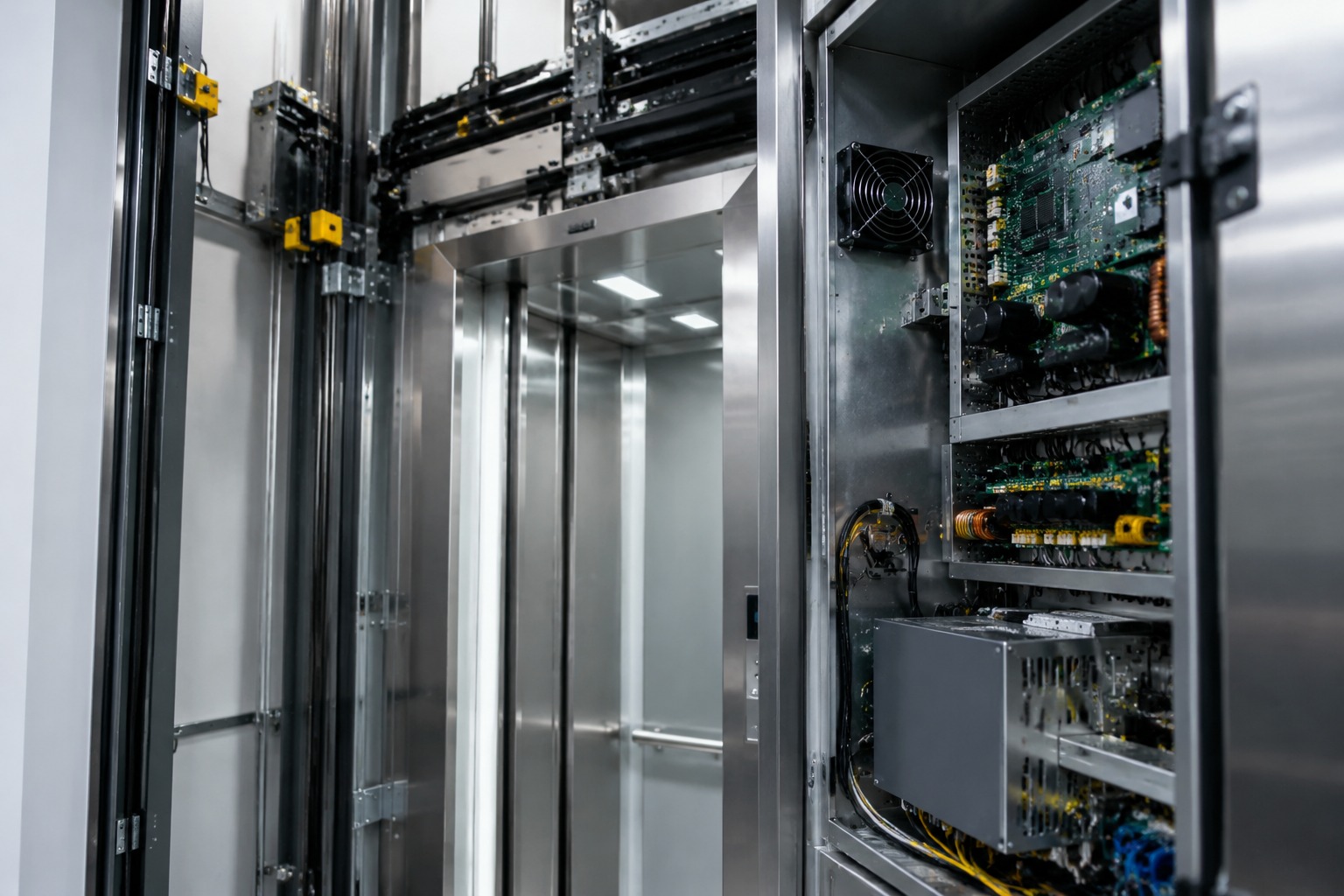
Cross flow fans and axial flow fans both have value in elevators, but they solve different problems. A cross flow fan pulls air across the length of a cylindrical impeller and delivers a broad sheet of air. An axial fan moves air parallel to the motor shaft, usually producing a concentrated stream. Because of this, cross flow fans are usually better for cabin comfort, while axial fans are often preferred for compact cooling tasks and cabinet ventilation.
A maintenance buyer comparing the two should consider four questions: where the fan is installed, what kind of airflow pattern is needed, how much mounting space is available, and how much noise is acceptable. A fan that performs well in a cabinet may feel poor in a passenger car, and a cabin fan may not provide enough static pressure or localized cooling for dense electronics.
| Factor | Cross Flow Fan | Axial Flow Fan | Best Elevator Use | Advantage | Limitation |
|---|---|---|---|---|---|
| Air distribution | Wide and uniform | Focused and directional | Cabin comfort vs cabinet spot cooling | Better comfort for passengers | Less concentrated airflow |
| Shape | Long and slim | Round or square compact frame | Ceiling panels vs control boxes | Easy cabin integration | May need custom bracket |
| Noise profile | Often smoother | Can be sharper at high speed | Passenger cars | Pleasant airflow feel | Varies by bearing quality |
| Cooling intensity | Moderate across area | Strong on target area | Drive and PCB cooling | Good for electronics enclosure | May create dead zones |
| Retrofit flexibility | Good when original cabin design uses it | Good for standard cabinets | Modernization | Wide spare availability | Wrong substitution can misfit |
| Cost pattern | Can be higher for exact-fit cabin parts | Often economical | Budget replacements | Simple sourcing | Comfort result may be lower |
For India’s elevator service market, the comparison is practical. A residential tower in Gurugram or Noida may prioritize low-cost cabinet cooling fans, while a hotel in Goa or a premium office in Bengaluru may prioritize cabin comfort and lower acoustic disturbance. Technicians should avoid substituting an axial fan for a cross flow fan without checking airflow pattern, grill design, and passenger experience. The fan may fit electrically yet still deliver poor ventilation inside the car.
The bar chart shows where demand is often strongest. Commercial office and residential segments typically generate the largest volume because of installed base and daily usage intensity. Hospitals and hospitality sites may have lower volume but stricter requirements for comfort and reliability.
How to select voltage size and airflow
Selecting a replacement elevator fan starts with exact technical matching. The three most important parameters are voltage, physical size, and airflow. If any of these are wrong, the new fan may fail early, cool poorly, create noise, or require unsafe wiring changes.
First, confirm the rated voltage and frequency from the nameplate, service manual, or actual circuit measurement. In elevator applications, you may see AC 110V, AC 220V, AC 230V, AC 240V, DC 24V, or other variants depending on the original equipment. Never assume based on fan appearance. A similar-looking motor can have a different voltage and current draw. In India, many replacement jobs involve 230V AC supplies, but imported elevators and branded systems can vary.
Second, measure size carefully. For a cross flow fan, record overall length, impeller length, housing width, depth, shaft position, bracket spacing, and outlet orientation. For an axial fan, measure frame size, thickness, mounting hole centers, and airflow direction. On older lifts, small dimensional differences can prevent the panel from closing properly.
Third, evaluate airflow. Cabin fans need enough air circulation for comfort, while cabinet fans need enough airflow to manage thermal load. Too little airflow can overheat the drive; too much is not always better if it increases dust intake, noise, or vibration. It is wise to compare the original airflow rating, fan speed, wattage, and application environment. Hot machine-room-less systems in Indian summer conditions may require better thermal margin than cooler indoor sites.
| Selection Item | What to Check | Common Units | Why It Matters | Risk of Wrong Choice | Field Tip |
|---|---|---|---|---|---|
| Voltage | Nameplate and measured supply | V AC / V DC | Electrical compatibility | Motor burn or no start | Measure before ordering |
| Frequency | 50Hz or 60Hz rating | Hz | Speed and performance | Wrong RPM and heat | India usually uses 50Hz |
| Physical size | Length, width, depth, hole spacing | mm | Fitment | Mounting mismatch | Take photos with scale |
| Airflow | Required cooling or cabin comfort level | CFM or m³/h | Thermal and comfort performance | Poor cooling or excessive noise | Match original as baseline |
| Current and wattage | Electrical load | A / W | Circuit safety | Overload or fuse issues | Check controller output rating |
| Bearing and insulation | Build quality and temperature rating | Class / type | Service life | Premature failure | Prefer stable quality parts |
The table above is useful because many replacement issues are caused by incomplete data capture. A technician sends only a fan photo, receives a part that looks similar, and then discovers that the bracket position or voltage is different. Good model matching saves repeated site visits and unnecessary downtime.
When buying for the India market, it is also wise to consider local conditions. Coastal cities such as Chennai, Kochi, and Visakhapatnam may need better corrosion resistance. Dust-heavy environments near construction zones in Ahmedabad, Pune fringe areas, or NCR expansion corridors may require more frequent filter cleaning in cabinet installations. High-rise premium towers in Mumbai and Bengaluru often place extra emphasis on noise level and visual fit.
Inverter cabinet fan replacement notes
Replacing an inverter cabinet fan requires more attention than replacing a cabin fan. The fan is part of the thermal protection strategy of the drive system. If the replacement fan does not deliver adequate airflow, power electronics may run hotter even if the lift appears normal during light traffic periods. Problems may surface later during peak usage, high ambient temperature, or long runs.
Before replacement, isolate power and follow lockout procedures. Identify whether the fan is blowing into the cabinet or exhausting from it. Confirm rotation and airflow direction arrows. Many inverter cabinets use a fan-and-filter arrangement, and replacing only the fan without cleaning the filter can leave airflow almost unchanged. Also inspect surrounding components for dust mats on heatsinks, wiring obstructions, and signs of capacitor swelling or heat discoloration.
For branded elevator systems using Hitachi, Toshiba, KONE, Mitsubishi, and other common platforms, the safe approach is to match fan specifications carefully and verify terminal type, connector type, frame size, and airflow. A generic fan may work physically but still not align with connector pinout or long-term reliability expectations. For maintenance companies handling mixed portfolios, reliable sourcing and accurate model matching are critical to reduce call-backs.
We support this need through strong technological capabilities in model identification and compatibility review. Instead of treating every fan as a commodity, we help customers check voltage class, dimensions, connector format, and application context so the replacement part fits the operating conditions of the actual lift system.
| Cabinet Fan Checkpoint | What to Inspect | Why It Is Important | Typical Fault Symptom | Recommended Action | Priority |
|---|---|---|---|---|---|
| Airflow direction | Intake or exhaust orientation | Maintains designed cooling path | Hot spots remain after replacement | Match original direction | High |
| Filter condition | Dust blockage | Controls actual airflow | Fan runs but cabinet still overheats | Clean or replace filter | High |
| Connector and wiring | Terminal style and polarity | Safe electrical connection | No start or intermittent running | Verify pinout before energizing | High |
| Fan size and frame | Hole pattern and thickness | Mechanical fit | Vibration or loose mounting | Use exact or approved equivalent | Medium |
| Thermal environment | Nearby heatsinks and drive load | Determines airflow requirement | Trips during peak traffic | Do not undersize airflow | High |
| Dust and corrosion level | Site environment | Affects service life | Early bearing failure | Select suitable quality and inspect often | Medium |
The explanation is simple: replacing the fan alone is only part of the job. Cabinet cooling performance depends on the full airflow path. A clean filter, clear vent openings, and correct airflow direction matter just as much as the motor itself.
Noise vibration and dust checks
Noise, vibration, and dust are among the most overlooked elevator fan issues. A fan can still run and move air while creating passenger complaints, cabinet resonance, or excessive contamination. In cabin installations, a rattling or buzzing sound often points to worn bearings, imbalanced impellers, loose screws, distorted mounting brackets, or a grille touching the fan housing. In cabinet applications, dust buildup can unbalance the blades and reduce cooling efficiency at the same time.
When evaluating noise, distinguish between aerodynamic sound and mechanical sound. Aerodynamic noise comes from airflow velocity and obstruction through narrow grilles. Mechanical noise comes from bearings, motor wear, or mounting looseness. Cross flow fans typically provide smoother cabin airflow, but if the impeller is clogged or bent, they can still become noisy. Axial fans may generate sharper tonal noise at higher speed, especially in thin sheet-metal enclosures.
Dust checks are essential in India because many buildings operate near active construction, busy roads, industrial zones, or dry-season particulate conditions. In cabinet cooling, dust on heatsinks can act like insulation and reduce heat transfer. In coastal areas, dust mixed with moisture and salt can accelerate corrosion and conductive contamination. This is why periodic cleaning should be part of preventive maintenance rather than a response only after overheating alarms appear.
The area chart reflects a broader maintenance trend. More Indian property managers are moving from reactive fan replacement to preventive inspection, especially in larger residential portfolios and Grade A commercial properties. This shift is driven by uptime expectations and the lower cost of planned servicing compared with emergency shutdowns.
Installation and wiring tips
Good installation practice is the difference between a reliable replacement and an early failure. Start by disconnecting power safely and confirming zero voltage. Compare the old and new parts side by side before mounting. Check arrow marks for airflow direction and rotation. Make sure brackets are aligned and the fan body is not twisted when screws are tightened. Over-tightening can distort the frame, leading to vibration and bearing stress.
For wiring, follow the original diagram or terminal identification exactly. If the replacement uses a different connector, do not improvise without confirming conductor size, insulation quality, polarity for DC fans, and safe termination. Keep wires clear of rotating parts and sharp metal edges. In cabinet installations, avoid routing wires across heatsinks or airflow channels. If a cabinet uses a thermostat-controlled fan circuit, confirm the switching function after installation instead of assuming continuous operation.
After energizing, observe start-up current, sound, vibration, and airflow. For cabin fans, close the car ceiling and verify that the grille does not rub. For cabinet fans, check that air is moving through the intended intake and exhaust path. Use a thermometer or thermal camera if available to compare before-and-after conditions around inverter heatsinks and sensitive electronic modules.
Our manufacturing capabilities support this process through stable quality inspection, dimensional checks, and protective packaging that helps parts arrive in ready-to-install condition. This is especially valuable for deliveries moving through major logistics corridors such as Mumbai, Chennai, Delhi NCR, Bengaluru, and Hyderabad, where multiple handling stages can affect delicate components if packaging is poor.
| Installation Step | Best Practice | Common Mistake | Result of Mistake | Useful Tool | Site Note |
|---|---|---|---|---|---|
| Power isolation | Lock out and test supply | Assuming circuit is dead | Safety hazard | Multimeter | Mandatory before work |
| Part verification | Match voltage and dimensions | Install on visual similarity only | Misfit or electrical fault | Caliper and photo record | Check label carefully |
| Mounting alignment | Use proper bracket position | Frame under tension | Noise and early wear | Screwdriver set | Do not force fit |
| Wiring termination | Secure and insulate correctly | Loose or reversed connection | No start or intermittent fault | Crimp tool | Label wires before removal |
| Airflow confirmation | Check arrow and actual flow | Reverse installation | Poor cooling | Airflow strip or tester | Verify cabinet path |
| Final performance test | Run and monitor | Leave site immediately after fitment | Undetected vibration or heat issue | Thermometer | Record maintenance log |
This table helps standardize field work. Even experienced technicians benefit from a repeatable checklist because fan replacements often happen quickly during service calls, and small oversights can cause return visits.
Maintenance schedule for elevator fans
A maintenance schedule should reflect traffic intensity, environment, and fan function. Cabin fans in clean residential buildings may only need periodic cleaning and annual performance review. Cabinet fans in dusty, warm, high-duty environments may need far more frequent inspection. The goal is to identify bearing wear, dust blockage, declining airflow, and wiring deterioration before these lead to passenger discomfort or controller overheating.
A practical maintenance plan for India can include monthly visual checks on high-use sites, quarterly cleaning of filters and ventilation paths, half-yearly noise and vibration checks, and annual replacement review based on age, operating hours, and site condition. Where buildings experience severe dust, monsoon moisture, or unstable power quality, the interval may need to be shortened.
Our service capabilities are built around responsive communication, careful model matching, and dependable supply support so customers can reduce downtime and keep lifts operating safely. For elevator maintenance companies managing multiple brands, this matters because a delayed or mismatched fan can leave a cabin uncomfortable or a cabinet exposed to thermal risk for longer than necessary.
| Interval | Cabin Fan Task | Cabinet Fan Task | What to Record | Warning Sign | Action if Found |
|---|---|---|---|---|---|
| Monthly | Basic airflow and noise check | Visual fan running check | Any abnormal sound | Weak airflow | Inspect fan and grille |
| Quarterly | Clean grille and dust deposits | Clean filter and vents | Dust level and cleanliness | Blocked filter | Clean or replace filter |
| Half-yearly | Check mounting tightness | Check vibration and terminal security | Fastener condition | Rattle or buzz | Retighten and inspect bearings |
| Annually | Review motor performance | Review thermal performance under load | Current draw and temperature | High cabinet heat | Consider replacement |
| After monsoon | Inspect for rust or moisture marks | Inspect corrosion and filter dampness | Corrosion presence | Stiff movement or rust | Clean and replace damaged parts |
| After major construction nearby | Extra cleaning | Deep dust inspection | Dust accumulation severity | Rapid clogging | Shorten service interval |
The maintenance schedule above is effective because it separates routine observation from deeper service. This helps building owners and contractors plan spare stock and service visits more efficiently, especially for large portfolios in growing urban clusters.
This comparison chart summarizes what matters most in replacement supply. Elevator fan procurement is not just about unit price. In practice, buyers value accurate model matching, stable quality, quick response, and the ability to reduce downtime by avoiding wrong parts.
FAQ about elevator fans
1. When should a cabin fan be replaced instead of cleaned?
Replace it when bearing noise persists after cleaning, airflow remains weak, the motor overheats, the impeller is damaged, or the fan fails to start reliably. Cleaning alone will not solve electrical winding damage or worn bearings.
2. Can an axial fan replace a cross flow fan in a lift cabin?
Sometimes it can be made to work physically, but it often changes airflow feel, noise, and appearance. For passenger comfort and proper fit, it is better to use the correct fan type unless an engineering review confirms the substitution.
3. How do I choose between AC and DC elevator fans?
Always follow the original equipment voltage and control design. Check the nameplate, wiring diagram, and actual measured supply. Never convert without confirming the circuit and protection requirements.
4. Why does an inverter cabinet still overheat after the fan was replaced?
Possible reasons include blocked filter media, wrong airflow direction, undersized airflow, dust on heatsinks, poor cabinet ventilation path, or another heat-related issue in the drive itself. The fan may not be the only cause.
5. What airflow rating is suitable for an elevator cabinet fan?
There is no single universal number. It depends on cabinet size, heat load, ambient temperature, filter resistance, and airflow path. Matching or slightly improving on the original specification is usually the safest approach.
6. Are cross flow fans better for elevator comfort in India?
In many cabins, yes. They usually provide more even distribution and a gentler airflow pattern, which helps passenger comfort in warm climates and crowded lifts.
7. How often should elevator cabinet fans be inspected in dusty Indian environments?
For dusty sites, monthly visual checks and quarterly cleaning are a practical baseline. If the building is near construction, industrial activity, or busy roads, the interval may need to be shorter.
8. What should be sent when requesting a replacement quote?
Send clear photos of the label, connector, mounting side, dimensions, airflow direction, and application location. Include brand, model, voltage, and any measured size details. This greatly improves matching accuracy.
9. Are fan problems more common in coastal cities?
They can be. Salt-laden air, humidity, and corrosion increase the risk of bearing deterioration and conductive dust buildup. Sites in Chennai, Kochi, Mumbai coastlines, and other marine environments should monitor condition carefully.
10. What trends will shape elevator fan selection in 2026?
Three trends stand out. First, higher focus on energy efficiency and low-noise components in premium buildings. Second, stronger preventive maintenance routines supported by digital service records. Third, sustainability and policy pressure encouraging longer-life parts, reduced waste, and better thermal management in modernization programs.
Looking ahead to 2026, India’s elevator maintenance market is likely to place more emphasis on energy-aware ventilation, better dust control, and reliable replacement sourcing for legacy branded systems. Sustainability will influence purchasing decisions through longer service life, fewer repeat replacements, and improved packaging efficiency. Policy and building management trends may also push for better equipment records, periodic condition checks, and thermal reliability in densely occupied properties.
For buyers across India, the smartest approach is simple: define the application clearly, capture the original specifications accurately, and source from a supplier that understands compatibility, quality inspection, and responsive support. Whether you need a cabin cross flow fan, a compact axial fan, or an inverter cabinet cooling fan, careful selection helps protect passenger comfort, controller stability, and overall elevator uptime.