
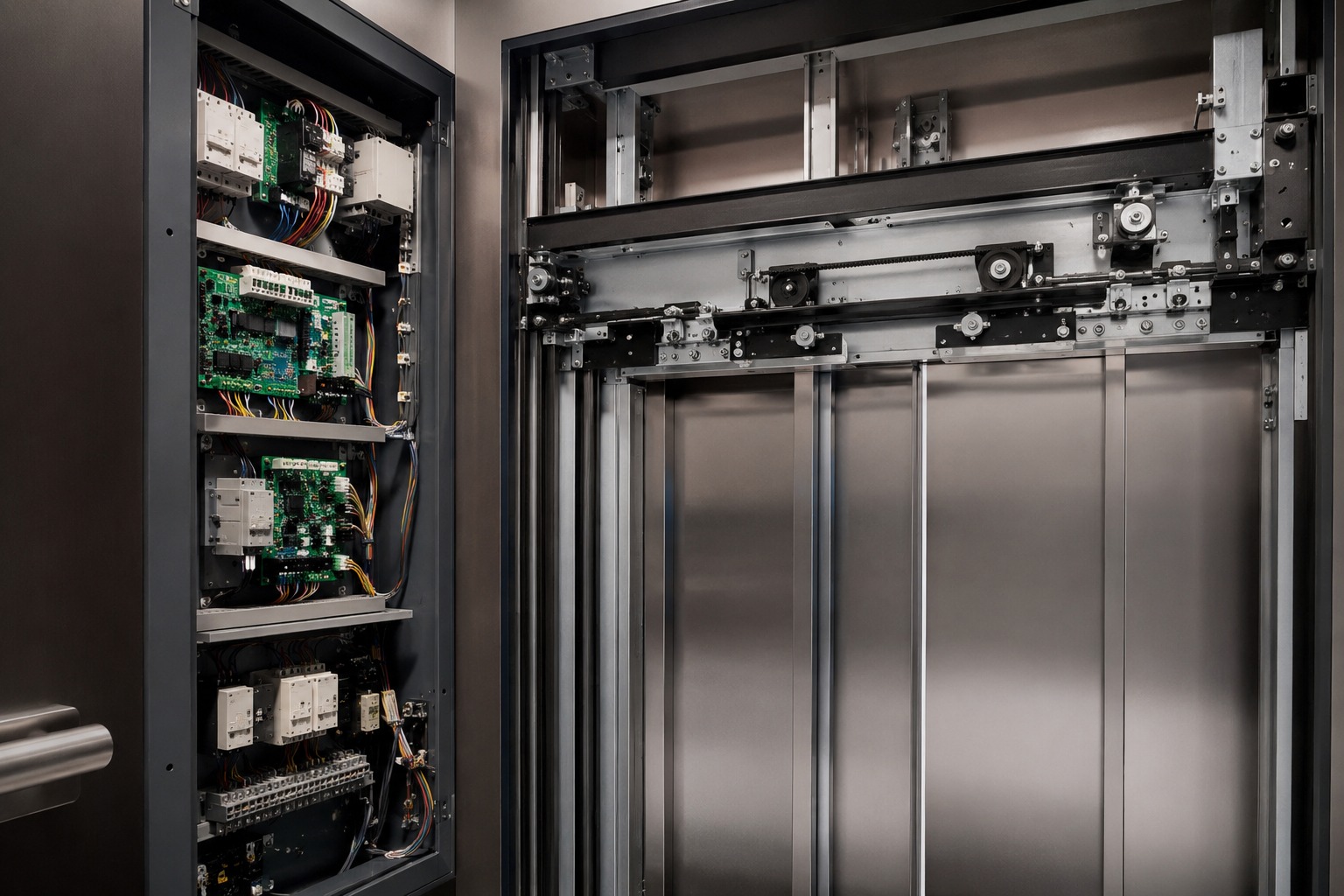
Elevator door control panels are the decision-making units that help a lift door operator open, close, slow down, reverse, and lock doors safely. In practical maintenance work across India, these panels coordinate the door motor, encoder or sensor feedback, landing door lock circuits, light curtain signals, open and close limits, and communication with the main lift controller. When the panel fails or loses parameter accuracy, the result is often obvious to building users: noisy operation, door reopening, slow closing, lock faults, nuisance trips, or complete shutdown.
For maintenance teams in Mumbai, Delhi NCR, Bengaluru, Chennai, Hyderabad, Pune, Ahmedabad, Kolkata, and other fast-growing urban markets, a good understanding of the elevator door control panel reduces downtime and prevents unnecessary replacement of motors, rollers, light curtains, and locks. In many Indian buildings, especially hotels, hospitals, IT parks, residential towers, metro-connected offices, and modernization projects, the door system is the highest-cycle subsystem of the lift. That means the door controller often receives more operational stress than many technicians expect.
This guide explains how lift door control boards work, how to approach Toshiba door control panel replacement, what settings matter for speed and torque, how to check light curtain and lock signals, how to diagnose faults logically, how to commission after replacement, and how to maintain door operators for longer service life. It also gives buying advice for maintenance companies, distributors, building owners, and modernization contractors who need compatible replacement parts with stable quality and careful model matching for the Indian market.
What elevator door control panels do
An elevator door control panel manages the complete motion sequence of the car door and, depending on system design, coordinates with landing door safety logic. At the simplest level, it tells the door motor when to open and close. At a more technical level, it monitors acceleration, deceleration, approach speed, torque output, obstruction response, reopen timing, limit signals, and lock confirmation before the lift is allowed to move.
In a modern door operator, the control panel usually receives commands from the main elevator controller such as open, close, nudge, hold open, and reopen. It then converts those commands into precise motor action. If the panel sees abnormal current draw, missing pulse feedback, lock mismatch, or a blocked entrance signal from the light curtain, it may stop the door, reverse movement, or issue a fault to the main system.
Technicians often describe the door board as the “traffic controller” of the entrance system because it coordinates several devices at once:
| Function | Connected device | What the panel does | Typical symptom if wrong | Risk level | Maintenance note |
|---|---|---|---|---|---|
| Open command control | Door motor | Starts opening with defined speed curve | Jerky or delayed opening | Medium | Check command input and motor drive output |
| Close command control | Door motor | Closes with torque and slowdown logic | Doors remain open or reopen repeatedly | High | Verify close limit, light curtain, torque settings |
| Position feedback | Encoder/sensor | Tracks door travel and speed | Overrun, hunting, panel fault | High | Inspect connector, pulse quality, alignment |
| Obstruction detection | Light curtain/safety edge | Reopens when a person or object is detected | Unexpected reopening or unsafe closing | Very high | Clean lens and verify input logic polarity |
| Lock verification | Door lock circuit | Checks that doors are secured before run | Lift not running, lock faults | Very high | Measure continuity and inspect mechanical engagement |
| Fault communication | Main controller | Sends alarms and status signals | Intermittent shutdown with no clear cause | Medium | Confirm interface wiring and event history |
The practical takeaway is simple: the door control panel is not an isolated spare part. It is part of a complete motion and safety chain. Replacing the board without checking the mechanical condition of the operator, hanger rollers, sill, door vane, lock, and cable integrity often creates repeat call-backs.
In India’s mixed building stock, technicians frequently encounter both older relay-supported door systems and newer microprocessor-based door operator boards. Residential towers in Navi Mumbai may still run older modernization combinations, while IT campuses in Bengaluru and high-rise offices in Gurugram often require more precise board matching, firmware awareness, and parameter backup discipline.
The chart above reflects a realistic market pattern seen in India: replacement demand is rising due to urbanization, increased lift density, and modernization of installations in commercial hubs such as Chennai, Hyderabad, Pune, and Ahmedabad. Older buildings are keeping existing operators longer, which increases the need for compatible repair boards and selective component replacement instead of full door operator changeouts.
Toshiba door control panel replacement notes
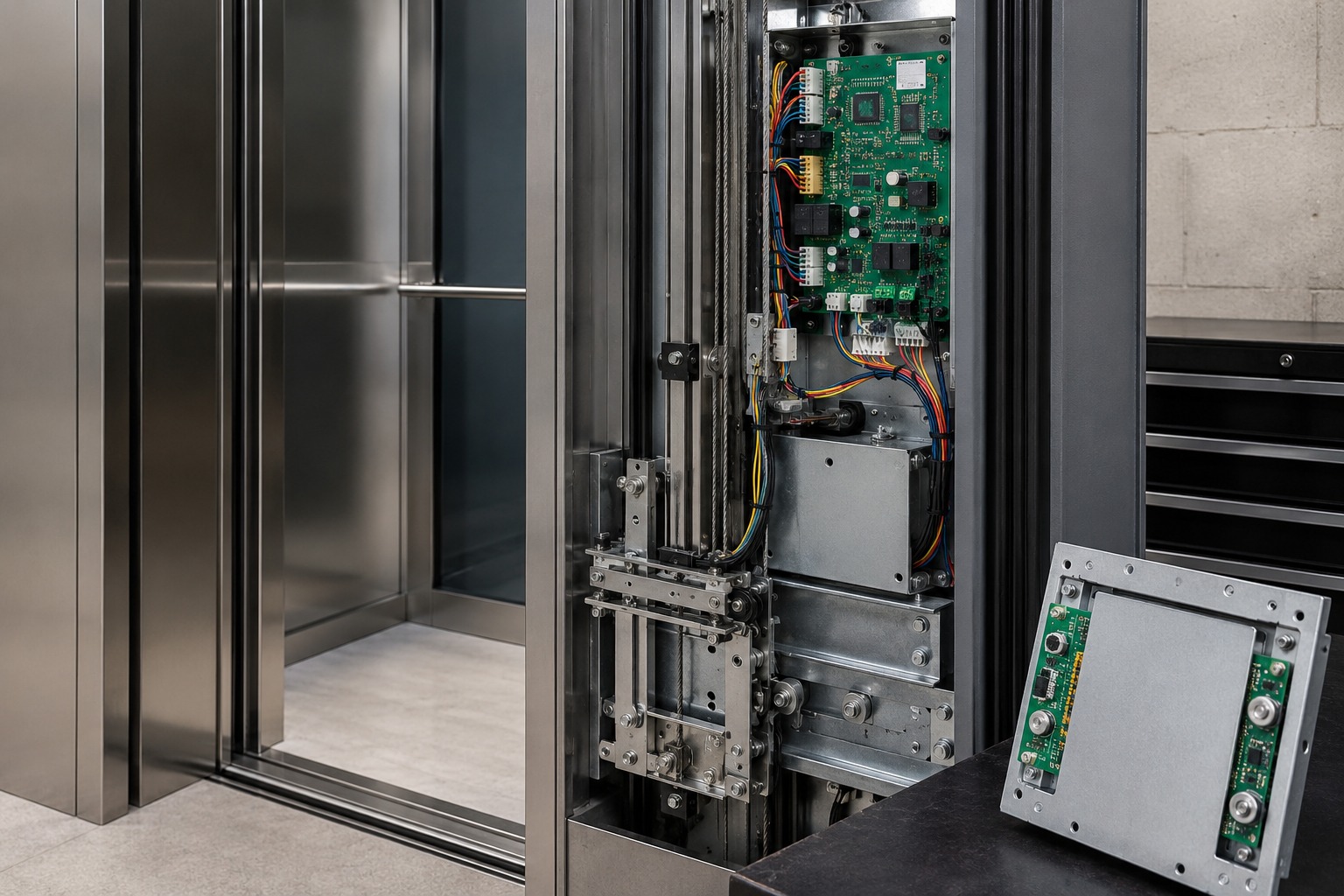
When replacing a Toshiba elevator door control panel, the most important rule is model matching before installation. Many technicians assume that a board with similar connectors can be used directly, but that can lead to output mismatch, incorrect sensor interpretation, or unstable torque behavior. Toshiba door systems may vary by series, firmware generation, door motor type, and signal arrangement.
Before removing the old board, record the board label, machine serial references, connector positions, jumper settings, parameter values, and fault history. Take clear photos of every terminal and cable path. If the original board has damaged markings, compare with operator nameplate, motor details, and controller documentation. This step is especially important in Indian service environments where an elevator may have received prior modifications during modernization or emergency field repair.
For buyers searching for a compatible replacement, a dedicated Toshiba elevator door control panel should be matched by board code, operator application, and wiring layout rather than by appearance alone. A supplier that supports careful model verification can help reduce installation errors and repeated site visits.
| Checkpoint | What to confirm | Why it matters | Common mistake | Recommended action | Result if ignored |
|---|---|---|---|---|---|
| Board part number | Exact code and revision | Ensures electrical and software compatibility | Matching only by shape | Cross-check with old label and supplier data | Start-up fault or unstable motion |
| Input voltage | Rated power supply range | Prevents overvoltage damage | Skipping site measurement | Measure incoming supply before energizing | Immediate board failure |
| Motor type | DC, AC, PM or specific operator motor | Output algorithm must match motor | Assuming all Toshiba operators are identical | Verify motor plate and controller notes | Poor torque or trip faults |
| Signal logic | NO/NC and voltage level of locks and sensors | Wrong logic causes false faults | Direct transfer without checking terminals | Test each input with meter | Continuous reopen or no-run status |
| Parameter backup | Speed, torque, timings, limits | Restores original behavior quickly | Powering down without recording values | Document every adjustable parameter | Long commissioning delays |
| Mechanical condition | Rollers, tracks, clutch, locks | Bad mechanics overload the new board | Replacing electronics only | Inspect and service operator hardware | Repeat failure or nuisance shutdown |
It is also good practice to inspect the door motor when a board is being replaced. If the old panel failed due to overcurrent, repeated jams, or unstable feedback, the root cause may lie in the motor, coupler, or mechanical drag. In some cases, technicians working on modernization or heavy-use sites may also need a replacement permanent magnet synchronous door motor for compatible operator repair projects where torque loss or overheating is confirmed.
In India, time pressure often pushes teams to replace the board quickly and leave parameter tuning for later. That is risky. A board that powers up is not necessarily a board that is correctly commissioned. Proper replacement means correct wiring, proper grounding, stable feedback, validated safety inputs, and accurate travel settings under real load conditions.
Door speed and torque settings
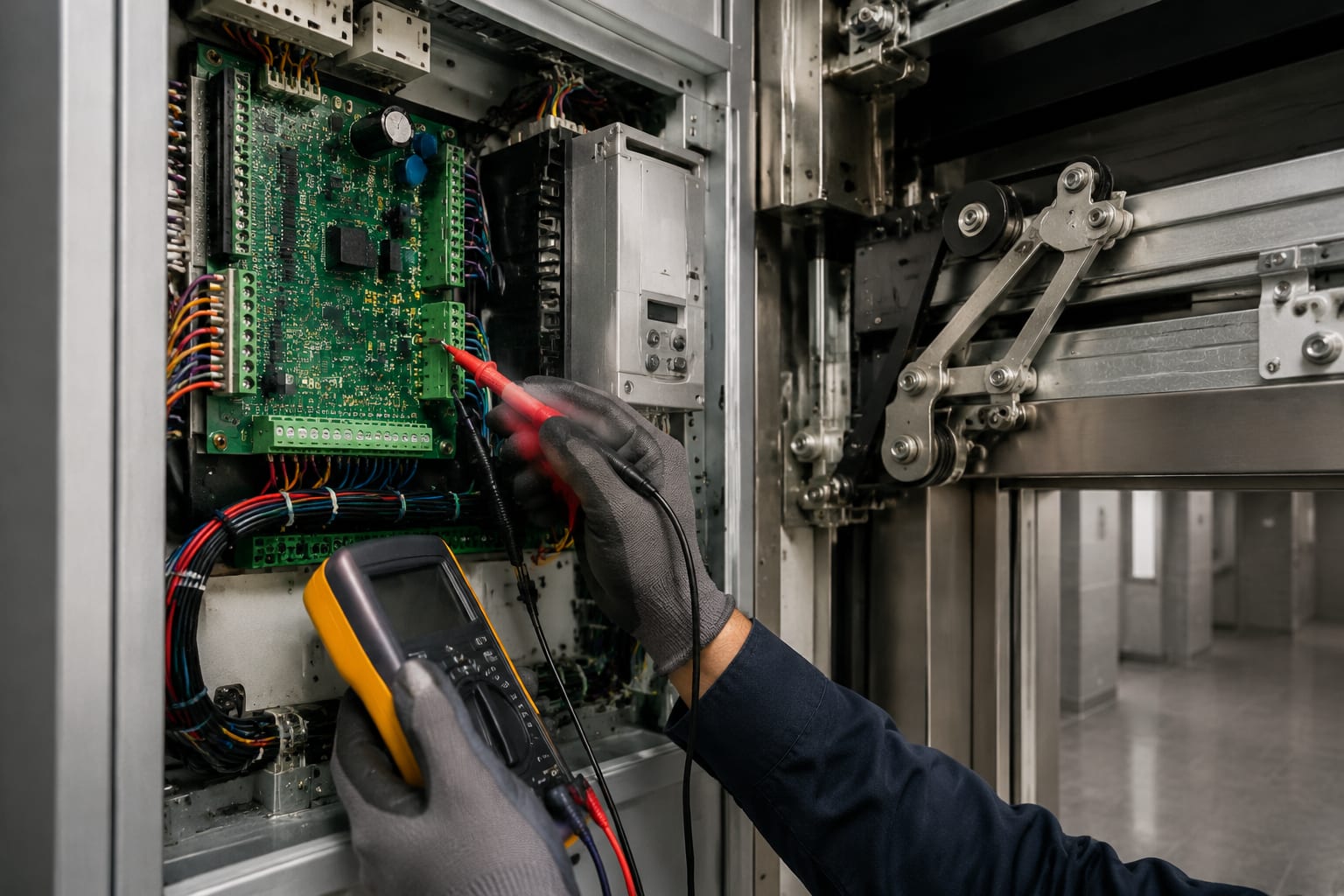
Door speed and torque settings determine how quickly the doors move, how smoothly they stop, and how safely they react to people and obstructions. If speed is too high, the doors may slam, overshoot, or create passenger discomfort. If speed is too low, traffic flow suffers and building users complain about waiting time. If torque is too high, the door can close harshly and wear components faster. If torque is too low, the door may fail to lock or may reopen on minor friction.
Most door controllers allow adjustment of opening speed, closing speed, initial torque, holding torque, slowdown points, nudging behavior, and obstruction response thresholds. These values must be set according to the door weight, panel width, opening type, mechanical condition, traffic pattern, and brand-specific logic.
| Setting | Main effect | If too low | If too high | Field symptom | Adjustment tip |
|---|---|---|---|---|---|
| Opening speed | Door opening time | Slow passenger flow | Noisy entry, mechanical shock | Users complain of sluggish or harsh opening | Increase gradually and observe final stop |
| Closing speed | Door closing time | Long cycle time | Aggressive closing | Frequent reopen or impact on meeting | Balance with light curtain sensitivity |
| Start torque | Breakaway force at motion start | Door hesitates | Sudden jerk | Shudder at start | Set just above friction requirement |
| Running torque | Force during movement | Stops before full travel | Overcurrent or hard operation | Incomplete close or hot motor | Check current and mechanical drag together |
| Slowdown point | Transition to low speed near end | Late deceleration | Excessively slow final approach | Bang at end or wasted cycle time | Align with encoder and travel length |
| Holding torque | Keeps door stable at end position | Door drifts | Motor heating | Buzzing sound while idle | Use minimum stable value |
As a rule, always begin with mechanical inspection before parameter changes. A technician may try to solve a rough-running operator by increasing torque, but if the sill is dirty, hanger rollers are worn, or the door panels are misaligned, added torque only hides the problem temporarily. It also increases heat and stress on the motor and control board.
In high-traffic applications such as metro-adjacent buildings in Chennai, hospitals in Delhi, shopping centres in Mumbai, and residential towers in Noida, door cycle frequency is high. This means parameter tuning should prioritize both passenger comfort and endurance. Smooth travel with correct slowdown is usually more valuable than maximum speed.
The demand pattern above shows why correct parameter setting matters across sectors. Commercial buildings and metro-linked offices tend to prioritize traffic handling and uptime, while hospitals and hotels emphasize smooth operation and user safety. That affects how service companies set door speeds, torque margins, and reopen timing.
Light curtain and lock signal checks
The light curtain and door lock circuit are two of the most important safety-related inputs connected to a door control panel. A dirty or failed light curtain can cause unnecessary reopen cycles, and a weak or inconsistent lock signal can keep the entire lift out of service. Many field complaints that appear to be “board faults” are actually caused by unstable external signals.
The light curtain should be checked for alignment, physical damage, lens contamination, cable breaks, and supply voltage. In dusty sites, under-construction towers, and humid coastal areas such as Chennai and Kochi, contamination and corrosion can affect signal stability. If the light curtain output is intermittent, the panel may interpret it as a passenger obstruction and reopen the doors repeatedly.
For replacement work, a dependable elevator light curtain with proper beam coverage and connector compatibility can improve reliability, especially in heavy-use entrances where old sensors have become inconsistent.
| Item | Check method | Normal condition | Abnormal sign | Likely cause | Corrective action |
|---|---|---|---|---|---|
| Light curtain power | Measure input voltage | Stable rated supply | Fluctuation or low voltage | Loose wiring or power issue | Tighten terminals and trace supply |
| Beam alignment | Visual and response test | Consistent detection across opening | Blind spots | Misalignment or damaged array | Realign or replace unit |
| Lens condition | Physical inspection | Clean surface | Dust, grease, scratches | Site contamination | Clean with proper non-abrasive method |
| Lock contact continuity | Meter test during full closure | Stable closed circuit | Intermittent contact | Worn lock or poor engagement | Adjust or replace lock parts |
| Mechanical lock engagement | Observe vane and keeper | Full engagement every cycle | Late or weak locking | Misalignment or play | Correct alignment and clearances |
| Input recognition on board | Monitor diagnostic LEDs or display | Signal changes correctly | No change or unstable state | Input stage issue or wrong wiring | Trace signal from device to board |
Always verify both electrical and mechanical sides. A lock contact may test correctly on the bench, but if the landing door is slightly misaligned or the car door vane engages late, the signal will be unreliable during normal operation. Likewise, a light curtain may have power and still fail because some beams are dead or the signal output type does not match the panel’s expected logic.
For buildings in coastal trade hubs such as Chennai Port, Visakhapatnam, and Mundra-linked logistics zones, salt exposure and dust are frequent contributors to signal instability. Protective maintenance intervals should be shorter in those environments.
Fault diagnosis workflow
A proper fault diagnosis workflow saves time, prevents random parts replacement, and improves first-visit repair rates. Door faults should be approached in a structured sequence: confirm symptom, read fault status, verify power, inspect mechanics, test inputs, test feedback, test outputs, review parameters, and then replace parts only when evidence supports it.
Too often, a technician sees repeated door reopen cycles and replaces the control panel immediately. But the real issue might be a dirty sill, a weak close limit, a failed light curtain, an intermittent lock contact, or excessive drag from worn rollers. The panel is frequently blamed because it is the visible “brain,” but many failures originate outside the board.
| Step | What to do | Tools needed | Why first | What it can reveal | Next action |
|---|---|---|---|---|---|
| 1. Confirm symptom | Observe several cycles | Notebook, video if allowed | Avoid assumptions | Pattern of failure | Separate reopen, no-close, or lock issue |
| 2. Read fault indicators | Check display or LEDs | Manual, torch | Fast direction to circuit area | Input or motor-related code | Follow code with measurement |
| 3. Verify supply | Measure board voltage | Multimeter | Low supply mimics many faults | Undervoltage, ripple, loose terminal | Correct power issue before further tests |
| 4. Inspect mechanics | Check rollers, track, sill, vane | Hand tools | Mechanical drag is common | Stiff travel or misalignment | Clean, align, lubricate where appropriate |
| 5. Test safety inputs | Check light curtain and locks | Meter, diagnostic screen | Unsafe or false signals stop operation | Intermittent reopen or no-run | Repair input device or wiring |
| 6. Check motor and feedback | Measure current and encoder response | Clamp meter, meter | Confirms load and control accuracy | Overload, lost pulses | Repair motor, sensor, or board output |
One effective practice is to divide possible faults into five groups: power issues, input issues, output issues, feedback issues, and mechanical issues. This prevents technicians from jumping between unrelated causes. For example:
- Power issues: unstable supply, poor grounding, damaged fuse, loose terminal.
- Input issues: faulty lock, bad light curtain, missing close command, wrong logic polarity.
- Output issues: failed motor drive stage, weak relay, damaged connector.
- Feedback issues: encoder pulse loss, sensor misalignment, open feedback wiring.
- Mechanical issues: rail contamination, bent panels, worn rollers, clutch or vane misalignment.
In busy Indian service networks, where technicians may cover multiple sites per day across large metropolitan regions, using a consistent diagnosis workflow increases efficiency. It also improves communication between field engineers, purchasing teams, and suppliers because the required spare part can be identified more accurately.
This trend shift is significant in India. As maintenance budgets become more performance-driven, many building owners prefer targeted board replacement and operator repair over complete unit change, provided safety, compatibility, and commissioning quality are not compromised.
Commissioning after replacement
Commissioning after door control panel replacement is the stage that proves whether the repair is successful. A panel should never be considered finished simply because the doors move. Commissioning means verifying safe, repeatable performance under normal and edge-case conditions.
Start with static checks: board fixation, grounding, connector seating, input voltage, fuse condition, cable routing, and sign of shorts or crushed wires. Then load or restore the correct parameters. If the original values are unknown, begin with conservative settings recommended for the operator type and fine-tune gradually.
After basic power-up, perform controlled door cycles while monitoring speed, smoothness, current draw, and final lock confirmation. Test opening, closing, stop-reverse behavior, obstruction response, landing alignment, and communication with the main lift controller. Repeat under multiple cycles, not just one successful run.
| Commissioning point | Acceptance target | How to verify | Common issue found | Immediate correction | Why it matters |
|---|---|---|---|---|---|
| Power and grounding | Stable supply, proper earth | Meter test | Voltage drop or poor earth | Correct terminal and grounding path | Prevents erratic electronics behavior |
| Parameter restoration | Correct speed and torque values | Compare against records | Missing or default settings | Enter verified parameters | Ensures predictable motion |
| Open/close cycle | Smooth repeatable travel | Run multiple cycles | Jerks, overrun, delay | Adjust torque and slowdown | Passenger comfort and component life |
| Safety input response | Correct reopen and lock logic | Interrupt light curtain, test lock | No reopen or false reopen | Trace input logic and sensor status | Critical safety verification |
| Main controller handshake | Clean status exchange | Observe run permission sequence | Door close but car does not move | Check interface wiring and lock output | Avoid no-run callbacks |
| Final documentation | Complete service record | Parameter log and photos | No baseline for future maintenance | Save values and installation notes | Improves future troubleshooting |
A good commissioning routine should also include traffic simulation where practical. In a hospital in Hyderabad, for example, repeated short-cycle openings may reveal different behavior than a simple test in inspection mode. In a residential tower in Pune, evening peak traffic can expose light curtain sensitivity and close force issues more clearly than daytime testing.
For modernization contractors and maintenance companies, this stage is where supplier quality makes a difference. A parts partner with experience in model matching, stable incoming inspection, protective packaging for transport across long routes, and responsive service support can help reduce commissioning delays. Those capabilities are especially valuable when parts move through hubs such as Mumbai, Nhava Sheva, Mundra, or Chennai for onward dispatch to regional service teams.
Maintenance tips for door operators
Preventive maintenance is the most cost-effective way to extend the life of a door control panel and the operator around it. Door boards fail more often in systems where mechanical friction, contamination, poor cable support, and voltage stress are ignored. Good maintenance reduces overload conditions and nuisance faults.
Routine attention should focus on track cleanliness, sill groove cleaning, hanger roller wear, panel alignment, clutch or vane condition, lock engagement, cable insulation, fan or ventilation path where applicable, and stable sensor mounting. Tightening a loose connector today can prevent a no-service call tomorrow.
For teams managing multiple brands, a practical spare parts strategy is essential. The best results usually come from a supplier approach that combines technological capability, manufacturing control, and service responsiveness:
- Technological capabilities: support for model identification, compatible board selection, control board and sensor matching, and practical guidance on brand-specific applications such as Toshiba, Hitachi, KONE, and Mitsubishi systems.
- Manufacturing capabilities: stable sourcing, incoming quality inspection, careful connector and component verification, and protective packaging that reduces transit damage on long shipments to cities and secondary markets across India.
- Service capabilities: responsive communication, part photo confirmation, application cross-checking, and assistance for maintenance companies, distributors, building owners, and modernization contractors who need quick decisions to reduce elevator downtime.
| Task | Suggested interval | Main purpose | Signs of neglect | Priority level | Comment |
|---|---|---|---|---|---|
| Clean sill and track | Monthly or more in dusty sites | Reduce drag and mis-tracking | Grinding, slow movement | High | Important for construction-zone towers |
| Inspect rollers and hangers | Quarterly | Maintain smooth travel | Noise, shake, uneven gap | High | Replace before flat spots worsen |
| Check lock and vane alignment | Quarterly | Ensure reliable lock signal | No-run or lock faults | Very high | Mechanical and electrical check both needed |
| Inspect light curtain | Monthly | Keep obstruction detection reliable | Repeated reopen | Very high | Clean lenses carefully |
| Tighten board connectors | Every 6 months | Prevent intermittent signals | Random faults | Medium | Power off before handling |
| Review parameters and fault history | Every 6 months or after complaint | Catch drift and recurring patterns | Increasing callbacks | Medium | Build site-specific service records |
Maintenance frequency should be increased in harsh environments: coastal humidity in Chennai, high dust in industrial corridors, heavy passenger traffic in commercial towers of Mumbai and Gurugram, and mixed public usage in hospitals and transit-connected buildings. In such sites, preventive work pays back quickly by avoiding emergency calls and passenger dissatisfaction.
FAQ about elevator door control panels
1. How do I know if the fault is in the door control panel and not the motor?
Start with supply voltage, fault code review, and input checks. Then inspect mechanical drag and measure motor current. A motor with excessive current, overheating, or poor insulation may be the root cause. A board with correct inputs but no stable output may be defective.
2. Can I replace a Toshiba door control panel with a visually similar board?
No. Visual similarity is not enough. Confirm part number, revision, motor type, connector mapping, and parameter compatibility before installation.
3. Why do the doors reopen again and again after closing starts?
Common causes include light curtain interruption, false obstruction signal, excessive closing torque causing bounce, wrong close limit setting, lock engagement delay, or mechanical resistance in the track.
4. Should speed be increased to improve traffic handling?
Only after checking the mechanical condition and safety margins. Faster is not always better. Proper acceleration and slowdown are more important than maximum peak speed.
5. What should be recorded before board replacement?
Board label, revision code, input voltage, connector positions, parameter values, fault history, motor details, and clear wiring photos.
6. How important is the light curtain in door controller diagnostics?
Very important. A weak or unstable light curtain can imitate a board problem by causing repeated reopen or refusal to close.
7. Are replacement boards relevant only for old lifts?
No. Even newer systems may require board replacement after power events, moisture exposure, wiring damage, or repeated overload from poor mechanics.
8. What industries in India most often need door control panel support?
Residential towers, office buildings, hospitals, hotels, industrial parks, shopping centres, and modernization projects all generate steady demand.
9. How should buyers choose a supplier?
Look for accurate model matching, reliable sourcing, stable quality inspection, secure packaging, and responsive communication. These reduce installation risk and downtime.
10. What trends should buyers watch in 2026?
The 2026 market is moving toward smarter diagnostics, better compatibility support, energy-efficient door operators, stronger safety compliance expectations, and more sustainable maintenance through targeted board repair instead of unnecessary full assembly replacement.
The comparison chart highlights what purchasing teams in India increasingly value when choosing suppliers for door control panels and related operator parts. Compatibility support and inspection discipline matter because site time is expensive, and repeat visits hurt both maintenance margins and building uptime.
Looking ahead to 2026, three trends are especially relevant. First, technology: more door systems will use better diagnostic feedback, more precise motor control, and easier parameter management. Second, policy and safety: building owners and service providers will face stronger expectations for documented commissioning, signal integrity, and lifecycle reliability. Third, sustainability: selective replacement of boards, sensors, and operator components will continue to grow where it safely extends equipment life and reduces unnecessary material waste.
For Indian buyers, the best repair outcome comes from combining field diagnosis discipline with dependable parts supply. Whether the job involves a Toshiba door control board, a motor, a light curtain, a lock, or related operator accessories, success depends on accurate identification, quality verification, correct installation, and complete commissioning. That approach keeps lifts moving safely in the country’s busiest residential, commercial, healthcare, hospitality, and modernization markets.