
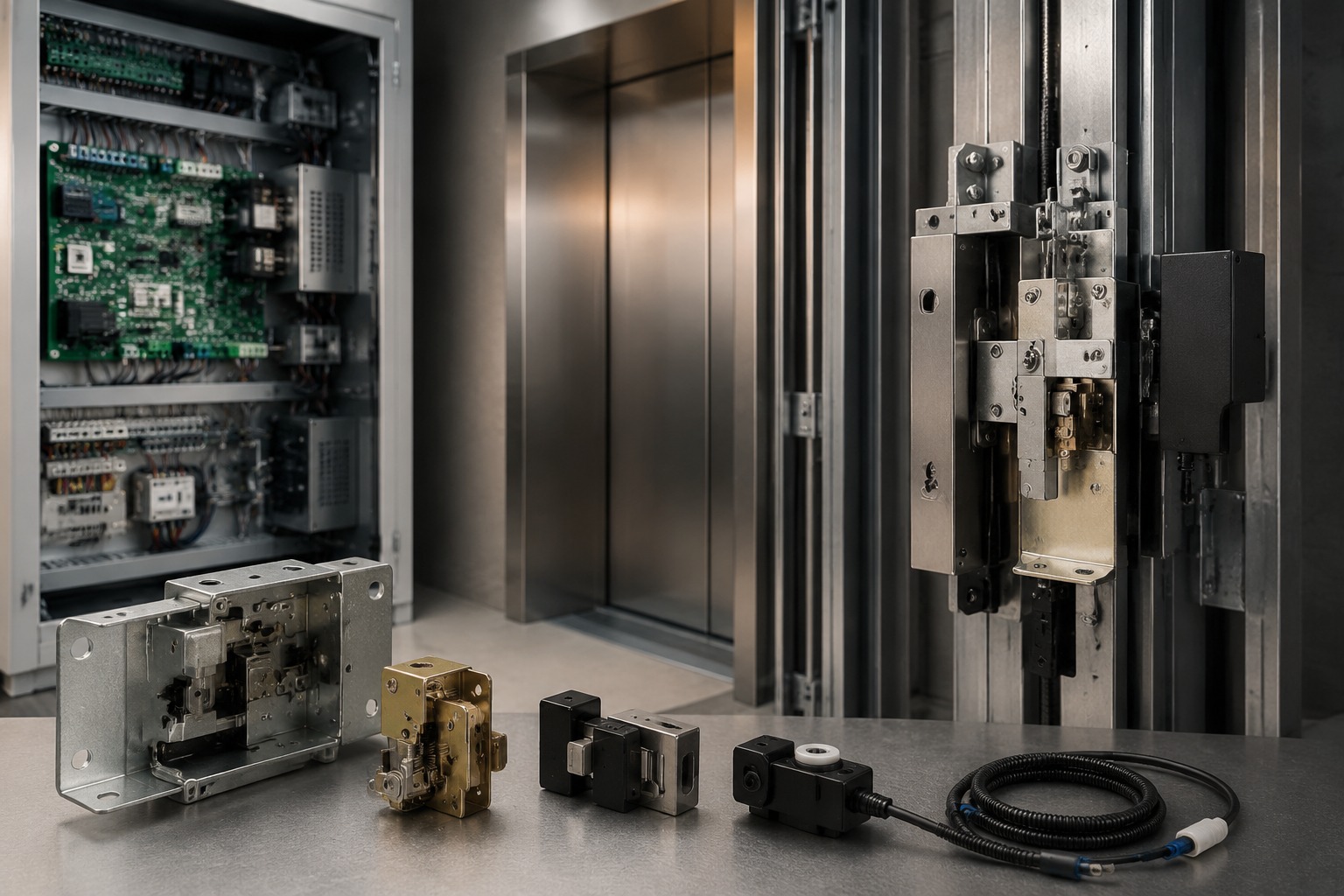
Elevator landing door safety depends heavily on the condition of the door lock assembly. In practical terms, the lock hook, contact switch, spring, keeper, roller interface, and mounting alignment must work together every time the car arrives, levels, opens, and closes. If even one part wears beyond tolerance, the landing door may not lock correctly, may give unstable electrical feedback, or may create intermittent shutdowns that increase passenger risk and maintenance calls. For building owners, maintenance contractors, and modernization teams in India, understanding elevator door lock parts is not only a technical issue but also a downtime, compliance, and lifecycle cost issue.
The most direct answer is simple: replace door lock parts before loss of engagement, weak spring return, or unreliable switch contact creates unsafe landing door conditions. Good practice means checking the mechanical hook for wear, confirming the electrical contact closes and opens consistently, inspecting the spring for fatigue, and sourcing certified matching parts for the exact lock type. This is especially important in busy urban environments such as Mumbai, Delhi NCR, Bengaluru, Chennai, Hyderabad, Pune, Ahmedabad, and Kolkata, where elevators often operate under high traffic cycles and maintenance teams need predictable spare parts supply.
In the Indian market, demand for dependable lift spare parts continues to rise across commercial towers, apartments, hospitals, logistics buildings, hotels, metro-connected properties, and industrial freight applications. Building operators increasingly want not just any replacement component, but compatible parts that reduce repeat failures. When a technician replaces a worn hall door lock hook for elevators, the job should restore stable mechanical engagement, not create a temporary fix that fails after a few months. The same applies when selecting a freight elevator door lock contact switch or fitting a hall door lock spring replacement for a busy landing door.
This guide explains how door lock hooks, contact switches, and springs affect elevator safety, how to identify replacement signs, how to test reliability after repair, and how to source certified parts for the India market. It also covers buying advice, product categories, applications by industry, local supply considerations, and 2026 trends in policy, digital maintenance, and sustainability.
Why Elevator Door Locks Are Critical
Elevator door locks are critical because they perform two linked safety functions at the landing entrance. First, they mechanically secure the hall door so it cannot be opened when the elevator car is not correctly positioned. Second, they provide electrical confirmation to the control system that the door is properly locked, allowing safe operation. If the mechanical lock is incomplete or the electrical circuit does not confirm closure, the elevator should not run. That relationship between mechanical security and electrical proof is what makes the door lock assembly one of the most important safety elements in the entrance system.
In India, this issue becomes more significant in high-rise residential societies, IT parks, hospitals, and shopping centres where doors cycle thousands of times per week. Dust, humidity, monsoon conditions, vibration, misuse, and irregular lubrication can accelerate wear. In older installations around central business districts such as Nariman Point in Mumbai, Connaught Place in Delhi, or older industrial corridors in Chennai and Kolkata, mixed-age equipment often means that door lock parts have been changed multiple times over the years, increasing the risk of mismatched components.
A typical landing door lock consists of a mechanical hook or latch, mating keeper geometry, actuation levers, return spring, switch cam, contact block, terminals, and mounting bracket. If the hook tip rounds off, the lock may only partially engage. If the spring weakens, the hook may not return with enough force. If the contact switch develops pitting or unstable travel, the controller may receive inconsistent lock status. This can lead to nuisance faults, random stoppages, or unsafe conditions if poor-quality parts have been used.
Maintenance managers often focus on motors, drives, and controllers because those components appear more complex. Yet many service interruptions begin at the landing door. Repeated “door lock open” faults, occasional re-levelling issues, or shutdowns during peak traffic often trace back to worn hooks, springs, or contacts. For that reason, a disciplined inspection and replacement strategy for door locks can reduce call-backs, improve passenger confidence, and help maintain compliance expectations.
| Component | Main Function | Common Failure Mode | Visible Symptom | Operational Risk | Recommended Action |
|---|---|---|---|---|---|
| Lock hook | Mechanical engagement of landing door | Tip wear or deformation | Shallow locking or scraping marks | Incomplete lock engagement | Measure wear and replace if beyond tolerance |
| Contact switch | Electrical proof of lock status | Contact pitting or unstable actuation | Intermittent “lock open” fault | Unexpected shutdowns or unsafe feedback | Test continuity and replace if unreliable |
| Return spring | Returns hook to locked position | Fatigue, stretch, or loss of force | Slow or incomplete return | Delayed locking after door close | Replace during preventive maintenance |
| Lever/cam | Transfers movement to switch | Misalignment or wear | Inconsistent switch timing | False lock indication | Realign and inspect mating surfaces |
| Mounting bracket | Maintains component position | Loose fasteners | Vibration, shifting, metal dust | Mechanical and electrical instability | Retighten and verify alignment |
| Wiring terminals | Carry lock circuit signal | Corrosion or loose connection | Random faults under movement | Intermittent control circuit interruption | Clean, tighten, and replace damaged terminals |
The table above shows that the lock is not a single part but a coordinated safety assembly. A successful repair therefore requires looking at the full mechanism, not only the failed piece.
India Market Demand for Door Lock Spare Parts
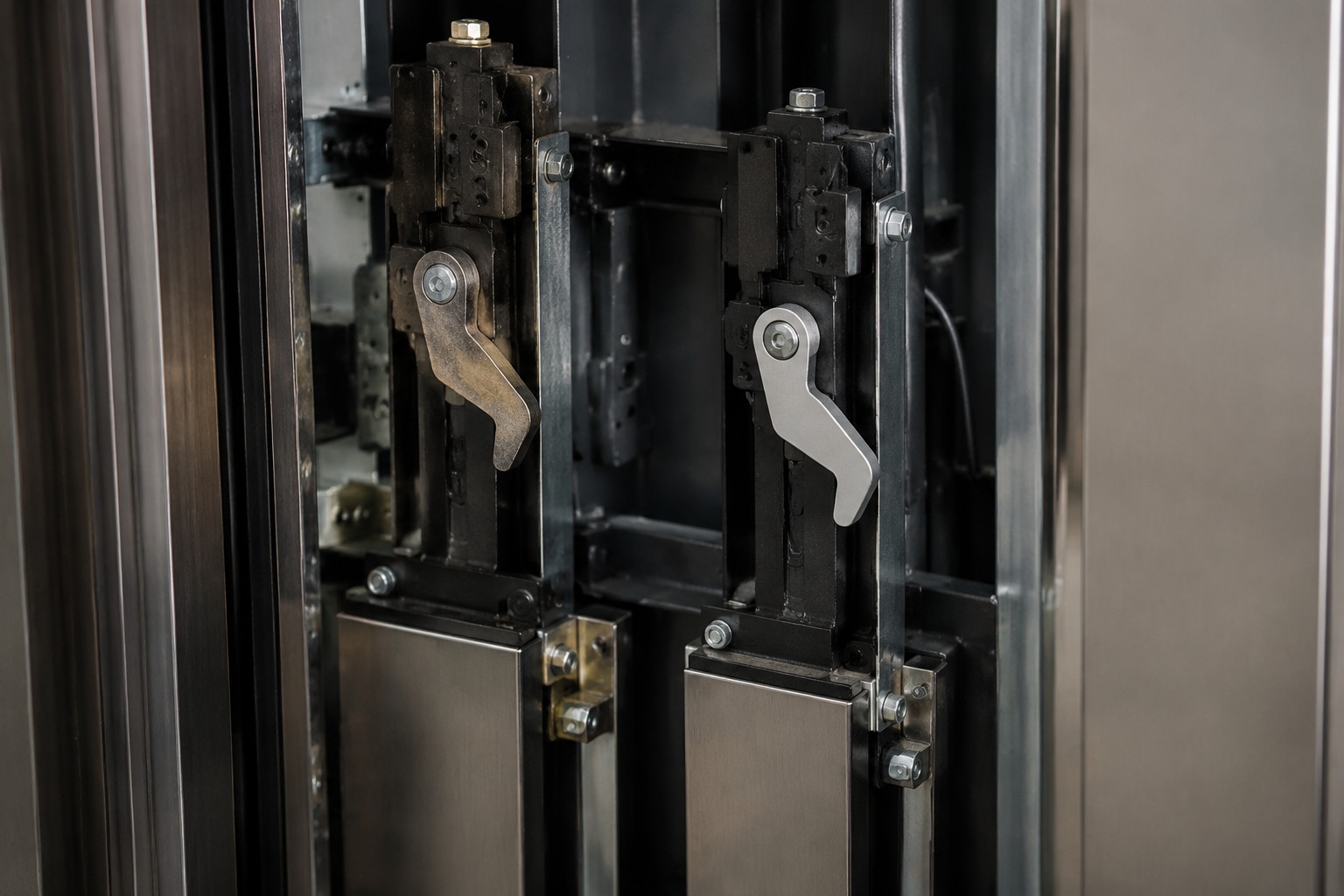
The elevator spare parts market in India is expanding due to urban redevelopment, housing growth, infrastructure investment, and the large installed base of elevators requiring maintenance and modernization. Door lock components are among the steady-demand items because they are wear-related and directly tied to safety shutdowns. Demand is especially strong in metro cities, state capitals, industrial clusters, and ports where goods lifts and passenger elevators work under heavy cycles.
Properties near logistics zones such as Nhava Sheva, Mundra, Chennai Port, and industrial belts in Gujarat, Maharashtra, Tamil Nadu, Telangana, and Karnataka often operate freight elevators with tougher duty conditions than standard passenger buildings. In these sites, contact switches and springs may fail sooner due to dust, vibration, loading impact, and less forgiving door use patterns. In residential high-rises, the pattern is different: frequent daily cycling causes gradual wear that can be missed unless inspections are documented.
The chart indicates a realistic upward trend in replacement demand, driven by modernization activity and preventive maintenance adoption. Buyers in India increasingly ask for model confirmation, photo verification, terminal layout checks, and dimensions before dispatch because door lock mismatches create repeat visits and longer downtime.
Product Types and Selection Basics
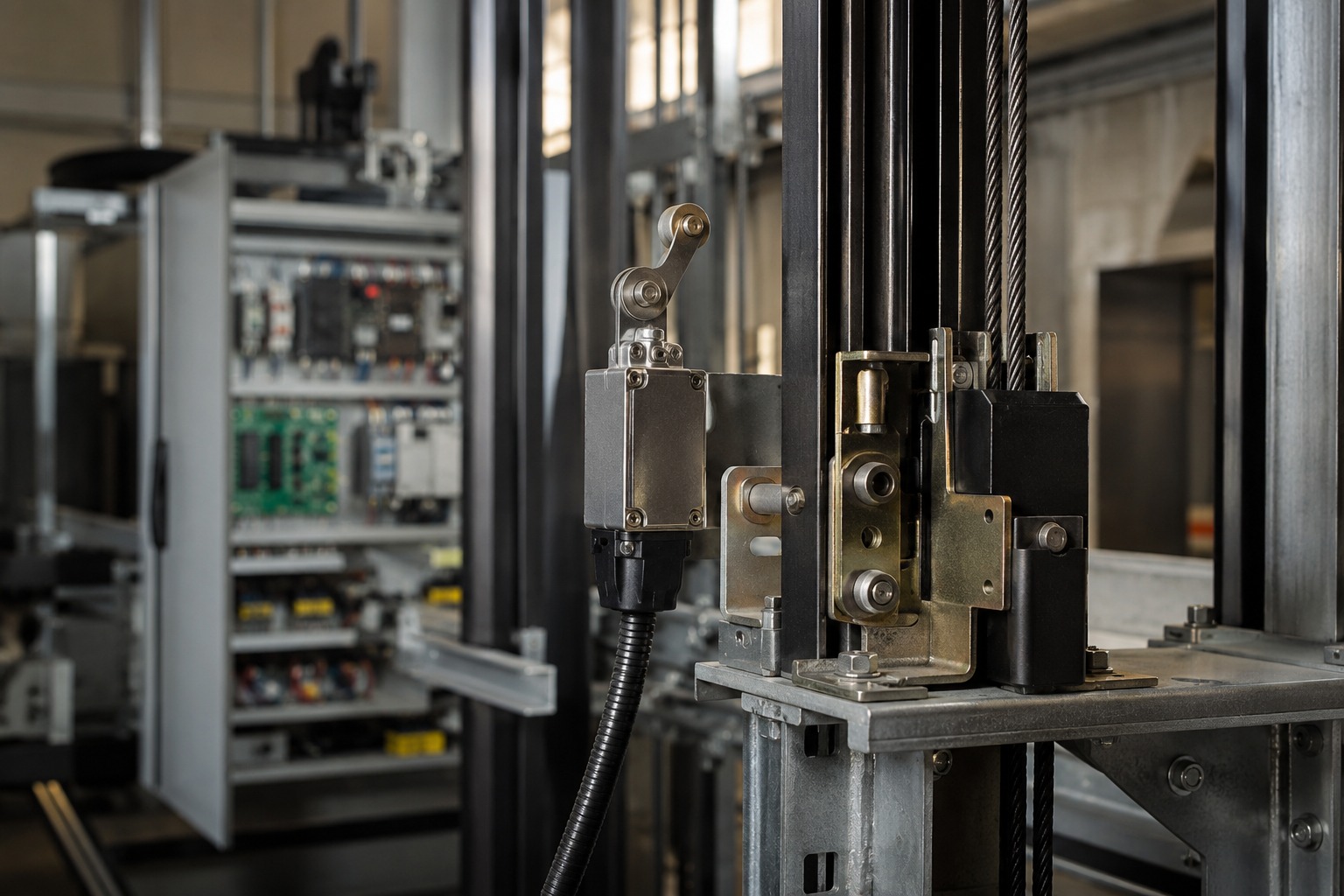
Door lock spare parts are not one-size-fits-all. The right part depends on elevator brand, lock design, door type, shaft entrance arrangement, mechanical dimensions, switch rating, actuator movement, and environmental conditions. A correct selection process starts with identifying whether the application is passenger, hospital, service, freight, or industrial goods lift usage. It then moves to exact matching of hook profile, switch mounting, spring length, wire interface, and operating direction.
In the India market, one common mistake is buying a visually similar part without confirming hole spacing, travel distance, or electrical contact type. Another is replacing only the switch while leaving a badly worn hook that continues to mis-time the mechanical sequence. Good selection requires looking at the entrance as a system.
| Part Type | Typical Application | Key Selection Criteria | Failure Clue | Repair Priority | Notes for India Buyers |
|---|---|---|---|---|---|
| Hall door lock hook | Passenger and service lifts | Profile, reach, hardness, mounting size | Rounded tip, shallow bite | High | Confirm lock body series before ordering |
| Door lock contact switch | Freight and high-cycle entrances | Voltage, current rating, terminal type, actuation travel | Intermittent continuity | High | Check wiring style used on site |
| Lock return spring | All landing doors | Wire diameter, free length, force, hook ends | Weak return or delayed lock | High | Replace in pairs if wear pattern is uneven |
| Lock lever/cam | Older mechanical locks | Geometry, pivot size, wear surface | Erratic switch timing | Medium | Often overlooked during overhaul |
| Keeper or mating plate | Landing door frame interface | Alignment, thickness, opening clearance | Scraping or partial engagement | Medium | Verify frame distortion in old buildings |
| Wiring harness/terminals | Modernization and repeated repairs | Insulation quality, terminal spacing, flexibility | Loose or overheated connection | Medium | Useful in humid coastal conditions |
The selection table helps buyers narrow the technical checks before ordering. When in doubt, sending photos, dimensions, brand references, and old part markings usually prevents costly errors.
Hall Door Lock Hook Replacement Signs
The hall door lock hook is one of the most visible wear points in the landing lock assembly. It repeatedly engages and disengages with each operation cycle, and over time the contact surfaces can round off, chip, bend, or polish to a point where secure engagement is reduced. Replacement should be based on actual wear signs rather than waiting for a complete failure.
Common replacement signs include visible rounding at the hook tip, uneven wear marks on one side, burrs from metal-to-metal impact, increased free play at the pivot, and shallow engagement depth with the keeper. Technicians may also notice that the door must be pushed slightly to complete the lock, or that lock-related faults occur more often on one landing than others. In high-use residential towers in Bengaluru or Gurgaon, this often starts as intermittent nuisance faults during peak commuting hours. In freight settings, impact from rough door handling can accelerate hook damage much faster.
If the hook wear changes the engagement geometry, the switch may still indicate lock in some conditions while the mechanical security margin is reduced. That is why visual inspection alone is not enough; the technician should also confirm engagement depth, alignment, and switch timing. Where repeated wear is found, inspect the keeper, door panel alignment, sill condition, and any frame twist before fitting the new part.
For replacement projects, buyers looking for a matching hall door lock hook should compare not only length and shape but also material finish, hardness consistency, and fit within the original lock body. Stable sourcing matters because a poorly machined hook can create premature wear on the keeper and restart the problem.
| Inspection Sign | What It Means | Likely Cause | Risk Level | Field Check | Action |
|---|---|---|---|---|---|
| Rounded hook tip | Reduced locking bite | Normal wear from high cycles | High | Compare with new part profile | Replace hook |
| Side wear on one face | Misalignment in engagement | Door skew or keeper offset | High | Check landing alignment | Replace hook and correct alignment |
| Metal burrs | Impact or dragging contact | Rough operation or wrong clearance | Medium | Inspect contact surfaces | Deburr and replace if geometry changed |
| Crack near pivot or body | Structural weakness | Fatigue or overloading | Critical | Dye penetrant or close visual check | Immediate replacement |
| Excessive free play | Unstable engagement position | Worn pivot or mounting | High | Manual movement check | Replace worn components |
| Door needs push to lock | Marginal lock return or timing issue | Hook wear or weak spring | High | Observe multiple cycles | Inspect hook and spring together |
The practical lesson is that a worn hook rarely fails alone. Replacing it together with related wear items often produces a longer-lasting repair.
Freight Elevator Lock Switch Selection
Freight elevators place tougher demands on the door lock switch than many passenger lifts. Doors are larger, closures may be heavier, vibrations are stronger, and loading impact can disturb lock geometry. Warehouses in Bhiwandi, industrial parks near Pune, auto clusters around Chennai, and pharmaceutical facilities in Hyderabad often require more robust switch performance because any intermittent lock circuit can stop goods movement and delay operations.
When selecting a freight elevator lock switch, the key factors are electrical rating, contact arrangement, actuator style, travel consistency, environmental durability, and mechanical fit within the existing lock body. The switch should have stable contact pressure and clear actuation repeatability. It is also important to confirm whether the original design uses normally open, normally closed, or changeover logic in the lock circuit and whether the terminal orientation suits the site wiring path.
For freight duty, buyers should pay special attention to dust protection, resistance to vibration, and the ability to maintain reliable contact after repeated impact cycles. In modernization projects, it may be tempting to use a general industrial micro-switch as a substitute. However, unless the dimensions, timing, contact reliability, and safety function are truly compatible, this approach can create hidden failures. A proper freight elevator door lock contact switch matched to the actual lock assembly is the safer choice.
| Selection Factor | Why It Matters | Typical Freight Requirement | What to Verify | Common Mistake | Best Practice |
|---|---|---|---|---|---|
| Electrical rating | Avoid overheating or premature failure | Matched to control circuit load | Voltage/current markings | Assuming any switch will work | Match original specification |
| Actuation travel | Ensures correct timing | Consistent switch point | Stroke and overtravel | Ignoring small travel differences | Measure old and new parts |
| Terminal layout | Prevents loose or stretched wiring | Easy secure connection | Orientation and spacing | Forcing wire rerouting | Confirm site wiring path |
| Mechanical fit | Maintains mounting stability | No bracket modification if possible | Hole distance and body size | Using field-drilled brackets | Choose direct-fit replacement |
| Dust and vibration resistance | Improves service life | Better sealing and repeatability | Construction quality | Using light-duty contact blocks | Specify freight-duty version |
| Contact reliability | Reduces intermittent faults | Stable continuity over many cycles | Bench and field testing | Testing only once after fitment | Cycle-test before handover |
For freight applications, switch selection should always be combined with inspection of the lock body, hook, spring, and alignment. A high-quality switch cannot compensate for a worn mechanical lock.
Door Lock Spring Wear and Inspection
The return spring is small but essential. Its job is to restore the lock mechanism to the intended position after actuation so the next landing door cycle begins correctly. When spring force drops, the hook may return slowly, inconsistently, or not fully. This produces delayed locking, unstable switch timing, and increased wear on the hook and mating components.
Spring wear is often missed because the component may still look intact. In reality, repeated cycling can cause fatigue, permanent set, loss of elasticity, corrosion, or slight deformation at the ends. In humid coastal environments such as Mumbai, Kochi, Visakhapatnam, or Chennai, corrosion can reduce reliability faster than in dry inland areas. In dusty industrial zones, contamination combined with old grease may restrict smooth spring action.
Inspection should include checking free length against specification, verifying equal return speed across repeated cycles, looking for surface corrosion, inspecting end hooks or anchor points for elongation, and confirming that the spring sits correctly without rubbing adjacent surfaces. If the spring is visibly stretched, discoloured from heat, or has lost symmetrical tension, replacement is advisable. Where one spring has failed after long service, many technicians prefer preventive replacement on similar entrances to avoid staggered failures.
When sourcing a replacement door lock spring for hall doors, buyers should confirm wire diameter, coil count, free length, end form, and force characteristics. Springs that appear similar can behave differently in the lock assembly, causing late return or excessive force that accelerates wear elsewhere.
| Inspection Item | Normal Condition | Wear Indicator | Likely Impact | Inspection Method | Recommended Response |
|---|---|---|---|---|---|
| Free length | Within original tolerance | Permanent stretch | Weak return force | Measure after removal | Replace spring |
| Surface finish | Clean and consistent | Rust or pitting | Early fatigue failure | Visual check with light | Replace and improve protection |
| End hooks | Closed and correctly formed | Opening or distortion | Unstable seating | Compare both ends | Immediate replacement |
| Return speed | Quick and repeatable | Slow or inconsistent reset | Delayed locking | Cycle observation | Inspect spring and friction points |
| Coil shape | Uniform spacing | Bent or uneven coils | Rubbing or side loading | Close visual inspection | Replace and verify fit |
| Noise during operation | Minimal mechanical sound | Clicking or scraping | Misalignment or contamination | Listen during several cycles | Clean, realign, or replace |
This inspection table is useful because spring problems are often subtle at first. Early replacement usually costs far less than repeated emergency call-outs caused by an intermittent lock issue.
Testing Contact Reliability After Repair
After replacing a hook, switch, spring, or complete lock assembly, testing should not stop at basic operation. A door may seem to work during one or two cycles and still fail later under vibration, temperature change, or slight alignment shift. Reliable post-repair testing is therefore essential.
Start with manual checks before restoring full service. Confirm that the hook enters and exits the keeper cleanly, the return spring resets the mechanism fully, and the switch actuates at the intended point. Then perform continuity checks across the contact terminals while operating the lock slowly and repeatedly. The reading should be stable with no flicker or uncertain transitions. If available, monitor controller input status during repeated cycles to confirm the electrical signal remains consistent.
A good field practice is to test the lock over multiple cycles with the landing door opened and closed at normal speed, then under slight vibration or gentle panel movement to ensure the signal does not drop out. Technicians should also verify cable routing and terminal tightness, because some intermittent faults are caused by wiring strain rather than the switch itself. For freight lifts, test under realistic operating conditions, including several loaded trips if site rules permit.
Record keeping matters. Maintenance teams should note the part number used, test results, cycle observations, and any alignment corrections made. This helps future technicians understand whether a later failure is a new defect or part of a recurring entrance issue.
Buying Advice for Certified and Compatible Door Lock Parts
Buying elevator door lock parts in India should be treated as a technical sourcing process, not a price-only transaction. The safest purchase is a certified, dimensionally matched, and application-confirmed replacement from a supplier that can support model matching and inspection documentation. Cheap substitutes may reduce the invoice amount on day one, but they often increase downtime, repeat labour, and risk exposure.
Before buying, gather the elevator brand, lock model markings, entrance photos, dimensions, switch rating, wire arrangement, old part images, and site usage type. If the original part number is unreadable, clear photos from several angles are extremely helpful. Ask the supplier whether the offered part is original equivalent, compatible replacement, or upgraded variant, and confirm any differences in mounting or actuation. In mixed-brand portfolios common across Indian buildings, disciplined identification saves both time and maintenance budget.
For contractors working across multiple cities such as Mumbai, Pune, Ahmedabad, Chennai, Bengaluru, and Hyderabad, consolidated sourcing can reduce lead time if the supplier maintains stable inspection, packaging, and dispatch processes. This is especially useful for modernization projects where several lock parts are replaced together.
How to Source Certified Door Lock Parts
Sourcing certified door lock parts starts with traceability. A good supplier should be able to confirm the product category, compatibility basis, and key technical details before shipment. This includes dimensions, photographs, label data, and where relevant, contact specifications or material characteristics. Buyers should also ask about quality checks performed before dispatch and whether the packaging protects small precision parts such as switches and springs during transport across India.
In practical sourcing terms, the best partners combine technical support, careful model matching, and responsive communication. That matters when maintenance companies need to restore service quickly in apartment complexes, hospitals, hotels, or commercial properties. It matters even more when distributors need repeat consistency across batches. In this area, our approach is built around three strengths. First, technological capability: we support detailed part identification across many elevator brands and accessories, helping customers compare model codes, photos, dimensions, and application details to reduce mismatch risk. Second, manufacturing capability: our sourcing network focuses on stable quality inspection, fit consistency, protective packaging, and dependable replacement components for door locks, control boards, sensors, buttons, light curtains, and related lift accessories. Third, service capability: we respond quickly to part inquiries, support compatibility checks, and help customers reduce downtime by organizing suitable replacement options for maintenance and modernization work.
For buyers in India, local logistics planning also matters. A project in Delhi NCR may need a different stocking approach than a remote industrial site in Odisha or a port-connected warehouse near Mundra. Ask about dispatch lead times, stock planning for critical safety spares, and whether the supplier can support repeat orders with consistent specifications.
| Checklist Item | Why It Matters | Questions to Ask | Warning Sign | Preferred Evidence | Buyer Benefit |
|---|---|---|---|---|---|
| Model matching | Prevents wrong-fit orders | Is it confirmed by dimensions and photos? | Only visual similarity claimed | Part photos and measurement sheet | Less downtime |
| Contact specification | Ensures electrical compatibility | What are the rating and terminal details? | No clear electrical data | Label image or datasheet | Safer operation |
| Material and finish | Affects wear resistance | How is hardness or finish controlled? | Uneven machining or rough surface | Inspection photos | Longer service life |
| Quality inspection | Reduces defective deliveries | What checks are done before dispatch? | No inspection process described | QC confirmation | Fewer repeat visits |
| Packaging protection | Avoids transport damage | How are small lock parts packed? | Loose mixed packaging | Protective packing method | Ready-to-install condition |
| After-sales response | Important for urgent repairs | Can the supplier support photo recheck? | Slow or generic replies | Responsive technical support | Faster closure of service calls |
The table above shows how sourcing quality affects operational results. A supplier that helps verify fitment can save more value than one offering the lowest upfront unit price.
Maintenance Schedule Recommendations
Maintenance scheduling for elevator door locks should be based on traffic, environment, and application type. There is no universal interval that suits all buildings. A premium residential tower in Mumbai, a hospital in Chennai, and a freight lift in an industrial facility near Pune will all age differently. The best schedule combines routine visual checks, periodic functional tests, and planned replacement of wear items before failure.
For standard passenger lifts, monthly visual inspection of lock condition and door alignment is advisable, with more thorough quarterly checks of hook wear, switch stability, and spring return. For high-traffic sites such as malls, offices, transit-linked developments, and hospitals, weekly observations of fault patterns and door behaviour can catch early issues. Freight and service lifts may need more frequent hands-on inspection because impact and rough use accelerate wear.
Planned maintenance should also reflect local conditions. Coastal humidity may justify shorter inspection intervals for switches and springs. Dust-heavy industrial locations may require extra cleaning and lubrication reviews. Where an entrance has already shown repeated wear, create a watch list and keep matched spares in stock.
| Site Type | Visual Check | Functional Test | Detailed Wear Inspection | Suggested Spare Stock | Reason |
|---|---|---|---|---|---|
| Residential high-rise | Monthly | Quarterly | Every 6 months | Hooks, springs, contact switches | High daily cycle count |
| Commercial office tower | Monthly | Quarterly | Every 4 to 6 months | Switches and hooks | Peak-hour passenger surges |
| Hospital | Monthly | Monthly critical checks | Quarterly | Complete lock kits | Need for high availability |
| Shopping mall | Biweekly | Monthly | Quarterly | Hooks, rollers, springs | Heavy public traffic |
| Freight/industrial lift | Biweekly | Monthly | Quarterly or sooner | Switches, springs, mounting hardware | Impact and vibration exposure |
| Coastal environment site | Monthly | Quarterly | Quarterly | Corrosion-sensitive parts | Humidity and salt exposure |
This schedule is a planning framework, not a substitute for the maintenance manual or local compliance needs. The key point is consistency: documented inspections find wear early and reduce emergency stoppages.
Industries and Applications Using Door Lock Spare Parts
Demand for landing door lock parts comes from a wide range of sectors in India. Residential housing societies need reliable lock operation for daily passenger movement. Commercial towers require low downtime and consistent entrance performance. Hospitals need dependable access with minimal interruption. Hotels prioritize safety and guest experience. Warehouses and factories depend on freight lock durability. Public buildings and educational campuses need maintenance simplicity across multiple elevators.
The bar chart shows why buyers should not treat all applications the same. Residential and commercial buildings drive volume, but industrial and freight sites require more rugged selection criteria.
| Industry | Typical Elevator Type | Main Lock Concern | Common Wear Pattern | Priority Spare | Maintenance Focus |
|---|---|---|---|---|---|
| Residential | Passenger lift | Stable daily operation | Gradual hook and spring wear | Hooks and springs | Cycle-based inspection |
| Commercial offices | Passenger/service lift | Peak-time reliability | Intermittent switch faults | Contact switches | Fast preventive replacement |
| Hospitals | Bed and passenger lift | High availability | Mixed mechanical/electrical wear | Complete lock sets | Strict testing after repair |
| Hotels | Passenger lift | Quiet smooth operation | Alignment-related wear | Hooks and levers | Early adjustment and replacement |
| Industrial plants | Freight/service lift | Vibration resistance | Switch and bracket fatigue | Freight lock switches | Rugged fitment checks |
| Retail and malls | Passenger/escalator support lifts | Heavy public traffic | Fast-cycle wear | Springs and hooks | Frequent inspections |
The application table helps facility teams align stocking strategy with actual risk. A hospital may stock full assemblies, while a residential portfolio may hold hooks, springs, and switches for common entrance types.
Case Examples from the India Market
Consider a residential tower cluster in Pune where repeated “door lock open” faults were appearing on one mid-level landing. The initial assumption was controller sensitivity, but inspection found a worn hall door lock hook combined with a weak return spring. After replacing both parts, rechecking alignment, and testing continuity over repeated cycles, the nuisance faults stopped.
In a warehouse near Bhiwandi, a freight elevator suffered random stoppages under load. The lock switch had been replaced earlier with a visually similar part, but the actuation point and terminal arrangement were not ideal. Under vibration, the contact signal dropped out. Once a properly matched freight lock switch was installed and the lock body fasteners secured, operation stabilized.
A hospital project in Chennai highlighted the value of sourcing discipline. Several entrances had mixed-age repairs over the years, making identification difficult. By comparing photos, dimensions, and wear patterns, the maintenance team grouped the locks into compatible sets and ordered certified matching replacements in advance. This reduced patient-area downtime during the refurbishment window.
Local Supply Considerations in India
India buyers often face a balance between urgency, compatibility, and consistency. Local markets may offer quick access to generic parts, but safety-critical lock components need more than immediate availability. A maintenance company serving Mumbai high-rises may need rapid dispatch, while a distributor supporting projects in Gujarat, Telangana, and Tamil Nadu may care more about consistent batch quality and repeat model accuracy.
When selecting a supply partner, ask whether they support brand coverage across major elevator systems, whether they can help identify legacy parts, and whether they have experience packing delicate contact switches and springs for long-distance transport. This matters for projects sending spares to remote sites, hilly regions, or coastal areas where transit handling can affect the final condition of the parts.
The area chart reflects a growing market preference for preventive replacement instead of waiting for breakdown. This trend is likely to continue as facility managers focus more on uptime, digital maintenance records, and occupant safety.
Our Company Support for Maintenance, Distribution, and Modernization
For customers in India, our role is to make elevator spare parts sourcing more dependable and more practical. On the technology side, we help with careful model matching for door locks, door operator components, control boards, sensors, encoders, buttons, COP panels, light curtains, intercom parts, power supplies, and other lift accessories across brands such as Hitachi, Toshiba, KONE, Mitsubishi, and more. This reduces the risk of ordering near-match components that create field rework.
On the manufacturing and quality side, we focus on stable sourcing, inspection consistency, and protective packaging so that small safety-related parts arrive in usable condition. This is important for lock hooks, switches, springs, and other components where dimensional stability directly affects fitment and service life. On the service side, we support maintenance companies, distributors, building owners, and modernization contractors with responsive communication, compatibility review, and practical replacement guidance that helps reduce elevator downtime.
The comparison chart highlights the supply factors most valued by professional buyers. In safety-related elevator parts, consistent fitment and traceable quality usually matter more than a small price difference.
2026 Trends: Technology, Policy, and Sustainability
Looking toward 2026, several trends will shape elevator door lock parts demand in India. First, predictive maintenance is becoming more practical as service companies use digital logs and input signal monitoring to track door lock faults before shutdowns become frequent. Second, modernization activity will continue to increase the need for compatible lock parts as older buildings upgrade controls and entrances while keeping some existing door hardware.
Third, policy and compliance expectations are likely to tighten around documentation, service records, and use of suitable safety-related replacement parts. Building owners will increasingly ask maintenance vendors to show what was replaced, why it was replaced, and whether post-repair tests were completed. Fourth, sustainability will matter more. Buyers are starting to prefer parts with longer service life, better packaging efficiency, and replacement strategies that avoid unnecessary repeated site visits. In practical terms, a correctly matched lock hook, switch, or spring that lasts longer is also a sustainability improvement because it reduces waste, transit, and emergency labour travel.
Another likely shift is better spare planning at the portfolio level. Instead of reacting site by site, larger residential and commercial operators may keep standardized safety spare kits for their common elevator types. This is especially relevant in cities with dense vertical growth and high service demand.
FAQ About Elevator Door Locks
1. How do I know if an elevator door lock problem is mechanical or electrical?
Check both. If the hook does not engage properly, it is mechanical. If the hook looks correct but the controller still shows a lock fault, test the switch and wiring for continuity. Many problems involve both wear areas together.
2. Can I replace only the switch and keep the old hook?
Only if the hook and related mechanical parts are within tolerance. If the hook is worn, the new switch may still receive unstable actuation and the fault may return.
3. How often should door lock springs be replaced?
There is no universal interval. Replace based on wear signs, service cycles, environment, and maintenance history. High-traffic and freight applications usually need closer monitoring.
4. Are freight elevator lock switches different from passenger lift switches?
They can be. Freight applications often need stronger resistance to vibration, dust, and heavy-duty cycling, along with exact actuation matching to the lock body.
5. Why is model matching so important for door lock parts?
Small differences in hook geometry, switch travel, spring force, or mounting hole spacing can affect locking performance and safety circuit timing. Near-match parts may create repeat faults.
6. Should I stock spare door lock parts on site?
Yes, especially for high-rise residential, hospitals, commercial towers, and freight sites. Keeping common hooks, springs, and switches shortens downtime.
7. What should be tested after repair?
Mechanical engagement, return force, switch continuity, controller input response, repeated cycle performance, and wiring terminal security should all be checked before handover.
8. What is the safest buying approach in India?
Buy from a supplier that supports photo and dimension verification, stable quality inspection, protective packaging, and responsive technical communication for the exact elevator application.
In summary, safer landing doors depend on understanding how door lock hooks, switches, and springs work together. For building owners, distributors, and maintenance teams across India, the most effective strategy is preventive inspection, accurate replacement, and sourcing from a technically reliable partner that can support compatibility and consistent quality.