
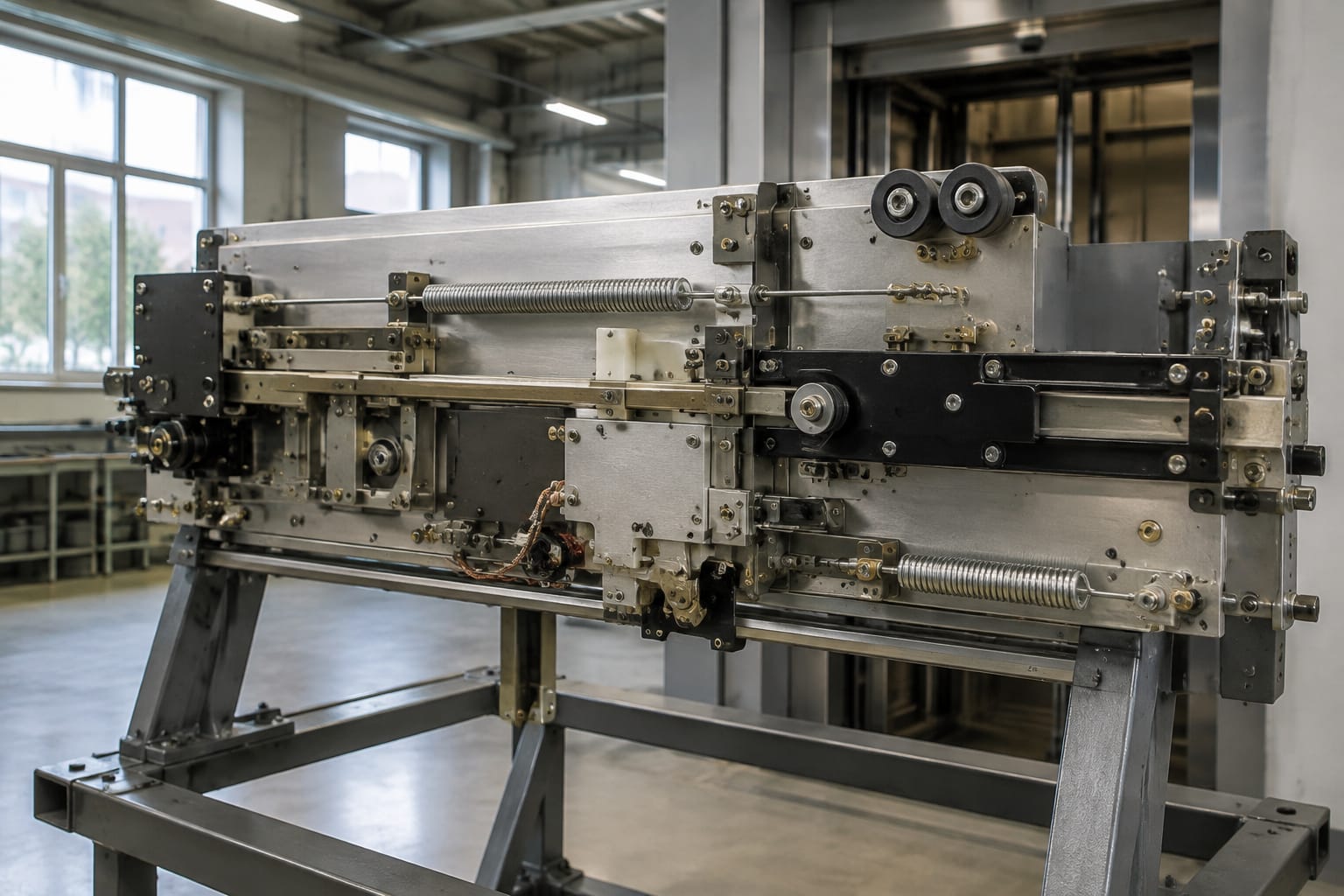
An elevator door stopper is not always a single, standard-named part. In practice, buyers and technicians use the term for any component that cushions, limits, arrests or controls the final movement of a landing or car door. It may be a spring, rubber buffer, roller stop, guide component, hanger-related part or a fixed bracket.
The correct replacement depends on where the door movement is uncontrolled: at full opening, during closing, at the lock side, or along the hanger track. Treat the stopper as part of the full door-motion system. A part that looks similar but has the wrong stroke, mounting position or material can leave the door noisy, poorly aligned or unable to close reliably.
What buyers mean by elevator door stopper
The phrase “elevator door stopper” commonly covers several different components. Before requesting a quotation or placing an order, identify the door type and the precise function of the original part.
A buyer may mean:
- A rubber or polyurethane bumper that absorbs impact at the end of door travel.
- A compression or tension spring that returns, cushions or restrains a moving linkage.
- A mechanical travel stop fixed to the header, sill, hanger assembly or door panel.
- A roller or cam-related stop that governs movement in a landing-door mechanism.
- A door-closing spring used in a centre-opening, telescopic or manual landing door arrangement.
- A car-door operator limit component, which is sometimes incorrectly described as a stopper.
- A knife, vane or coupling-related spring that affects how the car door engages the landing-door equipment.
“Stopper” alone is therefore not enough to establish compatibility. A useful enquiry should state whether the part belongs to the car door or landing door, the opening arrangement, manufacturer or operator type, and whether the part limits opening, cushions closing or returns a mechanism.
For landing-door spring requirements, compare the original design with available door spring lift accessories only after confirming its dimensions and fixing style. A spring that fits physically can still perform incorrectly if its rate or installed length differs.
Springs, buffers, and travel limits
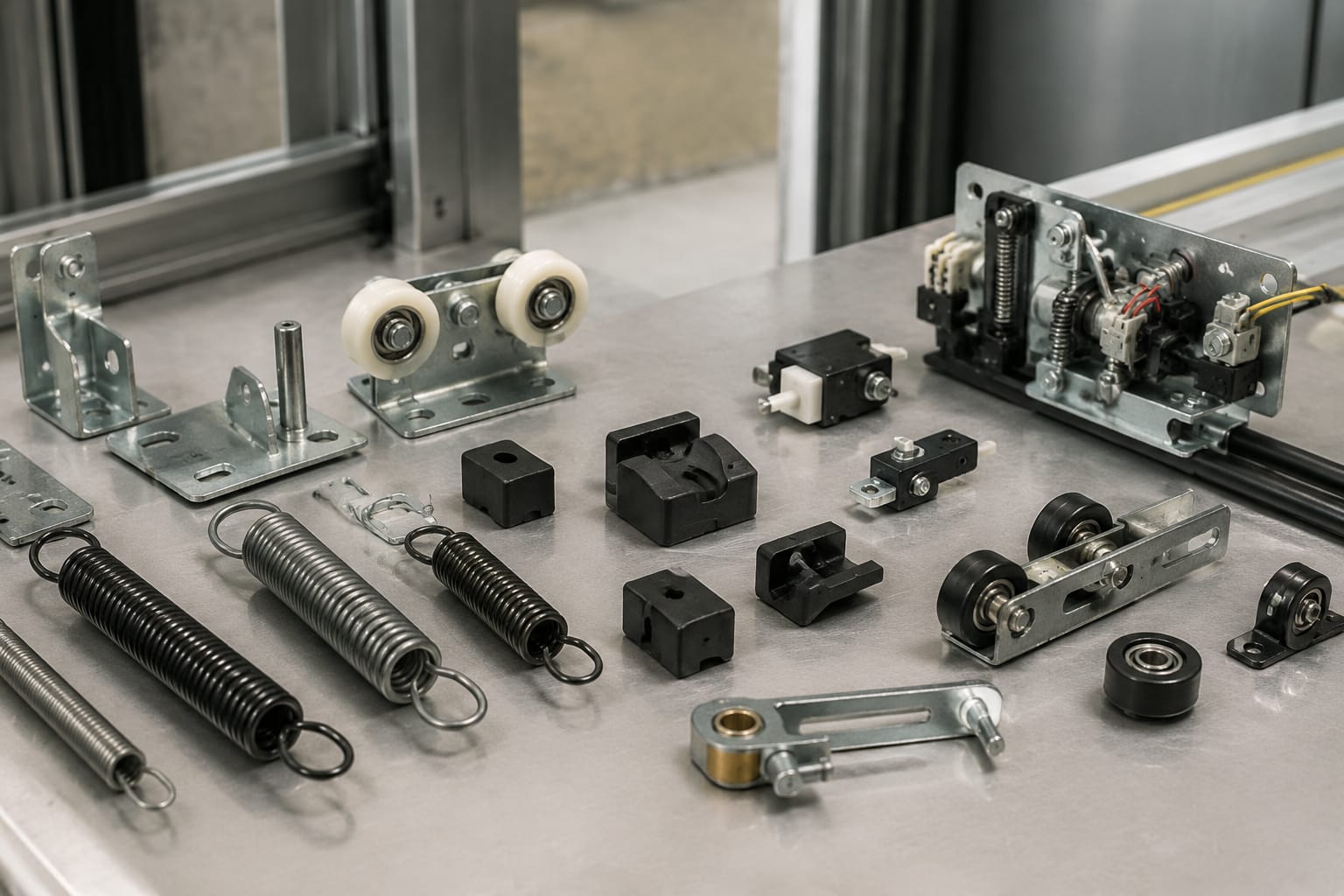
Different stopper components do different jobs. Distinguishing their function prevents a common error: replacing a visible worn buffer when the actual issue is incorrect door travel or a damaged hanger.
| Component type | Main function | Typical signs of wear or failure | Important checks before buying |
|---|---|---|---|
| Rubber or polymer buffer | Cushions impact at end of travel | Hard knock, cracked pad, flattened surface, missing piece | Diameter, thickness, stud or hole size, hardness where specified |
| Compression spring | Resists movement and provides cushioning or return force | Weak return, inconsistent closing, coil damage, permanent set | Free length, outer diameter, wire diameter, end style, working travel |
| Tension spring | Pulls a lever, lock linkage or closing mechanism back | Door does not return fully, stretched hooks, broken coils | Free length, hook type, coil diameter, extension in service |
| Fixed metal stop | Defines maximum permissible travel | Door over-travels, parts strike the header or frame | Bracket profile, slot positions, thickness, stop face location |
| Adjustable stop screw or bolt | Fine-tunes final position | Door stops too early or too late, loose adjustment | Thread size, locknut, tip shape, adjustment range |
| Door-closing spring assembly | Helps a landing door shut after coupling | Door remains ajar, returns slowly or bangs shut | Door make, spring geometry, mounting points and handing |
A bumper is generally intended to absorb the final impact, not compensate for excessive door speed. If a new buffer is repeatedly crushed, split or displaced, inspect the stop position, door speed, hanger movement and alignment. Replacing buffers alone will not correct an underlying mechanical fault.
Springs require equally careful selection. Their force changes as they compress or extend. Two springs with the same length may behave very differently because of wire diameter, coil count, material and working range. Do not select a spring based on appearance alone.
For applications using a header-mounted spring arrangement, a 600 mm hall-door spring accessory may be relevant only when the original length, end fittings and door-system application match. The stated nominal length is one identification point, not complete proof of interchangeability.
Travel limit versus cushioning
A travel limit establishes the final allowable position of the door or mechanism. Cushioning reduces impact as that position is reached. Some assemblies combine both functions, but they should be assessed separately.
For example, a door may hit a rubber stop with excessive force because:
- the travel stop is set too far;
- a roller is binding and suddenly releases;
- the operator’s opening or closing behaviour requires separate diagnosis;
- the door panel is misaligned;
- the buffer material has hardened or detached;
- a spring is missing, fatigued or installed incorrectly.
The remedy should match the fault. Moving a stop to silence an impact may create insufficient opening clearance or prevent correct engagement elsewhere in the mechanism.
Related rollers and hanging components
Door stoppers work alongside components that carry and guide the door. The door may seem to have a stopper problem when the real cause is in the rollers, hanger track, guides or panel fixings.
Important related parts include:
- Hanger rollers: Support the panel and allow it to travel along the header track.
- Eccentric adjustment rollers: Allow the technician to set panel height, track engagement or clearance.
- Door shoes and sill guides: Keep the lower edge of the panel guided and reduce lateral movement.
- Hanger plates and brackets: Connect rollers and operating linkages to the door panel.
- Retiring cams, vanes or door knives: Enable the car door to couple with landing-door equipment in applicable designs.
- Lock and interlock linkages: Must reach their intended positions without being obstructed by an incorrectly set stop.
A flat-spotted roller can create a periodic knock that is mistaken for a failing stopper. A worn door shoe can allow the panel to sway, making it strike a buffer off-centre. A loose hanger fixing can alter the apparent end position every few cycles.
Some door systems use a knife or vane spring as part of the coupling arrangement. Where this is the identified component, confirm the original drawing, material, slot and hole positions before considering an elevator door knife spring for Mitsubishi applications. The manufacturer reference should be checked against the actual installation; similar door parts are not automatically interchangeable across models.
Symptoms of poor stopping or closing
Door faults often provide useful clues, but a symptom is not a diagnosis. Observe the movement from a safe position and identify when in the travel cycle the issue occurs.
| Symptom | Likely mechanical areas to inspect | What not to assume |
|---|---|---|
| Sharp bang at full opening | Buffer, fixed stop, travel setting, rollers, operator movement | That only the rubber stop is defective |
| Door rebounds after reaching its end position | Buffer resilience, spring tension, stop placement, loose fittings | That more lubrication will solve it |
| Door stops short of full opening | Stop adjustment, obstruction, bent track, roller condition | That increasing travel without inspection is safe |
| Landing door closes slowly | Closing spring, pivots, linkage friction, shoe and roller condition | That a stronger spring is always appropriate |
| Door closes with a heavy impact | Return spring, damping arrangement, alignment, stop surface | That removing the stopper will reduce noise |
| Panel rubs frame or sill near the end of travel | Hanger adjustment, guide shoes, panel position, track condition | That a stopper adjustment is the root fix |
| Uneven gap between panels or jamb | Hangers, door panel fixings, coupling linkage, sill guides | That the door operator is necessarily faulty |
| Intermittent failure to close or lock | Mechanical alignment, lock linkage, rollers, control inputs | That it is exclusively an electrical problem |
Recurring impact noise deserves prompt examination because it can progressively loosen brackets, deform stop faces and damage rollers or door panels. However, technicians should avoid adjusting any door component merely to remove a sound. The final positions, locking condition and clearance requirements must still be met.
Inspect alignment and mechanical wear
Isolate the equipment and follow the site’s authorised lift maintenance and safety procedures before working on a door assembly. Door adjustments affect a protective system, so work should be carried out by competent personnel with access to the relevant manufacturer instructions.
A practical mechanical inspection can follow this order.
1. Identify the affected door and travel direction
Confirm whether the issue occurs at:
- car-door opening or closing;
- a particular landing door;
- all landings;
- centre-opening, side-opening or telescopic movement;
- the lock side or the non-lock side.
A fault at one landing is more likely to involve that landing door, sill, hanger, lock linkage or local stop. A repeated fault at every floor may point towards the car-door operator, coupling system or a common adjustment.
2. Check the stop and buffer condition
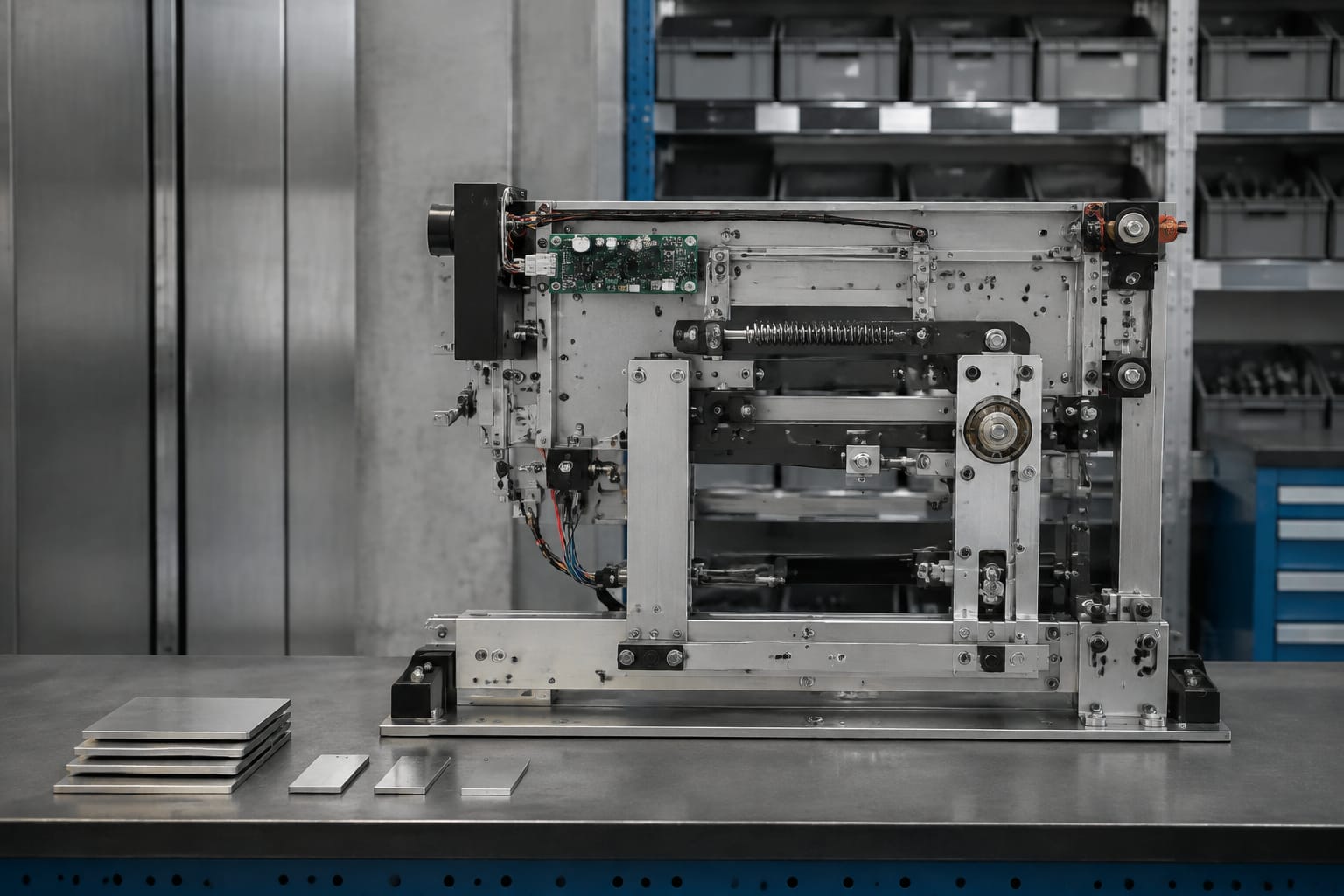
Look for cracking, flattening, hardened rubber, missing fasteners, bent brackets, elongated mounting holes and evidence of repeated off-centre impact. Inspect both the contact face and the component it contacts.
A buffer should meet the intended stop face squarely. An angled contact concentrates force on one edge and can produce premature failure.
3. Examine rollers, track and lower guidance
Turn or move rollers as permitted by the maintenance procedure. Check for rough rotation, flat spots, excessive play, damaged bearings, loose eccentric settings and signs that a roller is riding incorrectly on the track.
Inspect the sill channel for debris, worn guides and rubbing marks. Do not disguise a roller or guide fault by repositioning the final stop.
4. Review springs and linkage pivots
Check for broken coils, distorted hooks, corrosion, uneven seating, rubbing against adjacent parts and loss of preload. In a compression spring, look for coil bind at the maximum working position. In a tension spring, inspect both hooks and their attachment points.
Pivots should move freely within the original design. Excessive lubricant can attract dust and make some door mechanisms less reliable, while inappropriate lubricant may damage polymer components. Use only the lubricant and method appropriate to the door manufacturer’s instructions.
5. Check fixings and panel geometry
A loose door panel, hanger plate or stop bracket can shift under load. Verify fasteners, mounting slots and bracket faces. Then check that the panel remains level and that clearances remain consistent through the complete travel.
Marking the current adjustment position before any approved change helps retain a reference point and makes unintended movement easier to detect.
Measure the original component
Accurate measurement is essential because elevator spare parts are often application-specific. Photographing a component alongside a scale is helpful, but it should support, not replace, measured information.
Record the following before sourcing an elevator door stopper or related component:
- Lift and door manufacturer, operator type and available part number.
- Whether the part belongs to the landing door or car door.
- Door arrangement: centre-opening, single-slide, two-panel telescopic or another configuration.
- Location of the part, with clear photographs of the full assembly and mounting position.
- Material: rubber, polyurethane, steel, nylon, composite or another material.
- Overall length, width, thickness and diameter as applicable.
- Hole diameter, hole centres, stud diameter, thread pitch and bracket profile.
- Spring free length, outside diameter, wire diameter, coil count and end form.
- For a roller, wheel diameter, width, bore, bearing type and axle arrangement.
- Any stamping, casting mark, revision code or original equipment reference.
Measurements should be taken from an unbroken sample where possible. A failed spring can be permanently stretched, while a compressed bumper may have lost its original thickness. If there is uncertainty, retain the old part for side-by-side comparison rather than ordering from dimensions alone.
Compatibility checks that matter
A replacement component is suitable only when its function and installation geometry match. Confirm:
- The mounting holes or studs align without forcing the part.
- The component has adequate travel, clearance and load capability for its intended role.
- The contact face meets the mating surface in the intended position.
- The part does not obstruct locks, coupling equipment, rollers, guides or electrical devices.
- The material is suitable for the operating environment and contact duty.
- The part is correct for the specific door manufacturer and model where a model-specific design is used.
For B2B sourcing, send the measurements, photos and original reference together. Kelevator supplies multi-brand elevator spare parts for importers, distributors, maintenance contractors, modernisation companies and OEM buyers; complete identification information gives a supplier the basis to assess the closest matching item rather than relying on a generic part name.
Adjustment versus replacement
Adjustment is appropriate only when the components are sound and the original adjustment range is intended to correct the observed position. Replacement is generally required when the part is damaged, deformed, hardened, fatigued, loose beyond repair or no longer maintains its designed function.
| Condition found | Usual approach | Reason |
|---|---|---|
| Stop bracket is secure but final position is slightly incorrect | Inspect cause, then make a controlled adjustment within manufacturer guidance | The original component may remain serviceable |
| Rubber buffer is cracked, detached or permanently flattened | Replace the buffer and inspect its mating stop | The material can no longer cushion consistently |
| Spring is broken, stretched, corroded or distorted | Replace with a verified equivalent | Force and geometry are no longer dependable |
| Roller has bearing play, flat spots or rough running | Replace roller and check track alignment | Adjustment cannot restore a worn bearing or wheel |
| Mounting holes are elongated or bracket is bent | Repair or replace the mounting component as appropriate | The stop position may shift under impact |
| Door travel has changed without an obvious stopper defect | Investigate hangers, guides, linkage and operator system first | Re-setting the stop can hide the actual fault |
Avoid these common mistakes:
- Fitting a harder bumper to mask excessive impact.
- Cutting, heating or reshaping a spring to make it fit.
- Replacing one component without examining the part it contacts.
- Increasing travel until a door hits the frame, sill or lock mechanism.
- Adjusting one landing door to match another without checking its individual alignment.
- Treating a lock-related closing issue as a simple cosmetic noise problem.
- Using a generic roller, buffer or spring without checking bore, bracket and load geometry.
Where the original component is obsolete, the replacement decision should be based on functional equivalence, not only similar dimensions. Review the complete assembly and consider whether brackets, fasteners or mating parts also need renewal.
Final door-motion and safety tests
After an approved adjustment or component replacement, the door must be tested through its full intended travel. The objective is not merely quiet operation; it is repeatable movement, correct engagement and proper safety performance.
A competent technician should verify, in accordance with the applicable equipment instructions and maintenance process:
- smooth movement from fully closed to fully open and back;
- correct final stopping position at both ends of travel;
- no rebound, rubbing, binding or metal-to-metal impact;
- consistent panel alignment and sill guidance;
- secure fixings after cycling the door;
- correct operation of the door coupling and landing-door mechanism where applicable;
- proper closing and locking at affected landings;
- no interference with door contacts, locks, electrical devices or guards;
- repeatable behaviour over several operating cycles.
Do not return a lift to normal service solely because a knocking sound has reduced. A stopper adjustment that changes door clearances, locking geometry or coupling engagement needs a full functional check under the authorised maintenance procedure.
FAQ
Is an elevator door stopper the same as a door buffer?
Not always. A door buffer absorbs impact, while a stopper may be a fixed travel limit, an adjustable screw, a spring, a roller-related component or a complete bracket assembly. Ask what function the part performs before choosing a replacement.
Can a weak door spring cause a door to bang?
Yes. A weak, damaged or incorrectly fitted spring can alter return movement and allow a mechanism to strike its stop unexpectedly. But roller wear, misalignment, incorrect travel settings and loose brackets can produce similar noise.
Can a stopper be adjusted instead of replaced?
Only when it is undamaged and the door manufacturer’s design provides an adjustment range for that purpose. Cracked buffers, fatigued springs, worn rollers and bent brackets should not be treated as adjustment-only faults.
What should be included in an enquiry for a replacement part?
Include the original part number if available, lift and door make, the part’s location, clear photos, dimensions, material, mounting details and the observed fault. For springs and rollers, include all relevant dimensional and end or bearing details.
For a practical next step, inspect the original component and the associated rollers, guides and brackets together, then source a replacement only after confirming its function, dimensions and mounting arrangement.
Related product references
For practical catalog examples related to this topic, review [600mm hall door spring lift accessories elevator spare parts](/products/600mm-hall-door-spring-lift-accessories-elevator-spare-parts/), [Door spring lift accessories elevator spare parts](/products/door-spring-lift-accessories-elevator-spare-parts/), and [Elevator door knife spring 119x17mm Mitsubishi elevator parts lift accessories](/products/elevator-door-knife-spring-119x17mm-mitsubishi-elevator-parts-lift-accessories/). Confirm the exact model, dimensions, ratings, and connectors before ordering.