
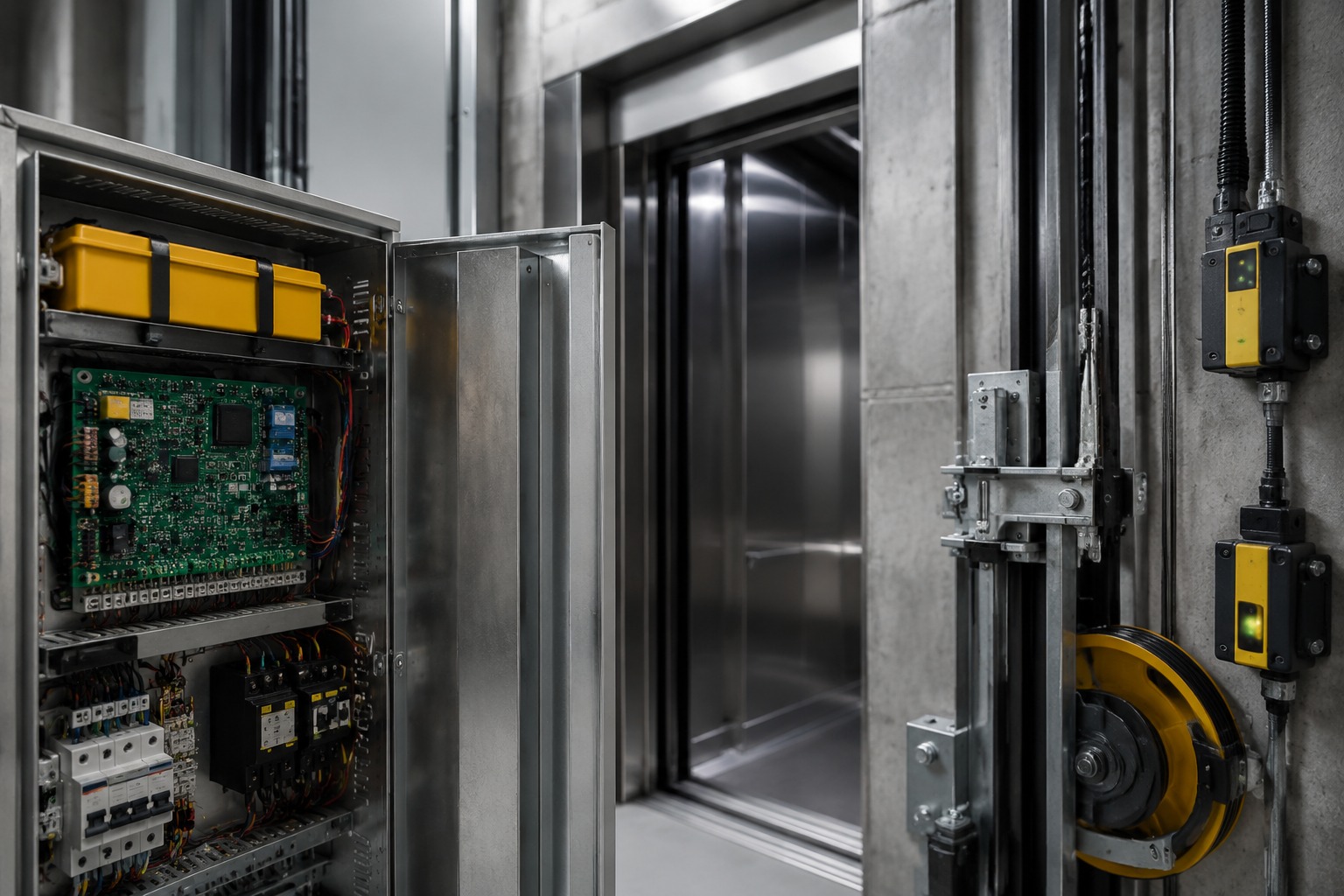
In India, elevator emergency power systems are installed for one simple reason: when the mains supply fails, passengers still need a safe path out of the lift car and technicians still need controlled system behaviour. A well-matched emergency power supply helps maintain car lighting, alarm or intercom functions, selected controller circuits, and in some cases rescue movement to the nearest floor. In residential towers in Mumbai, commercial buildings in Bengaluru, hospitals in Delhi NCR, hotels in Chennai, and industrial facilities around Pune and Ahmedabad, the right backup arrangement reduces panic, supports evacuation, and helps maintenance teams respond faster.
For building owners and maintenance companies, the topic is not only about buying a battery unit. It is about choosing a power supply that matches the elevator brand, controller logic, voltage requirements, load profile, and rescue method. A lighting-only unit is different from a rescue-capable power pack. A system used on an older modernization project in Kolkata may need different compatibility checks from a newer high-rise installation in Hyderabad. For Hitachi lifts and other major brands, model matching, battery condition, output stability, and post-installation testing all matter.
If your priority is sourcing reliable replacement parts with less downtime, it is important to work with a supplier that understands elevator applications rather than treating the power supply as a generic electrical item. For example, a Hitachi elevator emergency power supply should be matched carefully to the existing system architecture, while an elevator emergency lighting power unit may be selected based on lighting load, standby duration, and car top or controller panel conditions. In some cases, related items such as a UAX 48V brake power supply for Hitachi lifts also need evaluation during troubleshooting or modernization planning.
This guide explains what emergency power supplies do, how to choose them, what to check on Hitachi applications, how to inspect battery condition and voltage, how to confirm rescue operation compatibility, how to test after installation, and how to keep useful maintenance records for replacement planning in the India market. It also looks ahead to 2026 trends in safety, monitoring, policy alignment, and sustainability.
What emergency power supplies do
An elevator emergency power supply is designed to provide temporary electrical support when the normal incoming power fails or becomes unstable. Its exact role depends on the system design. In the simplest arrangement, it keeps the car light, emergency fan, alarm bell, and intercom active long enough for passenger reassurance and communication. In more advanced applications, it supports automatic rescue operation, allowing the lift to move at controlled speed to the nearest landing, open the doors, and discharge passengers.
In India, this function is especially important in areas where grid interruption, voltage fluctuation, monsoon-related failures, or diesel generator transfer delays can affect vertical transportation. Buildings in fast-growing urban corridors such as Gurugram, Noida, Navi Mumbai, and Whitefield often depend on uninterrupted elevator performance for both convenience and safety. In hospitals, elderly housing, mixed-use towers, metro-linked commercial developments, and export facilities near ports such as Nhava Sheva, Chennai Port, and Mundra, even a short outage can create passenger distress or operational disruption.
Emergency power systems also support controlled equipment behaviour. Without proper backup, abrupt power loss can leave passengers in darkness, disable communication, or interrupt logic circuits in a way that complicates recovery. Good emergency systems improve passenger confidence, reduce unsafe manual intervention, and support faster diagnosis by maintenance staff.
| Function | How It Helps | Typical Load | Why It Matters in India | Common Check Point | Selection Note |
|---|---|---|---|---|---|
| Car lighting backup | Keeps the cabin illuminated during outages | LED car light circuits | Prevents panic in residential and commercial towers | Runtime test in blackout condition | Size the unit for actual lighting wattage |
| Emergency fan support | Maintains airflow for trapped passengers | Small DC or AC fan load | Important in hot climates such as Chennai and Ahmedabad | Current draw and startup load | Check fan compatibility and duration |
| Alarm and buzzer power | Allows passengers to alert building staff | Low-power safety circuit | Useful where security response depends on audible alerts | Output continuity during transfer | Ensure steady low-voltage output |
| Intercom or phone support | Maintains communication with rescue teams | Communication module load | Critical in premium housing and hospitals | Call quality during battery mode | Confirm voltage and connector type |
| Automatic rescue movement | Moves the car to a landing and opens doors | Controller, drive logic, brake circuit support | Reduces entrapment risk in high-rise buildings | Rescue sequence test | Must match controller logic and motor system |
| Logic circuit stability | Preserves orderly control behaviour during failure | Selected PCB and control circuits | Helps avoid fault confusion after outages | Voltage drop under load | Use brand- and model-matched units where required |
The table above shows that emergency backup is not a single-purpose device. Depending on the building type, some owners only need emergency lighting support, while others require rescue-capable systems integrated with controller logic, brake release arrangements, or generator-backed power transitions. This is why emergency power supply selection must begin with the actual safety objective, not just the product label.
Emergency lighting power supply selection
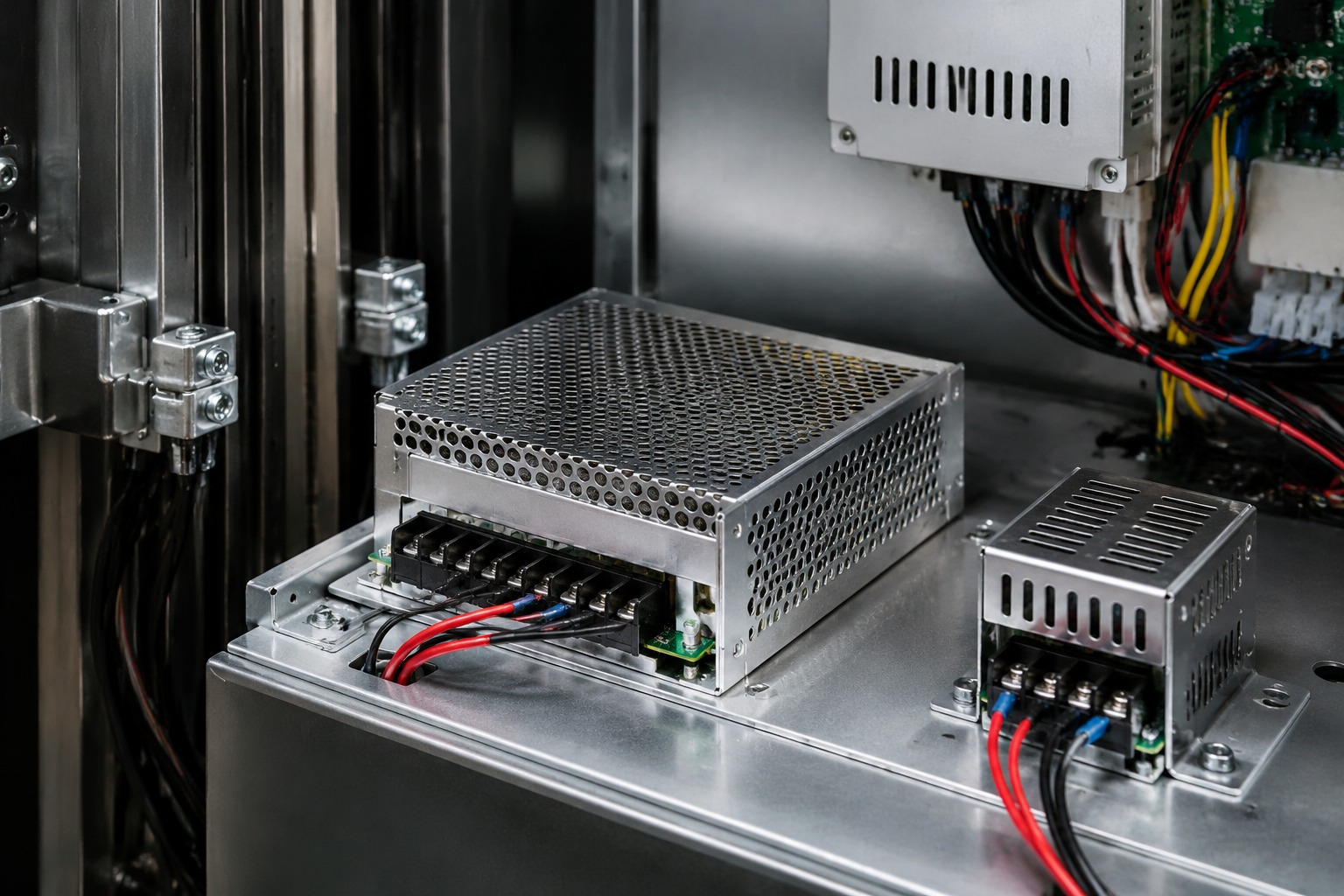
When selecting an emergency lighting power supply for an elevator, the first step is to define the protected load. Many buyers assume any backup battery unit can run car lights, but the reality depends on lamp type, total wattage, voltage, charging profile, and required backup time. Modern cars with LED lighting often need less power than older fluorescent systems, yet they still require stable output and reliable charging. If the lighting backup also supports a fan, alarm, or intercom, the specification changes again.
For the India market, installers should also consider operating temperature, dusty machine room conditions, voltage fluctuation history, and the ease of periodic maintenance. A building in coastal Chennai may face humidity concerns, while a plant in Rajasthan may place more stress on battery life because of heat. Product selection should be practical, not theoretical.
| Selection Factor | What to Measure | Recommended Approach | Risk if Ignored | Best Fit Example | Buyer Tip |
|---|---|---|---|---|---|
| Total lighting load | Actual wattage of all emergency-supported lights | Add full running load plus margin | Insufficient runtime or shutdown | LED-lit passenger elevator | Measure real load, do not rely only on old drawings |
| Output voltage | DC or AC output requirement | Match exact equipment voltage | Lamp damage or no operation | Brand-specific car lighting circuit | Check label, controller manual, and wiring points |
| Backup duration | Minutes of required operation | Select based on code, building policy, and rescue time | Passengers left in darkness before rescue | Residential tower with long response time | Account for aging battery performance |
| Battery type | Sealed lead-acid or other supported chemistry | Use proven maintenance-friendly option | Short life or charging mismatch | Standard machine room application | Follow charger compatibility strictly |
| Installation space | Controller panel or dedicated mounting area | Confirm dimensions and ventilation | Heat buildup or unsafe mounting | Modernization in tight panel space | Check cabinet drawings before ordering |
| Serviceability | Ease of battery replacement and test access | Choose accessible design | Delayed maintenance and hidden failures | Large apartment complex | Ask for terminal layout and maintenance guidance |
The key point from this table is that emergency lighting power supply selection should be load-based and environment-based. In many retrofit jobs in India, especially in older buildings in Kolkata, Kochi, or central Mumbai, existing wiring may have changed over time. A maintenance contractor should verify the real connected load rather than assuming the original drawing is still accurate. This is one reason professional model matching and careful sourcing save time and prevent repeat call-backs.
Another practical buying tip is to evaluate whether the project needs a dedicated lighting backup unit or a broader emergency power arrangement that can interact with controller functions. The answer depends on building risk profile, passenger traffic, and existing rescue procedures.
Hitachi emergency power supply notes
Hitachi elevator systems often require more careful compatibility review because power supplies may interact with controller boards, rescue circuits, brake-related functions, and monitoring logic in brand-specific ways. In the field, technicians should not assume that a physically similar power unit will perform correctly just because the voltage rating looks close. Connector formats, output stability under pulse load, charging characteristics, and communication with the wider control system can all affect operation.
For replacement work in India, especially in modernization projects or older buildings where records are incomplete, it is wise to confirm the original model number, board references, output values, and installation environment. Where brake control or rescue sequence performance is relevant, associated components should also be checked instead of replacing only one suspected part. That is why sourcing a matched Hitachi-compatible emergency power supply or, when needed, a DC48V UAX brake power supply for Hitachi elevators can reduce troubleshooting time.
| Hitachi Check Item | Why It Matters | What to Verify | Field Symptom if Mismatched | Recommended Action | Procurement Note |
|---|---|---|---|---|---|
| Exact model reference | Different series may use different logic | Nameplate, part code, controller details | Unit powers on but system behaves abnormally | Match part number before ordering | Send clear photos and labels to supplier |
| Output voltage accuracy | Control and battery circuits are voltage-sensitive | No-load and load voltage values | Under-voltage faults or unstable backup | Measure with calibrated meter | Request tested output data |
| Connector and terminal layout | Wiring errors can damage boards | Pinout, polarity, terminal numbering | No start, blown fuse, or alarm condition | Confirm wiring map | Avoid forced adaptation without review |
| Battery charging profile | Wrong charging can shorten battery life | Charge voltage and float behaviour | Swollen battery or weak standby time | Check charger specifications | Ask for compatible battery recommendation |
| Rescue logic interface | Automatic rescue depends on clean control signals | Trigger and response sequence | Lighting works but rescue does not start | Run supervised simulation test | Order as a matched application set if possible |
| Brake-related power support | Some rescue scenarios involve brake control stability | DC output under transient load | Brake release issues or incomplete rescue run | Inspect related power units too | Review linked brake supply components |
The explanation here is straightforward: Hitachi applications should be treated as system replacements, not only component replacements. In cities with dense service demand such as Hyderabad, Pune, and Delhi NCR, speed matters, but speed without proper model matching often increases repeat visits. A supplier that understands elevator parts and checks model references carefully can help maintenance companies reduce downtime and avoid unnecessary inventory risk.
Battery condition and voltage checks
The battery is often the first weak point in an emergency power system, particularly where periodic inspection is inconsistent. A backup unit can look normal during routine operation yet fail during a real outage because the battery has lost capacity, terminal resistance has increased, or the charging circuit is underperforming. This is why battery condition and voltage checks must be part of every planned maintenance cycle.
In India, heat is a major factor. Machine rooms and control cabinets in warm climates can reduce battery life significantly. Dust, corrosion, long idle periods, and unstable incoming supply can also shorten performance. Maintenance teams should document not only battery voltage, but also age, charging behaviour, visual condition, and actual runtime under test conditions.
| Inspection Item | What to Check | Acceptable Condition | Warning Sign | Immediate Action | Record to Keep |
|---|---|---|---|---|---|
| Battery terminal voltage | Voltage at rest and under load | Within manufacturer tolerance | Sharp drop during load test | Retest and inspect charger | Date, meter reading, technician name |
| Float charge voltage | Charging voltage during standby | Stable and within specified range | Overcharge or undercharge pattern | Inspect charging circuit | Logged charger reading |
| Visual battery condition | Case shape, leakage, corrosion | Clean, dry, no swelling | Bulging case or terminal rust | Replace battery safely | Photo and replacement note |
| Connection tightness | Terminal bolts and cable security | Firm and clean connection | Warm terminals or loose lugs | Retighten and clean | Torque or inspection note |
| Runtime performance | Actual support duration in test mode | Meets expected emergency time | Premature cut-off | Capacity test and battery review | Minutes achieved under load |
| Battery age | Manufacturing or installation date | Within planned service life | Near end-of-life period | Plan proactive replacement | Age tracker in PM log |
The practical lesson from this checklist is that voltage alone is not enough. A battery can show acceptable voltage with no load but still fail in service. Therefore, maintenance teams should combine voltage readings with functional testing. For buildings with heavy passenger flow, such as IT parks in Bengaluru or shopping centres in Gurugram, it is safer to replace aging batteries proactively rather than waiting for failure.
Where multiple elevators are installed in one site, comparing battery performance across the group can reveal patterns related to ambient heat, charger drift, or maintenance gaps. This is especially useful in large residential complexes and hospitals.
Rescue operation compatibility
Not every emergency power supply is intended for rescue movement, and not every elevator can perform automatic rescue with a simple battery add-on. Rescue operation compatibility depends on the lift controller, motor and drive type, door behaviour, brake release method, safety chain design, and the building’s broader backup strategy, which may include generator support or UPS transfer.
For example, a lighting backup unit may keep the car illuminated and maintain communication, but it may not have the capacity or control interface needed to drive the car to the nearest floor. Conversely, an emergency rescue system must be carefully matched so that the lift travels safely, stops level, opens correctly, and does not create secondary faults. In India, where buildings may combine generator backup with delayed startup or uneven transfer quality, the rescue sequence should be reviewed as a whole.
| Elevator Scenario | Lighting Backup Only | Rescue-Capable Backup | Main Compatibility Concern | Recommended Verification | Project Example |
|---|---|---|---|---|---|
| Low-rise residential lift | Often acceptable | Optional based on owner policy | Passenger reassurance and intercom availability | Light and alarm duration test | Apartment blocks in Pune |
| Mid-rise commercial building | Usually insufficient alone | Commonly preferred | Fast discharge of passengers during outage | Nearest-floor rescue simulation | Office buildings in Noida |
| Hospital elevator | Not ideal as sole measure | Strongly recommended | Critical passenger movement and urgent response | Integrated rescue and communication test | Hospitals in Delhi NCR |
| Hotel passenger elevator | Possible for basic compliance | Preferred for guest safety | High expectation of smooth evacuation | Door opening and relevel check | Hotels in Goa and Chennai |
| Industrial service lift | Depends on duty cycle | Often site-specific | Harsh environment and load characteristics | Load response review with maintenance team | Factories near Mundra logistics zone |
| Older modernization project | Sometimes easiest first step | Needs detailed compatibility study | Legacy controller and incomplete records | Part matching and staged functional test | Retrofits in Kolkata and Mumbai |
The explanation is that rescue compatibility should be assessed by scenario, not by assumption. Before ordering, maintenance companies should confirm whether the site expects only illumination and communication or a true automatic rescue operation. This affects power capacity, control interface, and test requirements. It also affects procurement lead time because matched rescue-capable units may require tighter model verification than standard emergency lighting power modules.
Testing after installation
Installation is not the end of the job. A newly fitted emergency power supply must be tested under realistic conditions to confirm charging, transfer, load support, and recovery. Too many failures appear only after installation because the wiring is correct but the actual load exceeds expectation, battery polarity was reversed during previous field modifications, or the rescue logic is not receiving the correct trigger.
A disciplined post-installation test should include a simulated power failure, visual inspection, battery charging confirmation, load measurement, passenger interface checks, and restoration behaviour when mains power returns. Testing should be carried out safely, with proper lift isolation and site coordination.
| Test Step | Purpose | Method | Pass Standard | Common Failure Found | Documentation Needed |
|---|---|---|---|---|---|
| Pre-power visual inspection | Catch wiring or mounting issues | Check terminals, fuses, polarity, clearance | No loose or unsafe connection | Miswired terminals | Installation checklist |
| Charging confirmation | Verify battery receives proper charge | Measure charger output and battery voltage | Stable charge within spec | Undercharge from faulty charger stage | Voltage log sheet |
| Simulated mains failure | Confirm transfer to emergency mode | Controlled shutdown of main supply | Backup engages without delay issue | No transfer or alarm failure | Test time and result note |
| Lighting and fan load test | Check actual runtime support | Run backup with normal emergency loads | Meets expected duration | Battery collapses early | Runtime minutes recorded |
| Communication test | Ensure trapped passengers can call out | Use intercom or phone during battery mode | Clear communication maintained | Audio dropout | Call record or technician remark |
| Rescue operation test | Verify safe movement where applicable | Initiate supervised rescue sequence | Car reaches floor and doors open correctly | Stops short, no brake response, or no door open | Detailed commissioning report |
The lesson from this table is that testing must be functional, not merely electrical. A charger reading alone cannot prove that passengers will be protected in a real outage. Sites with generator backup should also verify transition timing because some buildings experience a short power gap before generator pickup. The emergency unit must cover that gap smoothly.
The chart above reflects a realistic growth pattern in demand for elevator emergency power products in India, driven by urban housing, commercial towers, hospital expansion, modernization work, and stronger expectations around passenger safety during outages.
Maintenance records and replacement timing
Good maintenance records turn emergency power supply management from reactive replacement into planned asset control. Instead of waiting for a passenger complaint or a failed rescue test, building managers can use record trends to schedule battery changes, charger inspection, and spare planning in advance. This is particularly valuable for large portfolios such as housing societies, hospital groups, hotel chains, and industrial campuses.
At a minimum, the maintenance log should include installation date, battery date, voltage readings, load test results, observed faults, part numbers, replacement history, and technician remarks. For multi-brand portfolios in India, proper records also help with sourcing because older lifts often require careful part matching.
| Record Field | Why It Is Useful | Update Frequency | Trigger for Action | Replacement Guidance | Who Should Review |
|---|---|---|---|---|---|
| Part number and model | Supports accurate reorder and matching | At installation and replacement | Unclear label or mismatch suspicion | Verify before purchasing spares | Maintenance supervisor |
| Battery installation date | Tracks aging | Once, then verify at PM visits | Approaching service life limit | Plan proactive battery change | Site engineer |
| Monthly voltage reading | Shows charging health trend | Monthly or quarterly | Steady decline or irregular charge | Inspect charger and battery pair | Technician and manager |
| Runtime test result | Confirms real emergency performance | Scheduled test cycle | Runtime below target | Replace weak battery, inspect load | Safety officer where applicable |
| Fault and alarm history | Reveals recurring issues | Every event | Repeated undervoltage or transfer faults | Root-cause analysis before repeat part swap | Service coordinator |
| Replacement history | Builds lifecycle cost picture | Every replacement | Too-frequent failure pattern | Review environment and product fit | Procurement and maintenance team |
The practical explanation is that replacement timing should be based on both age and evidence. If a battery is old, heat-exposed, and showing reduced runtime, replacement should not be delayed. If the battery is relatively new but runtime is poor, the root cause may be charging failure or excess load. Accurate records help distinguish these cases.
The bar chart suggests where replacement and upgrade demand is strongest. Residential and commercial segments lead because of elevator volume, but hospitals show high safety sensitivity and often prioritize rescue-capable systems over basic lighting backup.
FAQ about elevator emergency power
How long should elevator emergency lighting stay on?
That depends on building policy, product design, connected load, and local safety expectations. In practice, the unit should comfortably support the expected rescue response window, with margin for battery aging.
Can one emergency power unit fit all elevator brands?
No. Some basic lighting backup applications may seem similar, but voltage, connector layout, charging profile, and rescue logic can vary. Brand and model matching is strongly recommended, especially for Hitachi and other proprietary systems.
Does generator backup eliminate the need for emergency elevator power?
Not always. Many buildings still experience a transfer gap before the generator takes over. Emergency lighting and communication support remain important during that interval, and some sites still need controlled rescue capability.
How often should batteries be checked?
Visual condition and voltage should be checked during routine maintenance, with periodic functional runtime testing according to the site safety plan. Hot environments may justify closer attention.
What are common signs that replacement is due?
Reduced runtime, unstable voltage under load, swollen battery casing, corrosion, charging faults, repeated alarm events, and battery age near the end of expected service life are all warning signs.
Can a lighting backup unit be upgraded later for rescue operation?
Sometimes, but not automatically. Rescue capability depends on controller compatibility, power capacity, and system logic. A technical review is required before planning an upgrade.
This area chart highlights a likely shift toward smarter backup systems with monitoring functions, a trend that is expected to accelerate through 2026 and beyond as maintenance teams seek better visibility into battery condition and site performance.
India market outlook and buying advice
The India market for elevator emergency power supplies is shaped by three parallel trends: new construction, modernization of aging lifts, and higher expectations for passenger safety. New towers in Mumbai Metropolitan Region, Bengaluru, Hyderabad, and Gurugram are increasing overall demand. At the same time, older installations in Kolkata, Chennai, and central business districts across major cities require replacement parts and upgrades because original batteries, chargers, or emergency modules are reaching end of life.
From a procurement perspective, buyers should avoid selecting only by the lowest price. An emergency power product affects safety outcomes, service reliability, and brand compatibility. The better approach is to compare suppliers on technical confirmation, inspection consistency, packaging quality, and response speed. For maintenance contractors managing many sites, a dependable sourcing partner can reduce downtime by helping confirm model details before dispatch.
When evaluating suppliers for the India market, ask practical questions. Can they review photos and labels before shipment? Do they understand controller-board and power-supply relationships? Can they support model matching for Hitachi, Toshiba, KONE, Mitsubishi, and other brands? Do they provide protective packaging suitable for long domestic transit from ports or warehouses to inland cities such as Nagpur, Indore, Lucknow, or Coimbatore? These details matter more than a generic catalog description.
The comparison chart shows why specialized elevator parts sourcing often delivers better field results than buying from a general electrical supplier. Emergency power supplies are closely tied to lift system behaviour, so careful matching and inspection usually outweigh small upfront savings.
Product types, industries, applications, and case examples
In practice, elevator emergency power products for the India market usually fall into several categories: emergency lighting power supplies, battery-backed communication and alarm units, rescue-capable backup modules, brake-related DC power supplies, and integrated modernization kits where several functions are reviewed together. The right category depends on building type and risk profile.
Residential towers: Most apartment complexes prioritize passenger reassurance, emergency lighting, fan support, and communication. In high-rise developments, rescue-capable systems are increasingly preferred, especially where elderly residents rely heavily on lift access.
Commercial offices: Offices in business districts such as BKC in Mumbai, HITEC City in Hyderabad, and Outer Ring Road corridors in Bengaluru often prefer faster passenger discharge and reduced disruption. Rescue-compatible systems are a strong fit for these properties.
Hospitals: Hospital elevators deserve stricter attention because outages can affect vulnerable users. Emergency power arrangements should be carefully tested with intercom, lighting, and rescue logic where applicable.
Hotels and mixed-use buildings: Guest safety and brand reputation make smooth emergency response essential. Even short periods of darkness in the car can create complaints and distress.
Industrial and logistics sites: Service lifts in factories and warehouses may face harsher operating conditions, including dust, heat, or irregular utility quality. Here, component durability and maintenance discipline are especially important.
Case example 1: A residential complex in Pune experienced repeated complaints after short power cuts because the lift car went dark before the diesel generator came online. After reviewing the actual lighting and fan load, the site replaced undersized backup modules with correctly matched units and documented monthly battery checks. Complaint frequency dropped and emergency response confidence improved.
Case example 2: An older office building in Kolkata wanted rescue capability but had incomplete records for its elevator controller. Instead of ordering a generic power module, the maintenance team captured labels, board photos, and wiring details for supplier review. The matched replacement reduced trial-and-error visits and made commissioning smoother.
Case example 3: A healthcare site in Delhi NCR found that batteries passed no-load voltage checks but failed runtime tests. The issue turned out to be heat-related battery degradation combined with charger drift. Replacing the batteries alone would have provided only temporary improvement. The full charging circuit review solved the problem more reliably.
Local suppliers and logistics considerations in India
India’s elevator parts supply chain depends on fast movement between import gateways, metro warehouses, and field service locations. Parts may arrive through major trade routes linked to Mumbai, Chennai, Mundra, or Kolkata and then move onward to installers in tier-1 and tier-2 cities. Because emergency power supplies contain electronics and often batteries, protective packaging and stable handling are important to avoid transit damage.
Local availability is useful, but availability without correct matching can be expensive. A nearby supplier that cannot verify model compatibility may still cause delays through wrong supply. For maintenance companies managing service contracts across multiple states, the better choice is often a specialist supplier that combines responsive communication with careful verification and dependable packing. That approach reduces repeat dispatches and protects the contractor’s reputation with building owners.
Our company support for India projects
We support maintenance companies, distributors, building owners, and modernization contractors by focusing on practical elevator parts sourcing rather than broad but shallow catalog supply. Our role is to help customers reduce downtime, improve replacement accuracy, and source compatible parts for real service conditions in India.
Technological capabilities
Our technical approach centers on careful model matching for elevator components, including emergency power supplies, control boards, brake power units, door operator parts, sensors, encoders, and related lift accessories. For emergency power projects, we pay attention to brand compatibility, output specifications, connector format, and application context so that buyers are not left guessing in the field. This is especially valuable for systems from Hitachi, Toshiba, KONE, Mitsubishi, and other widely used brands.
Manufacturing capabilities
On the product side, we focus on stable sourcing, quality inspection, and protective packaging. For power supplies and electronic lift parts, consistent checks help reduce the risk of mismatched or unstable replacements. Careful packaging also matters for shipments moving long distances across India, whether the destination is a metro city or an inland service hub. The goal is not just to send a part, but to send a part that arrives in usable condition and fits the intended application.
Service capabilities
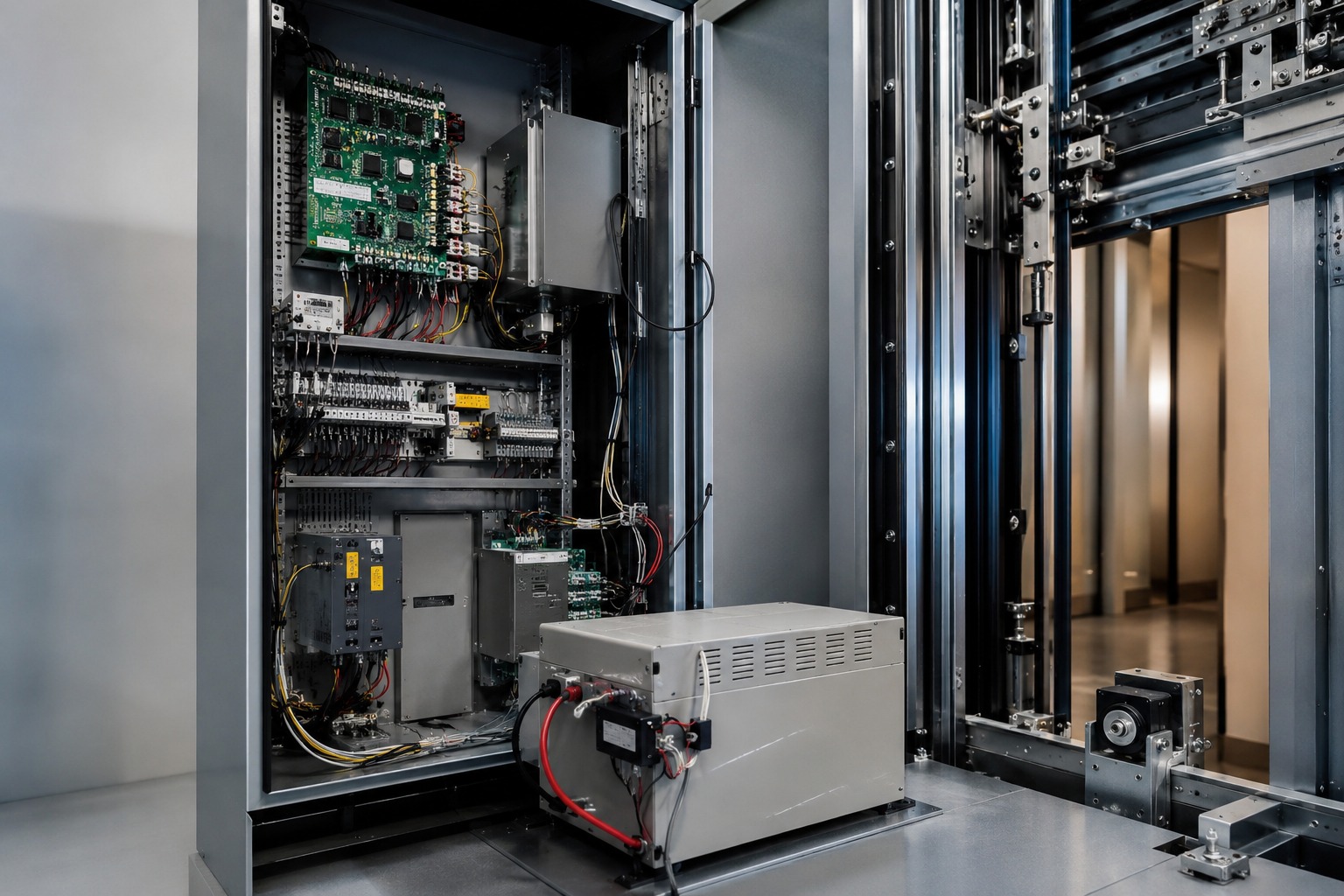
Our service capability is built around responsive communication and practical support for maintenance-driven purchasing. Customers often need fast answers on model verification, photos, labels, or related component checks before placing an order. By helping narrow the correct replacement path early, we aim to reduce downtime, limit trial replacement, and support smoother elevator maintenance operations. This service mindset is particularly important when a site has trapped-passenger risk, incomplete records, or urgent modernization deadlines.
Future trends for 2026: technology, policy, and sustainability
Looking toward 2026, elevator emergency power in India is likely to move in three clear directions. First, more systems will include smarter battery monitoring and status feedback, helping maintenance teams detect weak batteries before failure. This will support better preventive maintenance and fewer emergency breakdowns.
Second, policy and safety expectations are expected to strengthen around passenger communication, controlled evacuation, and reliable backup behaviour. Even where regulations vary by building type and project specification, market expectations are rising. Building owners increasingly see emergency power as a safety investment rather than an optional accessory.
Third, sustainability will play a bigger role. Lower-power LED car lighting, better charging efficiency, longer-life components, and more disciplined replacement scheduling can reduce waste and improve lifecycle value. In high-volume urban developments, that matters both financially and operationally.
For buyers, the practical takeaway is simple: plan emergency power as part of the elevator safety system, not as an afterthought. Choose the right product type, confirm compatibility carefully, test after installation, document maintenance properly, and replace batteries before they become a hidden failure point. In a growing market like India, that disciplined approach helps protect passengers and supports reliable lift performance across residential, commercial, healthcare, hospitality, and industrial applications.