
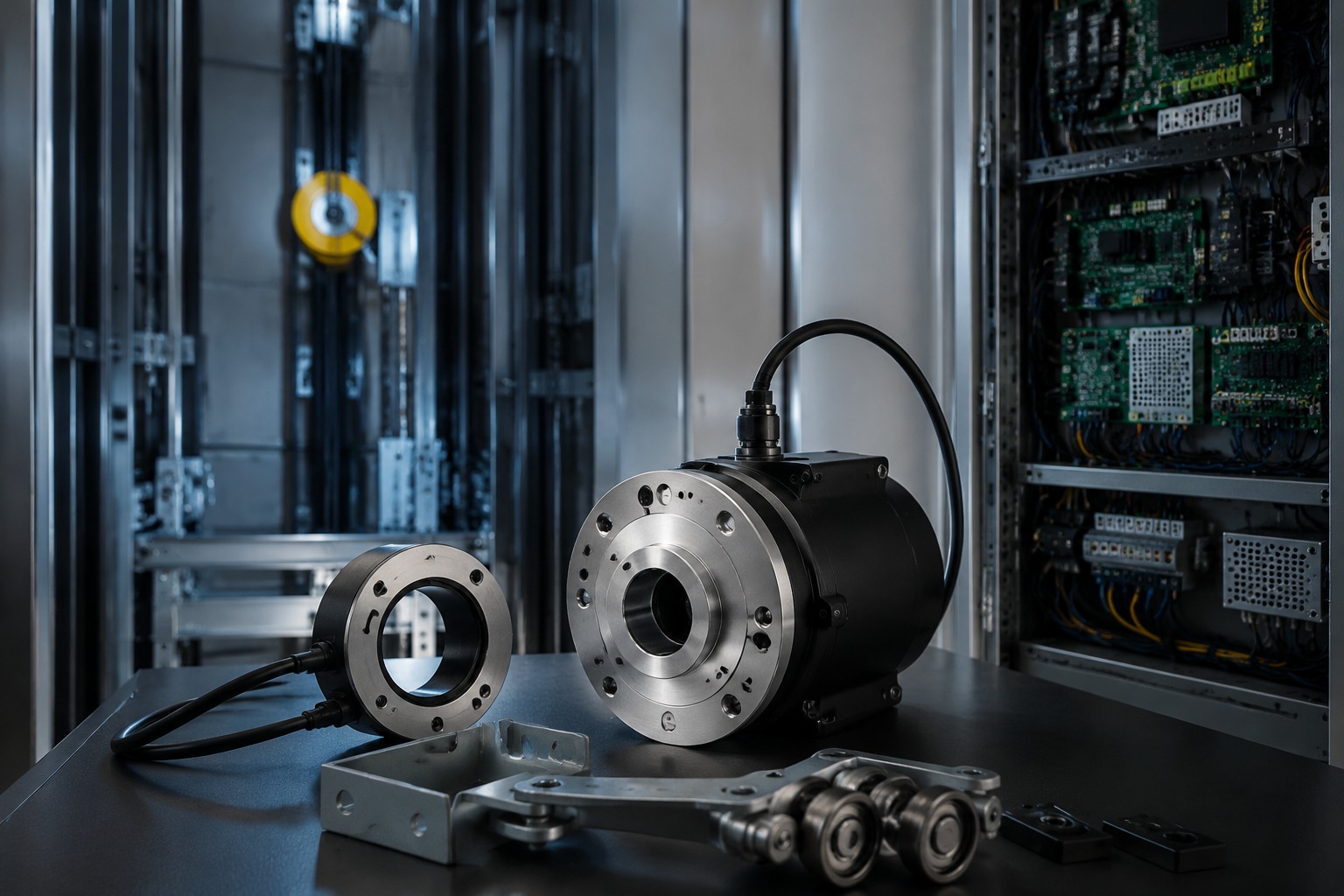
In modern traction elevators, the encoder is one of the most important feedback devices in the entire motion control loop. Its job is simple to describe but critical in practice: it tells the drive and controller how fast the motor is turning, in which direction it is rotating, and, in many systems, how accurately the car is approaching the floor. Without stable encoder feedback, a lift can show rough starts, poor leveling, speed faults, inverter trips, door zone issues, or repeated shutdowns. For maintenance companies, distributors, and modernization contractors across India, choosing the correct elevator encoder is not just a spare-parts decision. It is a safety, uptime, and compatibility decision.
Demand for replacement encoders is growing in cities such as Mumbai, Pune, Delhi NCR, Bengaluru, Chennai, Hyderabad, Ahmedabad, and Kolkata, where a large installed base of commercial, residential, hospital, and mixed-use buildings depends on reliable lift operation every day. In port-linked and logistics-heavy trade centers such as Nhava Sheva, Mundra, and Chennai Port, replacement parts also need to move quickly to support urgent service calls. Because of this, buyers increasingly look for suppliers that can confirm model matching, pulse output, shaft dimensions, connector style, mounting pattern, and packaging quality before dispatch.
This guide explains how elevator encoders work, how to identify failure symptoms, how to match specifications correctly, what to watch for in Hitachi UAX selection, and how to test speed feedback after replacement. It also covers buying advice for the India market, common application environments, and practical stocking strategies for urgent repairs.
India market demand for elevator encoders
India continues to expand its elevator base through new high-rise housing, metro-linked commercial projects, hospitals, hotels, industrial facilities, and modernization of older lift systems. Growth is not limited to tier-1 cities. Tier-2 and tier-3 cities are also seeing greater lift usage, which increases long-term replacement demand for speed feedback parts such as encoders, sensors, and inverter accessories.
In the replacement market, encoder purchases are usually driven by four conditions: routine wear, emergency failure, modernization compatibility, and preventive stock planning. Maintenance companies often need quick-response supply because a failed encoder can take a lift out of service immediately. Building owners, especially in hospitals, IT parks, and high-occupancy apartments, usually prioritize short downtime over lowest unit cost. As a result, buyers prefer suppliers that offer careful part verification and stable quality inspection.
The line chart above reflects a realistic upward trend in replacement demand, especially as older traction lifts move into a heavier maintenance cycle. By 2026, the market is expected to value not only availability but also better technical support for exact matching and testing.
| Driver | Typical site type | Main issue | Urgency level | Buying priority | Common cities |
|---|---|---|---|---|---|
| Aging lift fleets | Residential towers | Intermittent speed faults | Medium | Correct model matching | Mumbai, Pune |
| Heavy passenger usage | Malls and offices | Rough leveling | High | Fast dispatch | Delhi NCR, Bengaluru |
| Continuous service requirements | Hospitals | Downtime not acceptable | Very high | Ready stock | Chennai, Hyderabad |
| Modernization projects | Commercial complexes | Compatibility with new drive | Planned | Specification review | Ahmedabad, Kolkata |
| Industrial vibration conditions | Factories and warehouses | Cable and connector stress | High | Durable packaging and inspection | Surat, Vadodara |
| Remote site service delays | Mid-rise mixed use | Long lead time for brand parts | High | Compatible replacement options | Indore, Kochi |
This table shows why the buying decision changes by site type. A hospital may care most about same-day or next-day dispatch, while a modernization contractor may focus more on output signal compatibility and shaft dimensions.
What an elevator encoder does
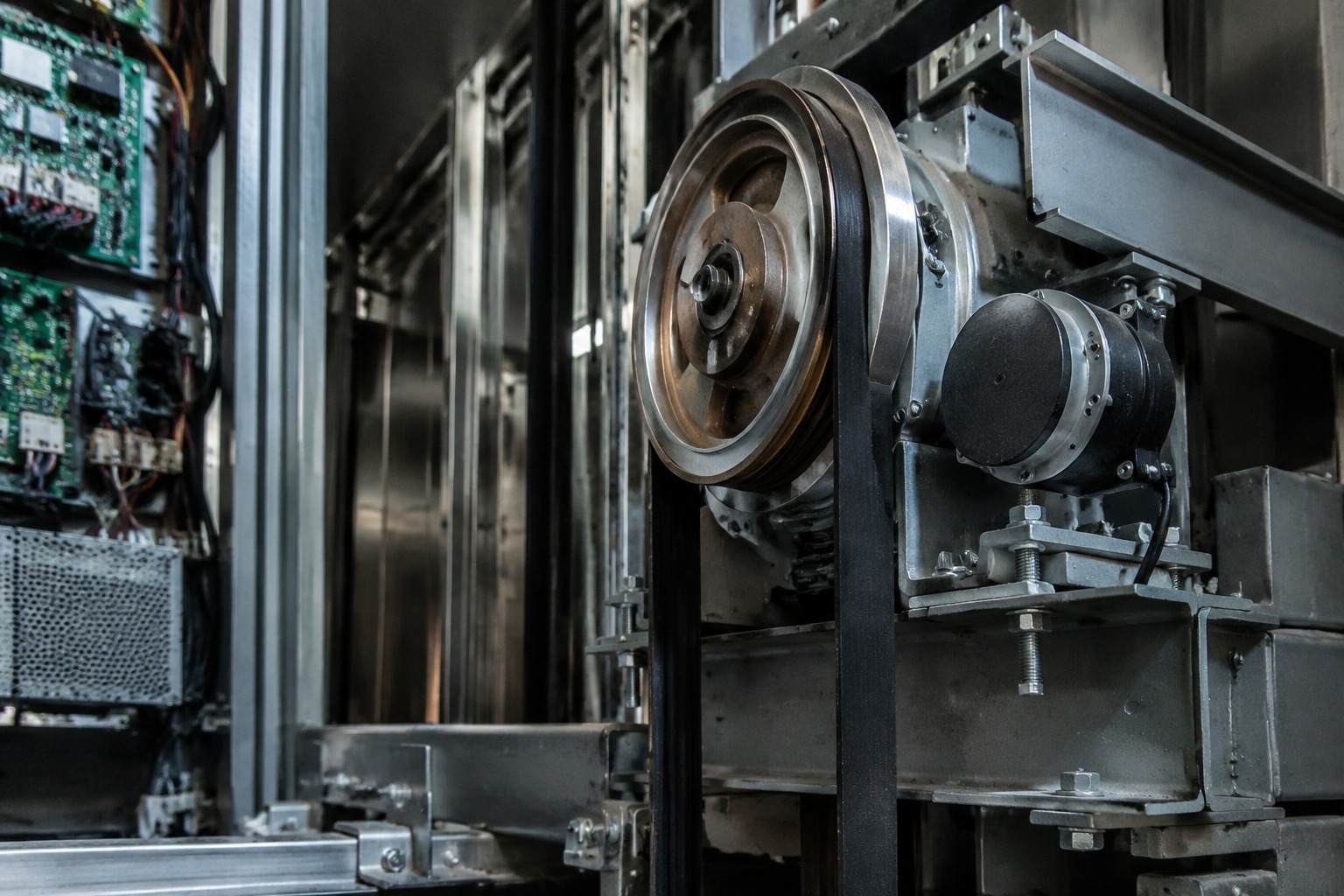
An elevator encoder converts mechanical rotation into electrical signals that the elevator drive or controller can read. In a traction elevator, the encoder is usually mounted on the motor shaft or a related rotating part. As the shaft turns, the encoder sends pulses or digital position information. The drive uses that information to regulate motor speed, torque response, acceleration, deceleration, and stopping accuracy.
In practical lift operation, this supports three core functions. First, it helps maintain stable traction control, especially during start-up and deceleration. Second, it improves smooth travel by allowing the inverter to compare commanded speed with actual speed. Third, it supports floor leveling accuracy so passengers do not experience car misleveling at the landing.
Depending on the system, the encoder may be incremental or absolute. Incremental encoders are common in many elevator applications and provide pulse signals such as A, B, and Z channels. Absolute encoders provide position information directly and can be used in more advanced feedback architectures. For most replacement purchases, buyers must confirm not only the encoder type but also pulse count, voltage, output format, connector arrangement, shaft style, mounting dimensions, and compatibility with the lift controller or inverter.
If you are reviewing a replacement for a known Hitachi application, it helps to compare with the available Hitachi UAX elevator encoder option and confirm all label data before ordering. Even small differences in output or mounting can cause installation delays.
| Encoder function | Signal use | Lift behavior affected | If signal is unstable | Service symptom | Why it matters |
|---|---|---|---|---|---|
| Speed feedback | Measures motor rotation speed | Smooth acceleration | Drive cannot regulate correctly | Jerking at start | Passenger comfort and safety |
| Direction feedback | Reads rotational sequence | Up/down travel control | Direction error or fault | Trip during run | Prevents unsafe movement |
| Pulse counting | Tracks motion increments | Stopping precision | Missed counts | Floor misleveling | Landing accuracy |
| Reference index | Provides home or index point | Position calibration | Loss of reference | Inconsistent floor approach | Stable control logic |
| Closed-loop control input | Feeds inverter correction loop | Ride quality | Oscillation in control | Speed hunting | Energy and motion stability |
| Emergency diagnostics | Supports fault tracing | Service troubleshooting | Invalid feedback records | Repeated unexplained alarms | Faster repair work |
The table above highlights why encoder accuracy is tied directly to both ride quality and fault diagnostics. A part that looks physically similar but sends the wrong pulse output can create immediate or hidden control problems.
Symptoms of encoder failure
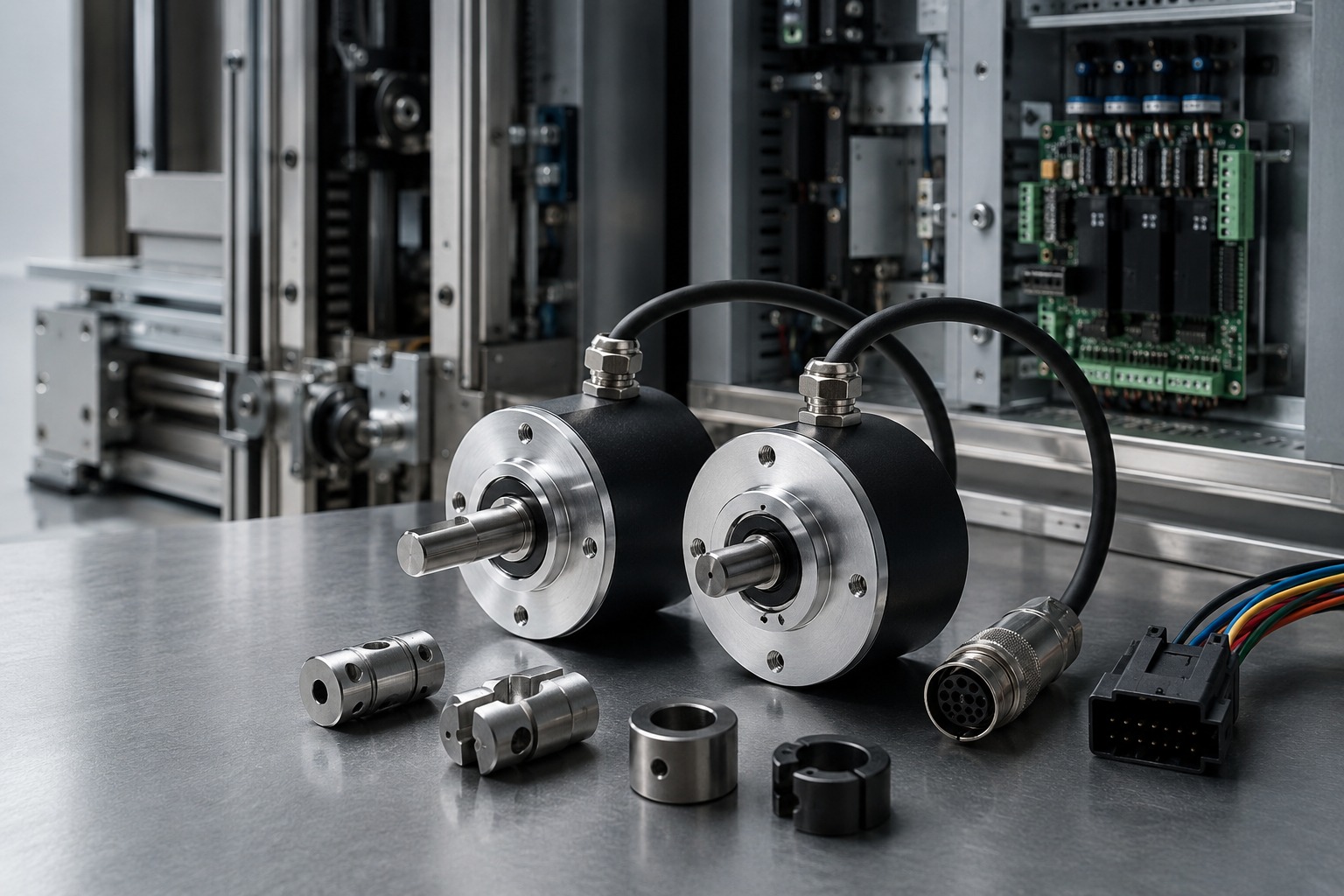
Encoder failure in elevators is not always a complete no-signal event. In many cases, the part degrades gradually, or the actual root cause is in the cable, connector, shielding, or mechanical alignment. This is why technicians should review both electrical and mechanical symptoms before deciding on replacement.
Common signs include rough starting, vibration during travel, poor floor leveling, intermittent inverter trips, unexplained overspeed or feedback alarms, and random shutdown after the car begins moving. In some installations, the car may run correctly at low load but become unstable during peak traffic. That can point to feedback dropout under vibration or heat. In coastal cities such as Chennai or Kochi, humidity and corrosion can also affect connector reliability. In industrial zones around Pune, Ahmedabad, or Faridabad, dust and vibration can accelerate cable wear.
Some symptoms are mistaken for brake or drive problems. For example, delayed deceleration or inconsistent landing may be blamed on the control board, but the actual issue may be pulse loss from the encoder. Likewise, intermittent faults after machine-room maintenance may be caused by cable strain or misalignment rather than by a defective new part.
| Observed symptom | Possible encoder issue | Possible non-encoder issue | Inspection priority | Urgency | Recommended action |
|---|---|---|---|---|---|
| Rough start | Weak or noisy pulse output | Drive parameter drift | Check signal quality | High | Measure feedback during start-up |
| Misleveling at floor | Missed pulse count | Brake drag or mechanical slip | Check count stability | High | Inspect encoder and coupling |
| Random inverter trip | Intermittent feedback loss | Power fluctuation | Check cable and connector | Very high | Test continuity and shielding |
| Travel vibration | Unstable direction signal | Motor bearing issue | Check A/B phase relationship | Medium | Compare waveform and mechanical noise |
| No run command accepted | No encoder output | Safety chain open | Check voltage and signal presence | Very high | Verify power to encoder |
| Fault only in hot conditions | Thermal failure inside encoder | Ventilation issue in panel | Check after heat build-up | Medium | Test during real operating cycle |
This symptom table is useful because not every ride issue justifies immediate replacement. Good troubleshooting saves time and avoids installing the wrong part when the real problem is in the cable run or drive settings.
How to match pulse output and shaft type
Correct matching starts with the old encoder label and the machine details. Buyers should record the brand, series, part number, pulse count or resolution, supply voltage, output type, shaft diameter, shaft form, body dimensions, mounting holes, connector style, cable length, and direction or phase information. If the label is faded, photographs of the installed part from multiple angles can help with identification.
Pulse output is one of the most critical points. If the inverter expects a certain pulse count per revolution and receives a different value, speed calculation and stopping accuracy can be wrong. Output format also matters. Open collector, push-pull, line driver, and other interfaces are not interchangeable unless the system is designed for them. Similarly, shaft type must match exactly. Solid shaft, hollow shaft, keyed shaft, flat shaft, and clamping arrangements all affect installation and stable rotation.
Technicians should also confirm whether the encoder is directly shaft-coupled or mounted through a bracket and coupling assembly. Coupling mismatch can introduce wobble, signal instability, or premature bearing wear. For general replacement review, many buyers compare several elevator spare encoder options before placing an order, especially when the original unit is not immediately available.
| Specification item | Why it matters | What to verify | Risk if wrong | Field check method | Buying note |
|---|---|---|---|---|---|
| Pulse output / PPR | Controls speed calculation | Label and drive manual | Incorrect speed feedback | Read part marking | Never guess by appearance |
| Output signal type | Electrical compatibility | A/B/Z, line driver, etc. | No signal recognition | Controller wiring check | Match exact interface |
| Supply voltage | Power requirement | 5V, 12V, 24V or specified range | Damage or unstable output | Measure input voltage | Confirm during ordering |
| Shaft diameter | Mechanical fit | Caliper measurement | Cannot install or slips | Measure old shaft | Check tolerance carefully |
| Shaft style | Coupling compatibility | Solid, hollow, flat, keyway | Misalignment and vibration | Visual inspection | Include photos with inquiry |
| Connector / cable style | Fast site replacement | Pin count, orientation, lead length | Rewiring delay or errors | Photo and continuity check | Prefer like-for-like match |
The main lesson from this table is that mechanical fit and electrical fit are equally important. A pulse-perfect encoder with the wrong shaft arrangement still becomes a site problem.
Hitachi UAX encoder selection notes
Hitachi elevator systems are widely used in many Indian buildings, and UAX-related encoder inquiries are common in the replacement market. When selecting a Hitachi UAX encoder, the safest approach is to verify the exact model marking, installation dimensions, connector details, and control system application rather than relying only on a broad equipment description.
In field service, confusion often happens because two encoders may look similar externally while having different pulse outputs, cable pin assignments, or shaft dimensions. Some technicians also order only by machine photo, which can be risky if the machine has already been modified during a previous repair. For this reason, the part label, machine model, and clear photos should be reviewed together.
When evaluating a replacement, it is useful to compare the specification with a documented Hitachi UAX lift accessory listing. If another compatible form is needed, a supplier familiar with elevator spare-parts matching can advise whether the replacement is functionally equal or whether an exact match is required for the control logic.
Buyers should also ask about packaging protection. Encoders are precision components, and damage during domestic transport from warehouse to site can create unnecessary callbacks. This matters especially when shipments move between major hubs such as Delhi, Mumbai, Bengaluru, Chennai, and Hyderabad, where frequent transfers can expose cartons to impact.
| Check item | What to review | Why it is important | Common mistake | Best practice | Result |
|---|---|---|---|---|---|
| Part number | Full printed code | Primary identification | Using partial code only | Send complete label photo | Better match accuracy |
| Pulse specification | PPR or output resolution | Drive compatibility | Assuming same as similar model | Cross-check manual | Stable speed feedback |
| Shaft dimensions | Diameter and length | Mechanical fit | Ignoring mounting depth | Measure before order | Faster installation |
| Connector pinout | Pin count and orientation | Signal continuity | Matching by plug shape only | Confirm wiring details | Reduced wiring risk |
| Application system | Lift model and drive series | Functional compatibility | Ordering from motor photo only | Share controller details | Lower return risk |
| Transport protection | Shock-resistant packing | Prevents hidden damage | Standard loose packing | Use protective packaging | Reliable on-site use |
For maintenance teams under time pressure, this checklist reduces the risk of ordering a part that reaches site quickly but cannot be installed correctly.
Installation alignment and cable checks
Installing a new encoder is not only a parts task. It is a precision alignment task. Even a correct replacement can fail early if the shaft is forced, the coupling is eccentric, the mounting bracket is stressed, or the cable is bent too sharply near the connector. Before removal, technicians should record the original mounting position and cable routing. During installation, they should avoid impact on the shaft and ensure that all mechanical fixing points are even and secure.
Cable inspection is equally important. Many elevator feedback faults come from broken cores, crushed shielding, moisture ingress, loose connectors, or incorrect grounding. In machine rooms exposed to heat or vibration, cable jackets may harden or crack. In coastal regions, connector oxidation can degrade signal quality. If the old encoder failed after a long period of intermittent faults, replacing only the encoder without checking the cable can lead to repeat service calls.
Where available, technicians often review alternative lift encoder spare configurations to compare connector forms or installation styles. This is especially useful during modernization work where previous repairs may have changed the original layout.
Good installation practice includes checking supply voltage, ensuring shield continuity according to the system design, keeping the cable separated from high-noise power lines where possible, and confirming that the coupling rotates freely without side load. After fitting, the encoder should never be treated as “done” until live speed feedback testing is completed.
The area chart reflects a wider service trend: more companies in India are moving from reactive repair to preventive replacement and signal-quality checks, especially in high-traffic buildings.
Testing speed feedback after replacement
Once the replacement encoder is installed, the next step is controlled verification. The first check is static: confirm power supply to the encoder, confirm connector seating, and verify continuity if required. The second is dynamic: run the lift under inspection or maintenance mode and observe whether the drive reads stable speed and direction feedback. The third is operational: test acceleration, normal travel, deceleration, and floor leveling under real-use conditions.
If the system permits waveform or monitor feedback review, technicians should look for clean and stable output without dropouts. On-site tests should include repeated runs in both directions. It is also wise to test under light load and nominal operating load where possible, because some alignment or vibration issues only appear during full machine stress.
For buildings with sensitive uptime requirements, such as hospitals, IT campuses, hotels, and premium residential towers, documenting the before-and-after fault status is useful for future maintenance records. Buyers seeking a replacement for urgent use often compare with another elevator encoder replacement model when the original part is no longer immediately available.
| Test stage | What to check | Expected result | If abnormal | Tools used | Decision |
|---|---|---|---|---|---|
| Power-on inspection | Encoder supply voltage | Within specified range | Check wiring or drive output | Multimeter | Do not run until correct |
| Connector review | Pin seating and locking | Firm and aligned | Reseat and inspect pins | Visual inspection | Prevent intermittent faults |
| Maintenance-mode run | Direction and signal stability | Smooth response | Check phase or coupling | Drive monitor | Adjust before full service |
| Normal-speed run | Acceleration and deceleration | No hunting or jerks | Inspect feedback noise | Controller diagnostics | Confirm closed-loop control |
| Landing test | Floor leveling accuracy | Consistent level stop | Review pulse count or slip | Floor-level gauge | Release only after repeated success |
| Repeat cycle test | Performance over multiple runs | No intermittent alarms | Inspect cable under vibration | Service log review | Close call with records |
This test sequence helps separate a good replacement from a merely installed replacement. Reliable speed feedback must be proven in operation, not assumed after fitting.
Stocking encoders for urgent repair
Many lift service companies in India face the same challenge: the encoder fails unexpectedly, the site is under pressure, and the part must be identified and dispatched fast. The best answer is not to stock every encoder. It is to stock the right encoder families based on installed base, common failures, and regional service patterns.
For example, maintenance teams serving premium apartments in Mumbai and Pune may prioritize encoders used in traction passenger lifts with high daily cycles. Teams supporting hospitals in Delhi NCR or Chennai may keep critical feedback parts for zero-delay restoration. Distributors serving modernization contractors in Bengaluru, Hyderabad, and Ahmedabad may focus more on specification-based sourcing for mixed-brand applications.
Smart stocking usually includes high-runner models, cross-referenced alternatives where appropriate, cable assemblies if commonly damaged, and a process for rapid photo-based identification. Warehousing near major transport corridors can reduce downtime. In India, stock planning often benefits from access to road and air links through hubs such as Mumbai, Delhi, Bengaluru, Chennai, and Hyderabad, and for larger trade movement, port-connected routes via Nhava Sheva, Mundra, or Chennai Port can support regional distribution chains.
The bar chart shows why hospitals and commercial buildings often drive the most urgent replacement demand. Downtime in these sectors has a direct operational impact.
Buying advice for maintenance teams, distributors, and building owners
For maintenance companies, the first rule is to buy by specification, not by appearance. For distributors, the second rule is to build a verification process that collects photos, dimensions, and system details before shipment. For building owners, the third rule is to choose supply partners who understand downtime risk and can support urgent matching.
Price matters, but lowest price alone can be expensive if the part is incompatible, poorly packed, or lacks technical confirmation. A professional supplier adds value by checking model references, reviewing pulse output and shaft data, inspecting quality before dispatch, and packing the encoder to resist transit damage. This becomes even more important in intercity shipping, where service companies depend on reliable movement from warehouse to site.
Technological capability is a major buying factor. A supplier with strong technical matching ability can compare part markings, connector styles, and mechanical drawings to reduce fitment errors. Manufacturing capability matters as well, particularly for quality inspection, batch consistency, and packaging control. Service capability matters in urgent repairs, where response speed, practical communication, and replacement guidance can reduce elevator downtime significantly.
Our role in this market is built around those three capabilities. On the technical side, we help customers confirm model matching for elevator control parts, inverter-related components, encoders, sensors, and other lift accessories across brands such as Hitachi, Toshiba, KONE, Mitsubishi, and more. On the manufacturing and sourcing side, we focus on stable quality inspection, careful selection of compatible replacement parts, and protective packaging for delicate items. On the service side, we support maintenance companies, distributors, building owners, and modernization contractors with responsive communication designed to reduce sourcing delays and keep elevators operating safely.
The comparison chart underlines a clear market reality: accurate verification and fast response are just as important as the physical product itself.
Applications and industries that rely on encoder accuracy
Elevator encoders are used across far more environments than many buyers realize. Residential towers require smooth, quiet travel and precise leveling for daily passenger comfort. Hospitals require dependable stopping accuracy for stretchers, wheelchairs, and uninterrupted service. Office towers and mixed-use commercial sites need stable performance under peak traffic and frequent start-stop cycles. Hotels need ride comfort and fast restoration if a lift goes offline. Industrial buildings may expose parts to higher vibration or dust loads, which makes correct installation and cable protection especially important.
Modernization projects create another important application group. When a building updates its drive system, control board, or motor arrangement, the encoder may need exact confirmation rather than simple replacement. In these cases, compatibility review can be more complex than for routine maintenance, and buyers should share the widest possible technical information before ordering.
| Industry | Main lift usage pattern | Top encoder priority | Typical fault impact | Preferred stock strategy | Purchase style |
|---|---|---|---|---|---|
| Residential housing | Morning and evening peaks | Smooth leveling | Resident complaints | Common model stock | Cost and uptime balance |
| Commercial offices | High daily cycles | Stable speed control | Traffic delays | Fast replenishment | Service contract driven |
| Hospitals | Continuous use | No unplanned downtime | Critical operations disruption | Emergency-ready stock | Reliability first |
| Hotels | Guest comfort focused | Quiet and smooth ride | Guest dissatisfaction | Brand-specific planning | Image-sensitive buying |
| Industrial sites | Rugged environment | Cable and vibration resistance | Maintenance interruption | Spare plus cable reserve | Technical screening |
| Modernization projects | Planned upgrades | System compatibility | Commissioning delay | Specification-based sourcing | Engineering-led purchase |
The table shows why “one buying method for all sites” does not work. Encoder sourcing strategy should reflect the operating environment and the cost of downtime.
Case-based buying scenarios in India
Consider a residential tower in Bengaluru with repeated leveling complaints in one lift during evening peak traffic. The maintenance team first checks guide shoes and brake behavior, but fault logs show irregular speed feedback. On inspection, the encoder cable shielding near the connector is damaged. Replacing the encoder alone might have restored operation temporarily, but replacing the damaged cable path and confirming clean feedback prevents recurring callbacks.
In a hospital in Chennai, a traction lift develops intermittent inverter feedback alarms during humid weather. The original encoder label is still readable, so the team confirms pulse output, supply voltage, shaft size, and connector style before ordering. Because patient movement depends on lift uptime, the customer chooses a supplier that can verify the model quickly and dispatch with protective packaging. That decision reduces risk more than simply selecting the lowest quoted price.
In a modernization project in Ahmedabad, the contractor is replacing older control hardware while retaining part of the machine arrangement. Here, encoder selection is more than spare replacement. The team must verify that the feedback device works correctly with the new inverter logic. In such cases, technical support and specification review become as important as stock availability.
Local supplier considerations in the India market
Whether you buy from a city-based trader, a specialized lift parts distributor, or a broader industrial parts supplier, there are several questions worth asking. Can the supplier identify the encoder from clear photos and label information? Can they check pulse output and shaft type rather than sending “similar” stock? Do they inspect parts before shipment? Can they provide protective packing for delicate signal devices? How quickly can they respond if the site needs urgent clarification?
Local availability in Mumbai, Delhi NCR, Bengaluru, Chennai, Hyderabad, Pune, and Kolkata can reduce transport time, but technical accuracy remains more important than simple proximity. A nearby supplier that sends the wrong encoder still causes downtime. On the other hand, a well-organized supplier with strong verification and dispatch capability can support sites efficiently even across state lines.
2026 trends: technology, policy, and sustainability
Looking toward 2026, three trends are shaping the elevator encoder market in India. The first is technology. More maintenance teams are using better diagnostics, inverter monitoring, and preventive replacement strategies rather than waiting for total failure. This increases demand for clearly traceable encoder specifications and faster technical matching.
The second trend is policy and compliance. As building operators focus more on safety, uptime documentation, and modernization planning, spare-parts sourcing will increasingly favor suppliers that can provide consistent identification and quality assurance. While policies vary by project and region, market behavior is already moving toward better documentation and service records.
The third trend is sustainability. Building owners are paying more attention to lifecycle cost, not just purchase cost. A correctly matched encoder that supports smooth control can help reduce repeated service visits, avoid unnecessary part waste, and support efficient motor performance. Better packaging and fewer wrong-part shipments also contribute to a more sustainable service chain.
FAQ about elevator encoders
What is the main job of an elevator encoder?
It provides speed and rotation feedback to the elevator drive or controller so the lift can accelerate, decelerate, and level accurately.
Can a lift run with a bad encoder?
In most closed-loop traction systems, unstable or missing encoder feedback can cause poor performance, frequent faults, or complete shutdown. It should be corrected immediately.
What causes encoder failure most often?
Common causes include internal wear, heat, vibration, moisture, damaged cables, loose connectors, misalignment, and incorrect handling during installation.
How do I know which replacement encoder to buy?
Check the part number, pulse output, voltage, output type, shaft diameter, shaft style, mounting dimensions, and connector details. Photos of the label and installed position help a lot.
Is a similar-looking encoder acceptable?
Not unless the electrical output and mechanical dimensions are confirmed to match. Similar appearance alone is not enough.
Why is Hitachi UAX selection handled carefully?
Because visually similar parts may still differ in pulse count, pinout, or shaft arrangement. Exact verification reduces installation risk.
Should the cable be replaced together with the encoder?
If there is visible damage, shielding failure, connector corrosion, or intermittent feedback issues, the cable path should be checked and replaced where necessary.
What tests should be done after replacement?
Check power supply, connector seating, direction and speed feedback in maintenance mode, repeated normal runs, and final floor leveling accuracy.
Is it worth stocking encoders for emergency use?
Yes, especially for maintenance companies serving hospitals, offices, and high-traffic residential buildings. Stock should be based on actual installed base and common failure models.
What should Indian buyers look for in a supplier?
Technical matching support, stable quality inspection, protective packaging, responsive service, and the ability to source compatible elevator spare parts quickly.
Choosing the right elevator encoder is really about protecting safe traction control, smooth leveling, and faster restoration when faults occur. In the India market, where high-rise expansion, modernization demand, and service responsiveness all matter, the most successful buyers are the ones who combine accurate technical matching with dependable sourcing and disciplined post-installation testing.