
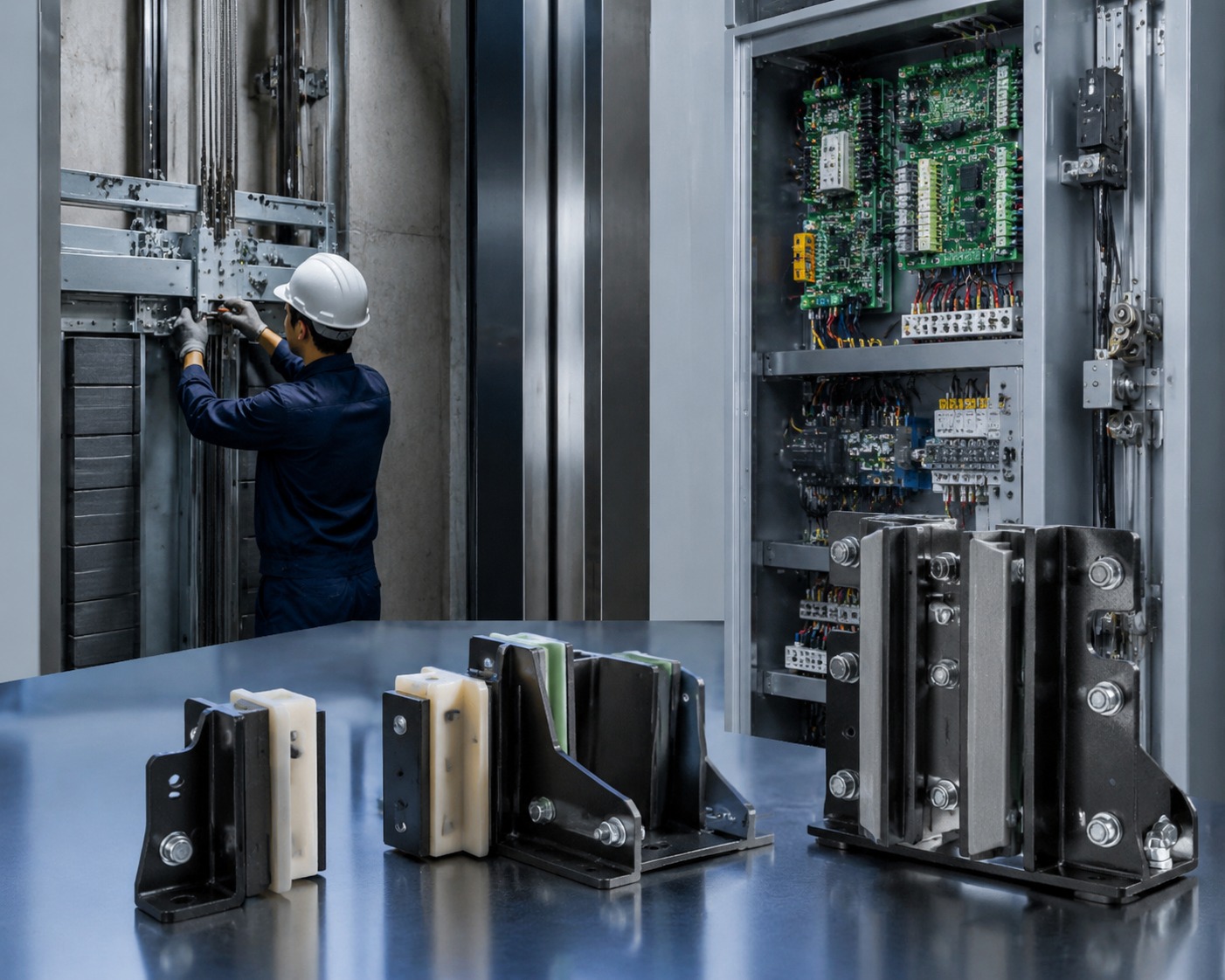
Elevator guide shoes and guide shoe liners are small parts with a big effect on ride comfort, rail protection, and long-term maintenance cost. In simple terms, the guide shoe keeps the car frame or counterweight aligned on the guide rail, while the liner or insert forms the wear surface that slides against the rail. When the liner size, material, and clearance are matched correctly, the elevator travels more smoothly, cabin vibration is reduced, door re-leveling becomes more stable, and rail wear is kept under better control.
For buyers in India, this matters across residential towers in Mumbai, office buildings in Bengaluru, hospitals in Hyderabad, hotels in Goa, factories in Pune, warehouses near Ahmedabad, and metro-adjacent commercial projects in Delhi NCR. In all of these locations, maintenance teams often need quick replacement of compatible lift accessories to avoid long shutdowns. That is why careful model matching, material selection, and packaging quality are as important as price.
If you are sourcing replacement parts, you can review options for sliding guide shoe lift accessories for routine maintenance and modernization projects. For many service companies, the buying decision comes down to four points: correct dimensions, suitable liner material, reliable finish quality, and dependable delivery.
What Elevator Guide Shoes Do
Guide shoes are mounted on the elevator car frame and on the counterweight frame. Their job is to guide vertical movement along the steel rails while keeping the moving mass properly aligned. In a sliding guide shoe arrangement, the liner is the sacrificial contact element. Instead of allowing metal-to-metal contact between the rail and the shoe body, the liner takes the wear and can be replaced at a much lower cost than rails or full shoe assemblies.
In practical operation, a properly fitted guide shoe assembly helps in several ways:
- Reduces lateral sway and cabin shake
- Lowers rubbing noise during travel
- Protects guide rails from excessive scoring
- Helps maintain smoother door zone leveling
- Supports safer and steadier operation in high-traffic buildings
- Simplifies periodic maintenance because the liner is replaceable
Sliding shoes remain common in many installations because they are durable, economical, and suitable for a broad range of passenger and service lifts. Even where roller guides are used in some premium systems, sliding guide shoe liners are still widely required in modernization work and in many standard-speed applications across India.
From a maintenance perspective, the liner acts as a controlled wear interface. If it is too hard, noise can increase and rail contact can become aggressive. If it is too soft, wear becomes too fast and the clearance changes early. This is why buyers should not treat all guide shoe linings as interchangeable plastic blocks. Dimensions, groove profile, rail fit, and compound quality all affect service life.
| Function | Guide Shoe Body | Guide Shoe Liner | Operational Impact | Maintenance Focus | Typical Failure Risk |
|---|---|---|---|---|---|
| Rail guidance | Holds assembly position | Contacts rail surface | Stable travel path | Check fastening and alignment | Misalignment if loose |
| Wear control | Provides structure | Takes sliding wear | Protects costlier parts | Inspect wear thickness | Rail scoring if worn through |
| Noise reduction | Maintains pressure setting | Absorbs friction effects | Quieter running | Monitor rubbing marks | Squeal or scraping sound |
| Vibration damping | Keeps geometry fixed | Supports smoother contact | Less cabin vibration | Confirm clearance | Side shake |
| Replacement economics | Longer service life | Consumable component | Lower overhaul cost | Stock spare liners | Unexpected downtime |
| Compatibility | Matches mounting design | Matches rail size/profile | Reliable fitment | Verify model data | Wrong part installation |
The table above shows why the liner deserves separate buying attention. In many sites, the shoe body is still serviceable, but the liner has reached its wear limit. Replacing only the liner is often the most cost-effective solution when dimensions are verified correctly.
Main Rail and Counterweight Guide Shoe Differences
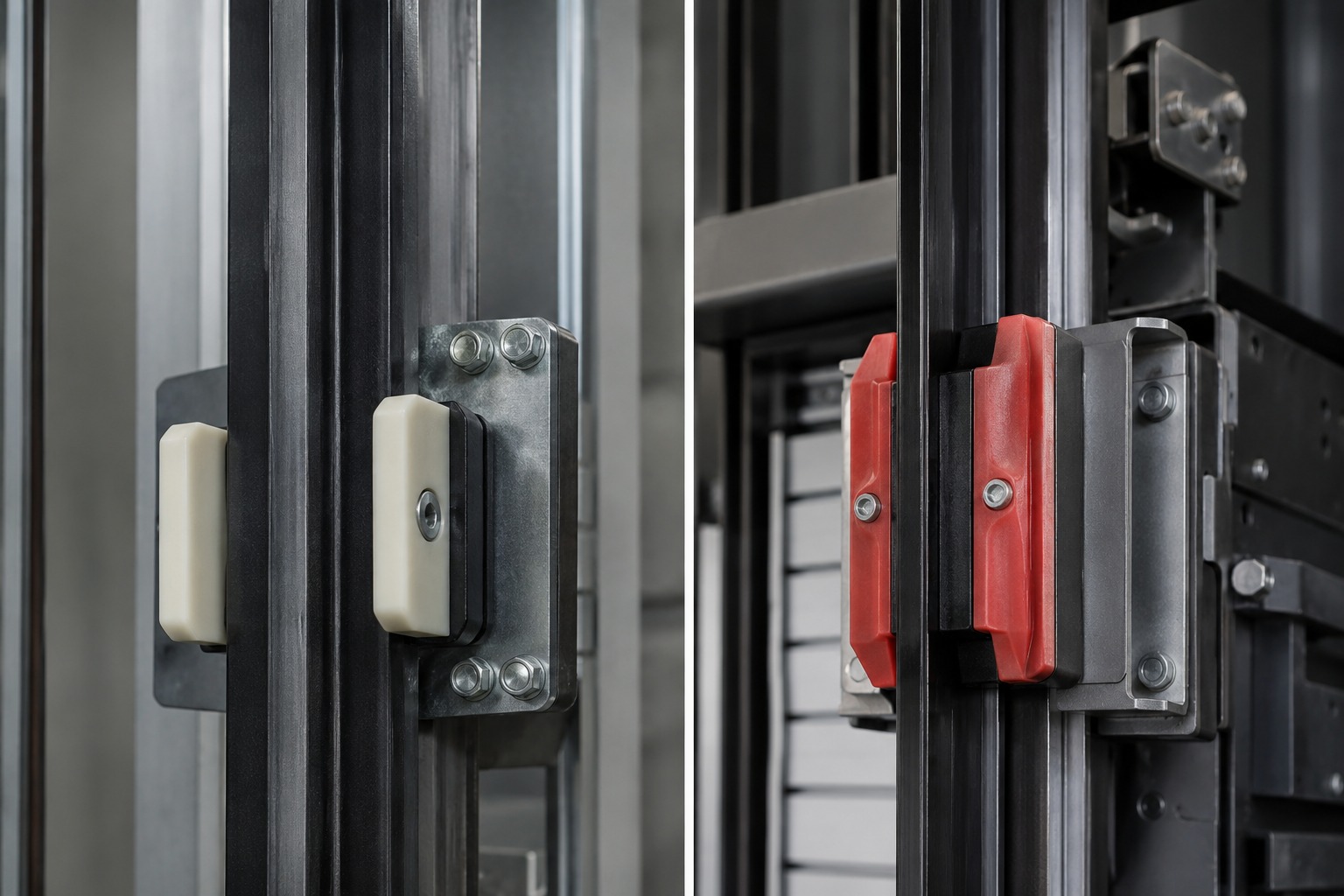
Main rail guide shoes and counterweight guide shoes may look similar at first glance, but they do not always use the same liner profile, pressure conditions, or wear pattern. The car side normally handles passenger comfort directly, so even slight variation in liner fit may be noticed as vibration, rubbing sound, or rough travel. The counterweight side may show different wear because of balance ratio, rail condition, and shaft alignment.
In many Indian buildings, especially older residential towers in Chennai, Kolkata, and Mumbai suburbs, maintenance teams encounter mixed replacement history. It is common to find one side replaced earlier, or a locally machined substitute installed without exact dimensional control. This can create uneven contact and shorten service life.
Main rail guide shoes usually require tighter attention to ride quality. Counterweight shoes are equally important, but symptoms may appear differently: banging during acceleration, periodic scraping, or faster liner wear on one edge. For this reason, many technicians inspect both systems together rather than replacing one side in isolation.
| Point of Comparison | Main Rail Guide Shoe | Counterweight Guide Shoe | Typical Wear Pattern | Inspection Priority | Buying Note |
|---|---|---|---|---|---|
| Primary purpose | Guides car frame | Guides counterweight frame | Car side often more noticeable | High | Check ride complaints |
| Effect on passengers | Directly affects comfort | Indirect but important | Vibration can transfer | High | Match dimensions carefully |
| Load behavior | Varies with passenger/load condition | Linked to balance side motion | Can wear unevenly | Medium to high | Review balance condition |
| Noise symptoms | Cabin rubbing or hum | Shaft-side scraping or thump | Depends on alignment | High | Inspect both rails |
| Replacement frequency | Often prioritized first | Sometimes delayed | Mismatch can occur | Medium | Replace as a set when needed |
| Part identification | Brand/model specific | May differ from car side | Wrong mix-up is common | High | Confirm position before ordering |
Where a dedicated counterweight part is needed, buyers can review counterweight guide shoe lining elevator spare parts. For car-side applications, a separate car main rail sliding guide shoe lining listing helps buyers avoid ordering the wrong side.
For distributors and building owners, the practical rule is simple: never assume the car guide lining and counterweight lining are identical unless the drawing, part code, or physical sample confirms it.
How to Select Lining Size and Material
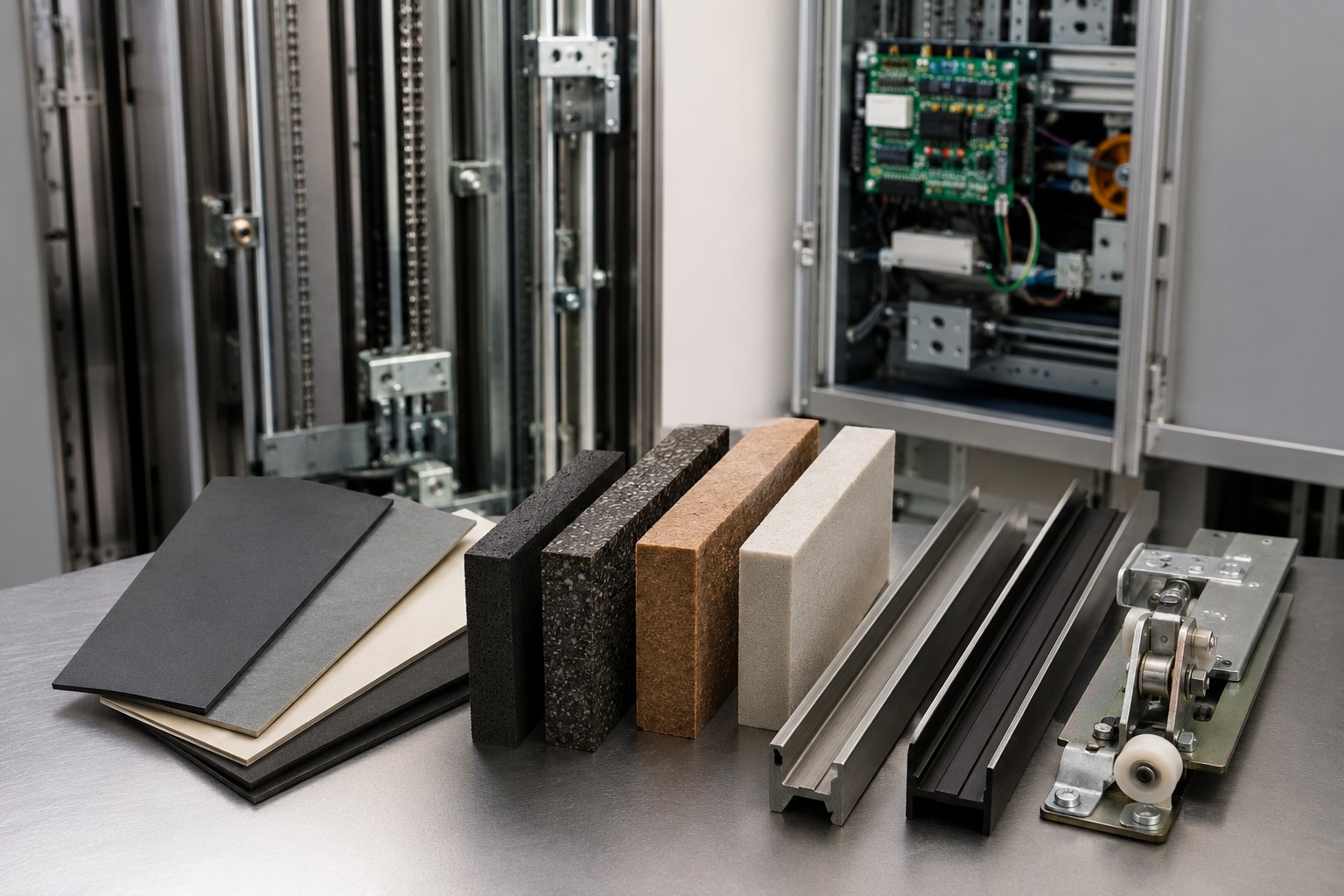
Selecting the correct guide shoe lining starts with size verification. The most common causes of early failure are wrong width, incorrect groove profile, excessive or insufficient running clearance, and unsuitable material hardness for the duty cycle. In India’s climate, temperature, dust, humidity, and maintenance frequency also influence material choice.
Start with these checks before ordering:
- Brand and model identification
- Rail size and profile
- Liner length, width, thickness, and groove dimensions
- Mounting arrangement and retaining method
- Application position: car main rail or counterweight
- Old sample condition and wear pattern
- Travel speed, load class, and building usage intensity
Material selection usually involves engineered polymer compounds chosen for wear resistance, low friction, dimensional stability, and acceptable noise behavior. For moderate-speed passenger lifts in apartments, a standard wear-resistant polymer may be suitable. For heavy-traffic commercial buildings, hospitals, and mixed-use towers, a tougher compound with better heat and abrasion characteristics is often preferred.
Buyers searching for a specific size can check guide shoe lining 88x20mm and related dimensions when matching existing parts. However, dimensions should always be confirmed against the old component or equipment record.
| Selection Factor | Why It Matters | What to Measure or Confirm | Common Mistake | Result of Mistake | Recommended Action |
|---|---|---|---|---|---|
| Length | Ensures proper seating | Overall liner length | Approximate estimation | Loose or tight fit | Measure actual sample |
| Width | Affects rail contact area | Outer width and contact width | Ignoring wear reduction | Wrong replacement size | Measure unworn area if possible |
| Thickness | Controls running clearance | Total thickness and wear depth | Using a similar part | Noise or binding | Match to drawing/sample |
| Groove/profile | Matches rail geometry | Internal shape and edge form | Checking only outer size | Poor rail contact | Compare profile closely |
| Material grade | Determines wear and noise | Polymer type or brand spec | Buying by lowest price only | Short life | Choose application-based grade |
| Position | Main rail and counterweight may differ | Installation location | Mixing left/right or car/cwt | Fitment issues | Label parts before removal |
| Duty cycle | Higher use needs stronger material | Trips per day/building type | Using residential grade in commercial use | Frequent replacement | Specify building traffic level |
The table makes clear that dimension alone is not enough. A liner that measures close to the original but uses a poor-quality resin or unstable molding process may wear quickly, especially in high-usage projects near transport nodes or retail corridors.
In ports and trade hubs such as Mundra, Nhava Sheva, and Chennai Port, spare-parts buyers often prioritize protective packaging because liners can deform or chip if packed poorly during long-distance movement. Good sourcing includes not just the right size, but also stable inspection and safe packing.
Signs of Worn Guide Shoe Liners
Guide shoe liners usually wear gradually, so the first warning sign is often a change in sound or ride feel rather than a total breakdown. Maintenance teams should look for both visual and operational symptoms. A liner does not need to be completely broken to become a problem; once wear changes the working clearance, vibration and rail contact quality can deteriorate quickly.
Common signs of wear include scraping noise, polished or grooved rail contact surfaces, black dust accumulation, side-to-side vibration, uneven liner edge wear, repeated re-leveling issues, and increased passenger complaints about roughness. In severe cases, cracks, chips, or missing material are visible.
| Observed Symptom | Likely Cause | Where to Check | Risk Level | Immediate Action | Longer-Term Action |
|---|---|---|---|---|---|
| Scraping or rubbing sound | Liner wear or misalignment | Car and counterweight shoes | High | Stop and inspect | Replace worn liner |
| Cabin side vibration | Clearance out of range | Main rail shoes | High | Check wear and rail condition | Reset alignment after replacement |
| Uneven edge wear | Rail/shoe misalignment | Liner contact face | High | Measure clearances | Correct mounting geometry |
| Black or fine powder dust | Excessive friction | Shoe area and rail | Medium | Clean and inspect | Review material suitability |
| Chipped or cracked liner | Aging, impact, poor material | Removed liner body | High | Replace immediately | Check source quality |
| Rail scoring marks | Liner worn through or debris | Guide rail face | Critical | Remove from service if severe | Inspect rail and shoe assembly |
| Frequent re-leveling complaints | Instability from wear | Ride test and shaft check | Medium to high | Review guide system | Replace and recheck setup |
The explanation behind these symptoms is straightforward: as the liner wears, contact pressure and geometry change. The elevator may continue to run, but friction is no longer controlled as designed. This creates a chain effect on comfort, sound, and adjacent parts.
For high-rise properties in Gurgaon, Noida, and central Mumbai, where passenger expectations are high and maintenance windows are short, early detection is valuable. Replacing a liner during planned service is far less disruptive than responding to a stoppage or severe ride complaint.
Hitachi Guide Shoe Replacement Notes
Hitachi elevators installed in India can vary by project age, series, and localization of components. When handling Hitachi guide shoe or guide shoe lining replacement, the safest approach is to confirm the existing part code, physical dimensions, rail application, and old sample profile before shipment. In many cases, a part may be described locally by size or by maintenance shorthand, but exact model matching still matters.
Key replacement notes for Hitachi-related applications include:
- Check whether the liner is for car main rail or counterweight side
- Confirm if dimensions such as 88x20 mm or similar are exact or approximate field notes
- Compare the groove/contact profile, not just the outside size
- Inspect whether the shoe body has abnormal wear that would make liner-only replacement insufficient
- Review rail condition, as a damaged rail can destroy a new liner quickly
- Record direction and position before removing old parts
Where buyers need compatible replacement support for Hitachi-oriented maintenance, suppliers should be able to review clear photos, dimensions, and nameplate data. This reduces return risk and saves service time, particularly for contractors covering multiple sites across Maharashtra, Karnataka, Telangana, and Tamil Nadu.
Our experience in this segment is that successful replacement depends less on brand name alone and more on accurate cross-checking. In technological capability terms, we support model matching through part-photo review, dimensional comparison, and application verification so buyers can reduce the chance of ordering a near-match that fails in service. That process is especially helpful when legacy installations have incomplete documentation.
| Replacement Checkpoint | Why Important for Hitachi-Type Jobs | What to Compare | Common Field Issue | Recommended Evidence | Outcome |
|---|---|---|---|---|---|
| Part code | Confirms intended application | Label, tag, manual | Missing records | Nameplate and old part photos | Better matching accuracy |
| Exact size | Prevents clearance errors | Length, width, thickness | Rough tape measure only | Caliper readings | Improved fitment |
| Profile shape | Critical for rail contact | Groove and edge form | Outer dimensions only checked | Side-view photos | Reduced wear risk |
| Installation side | Main rail/counterweight differ | Position on lift | Mixed samples in workshop | Label before removal | Avoids wrong-side supply |
| Body condition | Bad housing ruins new liner | Shoe frame and retaining features | Liner changed without body check | Assembly photos | More complete repair plan |
| Rail condition | Damaged rail causes repeat failure | Surface marks, straightness | New liner installed on poor rail | Inspection notes | Longer liner life |
Installation and Alignment Checks
Even the best liner will not perform well if installation and alignment are poor. During replacement, technicians should inspect the shoe body, retaining components, rail cleanliness, contact pattern, and running clearance. The objective is not only to install the new liner, but to restore a stable and even guidance condition.
Typical installation steps include isolating the lift safely, verifying the correct replacement part, removing the old liner carefully, cleaning the seating surfaces, checking for burrs or distortion, fitting the new liner without damage, and confirming the contact condition on the rail. After installation, a slow-speed observation run and ride test are advisable.
In modernization projects, alignment checks become even more important because old rails, worn brackets, or frame distortion can create recurring liner wear. Many repeat failures blamed on material quality are actually caused by shaft or mounting issues.
| Installation Check | Purpose | What Good Looks Like | What Bad Looks Like | Risk if Ignored | Recommended Follow-Up |
|---|---|---|---|---|---|
| Correct part verification | Avoid wrong fitment | Dimensions and profile match | Forced installation | Immediate noise/wear | Recheck before mounting |
| Seat cleaning | Ensures full support | Clean, flat contact area | Dirt or burrs present | Uneven pressure | Clean and deburr |
| Retaining condition | Holds liner securely | Stable and undamaged | Loose, bent, worn | Liner movement | Repair or replace hardware |
| Rail surface check | Prevents rapid wear | Smooth contact zone | Scoring or sharp marks | Short service life | Inspect rail further |
| Clearance/alignment | Controls vibration and friction | Even contact and correct gap | Side loading or pinch point | Noise and instability | Adjust shoe alignment |
| Test run | Confirms real operation | Smooth travel, low noise | Heat, scraping, vibration | Field failure | Stop and re-inspect |
| Post-install inspection | Catches early issues | Normal wear pattern | Rapid polish on one side | Premature repeat replacement | Schedule follow-up check |
For service companies, proper installation discipline is a major differentiator. On the manufacturing capability side, consistent liner dimensions, stable molding quality, and protective packaging help technicians receive parts that are ready to install without edge damage or shape variation. That reliability matters when parts are shipped quickly to sites in Coimbatore, Nagpur, Surat, or Kochi.
Maintenance Tips for Smoother Travel
Smoother travel depends on both part quality and preventive maintenance. Guide shoe liners should be checked during regular lift service visits, especially in high-cycle buildings such as hospitals, malls, corporate campuses, and transport-linked hotels. If a site is exposed to dust, humidity, or inconsistent housekeeping in the shaft, inspection frequency should be increased.
Useful maintenance practices include:
- Listen for change in noise during up and down travel
- Inspect liners for edge wear, polishing, cracking, or dust build-up
- Check rail surface condition and cleanliness
- Confirm shoe fasteners and retainers are secure
- Compare left-right wear patterns where accessible
- Review ride complaints and re-leveling logs together with physical inspection
- Keep replacement liners in stock for critical sites
In Indian coastal cities such as Chennai, Visakhapatnam, and Kochi, moisture and environmental conditions can accelerate corrosion around nearby metal parts, which in turn affects alignment and contact stability. In dry, dusty environments around industrial belts, contamination can increase abrasive wear. Local operating conditions should therefore influence maintenance intervals.
The market is also changing. By 2026, three trends are likely to affect elevator guide shoe liner buying in India. First, modernization will continue as older residential and commercial buildings upgrade for comfort and reliability. Second, policy and compliance focus will encourage better maintenance record-keeping and traceable spare-parts procurement. Third, sustainability goals will push buyers toward longer-life components, reduced repeat shipments, and more efficient inventory planning. In practice, that means building owners will increasingly prefer reliable compatible parts over uncertain ultra-low-cost substitutes.
To illustrate market direction, the charts below show realistic trend estimates for the India market, demand mix by sector, shift toward planned maintenance, and supplier evaluation priorities.
These trend lines matter because guide shoe liner procurement is shifting from reactive buying to planned lifecycle maintenance. Building managers who standardize inspection intervals and keep accurate spare records generally reduce downtime and emergency courier costs.
FAQ About Guide Shoe Lining
1. What is the main job of a guide shoe lining?
It provides the wear surface between the guide rail and the guide shoe body, helping reduce vibration, noise, and rail damage.
2. Are main rail and counterweight liners always the same?
No. They may differ in dimension, profile, or application position. Always verify before ordering.
3. How do I know the correct size?
Measure the old part carefully, confirm the profile, identify the installation position, and compare with equipment records or supplier drawings.
4. Can I replace only the liner and keep the old shoe body?
Yes, if the shoe body and retaining features are still in good condition and alignment is correct. If the body is worn or distorted, a liner-only replacement may not solve the issue.
5. What are the early signs of failure?
Scraping noise, side vibration, black dust, uneven wear, rail marks, or frequent ride comfort complaints.
6. How often should liners be inspected?
That depends on traffic and environment. High-use commercial and hospital lifts should be checked more frequently than low-use residential installations.
7. Are cheaper substitute liners worth trying?
Usually only if dimensions and material performance are verified. A low-cost but poor-fitting liner can lead to faster wear, more callbacks, and possible rail damage.
8. What should I send to a supplier for matching?
Brand, model, installation position, old part photos, dimensions, and any visible part code. Clear side-view images of the profile are very helpful.
9. Is Hitachi replacement mainly about size?
No. Size is essential, but profile, position, rail side, and assembly condition matter too.
10. Do packaging and shipping quality really matter?
Yes. Poor packaging can chip edges or distort parts, especially in long transit across India.
India Market, Applications, and Buying Advice
Across India, demand for guide shoe liners comes from maintenance firms, spare-parts distributors, building owners, and modernization contractors. The strongest recurring demand is seen in urban clusters with high elevator density: Mumbai Metropolitan Region, Delhi NCR, Bengaluru, Hyderabad, Chennai, Pune, Ahmedabad, Kolkata, and Kochi.
Applications include passenger elevators in apartments, freight and service lifts in hospitals and factories, hotel lifts in tourism corridors, and office building lifts in IT parks. Each application has different priorities:
- Residential: low noise, practical service life, stable availability
- Commercial office: ride quality and quick replacement turnaround
- Hospital: reliability, low vibration, minimum disruption
- Hotel: quiet travel and appearance of premium maintenance
- Industrial/service lift: durability under demanding duty
- Modernization project: compatibility and clear technical matching
Buyers should compare suppliers on more than price. A good supplier should support technological capability through careful model matching, manufacturing capability through consistent inspection and packaging, and service capability through responsive communication and shipment coordination. Those three areas usually determine whether a spare part works well in the field.
For example, in one Pune commercial retrofit case, repeated liner wear on a car main rail was initially blamed on poor material. After photo review and fitment checks, the issue was traced to incorrect profile matching from a previous local substitute. Once the correct profile and alignment checks were used, ride complaints reduced and replacement intervals improved. In another Hyderabad residential case, a counterweight liner ordered as a generic part caused uneven edge wear within a short period because the side position had not been confirmed. Correct position-based matching solved the problem.
Local supplier selection should also take logistics into account. Buyers near major transport corridors often benefit from suppliers that can organize prompt dispatch through hubs connected to Mumbai, Chennai, Ahmedabad, Delhi NCR, and Bengaluru. For urgent maintenance, response speed and packing reliability can matter as much as product cost.
About Our Support for Elevator Spare Parts in India
We supply elevator spare parts for maintenance companies, distributors, building owners, and modernization contractors who need dependable replacement support across brands such as Hitachi, Toshiba, KONE, Mitsubishi, and others. Rather than offering one-size-fits-all answers, we focus on practical compatibility, stable quality, and service that helps reduce downtime.
In terms of technological capability, we assist with model matching through part-code review, dimensions, application identification, and photo comparison. This helps customers distinguish between similar-looking liners and choose parts suitable for the actual rail position and operating condition.
In terms of manufacturing capability, we pay attention to consistent sourcing, inspection, and protective packaging. For guide shoes, oil cups, sensors, encoders, control boards, door parts, and related lift accessories, consistent fit and protected transit are essential for field success, especially when shipments move over long domestic routes or arrive at project stores before installation.
In terms of service capability, we respond quickly to enquiries, support compatibility checks, and work to help customers source replacement parts that keep elevator systems operating safely. This is valuable for maintenance teams handling multiple sites, for distributors needing reliable repeat supply, and for modernization contractors managing tight handover schedules.
Whether you need routine guide shoe lining replacement, broader lift accessories, or assistance with cross-brand spare-parts sourcing, the goal remains the same: reduce downtime, improve replacement accuracy, and support smoother elevator operation in the India market.