
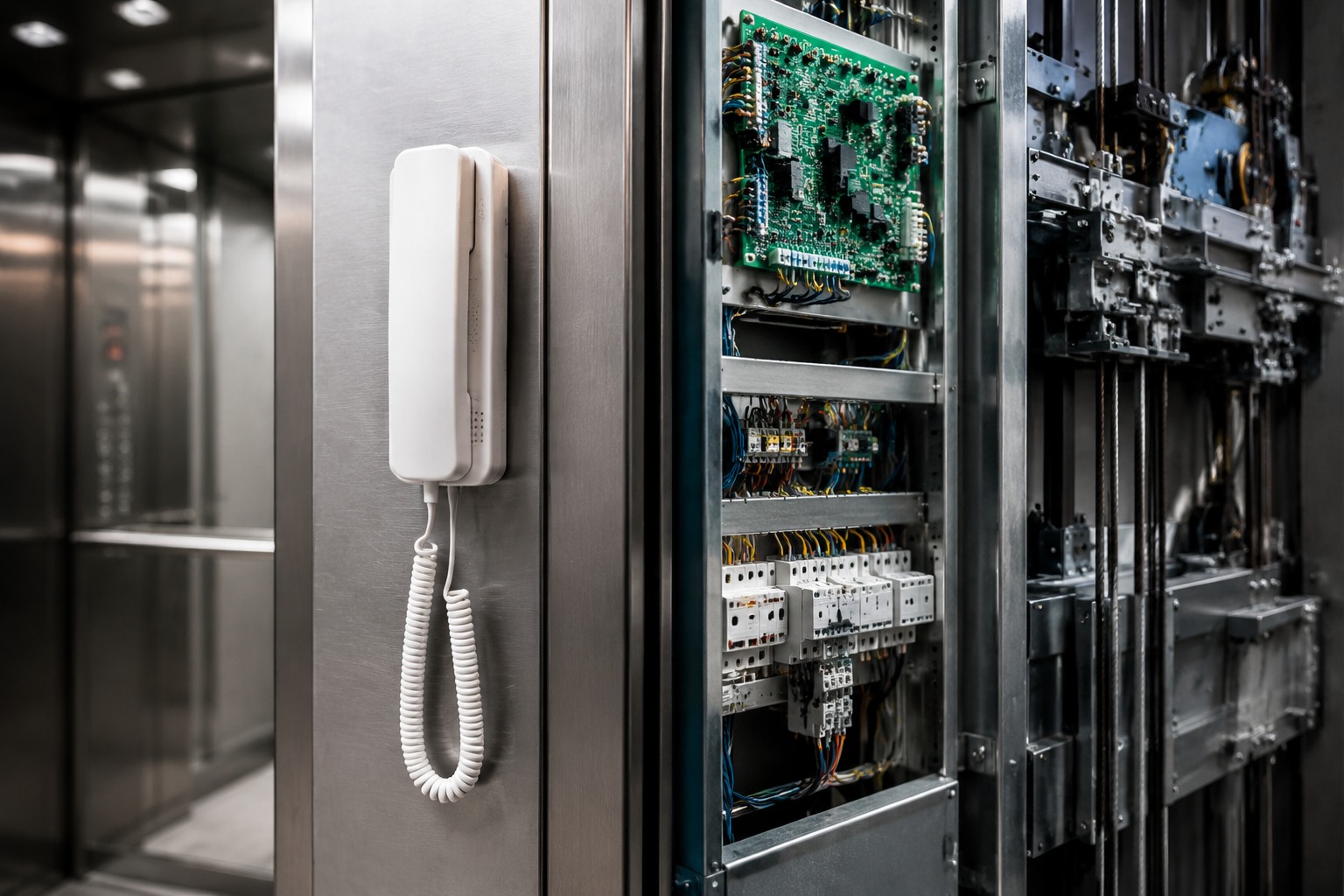
Elevator intercom phones are a basic but critical safety component in passenger lifts. In India, where elevators operate across residential towers, hospitals, IT parks, metro-linked commercial buildings, hotels, industrial campuses, and public infrastructure, a reliable intercom system helps trapped passengers contact security, a control room, maintenance staff, or emergency responders without delay. If a lift stops between floors, loses lighting, experiences a controller fault, or enters emergency mode, the intercom can become the first line of communication. For building owners and maintenance companies, that means intercom performance is not a small accessory issue; it directly affects passenger confidence, rescue coordination, service compliance, and downtime management.
This guide explains how elevator communication phones support emergency calling and code-oriented safety practices, how to compare a car intercom with an intercom terminal, what to check when sourcing Hitachi-related parts, and how to confirm voltage and wiring compatibility before installation. It also covers audio testing, replacement timing, maintenance planning, and practical sourcing advice for the India market, including common needs in Mumbai, Delhi NCR, Bengaluru, Chennai, Hyderabad, Pune, Ahmedabad, Kolkata, Kochi, and fast-growing tier-2 cities where modernization activity is rising.
For buyers who need model-matched replacement components, common product categories include the elevator intercom phone for Hitachi lifts, the intercom system phone assembly, the intercom terminal for elevator communication circuits, and the car intercom 24V/6V unit. Selecting among these products depends on the exact lift model, control architecture, call button arrangement, power supply, and wiring layout already present inside the car and machine room.
In the Indian market, intercom sourcing is often driven by three realities: aging installed bases in older apartments and office buildings, partial modernization projects that keep some original wiring while replacing control devices, and the need for quick dispatch of replacement parts to reduce service interruption. Ports and trade hubs such as Mumbai, Chennai, and Nhava Sheva influence import logistics, while regional service demand is concentrated in urban belts with high elevator density. Because of this, buyers usually prefer suppliers that can support model verification, practical compatibility checks, careful packing, and responsive communication rather than offering generic parts alone.
Why Elevator Intercoms Matter for Passenger Safety
An elevator intercom matters because passengers may not have mobile signal inside the car, may panic during entrapment, and may not know whether help has been notified. A working communication phone reassures the passenger, shortens the time needed to collect fault details, and allows building staff to coordinate rescue steps without confusion. In India’s high-rise housing societies, mixed-use towers, hospitals, and transport-linked buildings, intercom systems are especially valuable when a lift is used by elderly residents, children, patients, visitors, or staff unfamiliar with the building.
Intercoms also support operational discipline. When a trapped passenger can speak directly to a guard desk or maintenance contact, the response becomes more structured. Staff can confirm the number of occupants, whether anyone has a medical issue, whether lighting is available, and whether the lift is stable. This reduces unnecessary forced-door attempts by untrained people and encourages safer rescue procedures. In buildings with multiple cars, it also helps identify the exact lift location and event status faster.
From a compliance and risk-management perspective, emergency communication capability supports the wider objective of safe passenger evacuation and managed emergency response. While exact specifications vary by building type, lift design, and local maintenance practice, building owners generally treat the intercom as part of the essential safety communication chain along with alarms, emergency lighting, ARD or rescue arrangements, and control room coordination.
| Safety Situation | Why Intercom Access Is Needed | Risk If It Fails | Who Responds | Typical Building Type | Priority Level |
|---|---|---|---|---|---|
| Passenger trapped between floors | Immediate voice contact and reassurance | Panic, delayed rescue, false assumptions | Maintenance team and security desk | Residential towers | Very High |
| Power disturbance or blackout | Confirm car condition and occupant status | Confusion during restoration | Facility manager | Commercial buildings | High |
| Door zone fault | Gather symptoms before technician arrival | Repeated shutdown without diagnosis | Lift contractor | Malls and offices | High |
| Medical distress inside lift | Rapid escalation to emergency support | Health risk to passenger | Security and medical staff | Hospitals and hotels | Very High |
| Child or elderly passenger anxiety | Calm communication lowers panic | Unsafe passenger behavior | Concierge or guard | Housing societies | High |
| False alarm or accidental stoppage | Verify whether entrapment is genuine | Unnecessary dispatch and confusion | Control room | IT parks and campuses | Medium |
The table above shows why intercoms are not only for rare emergencies. They are useful in routine fault handling, passenger reassurance, and faster diagnosis. In practice, many service teams in India consider the intercom one of the simplest components to ignore until a breakdown happens, yet one of the most visible failures from the passenger’s point of view.
The line chart indicates a realistic upward trend in demand for elevator communication parts in India. The increase is supported by modernization of older lifts, more high-rise construction, and stronger owner focus on passenger safety and service responsiveness.
Differences Between a Car Intercom and an Intercom Terminal
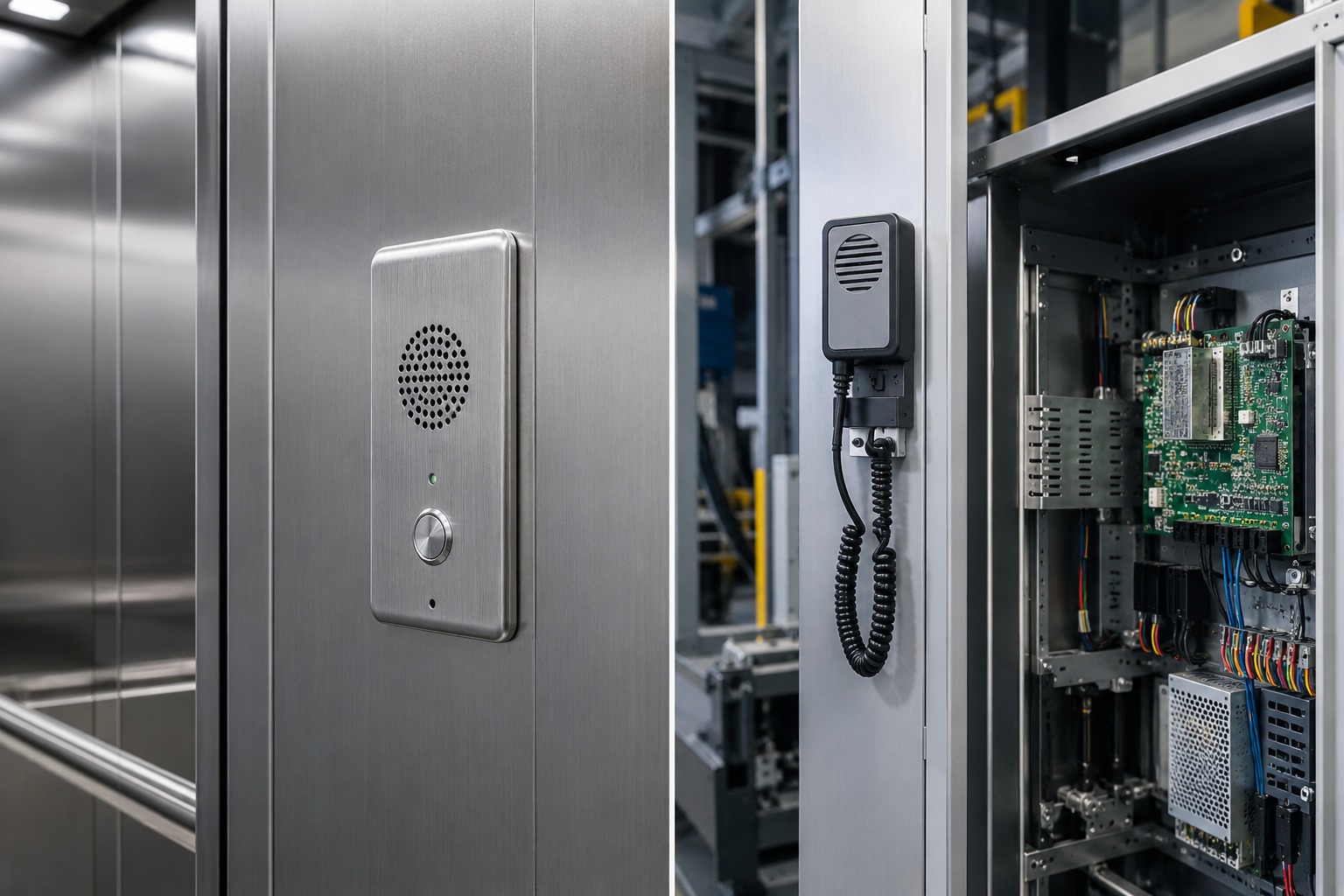
A common sourcing mistake is assuming that every intercom-related part inside a lift is the same. In reality, a car intercom and an intercom terminal usually serve different functions. The car intercom is typically the passenger-facing communication device installed in the lift car or integrated with the COP. It may include a microphone, speaker, handset, push-to-call button, or a compact emergency communication board depending on the design. The intercom terminal, by contrast, is more often the receiving, interface, or connection-side device located in the machine room, guard room, controller cabinet, or communication line network.
When a buyer asks for “the intercom phone,” the supplier should first verify where the device is installed and what role it plays in the communication chain. A car-side unit may need to fit a panel cutout, match a certain faceplate style, or work with existing power and line conditions. A terminal-side unit may need a particular connector type, terminal mapping, communication board interface, or output to the building’s security desk system.
In many Indian modernization projects, the confusion becomes greater because technicians replace only the failed side of the system. If the car unit is changed but the terminal side remains old or miswired, audio may still be weak or non-functional. That is why functional pairing matters.
| Feature | Car Intercom | Intercom Terminal | Typical Location | Main Buyer Concern | Replacement Trigger |
|---|---|---|---|---|---|
| User contact point | Yes, passenger-facing | No, usually backend-facing | Lift car / COP | Fit and call clarity | Mic, speaker, button failure |
| Wiring interface | Basic or dedicated harness | More likely multi-point interface | Controller area / guard room | Terminal mapping | Signal mismatch or corrosion |
| Audio components | Speaker and microphone common | May include line handling | Car vs machine room | Noise and volume | Weak communication |
| Mechanical fit | Important for panel mounting | Less visible but still important | COP / cabinet | Panel dimensions | Broken housing |
| Passenger operation | Button press or handset use | Receive and route call | Car and service point | Ease of use | Call not connecting |
| System dependency | Works with matching backend | Works with matching car-side device | Linked system | Compatibility | Partial modernization issue |
The comparison above helps buyers avoid incorrect orders. If your technician reports “voice problem from the car,” it does not automatically mean the car intercom alone is faulty. The issue could be the terminal, line condition, supply voltage, grounding, loose connector, or even speaker grille blockage caused by dust.
In practical procurement, it is helpful to share photos of the installed unit, connector side, labels, code markings, and the mounting position. This allows more accurate identification and reduces trial-and-error replacement.
Hitachi Intercom Phone Sourcing Notes
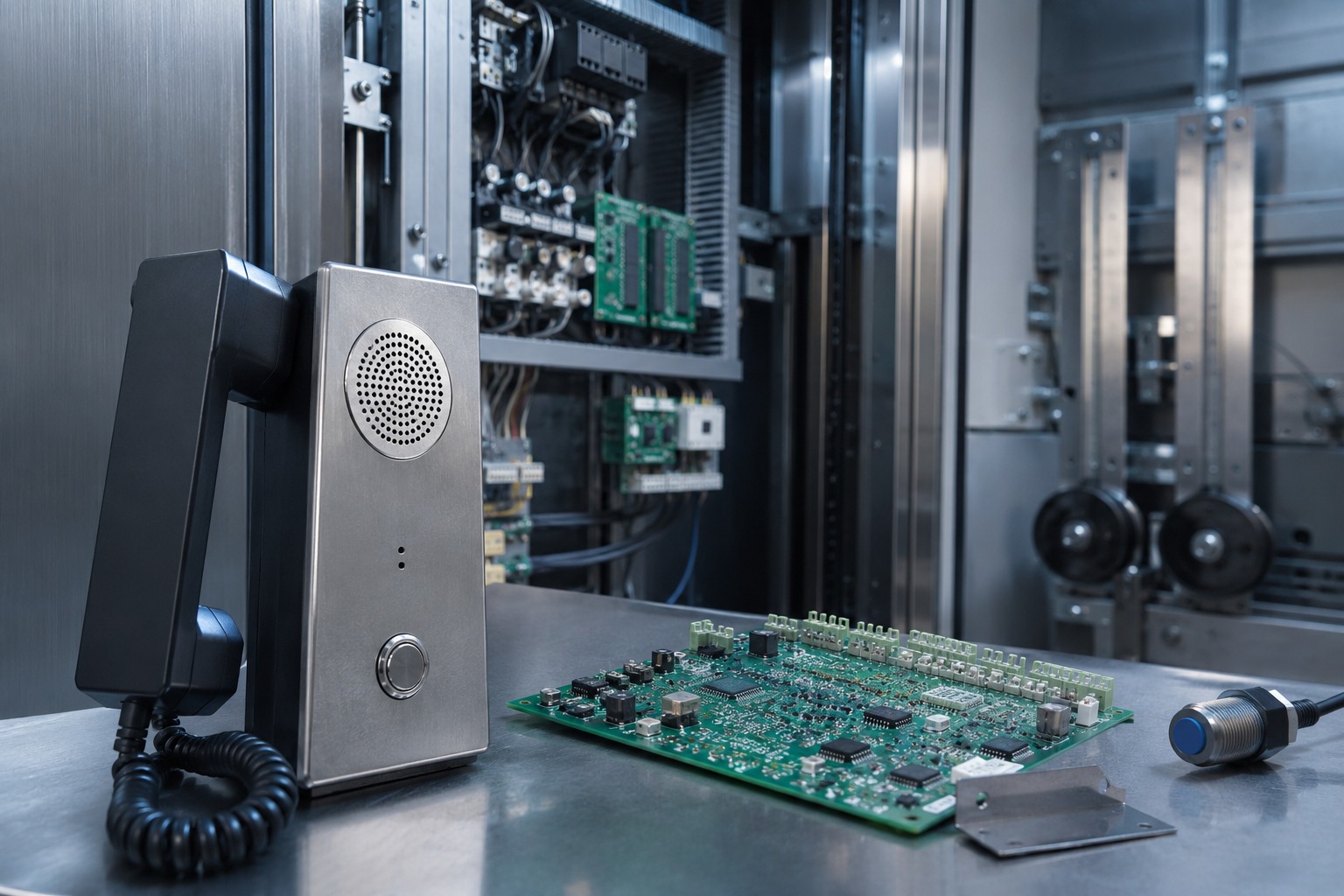
Hitachi elevator communication parts are often requested by maintenance companies and modernization contractors handling installed lifts in apartment projects, commercial towers, hotels, and institutional buildings. Sourcing these parts successfully requires more than matching the brand name. Buyers should verify the elevator model, controller generation, intercom type, voltage rating, faceplate dimensions, cable count, and whether the required item is a standalone phone, a car-side intercom board, a terminal unit, or a broader communication assembly.
When sourcing for India, buyers often deal with one of three situations: an exact replacement for a failed existing part, a compatible part for partial modernization, or a stock purchase for preventive maintenance support. In all three cases, the most useful information includes part photos, label codes, wiring side images, old and new dimensions, and a description of the fault. Good sourcing practice saves time at both the supplier and site level.
Our role in this segment is practical rather than generic. On the technology side, we support careful model matching for elevator control and communication components, review part markings, compare connector arrangements, and confirm likely fitment before dispatch where possible. This is especially important for replacement items connected to established lift circuits, where a visually similar unit may still differ in pinout, voltage, or board revision.
On the manufacturing and quality side, the focus is stable sourcing, inspection of appearance and basic condition, protective packaging for transit, and reducing the chance of damage during domestic distribution or international shipping into India through major logistics corridors such as Mumbai and Chennai. For service capability, responsive communication, photo-based verification, and support for maintenance companies and distributors help reduce downtime when an urgent replacement is required.
| Sourcing Checkpoint | What to Confirm | Why It Matters | Common India Scenario | Recommended Evidence | Outcome |
|---|---|---|---|---|---|
| Brand and model | Hitachi lift series or system code | Avoid generic mismatch | Older apartment lifts | Nameplate photo | Better model accuracy |
| Part function | Phone, system phone, terminal, car unit | Different devices are often confused | Partial service replacement | Installation location photo | Correct item selection |
| Voltage rating | 6V, 12V, 24V or system-specific | Wrong voltage can damage unit | Mixed vintage buildings | Old label and meter reading | Safer installation |
| Connector and wiring | Pin count and cable style | Plug mismatch delays repair | Retrofitted controller rooms | Rear-side close-up photo | Faster site fitment |
| Physical dimensions | Panel opening and mounting points | Car panel fit must match | COP replacement projects | Scale photo or drawing | Less rework |
| Fault description | No audio, low audio, no call, intermittent | Helps identify the real cause | High call volume sites | Technician notes or video | Smarter sourcing decision |
The table shows why procurement should be information-led. In cities such as Bengaluru and Hyderabad, where building uptime is commercially sensitive, maintenance teams increasingly prefer suppliers that can identify a suitable replacement from detailed images and data rather than relying only on broad product labels.
Voltage and Wiring Compatibility Checks
Voltage and wiring compatibility are the most important technical checks before replacing an elevator intercom phone. Many failures described as “dead unit” or “bad audio” are actually power mismatch, loose terminal conditions, reverse polarity issues, oxidized contacts, broken conductor strands, or incorrect line pairing after maintenance work. Because intercom circuits may vary by model and design generation, site technicians should not assume that visually similar parts share the same operating requirements.
For example, a car intercom may be rated for 24V or 6V depending on the lift system. Installing the wrong voltage-rated unit can cause complete non-operation, unstable sound, or permanent damage. Wiring layout matters just as much. Some systems use direct point-to-point wiring, while others route through controller boards, alarm devices, or dedicated communication modules. In older Indian buildings, wiring may also have been modified over time by different contractors, making field verification essential.
Before installation, technicians should inspect cable insulation, terminal tightness, grounding quality, and visible moisture or rust around the controller or machine-room area. In coastal cities such as Chennai, Kochi, and parts of Mumbai, corrosion can affect low-voltage communication lines more quickly than expected. In dusty industrial corridors near Pune, Ahmedabad, or NCR warehouse zones, contamination inside cabinets can also reduce connector reliability.
| Check Item | What to Measure or Inspect | Tool Needed | Acceptable Practice | Risk If Ignored | Technician Tip |
|---|---|---|---|---|---|
| Supply voltage | Actual voltage at input points | Multimeter | Match unit rating exactly | Burned or dead unit | Measure under operating condition |
| Polarity | Positive and negative orientation | Meter and wiring diagram | Follow original marking | No power or damage | Tag wires before removal |
| Pin count | Connector type and number of contacts | Visual inspection | Same as old part | Cannot install properly | Photograph rear side first |
| Continuity | Line continuity from car to terminal | Continuity tester | No open circuit | Call fails despite new part | Test both directions |
| Grounding and noise | Electrical interference sources | Meter and observation | Stable grounding path | Buzzing or low clarity | Separate from noisy power lines if possible |
| Terminal condition | Rust, looseness, heat marks | Visual and screwdriver check | Clean and tight terminals | Intermittent faults | Retighten during replacement |
This compatibility table is useful for maintenance teams because it shifts the process from guesswork to verification. In many service calls, checking power and continuity first can save the cost of replacing a good intercom with another part that will appear faulty for the same reason.
Audio Testing and Call Quality Evaluation
After installation, the intercom should not be considered complete until audio testing is performed. A powered unit that lights up but cannot deliver clear two-way communication is still a failed passenger safety component. Audio testing should include call initiation from the car, successful answer at the receiving point, volume level, clarity, feedback behavior, ambient noise resistance, and consistency over repeated test cycles.
Testing matters because elevator cabins are acoustically challenging spaces. Fan noise, vibration, door operator noise, and shaft-related sound can affect intelligibility. In busy buildings in Delhi NCR or Mumbai, background noise at the security desk can also reduce effective communication even if the hardware is functional. Therefore, testing should be done from the real passenger position and the actual receiving location.
A basic acceptance method is to simulate a trapped-passenger call, ask the receiving operator to repeat the car number, and confirm whether the message is understood without repetition. If the intercom is too soft, distorted, delayed, or crackling, technicians should inspect the microphone path, speaker grille, line condition, and terminal connections. Where multiple elevators connect to a common desk system, cross-call or routing confusion should also be checked.
| Test Step | Procedure | Pass Indicator | Common Failure Symptom | Likely Cause | Corrective Action |
|---|---|---|---|---|---|
| Call initiation | Press emergency call from car | Call reaches desk quickly | No response path | Wiring or terminal issue | Check line and backend unit |
| Voice from car to desk | Speak at normal volume | Words understood clearly | Muffled speech | Mic fault or blocked opening | Clean or replace mic side |
| Voice from desk to car | Reply from receiving point | Passenger hears clearly | Very low volume | Speaker weakness or line loss | Inspect speaker and wiring |
| Repeatability | Test 5 to 10 times | Stable every cycle | Intermittent operation | Loose terminal or unstable power | Retighten and retest |
| Noise check | Run lift and test during motion | Speech still intelligible | Buzzing or interference | Grounding or routing problem | Review cable path |
| Identification check | Confirm desk identifies lift | Correct car is recognized | Wrong car mapping | System configuration issue | Check terminal assignment |
This table shows that audio quality checks should cover both hardware and system behavior. A successful test is not simply hearing a tone; it is achieving clear, repeatable communication under real operating conditions.
The bar chart highlights where replacement demand is strongest in India. Residential towers dominate because of the large installed base and frequent daily use, while commercial and hospital segments also show steady need due to uptime sensitivity and occupant safety expectations.
When to Replace Old Intercom Parts
Old intercom parts should be replaced when reliability drops below acceptable safety standards, not only when they fail completely. Warning signs include intermittent audio, crackling sound, low volume, repeated call failure, broken call buttons, loose handset housing, corrosion on contacts, aged cable insulation, or cosmetic damage that exposes internal components. For building managers, the right replacement timing balances risk, service continuity, and cost.
There are two broad replacement approaches. The first is reactive replacement after failure. This is common in budget-sensitive residential societies but often causes passenger complaints and emergency urgency. The second is planned replacement during preventive maintenance or modernization, where aging intercoms are changed before complete failure. In high-traffic properties such as hospitals, premium apartments, large office parks, and hotels, planned replacement is usually the better choice.
In older Indian buildings, intercom devices may remain installed for many years even after repeated repairs. Once a unit has unstable sound, missing buttons, incompatible previous modifications, or recurring line faults linked to worn terminals, replacement is normally more efficient than repeated patch repairs. This is especially true when the lift already requires COP updates, controller service, or partial rewiring.
From a lifecycle perspective, replacement should also be considered when spare part availability becomes uncertain, when matching the original unit is increasingly difficult, or when multiple cars in the same building show similar wear. Standardizing the communication parts across several lifts can simplify maintenance planning and spares inventory.
Maintenance Tips for Building Managers
Building managers in India often focus on major lift breakdowns, but communication devices deserve a place in routine maintenance checklists. A simple monthly functional test can prevent a serious complaint later. Management teams should make sure that each lift intercom can place a call, that the receiving point is staffed or monitored, and that responsibility for answering calls is clearly assigned.
Best practice includes documenting the intercom model, voltage, wiring notes, replacement history, and test results for each elevator. This is especially useful in large apartment complexes in Pune or Hyderabad, where several towers may use similar but not identical equipment. Keeping a basic record reduces confusion when one unit fails unexpectedly.
Environmental care matters too. Moisture, dust, and vibration affect communication parts over time. Machine-room and control cabinets should be kept dry and reasonably clean. COP faceplates should be checked for loose mounting screws, cracked microphone openings, and passenger damage. In buildings close to the sea or high-humidity areas, extra attention to terminals and corrosion is recommended.
Service planning is another key point. If a property relies on multiple lifts and one intercom type is known to age poorly, managers should discuss stocking one or two critical spare units with their maintenance contractor. This reduces wait time if a failure occurs. For projects with imported parts, lead time can be important, so advance planning is often cheaper than emergency freight.
| Maintenance Task | Recommended Frequency | Purpose | Who Should Do It | Common Finding | Manager Action |
|---|---|---|---|---|---|
| Test emergency call | Monthly | Confirm live communication path | Maintenance technician | No answer or weak audio | Raise service ticket immediately |
| Inspect COP intercom opening | Monthly | Check visible damage or blockage | Site staff | Dust or vandalism | Clean and report if damaged |
| Check terminal tightness | Quarterly | Prevent intermittent faults | Qualified technician | Loose or oxidized terminals | Retighten and document |
| Review call receiving process | Quarterly | Ensure someone answers promptly | Facility manager | Desk confusion or missed calls | Train staff and update SOP |
| Compare fault history | Half-yearly | Find recurring weak components | Manager and contractor | Repeated same-car complaint | Plan replacement |
| Spare stock review | Half-yearly | Reduce downtime risk | Procurement or contractor | No spare for critical model | Order compatible stock |
The maintenance table above is practical for building managers because it links each task with a clear action. Intercom care does not require a large budget, but it does require consistency and accountability.
The area chart reflects a realistic trend in India: more building owners are moving from emergency-only replacement to planned modernization and preventive spares stocking. This supports better passenger safety and lower downtime over time.
India Market, Applications, and Buyer Guidance
The market for elevator intercom phones in India is shaped by a large and mixed installed base. New construction in cities like Gurugram, Noida, Bengaluru, Hyderabad, Chennai, and Pune creates demand for complete communication systems, while older towers in Mumbai, Kolkata, and central business districts often require replacement parts for legacy installations. Residential societies remain the biggest application segment because they combine high unit counts with constant daily use. Hospitals and hotels, however, usually place a higher value on immediate response and audio clarity because the consequence of delayed communication can be more serious.
Applications go beyond passenger rescue. Intercoms support service coordination during maintenance, fault reporting from attendants in certain buildings, and communication during controlled evacuation or technical inspection. They are relevant in residential towers, office buildings, malls, hospitals, warehouses with passenger lifts, educational campuses, metro-adjacent developments, and mixed-use complexes.
For buying advice, the most reliable process is this: identify the part function, collect photos and labels, confirm voltage, verify wiring and dimensions, check whether the issue is on the car side or terminal side, and test the line before ordering. If the lift is a Hitachi system or a compatible communication setup related to Hitachi parts, it is wise to compare the requested item with the old installed device rather than ordering by general description alone.
Local availability can vary. Some city-based traders may offer fast delivery for common items, but not all can support technical matching. A specialized elevator parts supplier can be more valuable when the requirement involves model variation, hard-to-find communication components, or the need to combine sourcing with packaging discipline and service support. This is particularly useful for maintenance contractors covering multiple sites across states.
Technology, Manufacturing, and Service Capabilities
Buyers in India increasingly expect suppliers to contribute more than a price quote. On technological capability, effective support means understanding elevator component relationships, comparing part codes, reviewing wiring photos, and helping maintenance teams reduce mismatch risk. For intercom phones, that includes attention to voltage classes, connector types, mechanical fit, and likely compatibility with existing control and communication arrangements. This kind of practical matching is valuable during both emergency replacement and planned modernization.
On manufacturing and sourcing capability, consistency is important. Elevator communication devices and related accessories should come from controlled supply channels, receive visible-condition checks, and be packed carefully for transport. Protective packaging matters because intercom components can be affected by impact, moisture, and connector damage during shipping. For buyers receiving goods through major trade routes into India or redistributing them to service branches in different cities, reliable packing and stable product handling reduce avoidable loss.
On service capability, responsiveness can be as important as the product itself. Maintenance companies, distributors, building owners, and modernization contractors often need quick clarification on photos, labels, dimensions, and equivalent options. A supplier that replies promptly, helps organize model information, and supports after-order communication can shorten downtime. This matters especially in urban service markets where technicians may need a decision within hours rather than days.
Case Examples from the Field
In a residential high-rise cluster in Navi Mumbai, a maintenance contractor faced repeated complaints that the emergency call button worked only intermittently in two out of six lifts. The first assumption was that the car intercom units had failed. After voltage checks and continuity testing, the actual cause turned out to be corroded terminal-side connections combined with one weakened car speaker. Replacing only the backend terminal would not have solved every complaint, and replacing all car units would have wasted budget. A mixed corrective approach restored communication quality and reduced callbacks.
In a hospital project in Chennai, staff requested proactive replacement of old communication phones because one unit had low audio and another had a cracked front assembly. Since patient movement and emergency sensitivity were high, the facility chose planned replacement during a maintenance window instead of waiting for complete failure. The site also documented each lift’s communication circuit details for future procurement. This reduced uncertainty for later spare orders.
In Bengaluru, an office park modernization contractor needed a communication part for a Hitachi-related lift system where the original unit was physically worn and label markings were partially faded. Part identification was completed using installation photos, dimensions, connector layout, and voltage confirmation. This kind of case is common in India: visual degradation of old parts makes exact code reading difficult, so structured comparison becomes essential.
Supplier Comparison and Product Selection Priorities
When comparing suppliers or product options, building owners and contractors should score more than just price. Delivery reliability, model matching support, communication speed, packaging quality, and willingness to review technical evidence all influence the success of an intercom replacement project. The lowest-cost part can become the most expensive choice if it causes repeated site visits or passenger complaints.
The comparison chart illustrates why specialized sourcing support is often preferred for elevator communication parts. In the India market, particularly for brand-specific or legacy components, technical matching and service responsiveness can directly influence repair speed and successful installation.
Future Trends for 2026: Technology, Policy, and Sustainability
Looking toward 2026, elevator intercom systems in India are likely to evolve in three connected directions. First, technology will move toward clearer integrated communication modules, more compact designs, better noise handling, and improved compatibility with broader emergency communication systems. In premium projects, there may also be greater integration between elevator alerts, guard room systems, and building management platforms.
Second, policy and safety expectations are likely to push building owners toward more consistent testing and documentation of emergency communication functions. Even where the intercom hardware itself remains simple, property managers and contractors will be expected to prove that the communication path works reliably. That favors routine test logs, clearer maintenance SOPs, and faster replacement of aging parts.
Third, sustainability will influence procurement. Instead of replacing entire elevator systems unnecessarily, more owners will choose targeted modernization: replacing communication devices, control boards, door parts, and accessories that extend the life of the lift safely. This approach reduces waste, supports cost control, and fits the practical reality of India’s huge installed base. Suppliers that can provide compatible replacement parts with stable quality and reduced mismatch risk will remain important in this transition.
FAQ About Elevator Intercom Phones
1. What is the main purpose of an elevator intercom phone?
Its main purpose is to provide two-way communication between passengers inside the lift car and a receiving point such as security, maintenance, or a control room during entrapment or fault conditions.
2. Is a car intercom the same as an intercom terminal?
No. The car intercom is usually the passenger-facing unit inside the lift. The intercom terminal is often the backend or receiving/interface unit. Both must be compatible for the system to work well.
3. Why does an intercom have power but no voice?
Common causes include wrong wiring, poor terminal contact, damaged microphone or speaker, line continuity issues, grounding noise, or mismatch between the car unit and the terminal unit.
4. How do I know whether I need 6V or 24V?
Check the old part label, system documentation, or measure the actual supply at the site with a qualified technician. Never guess based on appearance alone.
5. Can an old lift in India be upgraded with a replacement intercom without changing the whole system?
Often yes, but compatibility must be checked carefully. Partial modernization is common, especially in residential and commercial buildings.
6. What information should I send when asking for a quote?
Send clear photos of the front and rear sides, part labels, connector details, dimensions, wiring arrangement, installation location, and a short description of the fault.
7. How often should intercom phones be tested?
A monthly functional test is a good baseline for many buildings, with more detailed inspection during scheduled elevator maintenance.
8. When should a building manager replace rather than repair?
Replacement is usually better when the unit has recurring audio failure, broken housing, severe corrosion, uncertain spare availability, or repeated service calls for the same issue.
9. Are Hitachi intercom parts easy to source in India?
Availability depends on the exact model and part type. Sourcing becomes much easier when you provide labels, photos, and technical details for accurate matching.
10. Which products are commonly requested?
Common requests include car intercom units, intercom phones, complete intercom system phones, and intercom terminals, especially for replacement and modernization jobs.
In summary, elevator intercom phones are essential to passenger safety, emergency communication, and professional maintenance performance in India. The best results come from correct part identification, voltage and wiring verification, proper audio testing, and planned replacement of aging components. Whether the requirement is for a single residential lift in Pune, a hospital system in Chennai, a hotel in Mumbai, or a commercial tower in Gurugram, careful sourcing and compatibility checks help keep lifts operating safely and reduce avoidable downtime.