
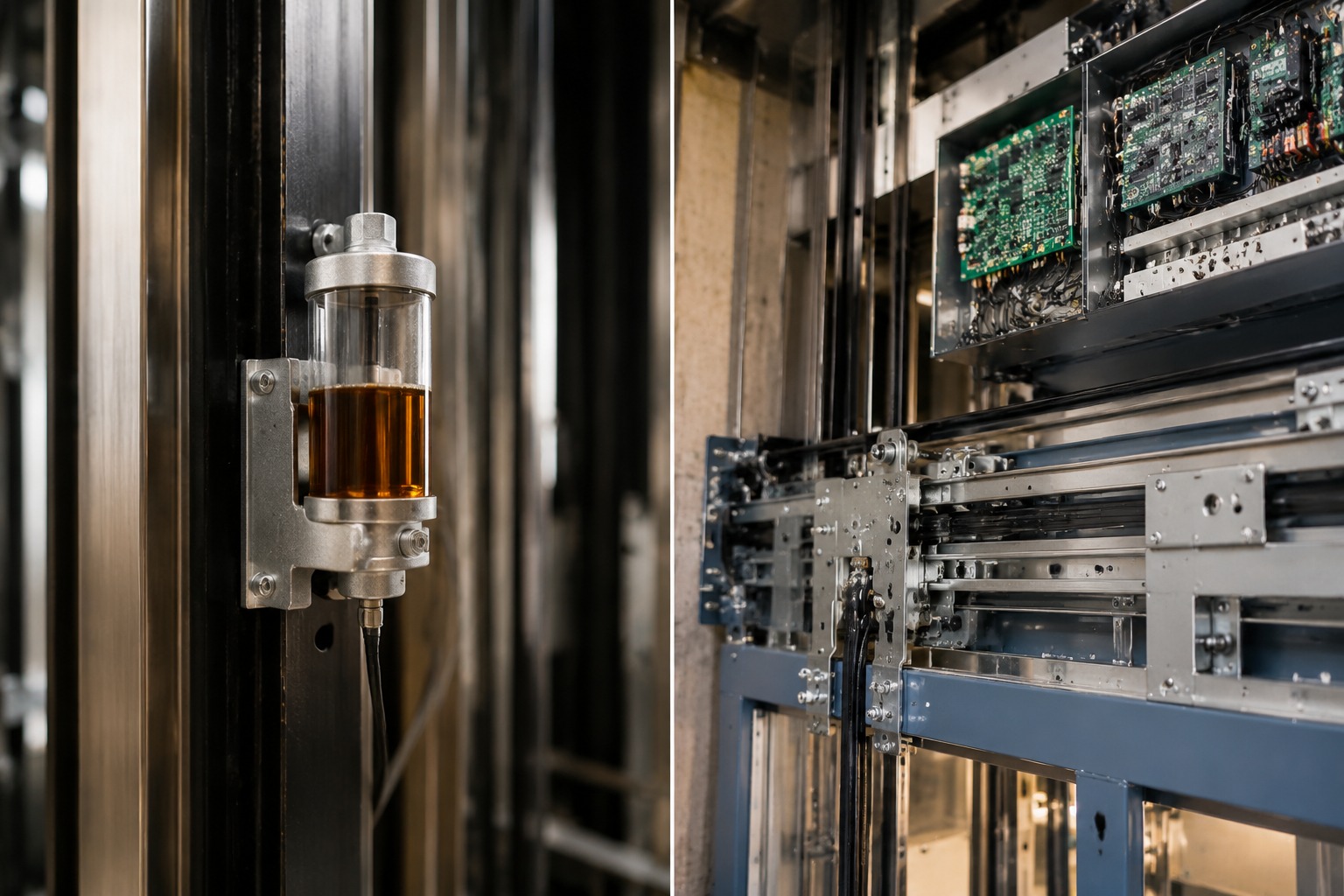
Guide rail lubrication is a small maintenance task with a very large impact on elevator reliability. In practical terms, a correctly selected elevator oil cup, a properly fitted felt pad, and a clean bottom pit oil collection box help reduce rail wear, support smoother travel, lower noise, and keep the shaft cleaner. For maintenance teams in India, where elevators operate under heavy passenger traffic, dust, humidity, coastal corrosion, and long duty cycles in cities such as Mumbai, Chennai, Bengaluru, Hyderabad, Delhi NCR, Pune, Ahmedabad, and Kolkata, lubrication control is not optional. It is part of preventing premature guide shoe wear, jerky motion, rail scoring, excessive oil dripping, and avoidable shutdowns.
The most direct answer is simple: elevator oil cups meter lubricant onto the guide rail, felt pads spread and regulate that oil into a controlled film, and oil collection boxes help capture excess oil at the pit level. When these three items are matched correctly to the rail condition, speed, guide shoe type, and machine-room or machine-room-less layout, the lift runs more consistently and service intervals become easier to manage. If any one of them is ignored, the result is usually either under-lubrication or over-lubrication, both of which create maintenance problems.
In the Indian market, buying decisions are increasingly shaped by modernization projects, mixed-brand building portfolios, and the need for compatible replacement parts. Maintenance companies and distributors often handle older commercial lifts, hospital elevators, residential towers, logistics facilities, and hotels using different controller and door system brands. In those cases, it helps to source oil cups and related accessories from a supplier that focuses on careful model matching, stable quality inspection, protective packaging, and responsive support rather than only low unit price. For those looking for a broader overview of elevator oil cup options for lift accessories, understanding the application environment first will lead to better selection.
India is also a strong elevator growth market. New metro corridors, mixed-use high-rises, industrial parks, medical infrastructure, and modernization of older buildings continue to increase demand for guide rail consumables and lubrication accessories. Ports and trade hubs such as Nhava Sheva, Chennai Port, Mundra, and Kolkata influence how quickly imported parts move, but local inventory planning remains critical because even a low-cost lubrication component can stop preventive maintenance if the right size or style is unavailable.
The chart above reflects a realistic upward demand trend driven by new installations and modernization. Even though oil cups and felt pads are small parts, they move with the wider elevator service market. As service fleets expand, maintenance teams require more consistent part standardization, especially for contracts covering multiple sites in one city.
Why guide rail lubrication matters
Guide rails do more than guide movement. They help maintain car and counterweight alignment, support smooth travel, and influence ride comfort. Lubrication matters because the contact between guide elements and rails generates friction. In systems where lubrication is specified, the rail surface needs a stable, thin film of oil rather than dry contact or uncontrolled dripping. Too little lubricant can accelerate wear, produce scraping marks, increase noise, and put more stress on guide shoes or inserts. Too much lubricant can contaminate the pit, attract dust, stain shaft surfaces, and create housekeeping and safety problems.
In India, these issues are amplified by environment. Coastal cities like Chennai, Kochi, and Mumbai can expose elevator shafts and metal surfaces to higher humidity and corrosion risk. Dry and dusty conditions in parts of Rajasthan, Gujarat, and central India can cause oil films to trap abrasive particles if lubrication is excessive or poorly controlled. In high-traffic residential towers in Gurugram, Noida, Thane, and Whitefield, elevator cycles are frequent enough that even minor lubrication errors become visible in wear patterns over time.
Well-managed guide rail lubrication brings several benefits:
- Reduced friction between guide surfaces and rails
- Lower chance of rail scoring and surface damage
- More stable ride quality with less vibration and chatter
- Extended life of guide shoes, liners, and related consumables
- Cleaner pit conditions when excess oil is collected properly
- Lower maintenance disruption and easier inspection planning
| Lubrication Condition | Typical Rail Surface Result | Ride Quality Effect | Impact on Guide Shoes | Housekeeping Effect | Maintenance Outcome |
|---|---|---|---|---|---|
| Correct oil film | Even, light protective coating | Smooth and stable | Normal wear rate | Clean shaft and pit | Predictable service intervals |
| Under-lubricated | Dry marks and abrasion lines | Noise or slight jerking | Faster wear | Little visible oil | Frequent inspections needed |
| Over-lubricated | Wet streaks and oil run-off | Usually smooth at first | Can mask wear issues | Dirty pit and dripping | More cleaning and waste |
| Contaminated oil | Dark deposits on rail | Inconsistent movement | Abrasive wear risk | Sticky residue | Requires flushing and replacement |
| Uneven pad contact | Patchy lubrication zones | Intermittent vibration | Localised wear | Irregular drips | Adjustment and pad change |
| Wrong oil viscosity | Either too dry or too wet | Seasonal inconsistency | Reduced protection | Possible leakage | Need to review specification |
This comparison shows why lubrication should not be treated as a simple refill task. The result depends on oil grade, cup design, felt condition, mounting position, and travel duty. For building owners, proper lubrication helps reduce nuisance complaints. For maintenance contractors, it lowers callback risk and supports better compliance records.
Types of elevator oil cups
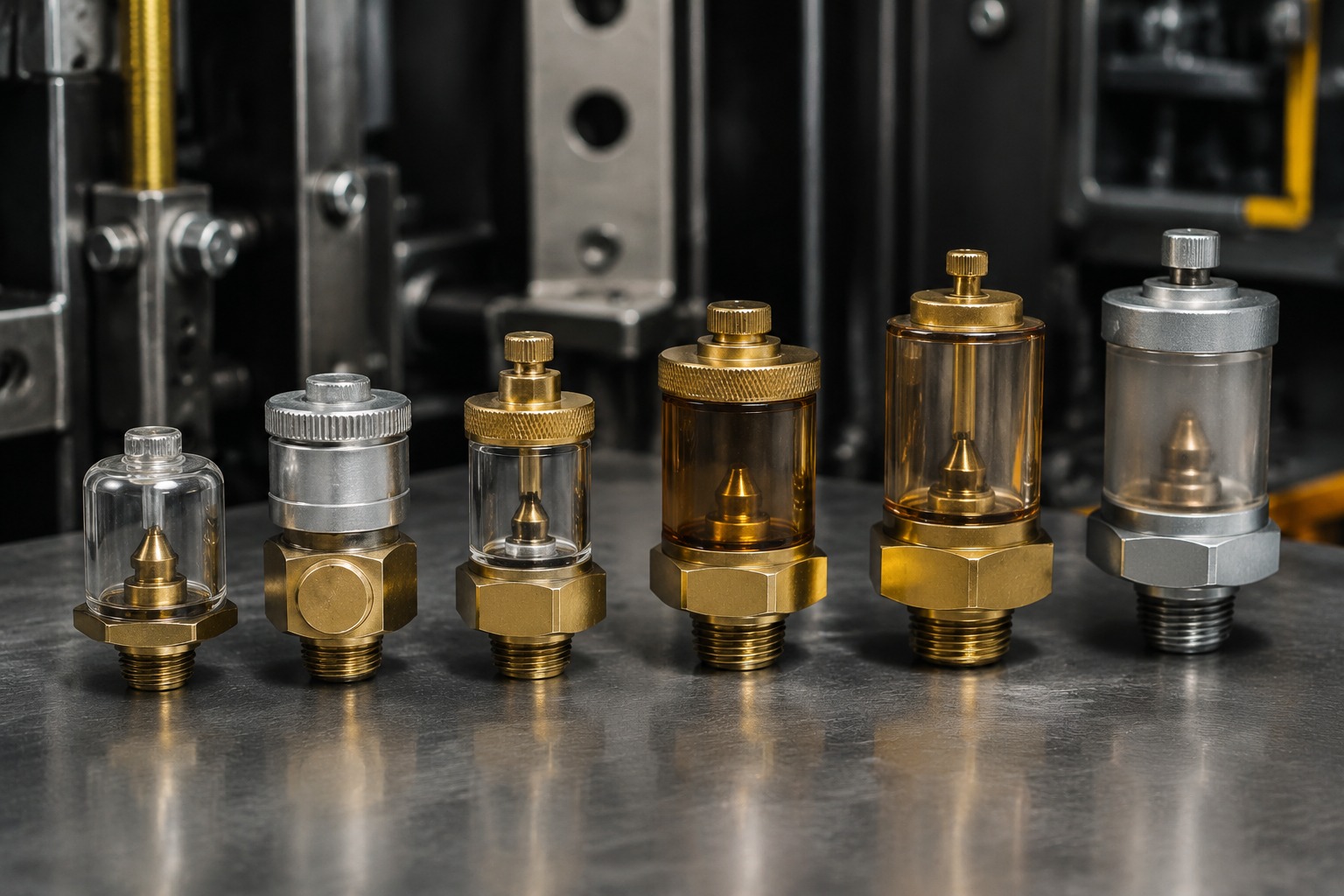
Elevator oil cups are available in several formats, and selection depends on shaft layout, available installation space, rail profile, and expected oil delivery rate. Common types include standard side-mounted cups, compact square cups, machine-room-less small square cups, and design variants intended to work with specific felt pad geometries. Some are selected mainly for accessibility; others are chosen because restricted shaft clearance demands a smaller body.
For many traditional installations, general-purpose oil cups remain the practical starting point. Where the service team needs a standard replacement for regular lubrication, a broad range of oil cup elevator parts and lift accessories can cover multiple maintenance applications. In tighter layouts, especially newer compact shafts, the available mounting space may point toward smaller form factors.
Machine-room-less elevators deserve special attention because they often use space-saving arrangements that leave less room for maintenance access. In these cases, a small square oil cup for machine-room-less elevator applications may be more suitable than a larger conventional cup. Compact dimensions help simplify installation while still allowing controlled lubricant delivery when paired with the correct felt pad.
| Oil Cup Type | Typical Application | Main Advantage | Possible Limitation | Best For | Selection Note |
|---|---|---|---|---|---|
| Standard oil cup | Conventional passenger lifts | Widely used and easy to replace | May need more space | Routine service portfolios | Check mounting compatibility |
| Square oil cup | General compact shafts | Efficient footprint | Model variation by size | Mixed commercial buildings | Confirm rail and bracket fit |
| Small square MRL oil cup | Machine-room-less lifts | Fits restricted spaces | Lower reservoir size in some models | Modern residential towers | Review refill frequency |
| Heavy-duty cup | Freight or high-use lifts | Supports longer running cycles | Can be bulkier | Industrial and logistics sites | Match with duty pattern |
| Brand-compatible replacement cup | Modernization and mixed fleets | Reduces fitting issues | Needs accurate model matching | Contract maintenance firms | Verify dimensions carefully |
| Cup with dedicated felt system | Controlled lubrication setups | More even oil spread | Pad must be maintained | Premium ride quality projects | Replace pad on schedule |
From a buying perspective, the right oil cup is not simply the cheapest one that can be mounted. The right choice is the one that maintains controlled lubrication over time without creating leakage, difficult refilling, or fitment issues. Indian service companies working across different OEM and non-OEM sites often benefit from maintaining a cross-reference list by rail size, car speed, and shaft configuration.
The industry demand distribution above is realistic for the Indian service ecosystem. Residential and commercial properties together create large replacement volume because of high unit counts, while hospitals and industrial sites require stricter uptime and cleaner lubrication management.
How felt pads control oil flow
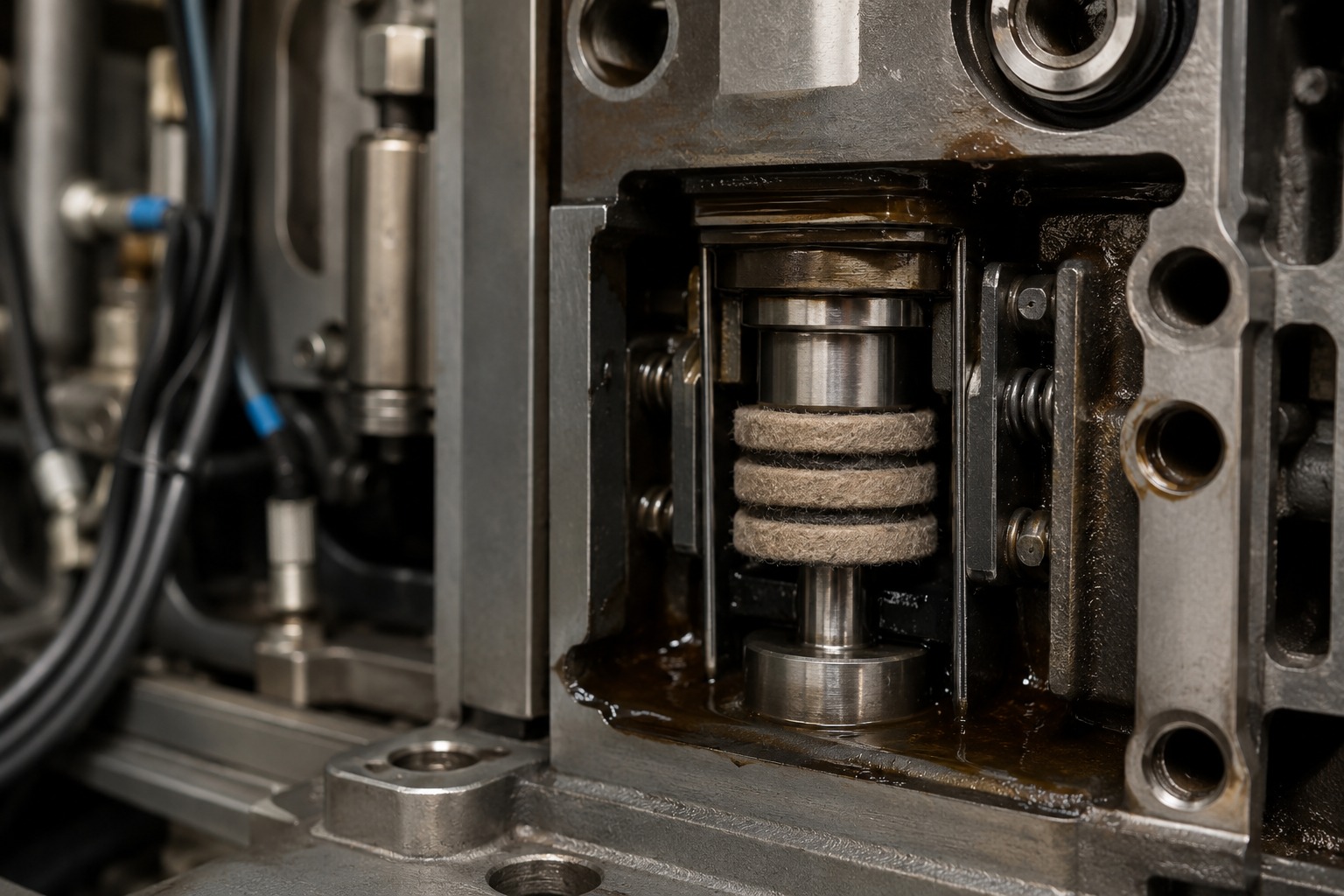
Felt pads are the quiet workhorses of guide rail lubrication. Their job is not just to hold oil; they meter it, spread it, and maintain contact with the rail so that lubricant is delivered gradually rather than dumped at one point. A good felt pad absorbs oil from the cup reservoir, transfers it evenly to the rail surface, and helps prevent uncontrolled dripping. When the felt hardens, becomes contaminated, wears unevenly, or loses proper pressure against the rail, lubrication performance changes immediately.
For maintenance teams, felt pad quality matters as much as oil cup quality. A correct cup with a poor felt insert still causes inconsistent lubrication. That is why many buyers source oil cup felt pads and cotton felt lift accessories together rather than treating them as unrelated items. Doing so makes replacement timing easier and improves consistency across service visits.
Felt pads control oil flow through four mechanisms:
- Absorption: the felt stores a measured amount of oil
- Capillary action: oil moves through the felt material gradually
- Surface contact: the felt touches the rail and spreads a thin film
- Resistance: the felt slows down rapid discharge and dripping
When selecting felt pads, technicians should review density, thickness, shape, edge finish, and resistance to contamination. Low-grade felt can compress too quickly or shed fibers. A pad that is too dense may starve the rail of oil, while one that is too loose may leak excessively. In dusty environments, replacement intervals may need to be shorter because debris can reduce capillary performance.
| Felt Pad Condition | Oil Flow Pattern | Visible Symptom | Rail Protection Level | Recommended Action | Risk if Ignored |
|---|---|---|---|---|---|
| New and correctly fitted | Stable and even | Light oil film only | High | Monitor during routine PM | Low |
| Compressed with age | Reduced transfer | Dry sections on rail | Medium to low | Replace pad | Wear marks develop |
| Over-saturated | Excess discharge | Dripping or oil streaking | High but messy | Check oil level and pad fit | Pit contamination |
| Contaminated by dust | Blocked and uneven | Dark residue on rail | Low | Clean or replace | Abrasive contact |
| Misaligned contact | One-sided lubrication | Patchy rail film | Uneven | Refit pad and bracket | Local rail wear |
| Incorrect pad density | Too slow or too fast | Either dry rail or leakage | Unreliable | Use correct specification | Repeat service calls |
The explanation from this table is straightforward: felt pads regulate oil behavior more than many people expect. In modernization projects across cities like Pune and Bengaluru, older brackets may still be usable, but replacing the felt pads with the correct specification can significantly improve lubrication control without major mechanical changes.
Machine room less oil cup selection
Machine-room-less elevators are now common across Indian residential towers, offices, and mixed-use developments because they save building space and support modern architectural planning. However, MRL layouts also create more demanding maintenance conditions. Access can be tighter, component positioning is more compact, and service teams may have less room to install standard lubrication accessories. This is why oil cup selection for MRL elevators should focus on fit, refill practicality, leak control, and compatibility with rail arrangement.
A compact MRL small square oil cup is often preferred where shaft clearances or bracket geometry restrict the use of larger units. But cup size alone is not the full answer. Selection should consider:
- Available bracket space near the rail
- Ease of access during regular maintenance
- Oil reservoir capacity versus refill interval
- Felt pad dimensions and contact pressure
- Risk of leakage onto nearby equipment or shaft surfaces
- Compatibility with modernization retrofits
In high-rise MRL projects in Mumbai, Gurugram, and Hyderabad, service contractors often balance two priorities: keeping maintenance access manageable and reducing repeat visits for refilling. A very small reservoir may fit well but require more frequent inspection. A slightly larger compact unit may be the better operational compromise if space allows. Building use matters too. A low-traffic boutique residential tower and a busy IT park elevator do not need the same lubrication planning.
| MRL Selection Factor | Why It Matters | Low-Risk Choice | Warning Sign | Typical Site Example | Buying Advice |
|---|---|---|---|---|---|
| Compact body size | Prevents interference in tight shaft spaces | Square or small-profile design | Cup rubs nearby parts | Urban residential MRL towers | Measure before ordering |
| Reservoir capacity | Affects refill frequency | Balanced medium volume | Frequent dry running | High-use office lifts | Match with traffic level |
| Leak control | Important in compact layouts | Secure seal and stable felt | Oil on shaft hardware | Premium commercial buildings | Check sealing quality |
| Service access | Reduces maintenance time | Easy refill point | Technician cannot reach safely | Retrofit modernization sites | Review actual shaft access |
| Compatibility with rail setup | Ensures proper contact | Model-matched bracket | Uneven rail film | Mixed-brand building portfolio | Confirm dimensions with supplier |
| Pad replacement availability | Keeps long-term maintenance simple | Standard felt support | No matching pad in stock | Regional maintenance depots | Buy cup and pads together |
As the MRL segment grows in India, future trends toward smarter maintenance will likely include digital service logs tied to consumables replacement, helping building owners see lubrication history and reducing undocumented service gaps.
Bottom pit oil collection box use cases
An oil collection box at the bottom pit is often overlooked until the pit becomes visibly dirty. Yet it serves an important housekeeping and maintenance function by collecting excess lubricant that travels down the rail. In many buildings, especially older ones or sites where lubrication has been inconsistent, a collection box helps contain oil and prevent the pit floor from becoming slippery or messy. It also makes inspection easier because technicians can see whether oil accumulation is within a normal range or indicates over-lubrication higher up the shaft.
For this purpose, many service teams choose a square bottom pit oil collection box for elevator applications that suits shaft dimensions and provides easy removal or cleaning. These boxes are especially useful in commercial towers, hospitals, hotels, and modernization projects where cleanliness and audit readiness matter.
Typical use cases include:
- Elevators with long travel where excess oil naturally moves downward
- Older systems with legacy lubrication setups
- Buildings where pit cleanliness is part of maintenance compliance checks
- Installations in dusty environments where oil can trap debris
- Sites where water ingress or humidity makes contamination control important
- Modernization projects seeking better pit management without major redesign
In Indian conditions, bottom pit oil collection becomes even more relevant during monsoon seasons, when any combined moisture and oil residue can create dirt build-up faster. In basements in Mumbai, Chennai, and Kolkata, where humidity management is already a concern, having a collection box supports cleaner preventive maintenance.
This area chart reflects the gradual shift from basic lubrication to controlled lubrication plus collection management. The trend is driven by better maintenance standards, more MRL installations, and stronger focus on clean pits in premium properties.
Inspection and replacement schedule
There is no single replacement date that fits every elevator, because rail condition, traffic, environment, oil type, and cup size all affect wear and consumption. However, a practical inspection schedule helps avoid surprises. Most maintenance companies in India already follow monthly or periodic preventive visits, and lubrication components should be included as check items instead of being reviewed only after noise or leakage appears.
A sensible schedule is to inspect oil level, felt pad contact, visible rail film, and signs of dripping during every regular service visit. More detailed review of pad condition, cup mounting security, and pit oil accumulation can be done monthly or quarterly depending on traffic. Replacement frequency often increases in harsh environments such as dusty industrial areas, coastal buildings, or high-cycle residential towers.
| Inspection Item | Recommended Frequency | What to Check | Acceptable Condition | Replace or Correct When | Notes for Indian Sites |
|---|---|---|---|---|---|
| Oil level in cup | Every service visit | Reservoir fill status | Sufficient for interval | Low or empty | Hot climates may affect viscosity behavior |
| Felt pad contact | Every service visit | Rail touch and alignment | Even contact across surface | Loose, skewed, or lifted | Common issue after vibration |
| Felt pad condition | Monthly or quarterly | Compression, dirt, hardness | Clean and absorbent | Contaminated or worn | Dusty sites need faster change |
| Rail oil film | Monthly | Consistency along travel path | Light, even film | Dry patches or heavy streaking | Check seasonal changes |
| Oil cup bracket security | Quarterly | Fasteners and position | Stable mounting | Movement or misalignment | Important in older retrofits |
| Pit oil collection box | Monthly or as needed | Accumulation and contamination | Managed collection level | Overflow or debris build-up | Monsoon periods need closer watch |
The explanation here is that inspection should be tied to actual operating conditions rather than only a calendar. For example, a hospital elevator in Delhi operating continuously may need closer felt monitoring than a lightly used residential lift in a small town. Likewise, a coastal hotel in Goa may need more attention to contamination and corrosion than an inland office lift with moderate use.
Common lubrication mistakes
Most lubrication problems come from simple errors repeated over time. One common mistake is overfilling the oil cup, assuming more oil means better protection. In reality, excess oil can flood the felt, drip into the pit, attract dirt, and mask underlying wear issues. Another mistake is using the wrong oil grade. If the oil is too thin, it may run quickly and fail to maintain a stable film. If it is too thick, it may not transfer properly through the felt pad.
Other frequent mistakes include reusing hardened felt pads, ignoring dry sections on the rail, fitting a cup that does not align correctly with the rail path, and failing to inspect the pit collection area. Some buildings also use mixed replacement parts without confirming compatibility, especially during emergency repairs. That approach can create short-term function but poor long-term lubrication control.
Below are errors that maintenance supervisors should train teams to avoid:
- Installing an oil cup without checking bracket and rail alignment
- Replacing only the cup while leaving a worn felt pad in place
- Ignoring oil contamination from dust or rust particles
- Choosing parts only by appearance instead of dimensions and fit
- Skipping pit collection box cleaning until overflow occurs
- Using one lubrication setup across all elevator duty types
| Common Mistake | Why It Happens | Immediate Effect | Long-Term Effect | How to Prevent It | Priority Level |
|---|---|---|---|---|---|
| Overfilling the oil cup | Assumption that extra oil is safer | Dripping and waste | Dirty pit and poor control | Fill to correct level only | High |
| Using old felt pads too long | Trying to reduce consumable cost | Uneven oil flow | Rail and shoe wear | Replace on schedule | High |
| Wrong oil viscosity | Generic oil substitution | Dryness or leakage | Inconsistent protection | Follow specification | High |
| Poor cup alignment | Quick installation without checking contact | Patchy lubrication | Localised wear marks | Verify fit after mounting | Medium |
| Ignoring pit oil build-up | Focus stays on top components | Mess in pit area | Housekeeping and safety issues | Inspect collection box regularly | Medium |
| Buying unmatched spare parts | Emergency sourcing pressure | Fitment issues | Repeat breakdowns and downtime | Use model-matched supply | High |
For maintenance firms, reducing these errors creates visible value: fewer callbacks, cleaner shafts, and more confident reporting to building owners. For building managers, it means lower lifecycle cost from a very modest consumables budget.
FAQ about elevator oil cups
How do I know whether an elevator oil cup needs replacement or only refilling?
If the cup body is intact, mount is secure, and oil delivery remains even, refilling may be enough. If the cup leaks, no longer fits firmly, or cannot maintain proper pad contact, replacement is usually the better option.
Should the felt pad always be changed with the oil cup?
Not always, but in many cases it is wise. If the felt shows compression, dirt loading, hardening, or uneven wear, replacing it together with the cup improves lubrication consistency.
Are MRL elevators more sensitive to oil cup selection?
Yes. MRL installations often have tighter shaft space and more limited maintenance access, so compact size, leak control, and easy servicing become more important.
What does a bottom pit oil collection box tell me?
It helps you observe whether excess oil is reaching the pit. A small amount may be normal depending on the system, but heavy or rapid accumulation often indicates over-lubrication or poor felt control higher in the shaft.
How often should felt pads be replaced in India?
There is no universal interval. High-traffic, dusty, coastal, or industrial sites usually require more frequent replacement than low-use, clean indoor environments. Monthly inspection with condition-based replacement is practical.
Can one oil cup type fit all brands?
No. Even where parts look similar, dimensions, mounting arrangements, and lubrication behavior can differ. Careful model matching reduces installation problems and downtime.
Is guide rail lubrication still important in modernization projects?
Absolutely. Modernization often improves control systems and door performance, but neglected rail lubrication can still undermine ride quality and increase wear.
What should distributors in India stock regularly?
A practical inventory usually includes standard oil cups, compact MRL square cups, matching felt pads, and bottom pit oil collection boxes, with size variations based on local service demand.
Buying advice for India: product selection, suppliers and applications
For buyers in India, selection should begin with the actual maintenance scenario rather than catalog appearance. Ask these questions first: Is the lift conventional or MRL? What is the rail arrangement? How much access does the technician have? Is the site coastal, dusty, or high traffic? Is the project a modernization with mixed-brand components? The answers determine whether you need a standard cup, compact square unit, replacement felt set, or pit oil box.
Industries with the strongest need for reliable lubrication accessories include residential high-rises, office towers, hotels, hospitals, warehouses, manufacturing plants, shopping centres, metro-connected developments, and institutional campuses. In hospitals and pharmaceutical sites, cleanliness and consistency matter. In industrial facilities near Pune, Sanand, Sriperumbudur, and Hosur, dust exposure may require closer felt maintenance. In premium commercial towers in BKC Mumbai, Gachibowli Hyderabad, and Cyber City Gurugram, ride quality and clean shaft conditions carry more importance because uptime expectations are high.
When comparing suppliers, look beyond price and check technical responsiveness, part matching support, stock consistency, packaging, and after-sales communication. This is especially important for distributors serving multiple cities or remote locations, where receiving the wrong lubrication accessory can delay maintenance and increase service cost.
This comparison highlights what serious buyers already know: lubrication accessories are inexpensive relative to elevator downtime, so choosing only on lowest price can be a false economy.
Our company for the India market
For customers in India, we support maintenance companies, distributors, building owners, and modernization contractors with a practical spare-parts approach focused on fit, reliability, and service continuity.
Technological capabilities: we help customers with careful model matching across a wide range of elevator parts, including oil cups, felt pads, guide components, door operator parts, control boards, sensors, encoders, buttons, COP panels, intercom parts, and power supplies. This is useful for mixed-brand fleets where compatibility matters more than generic appearance. For lubrication accessories, the goal is to match the correct form factor and application environment so the part works consistently in the field.
Manufacturing capabilities: our sourcing and quality control process emphasizes stable inspection standards, practical dimensional consistency, and protective packaging suitable for domestic distribution and export movement through Indian trade hubs. For small components like oil cups, felt inserts, and pit collection boxes, packaging matters because deformation, contamination, or breakage during transit can make a low-cost part unusable by the time it reaches a site in Delhi NCR, Chennai, Jaipur, Lucknow, Coimbatore, or Guwahati.
Service capabilities: we focus on responsive communication, clear product confirmation, and support that helps customers reduce downtime. For maintenance teams, that means easier reordering of compatible replacement parts. For distributors, it means better confidence when stocking items that need to move across different building types and service regions. For modernization contractors, it supports quicker sourcing when original part references are incomplete or when a compact MRL-friendly replacement is required.
In practical use, customers often combine standard lubrication parts with other replacement items in a single order so scheduled service and repair work can move faster. That is particularly valuable in India’s high-density urban service markets, where travel time, traffic, and site access already increase maintenance costs.
2026 trends: technology, policy and sustainability
Looking toward 2026, elevator lubrication accessories in India will be shaped by three trends. First is technology: service companies are increasingly documenting preventive maintenance digitally, and consumable replacement records for oil cups and felt pads will likely become more structured. This supports predictive maintenance and better accountability across large portfolios.
Second is policy and compliance. As building owners demand more documented maintenance quality, shaft cleanliness, pit condition, and disciplined consumables replacement will receive greater attention during audits and service reviews. Even where lubrication components are simple, recordkeeping around them is likely to improve.
Third is sustainability. Building operators are becoming more sensitive to waste, leakage, and housekeeping. Controlled lubrication with the correct felt pad and a functioning oil collection box reduces excess oil use, lowers contamination, and supports cleaner pit management. Over time, this can contribute to more efficient maintenance routines and lower environmental burden from unnecessary oil disposal.
For buyers and maintenance firms in India, the best strategy is not to wait for a problem. Standardize the correct oil cup and felt pad combinations for each elevator group, use pit collection boxes where appropriate, and review lubrication outcomes during routine service. Small parts, when selected correctly, protect larger systems.