
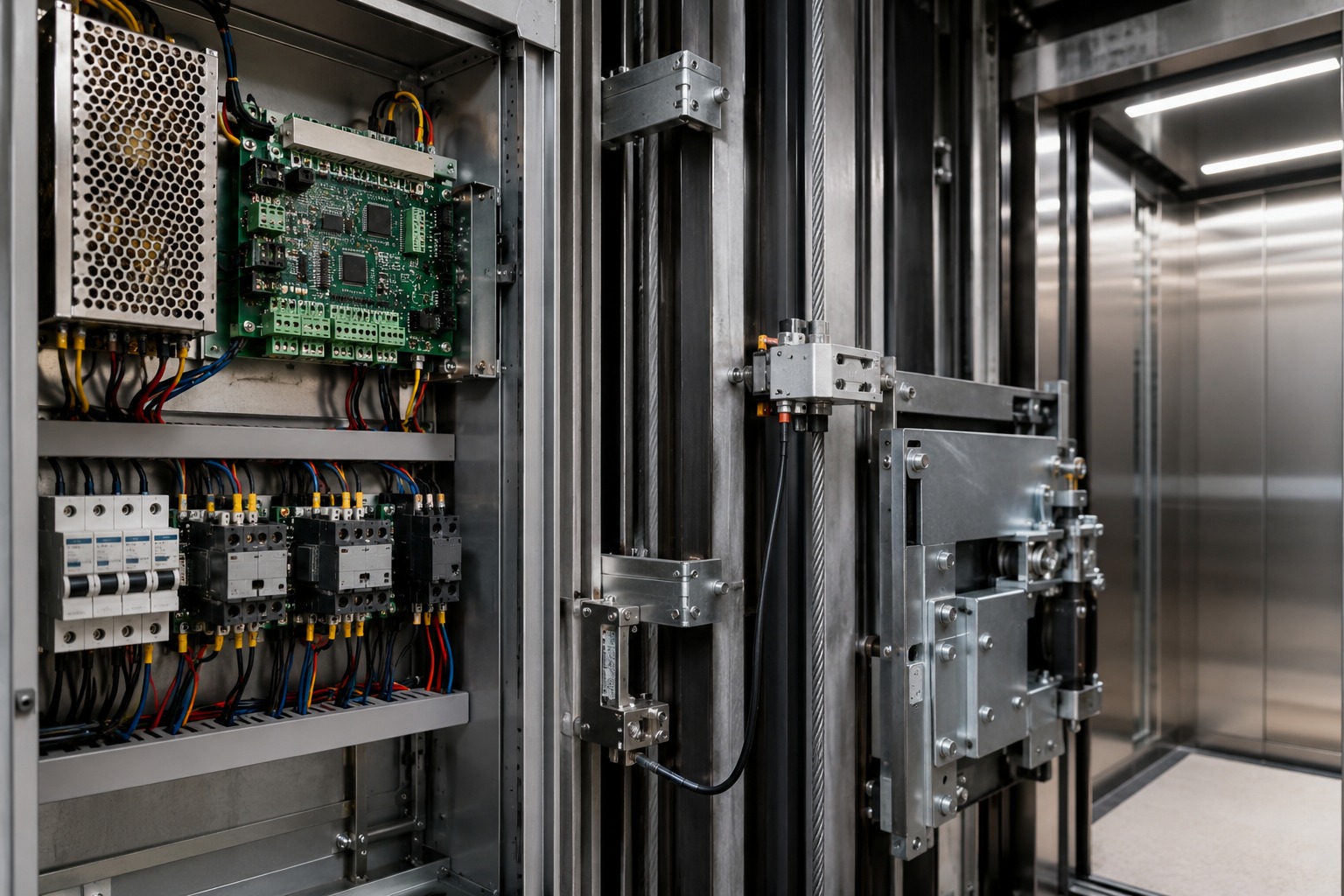
Elevator power supply parts do far more than provide simple electrical output. In a lift system, the right power module supports controller logic, door operation, brake release, communication lines, car lighting, emergency rescue functions, and fault reporting. In India, where installation environments range from premium towers in Mumbai and Bengaluru to humid coastal buildings in Chennai and Kochi, and from industrial sites in Pune to mixed-use complexes in Delhi NCR, selecting the correct elevator power supply is directly linked to uptime, passenger safety, and maintenance cost.
The short answer is this: maintenance teams should match every elevator power supply by input voltage range, output voltage, current capacity, ripple stability, insulation quality, protection functions, and actual application inside the lift. A controller board power supply cannot be replaced casually with a generic unit of the same voltage if connector type, surge handling, grounding behavior, or load response are different. The same principle applies to switching power supply boards, brake release power units, and emergency lighting backup modules.
For the India market, this matters even more because many buildings face fluctuating mains supply, generator changeover events, inconsistent earthing quality, and seasonal heat. A high-rise in Gurgaon may experience power dips during peak summer load, while a commercial building near Ahmedabad or Surat may need careful filtering due to industrial electrical noise. Good sourcing, correct model matching, and a disciplined testing workflow help reduce repeat failures. For teams comparing replacement options, a dedicated elevator switch power supply should always be reviewed against the original controller requirement rather than purchased by appearance alone.
India elevator market context and why power supply planning matters
India remains one of the fastest-growing elevator markets in Asia, supported by urban housing, metro-linked redevelopment, hospital expansion, warehousing, IT parks, hotels, and modernization of older residential towers. New installations are increasing, but the replacement market for spares is growing just as quickly. In older lifts, power supply failure is one of the most common causes of intermittent shutdown, door communication loss, random controller reset, and emergency light battery drain.
In cities such as Hyderabad, Noida, Kolkata, and Jaipur, maintenance companies often manage mixed elevator fleets with multiple brands and generations. This creates a practical challenge: one building may use a modern SMPS controller board, another may use an AVR-assisted supply, and a third may have a separate constant-voltage box for communication and auxiliary functions. As a result, buyers in India increasingly prefer suppliers that can help confirm model compatibility, pin layout, voltage ratings, and operating environment before dispatch.
| Market factor in India | Effect on elevator power supplies | Typical risk | Recommended response |
|---|---|---|---|
| Frequent voltage fluctuation | Stresses SMPS input stages and capacitors | Random controller reboot | Choose wide-input and surge-tolerant designs |
| Generator changeover | Creates transient dips and switching spikes | Brake or relay misoperation | Verify hold-up time and transient protection |
| High ambient heat | Reduces capacitor life | Premature board failure | Select quality thermal design and spacing |
| Coastal humidity | Corrodes terminals and connectors | Intermittent output drop | Use protected packaging and inspect contacts |
| Mixed-brand modernization | Requires exact output and connector matching | Wrong replacement board | Cross-check model, photo, and wiring diagram |
| High uptime expectation | Elevators run long daily cycles | Auxiliary power fatigue | Plan preventive replacement for aging supplies |
The table above shows why power supply selection in India is not only about voltage labels. The actual building power profile, environmental exposure, and traffic pattern should be considered before replacement.
Main power supply types in elevators
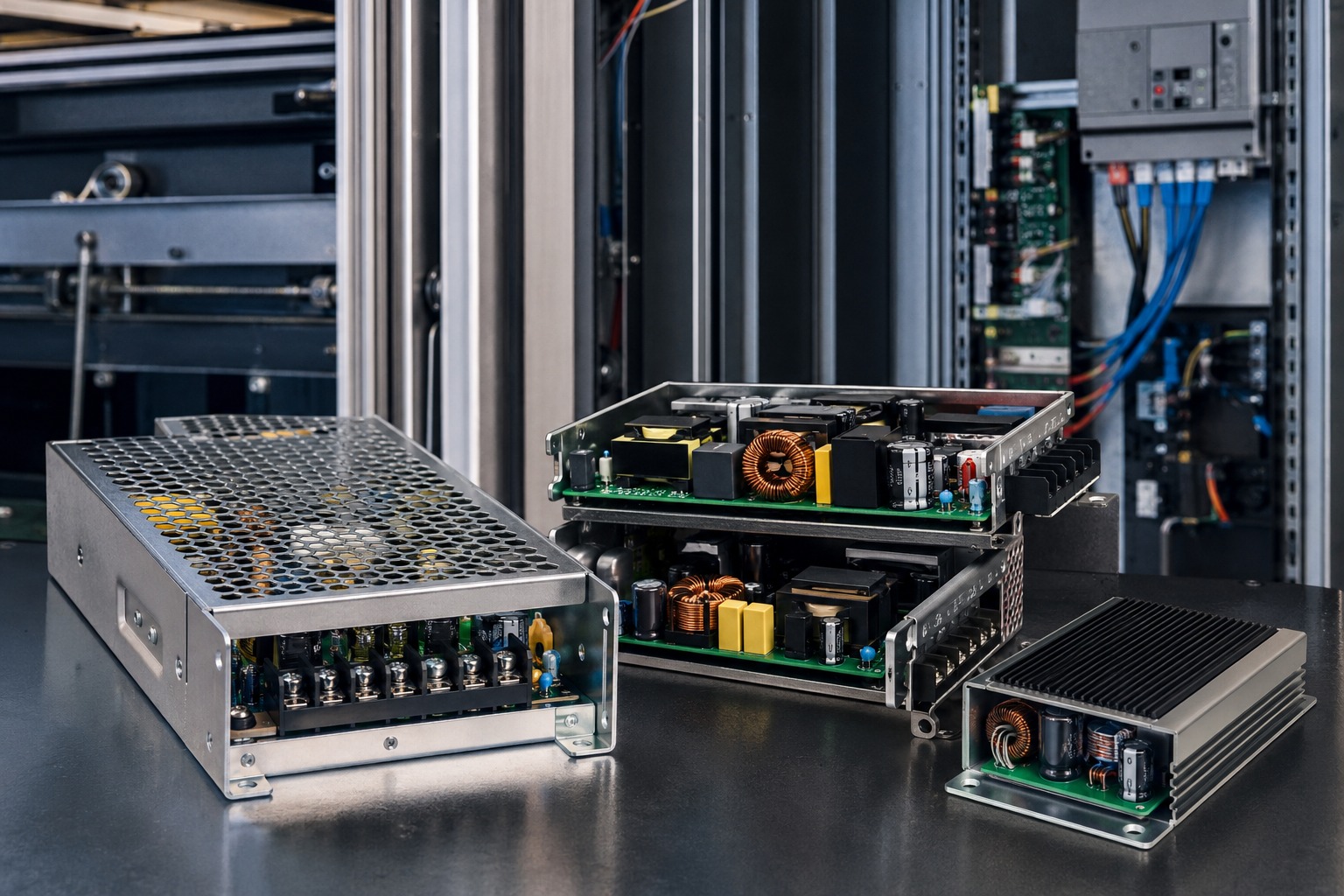
Elevators use several power supply forms, and each serves a different electrical role. The main AC incoming supply feeds the system, but internal conversion stages then provide stable DC outputs for controller boards, safety circuits, indicator panels, communication devices, and brake control. Understanding these categories helps buyers avoid the common mistake of ordering a visually similar board with an unsuitable electrical profile.
The first category is the controller power supply. This unit typically converts incoming AC to regulated DC outputs such as 24V, 12V, or 5V for logic and relay circuits. The second category is the switching power supply board, widely used because it is compact, efficient, and stable under varying loads. The third category includes constant-voltage boxes or dedicated regulated supply assemblies, sometimes found in older branded systems or in specific Hitachi configurations. The fourth category is brake release power supply hardware, which must deliver controlled energy at the correct timing to release the machine brake safely. The fifth category is emergency supply hardware for lighting, alarm, or rescue communication.
For maintenance teams working with Japanese and multinational lift brands in India, application-specific parts are important. A 24V/51V AVR power board for Hitachi elevators may be suitable only where the original design calls for those exact outputs and board characteristics. Likewise, a constant-voltage power supply box for Hitachi lifts is not a universal substitute for all controller supplies even if the cabinet footprint appears similar.
| Power supply type | Main function | Common outputs | Where used in lift | Typical failure effect |
|---|---|---|---|---|
| Main controller supply | Feeds logic and relays | 24V DC, 12V DC, 5V DC | Controller cabinet | System reset or shutdown |
| Switching power supply board | High-efficiency regulated DC conversion | 24V DC, 48V DC, multi-output | Controller and auxiliary circuits | Communication and I/O faults |
| AVR or regulated board | Stabilized output in brand-specific systems | 24V/51V or special outputs | OEM-specific cabinets | Unstable logic behavior |
| Brake release supply | Provides energy to release brake coil | DC or rectified output as specified | Drive/brake section | Lift cannot start or brake alarms |
| Emergency lighting supply | Supports cabin light during outage | Battery-backed DC | Car top or car operating panel area | Dark cabin during power loss |
| Intercom/communication supply | Powers alarm and communication devices | 12V DC or 24V DC | COP, machine room, rescue panel | No voice link in emergency |
This breakdown is useful when reviewing spare requirements with building owners. One failed “power board” may affect only COP lighting, while another power module may halt the entire lift. Accurate naming and isolation of the faulty stage reduce unnecessary part replacement.
Switching power supply board selection
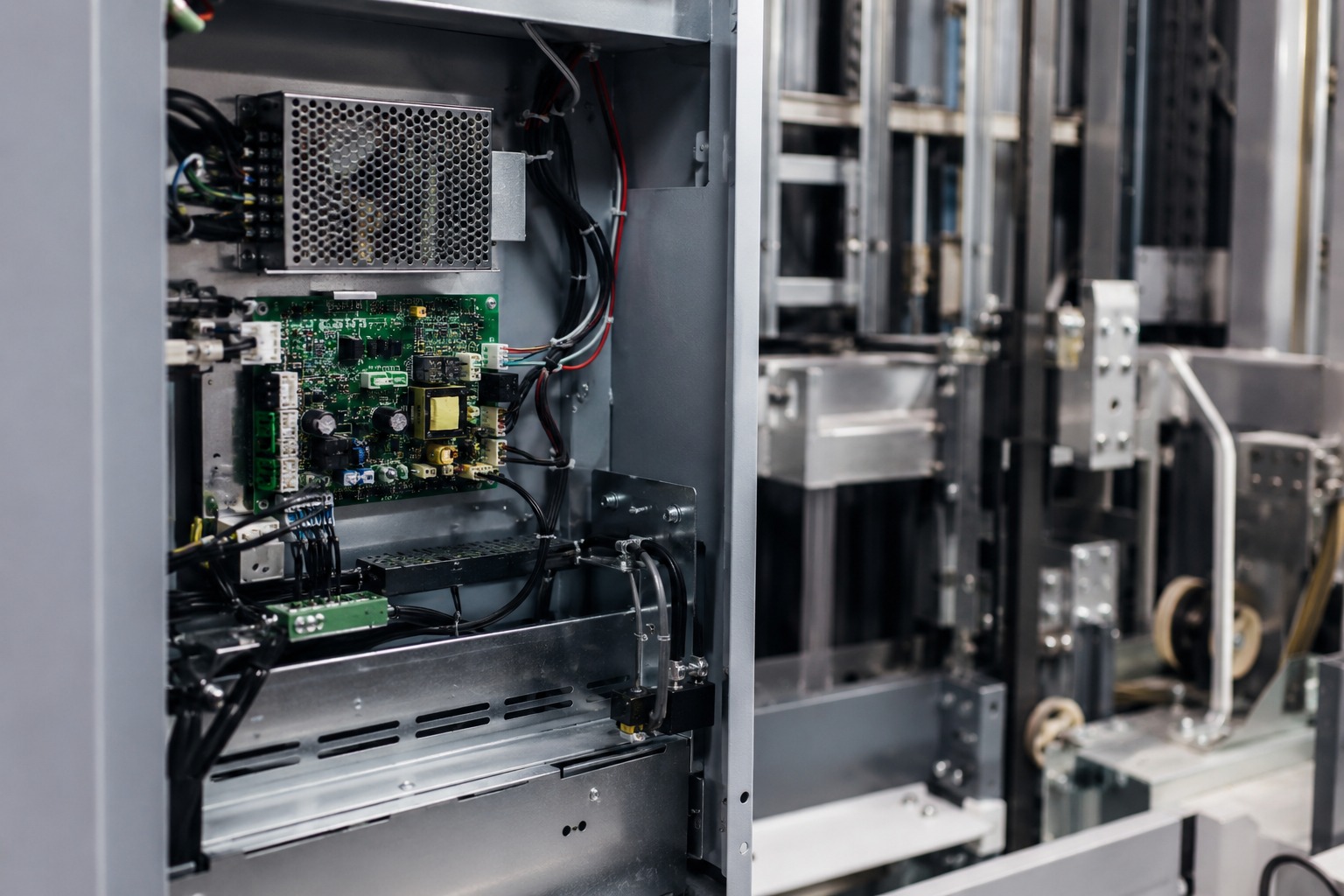
Switching power supply boards are among the most widely replaced elevator electrical parts because they work continuously and are sensitive to heat, dust, voltage surges, and aging capacitors. When choosing a replacement, the first checkpoint is the exact input specification. In India, many elevators operate on supply conditions that fluctuate around nominal values, so the board should tolerate realistic site variations rather than only ideal laboratory input.
The second checkpoint is output voltage and current capacity. A 24V board rated at low current may produce the correct voltage with no load but collapse when relays, sensors, and communication modules all energize together. The third checkpoint is ripple and noise. Excessive ripple may cause encoder feedback disturbance, communication instability, and unexplained CPU resets. The fourth checkpoint is connector style and mounting footprint. The fifth is protection: over-voltage, short-circuit, thermal, and overload protection are all valuable in field conditions.
For maintenance contractors that handle multiple brands, it is often practical to compare both standard modules and application-specific boards. A dedicated switching power supply board for lift accessories can be useful where the original board architecture matches. However, compatibility should still be verified by part number, terminal designation, board dimensions, and output behavior under load.
| Selection point | Why it matters | Field check method | Risk if ignored |
|---|---|---|---|
| Input voltage range | Must survive site fluctuation | Read label and compare with site data | Frequent input stage failure |
| Output voltage accuracy | Controller logic needs stable DC | Measure no-load and loaded output | CPU reset or sensor errors |
| Current capacity | Peak loads may exceed average load | Add total circuit demand with margin | Voltage sag under operation |
| Ripple/noise control | Affects communication and electronics | Use oscilloscope if available | Intermittent faults difficult to trace |
| Connector and pin layout | Wrong wiring may damage boards | Match photos, labels, and terminals | Miswiring and secondary failure |
| Protection functions | Improves survival in harsh sites | Check datasheet or OEM marking | Repeat breakdown after installation |
In practical buying terms, Indian distributors and service companies should also ask how the part is packaged and inspected. Sensitive boards shipped to Navi Mumbai, Chennai Port, Mundra, or ICD facilities near Delhi should be packed against moisture and shock. A reliable supplier does not only quote a board number; they help verify the old part, the application, and the expected output performance before shipment.
Brake release power supply requirements
The brake release power supply has one of the most safety-sensitive jobs in an elevator. It must energize the brake coil with the correct voltage and timing so the machine brake releases when commanded and re-engages properly when power is removed. A weak supply can leave the brake partially engaged, causing noisy starts, motor overcurrent, or failure to move. An incorrect or unstable supply can also create delayed release or drop-out behavior that affects ride quality and safety logic.
Brake systems vary by manufacturer and machine design. Some use rectified outputs, some rely on dedicated brake control boards, and others integrate the function within a drive package plus external power hardware. During modernization in India, one of the biggest mistakes is assuming the brake coil can accept “roughly similar” voltage. That assumption can lead to overheating, chatter, or unreliable release. Engineers should confirm coil resistance, nominal voltage, inrush requirement, holding requirement, and timing parameters.
Brake release circuits should also be checked alongside the mechanical condition of the brake itself. If the friction surfaces are worn or the spring setting is incorrect, replacing the electrical supply alone will not solve the problem. Maintenance teams should view the brake circuit as a system that includes coil, rectifier or supply module, command relay, controller logic, and mechanical adjustment.
| Brake supply requirement | Technical purpose | What to inspect on site | Possible symptom if incorrect |
|---|---|---|---|
| Correct coil voltage | Prevents under- or over-energizing | Nameplate and coil measurement | Brake not releasing or overheating |
| Stable current delivery | Supports full release force | Loaded current test | Jerky start or humming |
| Proper timing | Coordinates with drive start | Observe release delay | Rollback or rough launch |
| Heat resistance | Brake areas can run hot | Cabinet temperature review | Frequent repeat failure |
| Insulation quality | Protects against leakage and shock | Visual and meter checks | Trips or unsafe operation |
| Compatibility with control logic | Ensures command signal alignment | Wiring and signal tracing | Brake alarm or no start condition |
In hospitals, hotels, and premium residential towers where smooth starts are expected, brake supply quality has a noticeable effect on user experience. In freight or industrial lifts, it is equally important because higher load conditions expose weak brake power circuits quickly.
Emergency lighting power supply planning
Emergency lighting is often treated as a small accessory function, but in passenger perception and rescue situations it is essential. During a mains failure, passengers expect the car to remain illuminated enough to reduce panic. In many elevator designs, the emergency lighting supply also relates to alarm devices, intercom support, and in some cases emergency fan operation depending on system design.
Good planning begins with duration. Building owners should define how long emergency light must remain functional after a power cut or generator delay. In India, where generator start time and transfer quality vary widely by building type, a short backup duration may be inadequate. Hospitals, metro-linked commercial buildings, data campuses, and public-use buildings should generally adopt a more conservative backup plan than a low-rise private residence.
The second planning point is battery chemistry and replacement cycle. Even if the charger circuit is healthy, aged batteries lose real capacity. The third point is lamp load: LED conversion often reduces demand and improves backup time, but compatibility must still be checked. The fourth is maintenance access. Emergency light modules hidden in difficult car-top spaces are more likely to be neglected.
| Planning item | Why it is important | Practical recommendation | Common oversight |
|---|---|---|---|
| Backup duration | Supports passengers during outage | Set requirement by building use | Assuming generator starts instantly |
| Battery health | Determines actual runtime | Test under load periodically | Checking only charging voltage |
| Lighting load | Affects energy draw | Use suitable low-load LED fixtures | Adding lamps without recalculation |
| Charging circuit quality | Protects battery life | Review float and recharge behavior | Overcharging the battery |
| Integration with alarm/intercom | Improves emergency response | Separate critical loads if needed | One small supply carrying everything |
| Maintenance access | Improves routine inspection | Label and position clearly | Ignoring hidden modules |
From a building operations perspective, emergency lighting power planning should be reviewed during annual maintenance audits, especially in high-footfall assets in Mumbai, Bengaluru, Chennai, and Delhi NCR. If a property manager is already upgrading cabin fixtures, it is a good time to evaluate the backup unit, charger board, and battery condition together.
Voltage ratings and load checks
Voltage label matching is only the first step. Proper elevator power supply selection requires real load checks, because the same 24V output may behave very differently under actual field demand. Maintenance teams should identify connected loads such as controller boards, relays, contactor coils, safety chain circuits, door sensors, COP indicators, intercom boards, fans, and light modules. Peak current can be much higher than average current, especially during start-up or relay switching.
A practical method is to list every load on the supply, note nominal current, and add a safe engineering margin. Where exact values are unavailable, measured current under different operating states is better than assumption. Do not forget ambient temperature derating. A board that performs well in a cool workshop may struggle inside a hot controller cabinet in an Indian summer.
Another important point is isolation between loads. In some elevators, communication circuits and relay-heavy circuits should not share a marginal or noisy supply. Sensitive encoder or serial communication boards may need cleaner power than lamp circuits. This is why exact application review is often more important than choosing the cheapest unit with the correct headline voltage.
| Check item | What to verify | Recommended action | Why it matters |
|---|---|---|---|
| Input AC rating | Single-phase or specified range | Compare with site mains and generator output | Avoid input-side stress |
| Output DC voltage | Nominal and tolerance | Measure unloaded and loaded values | Protect controller stability |
| Total current load | Running and peak demand | Calculate with reserve margin | Prevents voltage sag |
| Inrush behavior | Short-term startup demand | Observe during relay/door activity | Reduces nuisance trips |
| Temperature derating | Capacity at high cabinet temperature | Review installation environment | Improves real-life reliability |
| Grounding and noise | Electrical cleanliness | Inspect earth continuity and interference sources | Avoid communication and sensor faults |
For procurement teams, this is where supplier support becomes valuable. A good elevator parts partner helps compare output ratings, board photos, terminal definitions, and load application before shipment. That reduces the risk of ordering a replacement that powers up on the bench but fails in service.
Common power failure symptoms
Power supply faults in elevators are not always obvious. Some failures are complete, but many are intermittent and misleading. A weak board may allow the lift to run for hours and then reset unexpectedly. A noisy supply may create communication dropouts that look like controller faults. A degraded charger may keep an emergency light LED glowing in standby but fail completely during a mains outage.
Common symptoms include display flicker, random shutdown, repeated door reopening, no response from COP buttons, brake alarms, relay chatter, no car light during outage, intercom failure, and unstable floor position display. In modernized mixed-brand systems, mismatched replacement boards can create symptoms that appear only under traffic load or generator operation.
| Observed symptom | Likely power-related cause | Fast diagnostic step | Other possible linked issue |
|---|---|---|---|
| Controller resets randomly | 24V output sag or ripple | Measure loaded voltage during run | Loose terminals or overheating |
| Door operator faults | Unstable auxiliary DC supply | Check supply under door movement | Door motor or sensor issue |
| Brake does not release | Weak brake power module | Measure coil voltage at command | Mechanical brake sticking |
| COP display flickers | Noise or low output | Inspect 12V/24V line quality | Connector oxidation |
| Emergency light fails in outage | Dead battery or charger fault | Run discharge test | Wrong lamp load |
| Intercom dead during rescue | Communication supply loss | Trace dedicated communication power line | Handset or cable damage |
The explanation behind this table is simple: one symptom does not always equal one failed part. Elevator technicians should confirm whether the problem is caused by the supply itself, by the load pulling the supply down, or by a wiring issue between them.
Replacement and testing workflow
A disciplined replacement workflow reduces downtime and avoids damaging expensive control boards. First, isolate the elevator safely according to site procedure. Confirm the incoming supply condition before condemning the board. Second, identify the exact failed unit by part number, photos, terminal marks, and system function. Third, test the old unit if possible: measure input, no-load output, loaded output, visible capacitor condition, burnt components, and connector integrity.
Fourth, check the downstream load. If a shorted relay coil, damaged door board, or wiring fault exists, installing a new power supply without fixing the load may cause immediate repeat failure. Fifth, compare the replacement carefully: mounting points, output rating, polarity, connector order, and application notes. Sixth, power up with controlled observation. Monitor voltage stability, heat, relay operation, and system response through idle, door operation, and travel cycles.
In India, many maintenance teams also need a practical logistics workflow. That includes fast photo sharing from site, remote model confirmation, and secure dispatch to major service hubs such as Mumbai, Pune, Ahmedabad, Chennai, Bengaluru, Hyderabad, Kolkata, and Delhi NCR. This is where supplier responsiveness can be almost as important as product availability.
| Workflow step | Action | Purpose | Common mistake to avoid |
|---|---|---|---|
| 1. Safe isolation | Shut down and secure system | Protect personnel and equipment | Testing live without controls |
| 2. Fault confirmation | Verify symptom and circuit role | Avoid wrong-part ordering | Calling every board a “power board” |
| 3. Measure old unit | Check input and output under load | Confirm true failure mode | Replacing based on appearance only |
| 4. Inspect connected load | Find shorts or overloads | Prevent repeat burn-out | Ignoring downstream fault |
| 5. Match replacement | Verify model, voltage, pins, size | Ensure compatibility | Using near-match substitutes blindly |
| 6. Commission and monitor | Run functional test cycles | Validate stability in service | Handing over without load testing |
Case experience from modernization contractors shows that this workflow is especially useful in older residential towers in Mumbai suburbs, office buildings in Bengaluru, and healthcare facilities in Chennai, where the consequence of repeat downtime is high. In one common scenario, a replacement controller power board restored normal operation only after a hidden overloaded fan circuit was separated from the logic supply. In another, a brake release issue traced back not to the brake coil but to a voltage drop across aging terminals in the supply path.
Buying advice for India: local sourcing, model matching, and stock planning
For building owners and maintenance companies in India, buying elevator power supplies should be based on service reality, not catalog simplicity. First, ask whether the supplier can help match by model number, board photo, brand, and function. Second, ask whether the unit is tested or visually inspected before packing. Third, ask about protective packaging for long-distance domestic transport and international import routes. Fourth, check whether the supplier can support both common parts and hard-to-find branded modules for systems such as Hitachi, Toshiba, KONE, Mitsubishi, and other installed fleets.
Stock planning is also important. High-volume maintenance firms often keep fast-moving items such as 24V switching supplies, emergency light modules, and select brake power components in reserve stock. Lower-frequency parts can be sourced project-wise. Buildings with critical uptime requirements, such as hospitals and premium offices, may benefit from having at least one approved spare controller supply on hand.
When comparing local suppliers, buyers should balance price, matching accuracy, and service speed. The lowest quotation is rarely the lowest total cost if the wrong board is delivered, packaging is poor, or technical confirmation is missing. In ports and trade-linked cities such as Mumbai, Chennai, and Mundra-connected supply corridors, fast logistics help, but technical correctness remains the real time-saver.
Our approach for elevator power supply sourcing in India
For customers in India, our work is not limited to selling a part label. We support maintenance companies, distributors, building owners, and modernization contractors that need reliable sourcing for elevator controller boards, inverter and frequency converter parts, door operator components, door locks, light curtains, guide shoes, oil cups, sensors, encoders, power supplies, buttons, COP panels, intercom parts, and other lift accessories.
In technical capability, we focus on careful model matching and application review. That means checking part references, connector configuration, output requirements, and brand-specific usage before recommending a replacement. This is especially valuable when a customer is comparing a standard switching supply with a more specific regulated board or auxiliary module. Our goal is to reduce the risk of ordering a board that is electrically close but operationally wrong.
In manufacturing and quality capability, we emphasize stable inspection and protective handling. Power supply boards and related lift electronics need consistent visual checks, practical quality screening, and packaging that protects against transport shock and moisture. This matters for supply chains serving coastal and inland destinations across India, from Chennai and Kochi to Ahmedabad, Pune, and Delhi NCR.
In service capability, we respond quickly to site information and help customers reduce downtime. Maintenance teams often need support with photo confirmation, model cross-checking, or identification of compatible replacement parts for multi-brand fleets including Hitachi, Toshiba, KONE, Mitsubishi, and more. By combining responsive communication with careful sourcing, we help customers restore elevators faster and avoid repeated service disruption.
2026 trends in elevator power supplies
By 2026, elevator power supply demand in India is expected to shift in three clear directions. The first is smarter fault prevention. More maintenance teams will look for supplies with better thermal endurance, cleaner regulation, and easier diagnostic visibility because intermittent electronic faults are costly to trace. The second is modernization-driven compatibility demand. As older towers upgrade control systems, there will be greater need for bridge solutions that match legacy wiring while improving stability.
The third trend is sustainability and policy alignment. Energy efficiency, lower standby losses, and longer service life are becoming more important in commercial projects and ESG-focused building portfolios. LED cabin lighting, efficient SMPS design, and improved battery management for emergency units all support this direction. Future procurement will likely give more weight to product life-cycle value rather than only initial purchase price.
There is also a policy dimension. As building safety expectations rise, emergency communication and reliable backup functions will receive closer attention during audits and modernization planning. In practical terms, this means emergency lighting, alarm support, and communication power cannot be treated as minor accessories. They are part of the passenger safety experience.
FAQ about elevator power supplies
1. Can I replace any 24V elevator power supply with another 24V unit?
No. Voltage alone is not enough. You must verify current capacity, connector layout, ripple behavior, mounting, protection features, and application in the elevator system.
2. Why does the elevator run normally on mains but fail during generator operation?
Generator changeover may introduce voltage dips, spikes, or frequency instability. Some older or weaker power supplies cannot hold stable output during that transition.
3. How often should emergency lighting batteries be checked?
They should be inspected regularly and tested under load, not only measured for charging voltage. Actual runtime matters more than standby indication.
4. What causes random controller resets?
A weak switching power supply board, excessive ripple, overload on the 24V line, poor earthing, loose terminals, or heat-related degradation are common causes.
5. Can brake release problems be purely electrical?
Yes, but not always. The power module, coil voltage, timing, and wiring must be checked together with the mechanical brake condition.
6. Is it better to keep spare power supplies in stock?
For high-traffic or critical buildings, yes. A matched spare controller or auxiliary supply can reduce downtime significantly.
7. Which sites in India should pay the most attention to power quality?
All sites should, but buildings with frequent generator use, poor grid stability, high ambient heat, coastal humidity, or mixed-brand modernized systems need especially careful review.
8. How do I know whether I need a standard SMPS or a brand-specific board?
Check the original part number, board outputs, connector arrangement, and the elevator brand configuration. If the original design uses a specific regulated board or boxed supply, use a compatible replacement rather than guessing.
9. What is the safest way to order a replacement from a supplier?
Share clear photos of the old part, its label, terminal marks, elevator brand, model, fault description, and measured input/output values if available. This speeds correct matching.
10. What should be included in a final post-replacement test?
Verify output voltage under load, controller stability, door operation, travel cycles, brake release, emergency light performance, and communication devices before handover.
In summary, elevator power supply parts affect far more than one isolated board function. They influence safety circuits, ride performance, communication reliability, emergency readiness, and maintenance cost. In the India market, where site conditions, power quality, and mixed-brand fleets add complexity, the best results come from careful specification review, correct load checks, disciplined testing, and dependable sourcing support.