
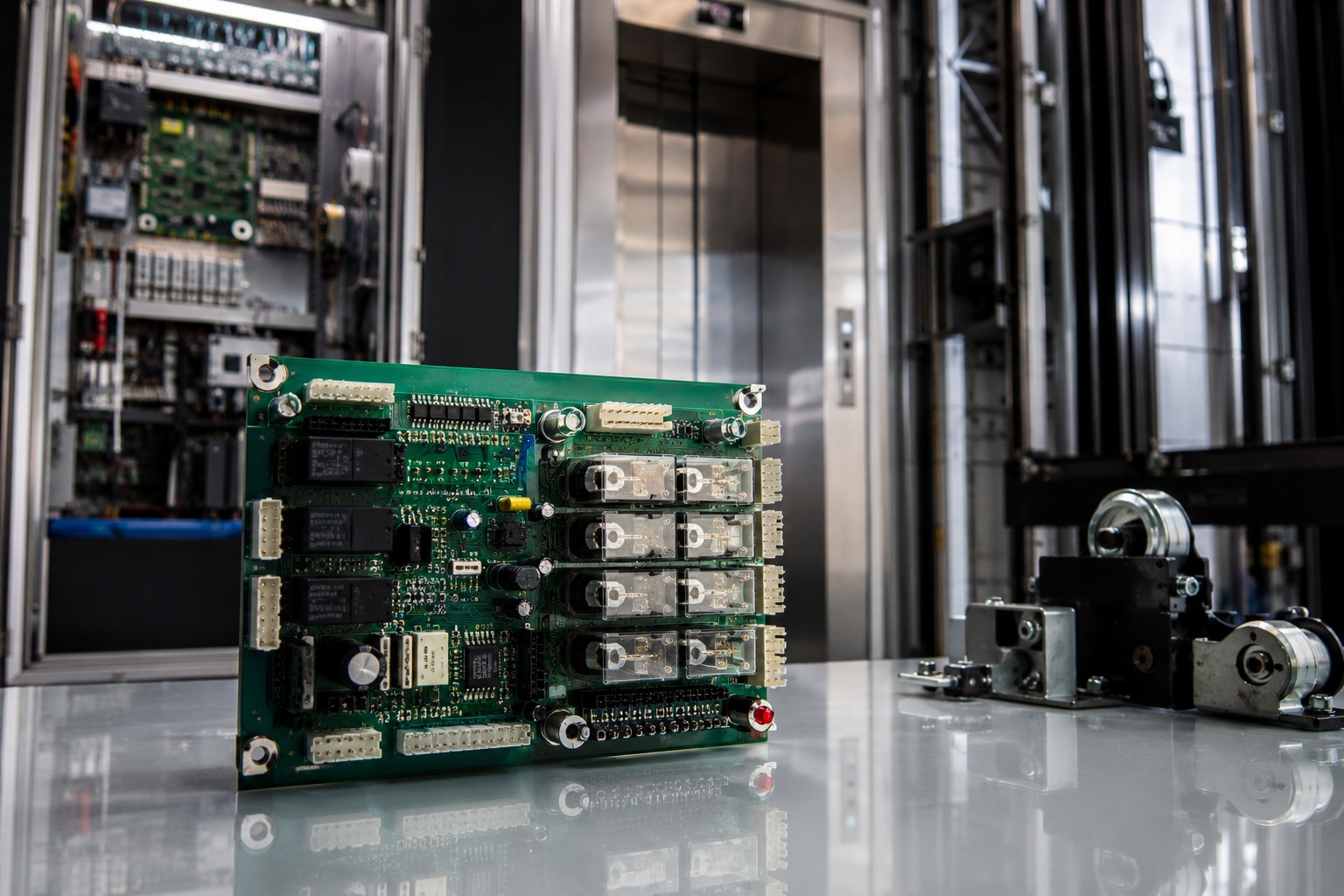
A safety circuit relay board is one of the most important protection components inside an elevator control system. In Toshiba lift systems, this board helps monitor and pass critical safety-chain signals so the elevator can run only when essential conditions are satisfied. When door locks, emergency stop circuits, limit switches, overspeed protection interfaces, and related safety devices are normal, the board allows operation. When a fault appears, it helps interrupt movement, protect passengers, and support fault diagnosis.
For maintenance teams in India, especially in high-rise projects across Mumbai, Pune, Bengaluru, Hyderabad, Chennai, Delhi NCR, Ahmedabad, and Kolkata, understanding the function of a safety relay board is not just a technical issue. It affects uptime, call-back rates, passenger confidence, annual maintenance costs, and modernization planning. In commercial towers, hospitals, metro-linked buildings, hotels, and residential complexes, even a short shutdown can create disruption. That is why careful sourcing of replacement boards, proper model matching, and post-installation testing are essential.
In practical terms, the Toshiba elevator safety circuit relay board acts like a decision gate for safe movement. It receives and processes safety contacts from multiple points in the lift circuit. If one critical contact opens unexpectedly, the board should remove the run permission and trigger a safe stop or prevent start-up. Because of this role, technicians treat the board as part of the wider safety chain rather than as a simple accessory part.
Many buyers in India also need faster access to replacement parts due to site pressure, resident complaints, and strict uptime targets. When selecting a replacement, technicians often review board code, connector layout, relay rating, application series, and software or hardware revision. A mismatch can create intermittent faults, nuisance trips, or inability to reset the safety chain. This guide explains what the board does, common fault symptoms, Toshiba relay board sourcing notes, compatibility checks, testing after replacement, required documentation, maintenance ideas, and frequently asked questions.
For buyers comparing Toshiba-related electronic parts, it is also useful to review associated boards because some faults may appear similar. In some cases, engineers inspecting a Toshiba elevator safety circuit relay board may later determine the issue actually relates to a logic extension or communication path. That is why system-level diagnosis matters.
How Safety Relay Boards Support Elevator Protection
The primary job of a safety circuit relay board is to verify that all required safety contacts are in the correct state before the lift runs. In older and newer Toshiba arrangements, the exact architecture may differ, but the operating principle remains similar: the safety chain must remain complete and stable. If any device in that chain fails or opens, the elevator should stop or refuse motion.
Typical safety inputs associated with the board can include landing door lock contacts, car door lock status, pit stop switch, car top stop switch, governor-related protection interfaces, final limit contacts, buffer monitoring interfaces, overload-related interlocks, emergency rescue mode conditions, and controller safety permissions. The relay board may also provide isolation between field contacts and the main controller, helping manage safe signal transfer and relay logic.
In a busy Indian installation environment, where elevators operate under variable power quality, heavy traffic, dust, humidity, and seasonal temperature shifts, relay performance and terminal integrity matter. Stable relay actuation, clean contact surfaces, and correct voltage behavior help prevent false trips. In mixed-use buildings near industrial zones or coastal areas such as Chennai, Kochi, Visakhapatnam, or near port logistics corridors like Nhava Sheva and Mundra-linked projects, environmental conditions can increase wear on electronic assemblies.
The board does not replace the function of mechanical safety devices. Instead, it works as an electronic supervisory and switching element inside the protective chain. That distinction is important when discussing troubleshooting. If the relay board reports a safety fault, the root cause may be on the board itself, on the connected field device, in the wiring harness, or in a related controller interface.
| Safety Function | Board Role | Typical Connected Device | Effect if Open | Site Risk | Technician Focus |
|---|---|---|---|---|---|
| Door interlock verification | Confirms secure door circuit continuity | Landing door lock | Lift will not start | Repeated service interruption | Check contact continuity and alignment |
| Emergency stop monitoring | Interrupts run permission | Car top stop switch | Safety chain breaks | Unexpected shutdown | Inspect switch state and wiring |
| Pit protection input | Verifies safe condition from pit circuit | Pit stop switch | Movement disabled | Maintenance delays | Confirm reset and terminal condition |
| Limit protection path | Transfers critical travel limit status | Limit switch | Controller blocks operation | Operational lockout | Trace upstream field contact |
| Relay isolation | Separates field and control logic | Internal relay set | Intermittent or no response | Difficult fault repetition | Measure coil and contact behavior |
| Safety chain output | Passes final permission signal | Controller interface | No run command accepted | Extended downtime | Check output voltage and signal timing |
The table above shows why a relay board is central to fault handling. It is not only a switching PCB; it is a checkpoint in the elevator safety architecture. In many service calls, teams first verify whether the board is truly defective or whether it is correctly reacting to an actual unsafe condition elsewhere in the system.
Common Signs of Safety Circuit Relay Board Faults
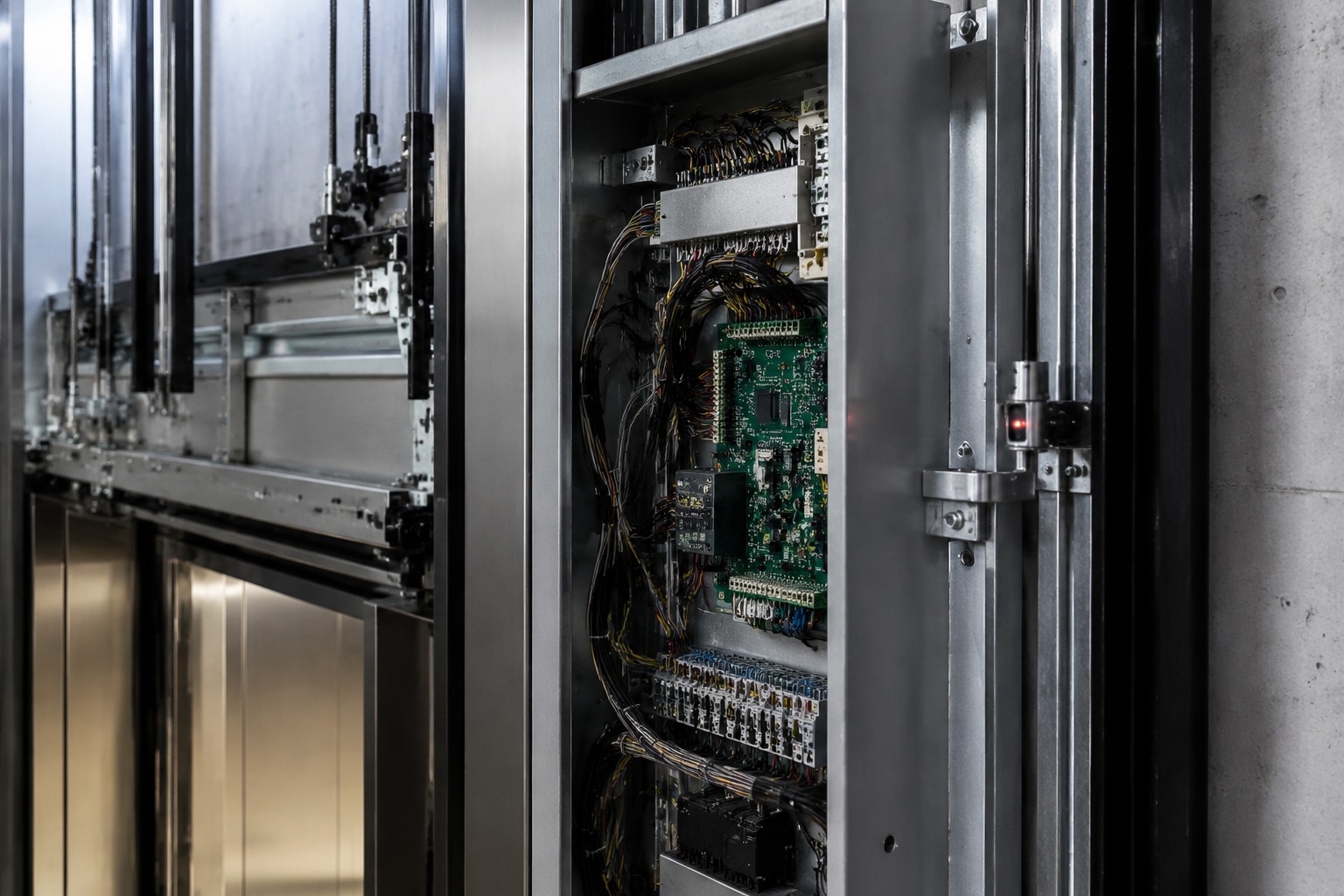
Fault symptoms vary by model, site condition, and controller generation. However, service teams often notice repeated no-run conditions, random safety-chain trips, or relays clicking without stable output. The elevator may reset temporarily and then fail again. In some cases, the issue appears after power fluctuation, water ingress, cabinet contamination, relay aging, or connector oxidation.
One common symptom is a lift that powers up normally but refuses to move even though doors appear closed and no obvious mechanical issue is found. Another symptom is intermittent shutdown during operation, especially after vibration, temperature change, or peak traffic hours. Engineers may also observe that a relay indicator does not energize consistently, or that a safety input is present at the terminal but not correctly passed through the board output.
In India, technicians working in older residential towers often report issues linked to dust accumulation, loose terminal screws, relay contact wear, and prior repair work done without proper model traceability. In premium commercial buildings, the challenge may be more about exact revision matching, because modernized controllers and older field devices may coexist. Therefore, symptoms alone do not confirm board failure; structured diagnosis is needed.
| Observed Symptom | Possible Board-Related Cause | Possible Non-Board Cause | Urgency | Recommended Check | Typical Outcome |
|---|---|---|---|---|---|
| Lift not starting | Relay not pulling in | Door lock chain open | High | Measure safety-chain continuity | Board or field issue isolated |
| Intermittent shutdown | Weak relay contact | Loose harness connection | High | Vibration test and terminal inspection | Repair or replacement decision |
| Repeated safety fault code | Incorrect output from board | Controller interpretation issue | Medium to high | Cross-check with wiring diagram | Signal path identified |
| Relay clicking repeatedly | Coil voltage instability | Power supply fluctuation | Medium | Check input voltage under load | Board or supply fault found |
| No indicator response | Board input stage failure | Open field contact | Medium | Trace input from source contact | Actual fault point located |
| Random reset success | Marginal internal relay or solder issue | Intermittent external switch | Medium | Thermal and continuity observation | Deeper inspection required |
These symptoms should be documented carefully. Recording fault code, time of occurrence, travel direction, load condition, and environmental context helps reduce misdiagnosis. For example, if the fault happens mainly during monsoon humidity in coastal cities, connector and insulation checks become more important. If the trip occurs during generator transfer in a commercial complex, power quality evaluation should be included.
Toshiba Safety Relay Board Sourcing Considerations
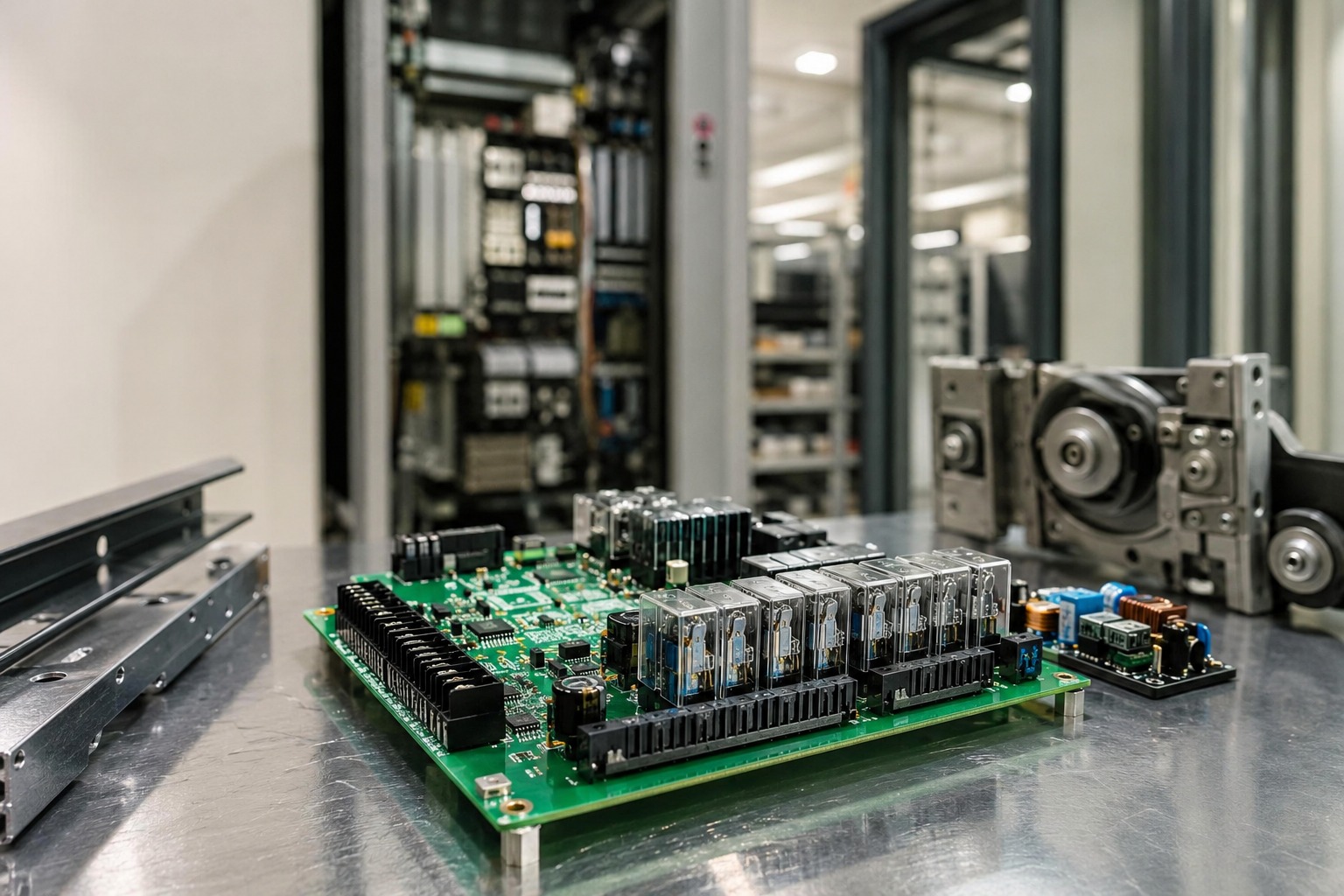
When buying a replacement Toshiba safety circuit relay board, the most important sourcing principle is exact or verified compatibility rather than appearance-based matching. Boards that look similar may differ in terminal arrangement, relay logic, firmware interaction, revision level, or application series. Professional sourcing starts with the complete part number, board label, controller series, elevator model context, and if possible, clear photos of both sides and connectors.
For Indian buyers, lead time and packaging also matter. A relay board can be damaged by poor anti-static handling, loose packing, or moisture during long transit. Whether the shipment moves through Delhi, Mumbai, Chennai, Bengaluru, or via freight hubs connected to major ports, protective packaging and proper labeling reduce the risk of receiving a part that is physically intact but electronically compromised.
It is wise to ask whether the supplier has experience with Toshiba lift electronics specifically, not just general elevator spare parts. A capable supplier should understand board-to-system relationships, common supersession cases, and the difference between a safety board, an expansion board, and a communication board. During diagnosis, some projects also require review of a Toshiba elevator expansion board or a Toshiba elevator car top communication board, because communication or input extension faults can mimic safety-chain behavior.
In our work with maintenance companies, distributors, building owners, and modernization contractors, we see that successful sourcing depends on three practical capabilities. First is technological capability: model matching based on part codes, connector verification, circuit role understanding, and image-based comparison support. Second is manufacturing and quality capability: stable inspection routines, careful handling, and protective packaging suited for long-distance delivery. Third is service capability: responsive communication, pre-shipment confirmation, and follow-up support for identifying compatible replacement options.
| Sourcing Factor | Why It Matters | What Buyer Should Provide | What Supplier Should Confirm | Common Risk if Ignored | India Market Relevance |
|---|---|---|---|---|---|
| Full part number | Prevents visual mismatch | Nameplate photo | Exact code match | Wrong board received | Important for urgent AMC jobs |
| Controller series | Board function varies by system | Controller model info | Application range | Board powers up but does not work | Common in mixed-age buildings |
| Connector layout | Avoids pin mismatch | Front and rear board images | Socket and terminal alignment | Installation impossible or unsafe | Critical for remote site teams |
| Revision level | Prevents logic or hardware conflict | Revision marking photo | Equivalent revision status | Intermittent faults | Relevant in modernization projects |
| Packaging quality | Protects electronics in transit | Shipping destination details | Anti-static and cushioning method | Transit damage | Important for long domestic routes |
| Response speed | Reduces downtime | Fault urgency and quantity | Stock and dispatch timing | Extended shutdown | Vital in metro cities and hospitals |
The explanation above shows why professional sourcing is not just about price. In high-occupancy buildings, the cost of wrong matching often exceeds the saving from a cheaper but uncertain part. Buyers in India increasingly prefer suppliers that can support technical confirmation before dispatch.
The chart suggests a realistic growth pattern for replacement demand in India. Growth is driven by aging building stock, modernization cycles, stricter uptime expectations, and wider awareness among facility managers that exact board compatibility reduces repeat failures.
How Technicians Confirm Compatibility Before Replacement
Compatibility verification should never rely on one data point alone. Experienced technicians normally use a layered approach. They review the board code, compare physical dimensions, inspect connector type and position, confirm relay count and rating, verify mounting points, and compare any visible hardware revision markings. They also check the lift controller manual, wiring diagram, or previous service records when available.
On a Toshiba system, compatibility may depend on whether the board is used in a specific controller family, a defined safety input architecture, or a certain installation era. Even when two boards look alike, different jumper settings, onboard relays, or terminal numbering can change behavior. Some teams make the mistake of replacing a failed board with a unit from another site without confirming application fit. That can create unsafe uncertainty, especially if the board forms part of the permissive safety path.
Technicians also verify field condition before replacement. If a field contact is welded, a harness is broken, or the controller power supply is unstable, fitting a new board may not solve the issue. A good practice is to document input states before removal and to photograph the installed wiring. This reduces reconnection errors and gives a reference if post-replacement behavior differs.
| Compatibility Check Step | What to Inspect | Tool or Source | Acceptance Standard | Warning Sign | Decision Impact |
|---|---|---|---|---|---|
| Part number review | Main board code and suffix | Label and supplier confirmation | Exact or validated equivalent | Missing suffix details | Do not install yet |
| Physical match | Board size and fixing holes | Visual comparison | Same dimensions and mounts | Offset mounting points | Risk of wrong application |
| Connector check | Pin count and arrangement | Photos and terminal map | One-to-one alignment | Different keying or numbering | Potential wiring error |
| Relay specification | Relay type and quantity | Board surface inspection | Same functional set | Missing relay stage | May alter safety behavior |
| Revision check | Hardware/series version | Sticker or PCB print | Approved same or compatible revision | Unknown revision origin | Need technical validation |
| System context review | Controller and lift model | Manual and site records | Application confirmed | Board from unrelated series | Reject replacement |
Technological capability is especially valuable at this stage. A specialized supplier should help compare labels, socket layout, and application notes before dispatch. This reduces trial-and-error replacement, which can waste site time and increase elevator downtime. For buyers serving buildings in Tier 1 and Tier 2 cities alike, remote technical confirmation can be a major advantage when the original documentation is incomplete.
This industry demand comparison reflects where replacement needs are often most urgent. Hospitals and commercial offices usually demand the fastest turnaround because shutdown tolerance is lower and lift usage intensity is higher.
Testing the Safety Chain After Installing a Replacement Board
After replacement, technicians should not stop at power-on success. A full safety-chain verification is required. The aim is to confirm that the new board not only fits physically but also reacts correctly to normal and fault conditions. This process should follow site safety procedures, manufacturer guidance, and local operational protocols. Functional checks must be carried out by qualified personnel.
A typical post-replacement sequence includes visual inspection of terminals, confirmation of proper grounding where applicable, voltage checks at input and output points, observation of relay actuation, controller fault reset review, and controlled testing of relevant safety-chain responses. Teams often verify whether the elevator starts only under normal safe conditions and refuses operation when a monitored safety contact is intentionally opened within the approved test procedure.
It is also good practice to observe multiple travel cycles under no load and then under normal service load. If the previous fault was intermittent, extended observation may be required. In buildings with high call volume, technicians sometimes monitor behavior during peak traffic periods to confirm that vibration and thermal conditions do not trigger recurrence.
| Test Stage | Objective | What to Observe | Expected Result | If Result Fails | Documentation Needed |
|---|---|---|---|---|---|
| Visual recheck | Catch wiring or mounting issues | Connectors, screws, insulation | Clean and secure installation | Power off and correct setup | Installation photo |
| Power verification | Confirm proper supply | Input voltage to board | Stable rated value | Trace PSU or terminal issues | Voltage reading log |
| Input confirmation | Ensure safety contacts reach board | Signal presence at inputs | Correct status for all required lines | Check field devices and wiring | Input checklist |
| Output confirmation | Verify board passes permission correctly | Relay output or status signal | Matches logic condition | Reassess compatibility or board fault | Output record |
| Functional safety test | Validate reaction to a fault condition | System blocks unsafe run | Safe stop or no-run response | Stop commissioning and investigate | Test report |
| Operational cycling | Check stability over repeated runs | Multiple trips without fault | Normal service restored | Look for intermittent causes | Final release note |
The explanation above is important because many repeat failures come from incomplete post-installation testing. A board may seem correct at startup but fail when one safety contact changes state under actual operation. Thorough testing reduces call-backs and protects site credibility.
The trend shift shown here reflects an important market change: more Indian buyers are moving from price-only purchasing to compatibility-first purchasing. This is especially visible in cities where downtime penalties and tenant expectations are rising.
Documents and Information Suppliers Should Provide
Reliable documentation supports safer installation and smoother procurement. Even when a replacement part is straightforward, the supplier should provide enough information for the buyer to verify fit, traceability, and handling. This is especially useful for maintenance contractors managing many sites across different states.
At minimum, buyers should expect a clear quotation with part identification, application notes if available, packing details, and basic inspection confirmation. For sensitive electronic parts, anti-static handling and shipment protection should also be stated. If the board is offered as a compatible replacement rather than the exact same marked code, the basis of compatibility should be explained clearly.
Service capability matters here. Responsive suppliers help customers reduce downtime not only by shipping quickly but also by sending usable confirmation details before dispatch. This is particularly helpful when a site in Jaipur, Surat, Lucknow, Coimbatore, Nagpur, or Bhubaneswar needs a fast decision without waiting for lengthy back-and-forth.
| Document or Data | Why Buyer Needs It | What It Should Include | Who Uses It | Risk if Missing | Best Practice |
|---|---|---|---|---|---|
| Quotation with part code | Confirms commercial and technical identity | Full code, quantity, condition | Purchasing and service teams | Wrong item ordered | Use code plus board photo |
| Board photographs | Supports pre-shipment verification | Front, rear, connectors, labels | Technicians | Connector mismatch overlooked | Send high-resolution images |
| Compatibility note | Explains application fit | System or series reference | Site engineer | Unsafe substitution | State exact basis of match |
| Inspection confirmation | Shows basic quality check | Visual condition and handling status | Maintenance manager | Unverified part arrives | Include dated inspection note |
| Packing specification | Protects transit-sensitive electronics | Anti-static and cushioning method | Stores and receiving team | Transit damage disputes | Photograph packed item if needed |
| Invoice and traceability data | Supports records and warranty handling | Supplier identity and shipment details | Accounts and operations | Poor after-sales follow-up | Keep linked with site log |
Manufacturing and quality capability are relevant here as well. A disciplined supplier should have stable inspection routines, careful labeling, and packaging methods designed to reduce shocks and static exposure. This is valuable for replacement boards shipped over long distances inside India or through international cargo routes serving local projects.
Maintenance and Inspection Practices That Extend Board Service Life
Not every board failure can be prevented, but many service issues can be reduced with routine inspection. The most useful maintenance habits are environmental control, wiring integrity checks, power quality awareness, and proper handling during service visits. Control cabinets should be kept reasonably clean and dry. Excessive dust, oil vapor, insects, moisture, or rust can affect terminals and PCB surfaces over time.
During periodic maintenance, technicians should inspect relay board mounting security, check for loose connectors, look for signs of overheating, and confirm that terminal screws remain tight. They should also review whether cabinet fans or ventilation paths are functioning where installed. In sites with erratic power supply or generator transfer events, review of upstream power quality and power supply modules is worthwhile.
In India, local conditions vary significantly. Coastal humidity in Chennai or Kochi, dust exposure in construction-adjacent sites in NCR or Ahmedabad, and heavy monsoon influence in Mumbai can all accelerate deterioration if cabinets are not maintained. Hospitals, malls, and office towers with high elevator usage may need more frequent inspection intervals than low-traffic buildings.
Our service approach emphasizes practical preventive support: careful model matching before replacement, stable quality inspection before dispatch, secure anti-static packaging, and responsive communication when field teams need confirmation. These service capabilities help customers reduce repeat visits and avoid ordering boards for faults that actually originate elsewhere in the safety chain.
This comparison highlights why supplier quality affects field results. Boards that are sourced with technical review, better packaging, and stronger traceability are less likely to create installation uncertainty or repeat downtime.
Applications, Industries, and Typical Buying Advice in India
Safety circuit relay boards are used across many building categories. In residential towers, they support daily reliability where passengers expect immediate service restoration. In hospitals, safe and stable operation is essential for patient movement. In office towers, lift downtime directly affects tenant productivity. Hotels, malls, educational campuses, and industrial facilities also depend on elevator safety circuits working correctly and predictably.
For buyers, the best advice is to purchase based on technical confirmation, not urgency alone. Urgent demand is common, but rushing without verification often causes a second shutdown. Keep a record of installed board codes by site, photograph control cabinet labels during routine maintenance, and maintain a simple spare-part history. These habits make future sourcing faster and safer.
Where building portfolios are large, some maintenance companies in India now keep critical electronic spares lists by city cluster. For example, service teams may maintain faster access planning for Mumbai-Pune, Bengaluru-Hosur, Chennai-Sriperumbudur, Delhi-Gurugram-Noida, and Ahmedabad-Sanand corridors. This approach reduces downtime in dense service territories.
Our manufacturing-side discipline focuses on stable quality inspection and protective packaging for electronic elevator parts. Combined with technological matching support and responsive service, this helps maintenance companies, distributors, and modernization contractors source compatible replacements more confidently.
Market Outlook, 2026 Trends, and Sustainability Direction
Looking toward 2026, the market for elevator safety-related electronic spares in India is expected to become more structured. Three trends are especially important. First is digital traceability. Buyers increasingly want part photos, revision records, and faster remote verification before dispatch. Second is policy and compliance awareness. Building owners and facility managers are paying greater attention to documented maintenance, safe replacement practice, and reduced repeat failures. Third is sustainability. Instead of replacing larger assemblies unnecessarily, more projects aim for accurate component-level identification so that only the required board is changed.
Technology trends will also shape purchasing decisions. Better fault logging, smarter controller diagnostics, and improved communication between field technicians and suppliers will reduce trial replacements. Policy trends may encourage stronger documentation, especially in premium commercial and institutional buildings. Sustainability trends will favor careful packaging, reduced waste from wrong orders, and more efficient logistics planning through major trade hubs and city distribution networks.
For India, this means buyers will increasingly choose suppliers that combine technical understanding with practical service execution. In a market where elevators are critical to urban infrastructure growth, safe and compatible replacement parts will remain essential.
Frequently Asked Questions About Safety Circuit Relay Boards
What does a safety circuit relay board do in a Toshiba elevator?
It helps monitor and transfer safety-chain conditions so the elevator runs only when required protective contacts are normal.
Can a safety relay board fail intermittently?
Yes. Relay wear, loose terminals, poor solder joints, unstable power, humidity, and connector oxidation can all create intermittent symptoms.
Is the same board suitable for all Toshiba lift models?
No. Compatibility depends on part number, controller series, connector layout, hardware revision, and application context.
How do technicians confirm whether the board is really faulty?
They check the full safety chain, input and output signals, relay behavior, wiring integrity, power supply condition, and controller response before concluding that the board itself is defective.
What should be tested after replacement?
Technicians should verify power, safety inputs, board outputs, controlled fault response, repeated operating cycles, and stable service restoration.
What information should I send to a supplier?
Provide the board part number, clear photos of both sides, connector images, controller model, fault description, and site context if available.
Why is protective packaging important?
Electronic boards can be damaged by static, vibration, moisture, and poor cushioning during transport. Good packaging helps preserve reliability.
Can communication or expansion boards cause similar symptoms?
Yes. In some cases, faults from related boards can appear as safety-chain issues, which is why system-level diagnosis is important.
What maintenance helps extend service life?
Keep cabinets clean and dry, inspect connectors and terminals regularly, monitor power quality, and document recurring fault patterns.
What is the smartest buying strategy for India?
Choose a supplier that can support exact model matching, quality inspection, secure packaging, and responsive technical communication. This approach reduces downtime and lowers the risk of ordering the wrong part.
In summary, Toshiba elevator safety circuit relay boards play a critical role in protecting lift operation and fault response. For India’s fast-growing and service-sensitive elevator market, the best results come from disciplined diagnosis, verified compatibility, careful replacement testing, and supplier support that combines technical understanding with dependable execution.