
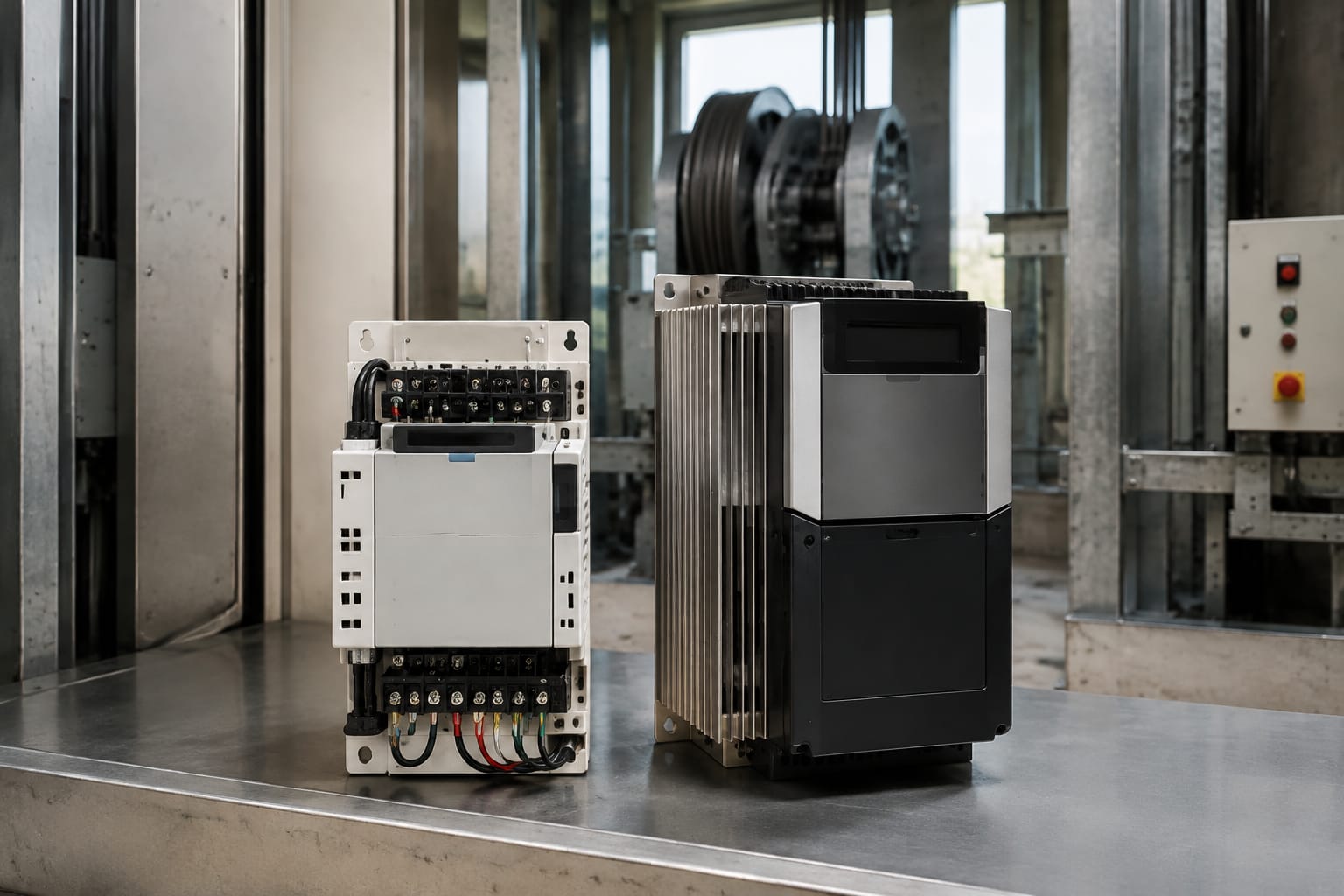
An elevator soft starter is usually appropriate where the objective is to reduce motor starting current and mechanical shock in a simple, fixed-speed lift arrangement. A VFD, also called a variable frequency drive, is the better fit where controlled acceleration, deceleration, levelling performance and smoother ride quality are required.
The right choice depends less on which device is newer and more on the existing motor, controller architecture, traffic pattern, landing accuracy requirement and availability of compatible safety and protection components. A soft starter cannot provide true variable-speed elevator travel, while a VFD requires more careful matching, commissioning and motor suitability checks.
How an elevator soft starter works
An elevator soft starter controls the voltage applied to an AC motor during starting. In many designs, it uses semiconductor devices to raise voltage gradually rather than applying full line voltage immediately. This reduces the inrush current and limits the abrupt torque rise that can stress the motor, coupling, gearbox and supply system.
Once the motor reaches operating speed, the soft starter is commonly bypassed by a contactor so the motor runs directly from the supply. The lift then continues at its normal fixed speed. During stopping, a soft starter may provide a controlled voltage reduction in certain applications, but it does not regulate motor speed across the journey in the way a VFD does.
For older fixed-speed traction lifts, an elevator soft starter can be a practical improvement over direct-on-line starting. It may reduce visible light flicker, supply disturbance and mechanical jerk at the start, particularly where the electrical installation has limited tolerance for high starting current.
However, the outcome depends on correct adjustment. A starting ramp that is too short can produce little benefit. A ramp that is too long may leave the motor with inadequate torque, causing delayed movement, overheating or a start fault under load.
What a soft starter can and cannot do
A soft starter can help with:
- Reducing starting-current peaks compared with direct-on-line starting
- Reducing abrupt initial motor torque
- Limiting mechanical shock during starts
- Improving starting behaviour in fixed-speed applications
- Reducing stress on contactors and supply equipment when correctly designed
A soft starter cannot normally provide:
- Variable travel speed
- Precision speed profiling through acceleration and deceleration
- High-quality floor levelling through closed-loop motion control
- Regenerative braking
- A direct replacement for a modern VVVF elevator controller
The distinction matters during modernisation planning. Installing a soft starter in a fixed-speed system may improve its starts, but it will not turn that lift into a VFD-controlled installation.
How a VFD controls elevator motion
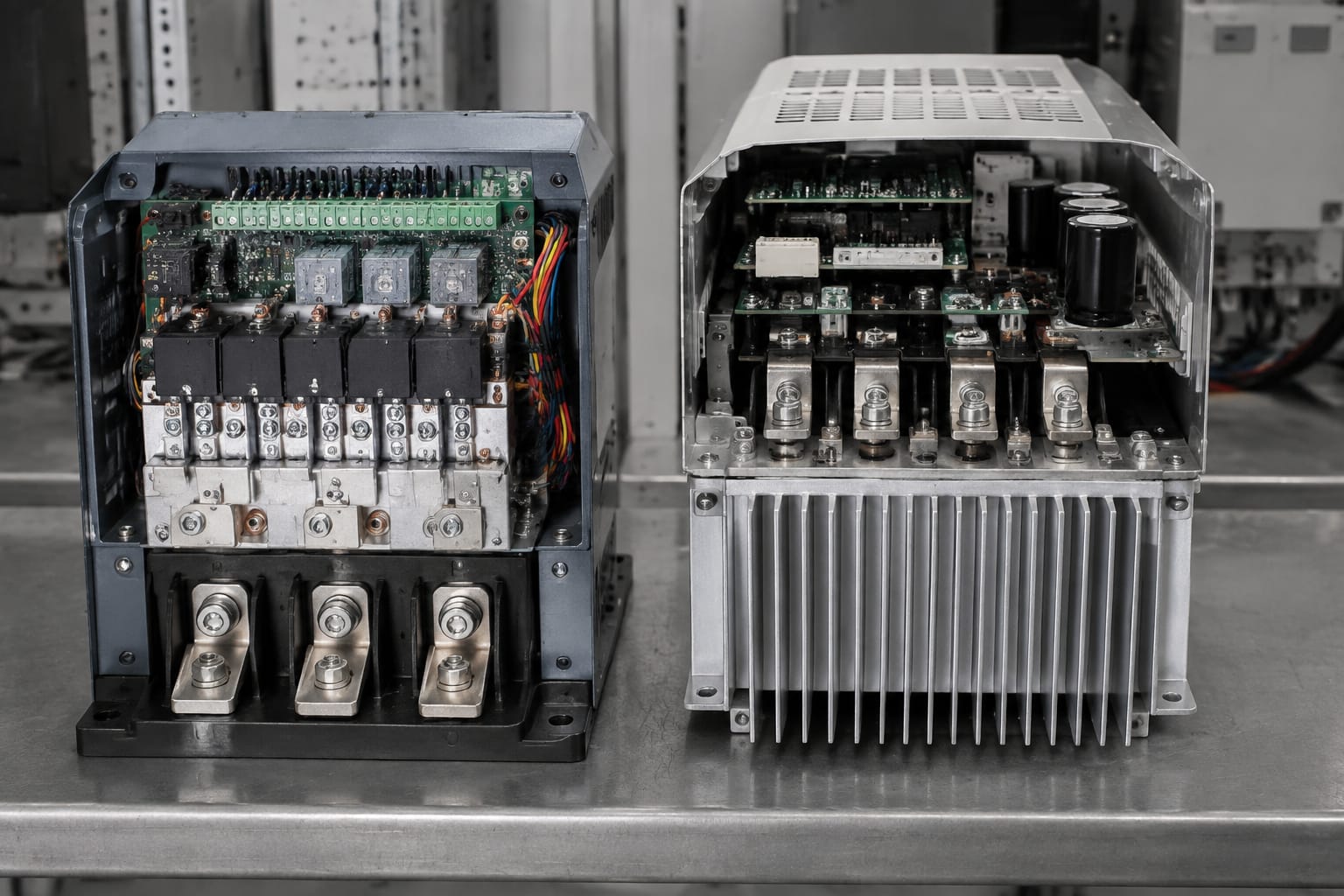
A VFD first converts incoming AC power to DC and then generates output AC at a controlled frequency and voltage. By changing the frequency supplied to the motor, it controls motor speed. The drive can follow a programmed motion profile: accelerate smoothly, travel at rated speed, decelerate before the floor and approach the landing at a controlled low speed.
In elevator applications, the VFD is usually part of a coordinated controller and drive arrangement. The system must manage direction commands, brake timing, motor torque, inspection operation, door zones, levelling inputs, safety chain status and fault handling. It is not simply a general-purpose industrial drive connected to a lift motor.
For passenger lifts and many modernisation projects, VFD control is preferred because it can improve passenger comfort and make movement more consistent across changing loads. With the correct motor, encoder arrangement where required, tuning and brake adjustment, a VFD can provide controlled starts and stops without relying on a full-voltage changeover between motor speeds.
VFD control modes matter
Not every VFD arrangement gives the same elevator performance. Common approaches include:
- Open-loop vector control: Uses calculated motor behaviour without a speed feedback device. It can suit some applications but may have limits at very low speeds or under changing loads.
- Closed-loop vector control: Uses feedback, often from an encoder, to maintain more precise motor speed and torque control.
- V/f control: Controls voltage in proportion to frequency. It can be suitable for some loads but may not offer the low-speed torque and ride performance expected in demanding lift applications.
The suitable control mode depends on the motor type, lift duty, desired landing accuracy and controller design. It should be selected as part of the complete elevator system, not in isolation.
Starting current and motor stress
Starting current is one of the clearest differences between direct-on-line, soft-starter and VFD operation. A direct-on-line start can draw a high inrush current because full supply voltage is applied while the motor is stationary. This may cause supply voltage dip, stress electrical contacts and create a sudden torque response.
An elevator soft starter lowers the voltage at start, which generally lowers the current peak. The exact current reduction and available starting torque depend on the starter settings, motor characteristics and load. Reducing voltage also reduces torque, so a soft starter must still provide enough torque to start the car safely under the expected load condition.
A VFD controls frequency and voltage together. It can build torque progressively from low speed and limit current according to its programmed and rated capability. This makes it better suited to controlled movement rather than simply limiting the initial current surge.
| Factor | Elevator soft starter | VFD elevator control |
|---|---|---|
| Primary role | Reduce starting shock and current | Control speed, torque and complete travel profile |
| Motor operation after start | Normally runs at supply frequency | Runs at variable frequency |
| Starting current | Lower than direct-on-line when correctly set | Controlled and generally limited by drive configuration |
| Starting torque | Reduced with reduced voltage | Can be managed at low speed, subject to motor and drive capability |
| Mechanical effect | Softer start than direct switching | Smooth acceleration and deceleration |
| Stopping control | Limited; depends on arrangement | Controlled deceleration and approach speed |
| Best fit | Basic fixed-speed installations | Modern VVVF or performance-focused modernisation |
Neither option removes the need to assess the mechanical system. Worn brake linings, excessive gearbox backlash, poor sheave condition, incorrect balancing or deteriorated guide shoes can still cause poor lift behaviour. Electrical control cannot compensate indefinitely for mechanical faults.
Avoid confusing current reduction with energy savings
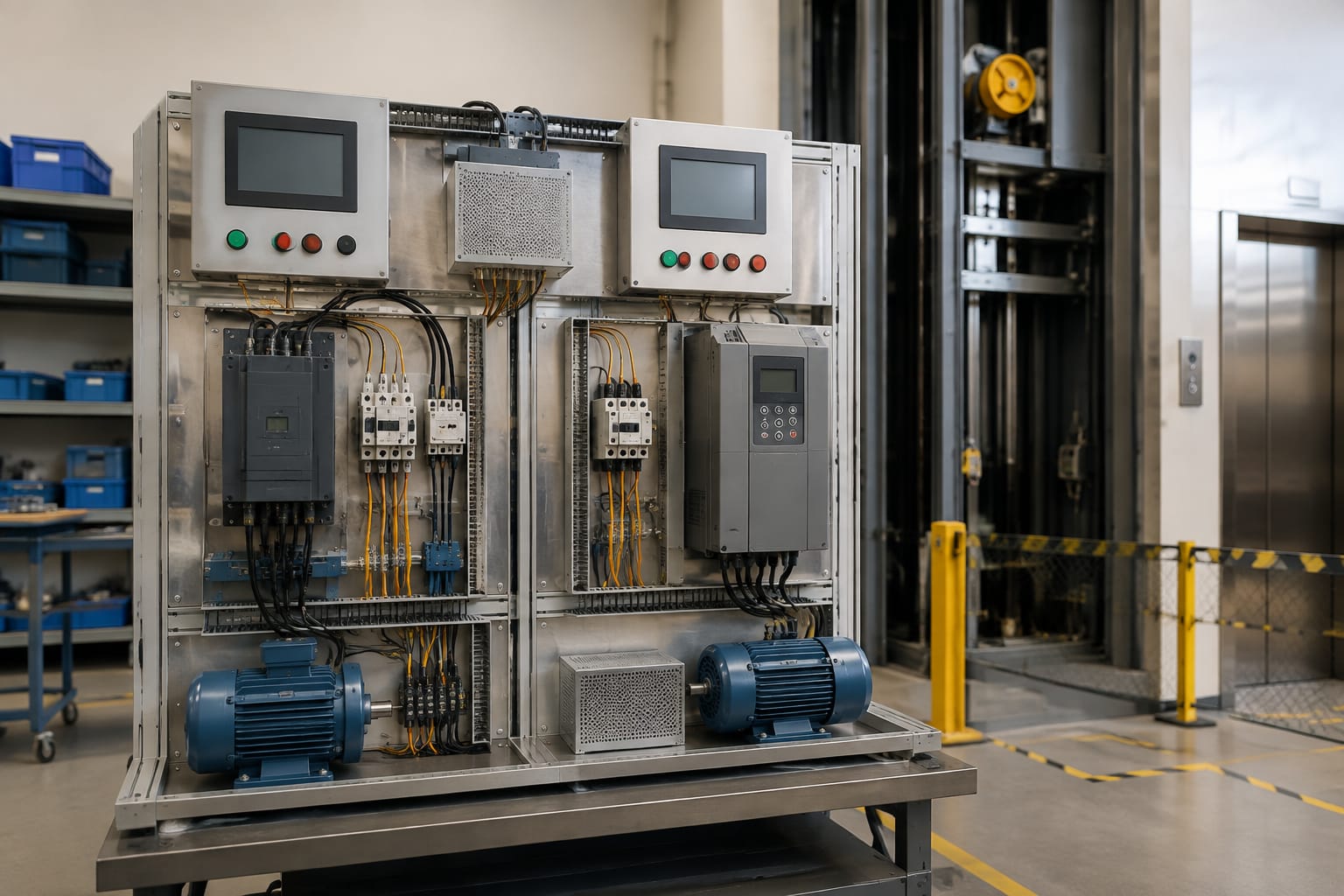
Lower starting current does not automatically mean a large reduction in overall energy use. A soft starter mainly affects the short starting period, after which the motor usually runs at normal supply conditions. A VFD may offer operational efficiency benefits in some circumstances, but actual energy use varies with motor type, traffic, load, travel distance, counterweight balance and control strategy.
Energy claims should therefore be evaluated from the proposed equipment specifications and the actual duty cycle, rather than assumed from the presence of a soft starter or VFD.
Speed control and ride quality
Ride quality is shaped by acceleration, jerk, deceleration, braking response, guide rail condition, car balance and mechanical maintenance. Of the two control methods, a VFD gives much greater scope to shape the electrical motion profile.
A VFD can use gradual acceleration and deceleration ramps, controlled creep speed and torque management. This can reduce the abrupt transitions associated with older fixed-speed or two-speed arrangements. It also supports more consistent behaviour as passenger load changes, provided the drive is tuned correctly and the mechanical system is in good condition.
An elevator soft starter provides a gentler initial start but does not continuously vary speed. Once the motor is running, the lift travels at its normal fixed speed. In a system with hard braking, coarse speed transitions or poor levelling, a soft starter alone will not resolve the underlying ride-quality issue.
Common ride-quality mistakes
Poor outcomes often arise from treating the drive settings as a substitute for diagnosis. Before changing ramp times or torque parameters, verify:
- Brake opening and closing timing
- Car and counterweight balance
- Motor and gearbox condition
- Encoder condition and alignment, where fitted
- Terminal tightness and cable condition
- Guide rail lubrication and alignment as applicable
- Correct motor data entered in the VFD
- Landing sensors, door-zone inputs and controller signals
For example, extending deceleration time may appear to soften a stop but can cause levelling errors or brake timing issues if the controller and mechanical brake are not coordinated.
Typical elevator applications
A soft starter and a VFD serve different project types. The following examples help frame the decision, but each lift should be assessed by its control diagram, motor data and service history.
Fixed-speed traction lifts
Older fixed-speed traction lifts with direct-on-line starting may be candidates for an elevator soft starter where the aim is to reduce start shock without replacing the complete controller. This may be relevant when the existing motor is sound, travel speed remains acceptable and no advanced levelling or ride-performance requirement is driving the project.
The installer must confirm that the starter’s control logic works with the existing reversing contactors, brake circuit and safety chain. It is also essential to check motor thermal protection and the duty cycle.
Two-speed lift systems
Some older lifts use separate motor windings or a two-speed motor arrangement for high and low speed. A soft starter may assist only with selected starting transitions, depending on the circuit. It does not inherently replace the function of the low-speed winding.
Replacing such a system with VFD control can provide smoother speed transitions, but it is a more involved modernisation. The motor’s suitability, the controller sequence, brake operation and low-speed levelling strategy all need review.
Modern VVVF traction lifts
For a lift designed around variable-voltage variable-frequency operation, a VFD is the appropriate control method. The drive and controller must be compatible with the motor type, feedback method and safety design. Replacing only the drive without validating communication, inputs, brake sequencing and parameters can create unreliable operation.
Hydraulic lifts
Hydraulic systems use different power-unit and valve arrangements, so the comparison is not always directly equivalent to traction lift control. A VFD may be used to manage a hydraulic pump motor in suitable systems, while soft-starting principles can also be relevant. The compatible hydraulic control valve, motor duty and controller logic must be confirmed before selecting either approach.
Contactors and protection devices
Contactors and protection devices remain important in both arrangements. A soft starter does not eliminate the need for correctly rated switching, isolation and protection components. A VFD also requires a properly designed input supply arrangement, protective earth connection and appropriate upstream protection.
In soft-starter circuits, contactors may be used for line switching, reversing and bypass operation. Their voltage coil, current rating, auxiliary contacts, interlocks and utilisation category must match the circuit design. Where a replacement is needed, confirm the existing wiring diagram and coil supply before selecting an [AC contactor for elevator control panels](/products/fuji-ac-contactor-lift-parts-elevator-accessories-2/). A visually similar contactor may have different terminal layout, coil voltage or auxiliary-contact configuration.
VFD systems may still use contactors for upstream isolation or safety-related switching arrangements as specified by the controller design. A contactor should not be used to repeatedly start and stop the motor on the VFD output unless the drive manufacturer and system design explicitly permit it. Doing so can cause faults or damage.
Protection selection should consider:
- Incoming supply voltage, phase arrangement and fault level
- Motor rated current and overload requirements
- Drive or soft-starter manufacturer requirements
- Cable size, cable length and installation method
- Short-circuit coordination
- Earthing arrangement
- Control transformer and auxiliary circuit protection
- Local electrical and lift safety requirements
For suitable panel protection, verify the trip curve, breaking capacity, pole count and current rating rather than selecting by physical size alone. A [small circuit breaker for elevator equipment](/products/small-circuit-breaker-elevator-equipment-lift-accessories/) should be chosen against the approved panel design and fault-protection requirements.
Retrofit and compatibility questions
Retrofitting is where many control projects become difficult. The new device must work with the motor, controller and mechanical equipment already installed. A generic rating match is not enough.
Questions to answer before installing an elevator soft starter
- Is the motor an induction motor suitable for reduced-voltage starting?
- What are the motor nameplate voltage, current, power, frequency and connection details?
- What starting torque is required for the car, counterweight and worst-case load?
- Does the lift use one speed, two speeds or a specialised motor arrangement?
- Is there a separate brake supply, and how is brake release timed?
- Does the controller expect feedback from a bypass or run contact?
- Are reversing contactors electrically and mechanically interlocked?
- What thermal protection is fitted to the motor?
- Can the building supply accept the selected starter arrangement?
- Is the starter designed for the actual starts-per-hour duty?
A soft starter that is undersized or incorrectly set can fail to start a loaded car, overheat, trip on overload or produce inconsistent movement.
Questions to answer before installing a VFD
- Is the existing motor compatible with inverter-fed operation?
- Is an encoder required for the intended control mode and levelling performance?
- Can motor insulation, cable condition and cable length support VFD operation?
- Is a brake resistor, regenerative unit or another braking arrangement required by the duty?
- Does the lift controller provide the correct direction, speed, run and safety interfaces?
- Are the controller and drive intended to communicate, and by which interface?
- How will inspection operation, rescue operation and fault recovery work?
- Are filters, reactors or shielded cables required for electromagnetic compatibility?
- Can the existing cabinet manage drive heat dissipation and ventilation?
- Who will record the original parameters and commission the replacement safely?
Do not assume that a VFD can operate every old traction motor satisfactorily at low speed. Motor cooling, insulation condition, torque characteristics and feedback capability can limit the result. In some projects, motor replacement is a better technical choice than forcing a new drive onto an unsuitable motor.
Document the existing system first
Before ordering replacement parts, record:
- Motor nameplate information and terminal connections.
- Controller and drive make, model and parameter backup where accessible.
- Contactor coil voltages, auxiliary contacts and wiring terminal numbers.
- Input supply measurements and phase sequence.
- Existing fault history and observed ride symptoms.
- Brake voltage, coil condition and opening/closing timing.
- Cabinet dimensions, ventilation and cable entry arrangement.
Clear documentation reduces the risk of ordering an apparently compatible part that cannot be integrated safely. For assemblies requiring a specific control voltage, a [Siemens AC110V contactor for lift panels](/products/sw-contactor-ac110v-siemens-contactor-elevator-parts/) illustrates why coil voltage and component configuration must be checked alongside the main current rating.
Choosing the appropriate control method
Choose an elevator soft starter when the project needs a controlled, lower-stress start for a suitable fixed-speed motor and the existing lift does not require variable travel speed or major ride-quality improvement. It can be a proportionate option when retaining the current controller and motor is practical.
Choose a VFD when the project requires smooth acceleration and deceleration, controlled low-speed operation, improved travel profile, modern variable-speed functionality or more sophisticated torque management. It is generally the stronger choice for wider controller modernisation, but it needs a more complete engineering review.
Use this decision checklist:
| Project condition | More likely choice |
|---|---|
| Basic fixed-speed lift, sound motor, aim is to reduce start shock | Soft starter |
| Direct-on-line starting causes supply disturbance but travel performance is otherwise acceptable | Soft starter, after torque and duty checks |
| Need smoother acceleration, deceleration and floor approach | VFD |
| Existing lift already uses VVVF control | Compatible replacement VFD |
| Motor has doubtful inverter suitability | Investigate motor condition before selecting a VFD |
| Need a simple device swap without controller changes | Soft starter may be possible, but verify circuit logic |
| Full modernisation with controller, motor and ride-quality targets | VFD-based system assessment |
The final selection should be based on the complete lift circuit and application, not only motor kW rating. Confirm ratings and compatibility with the equipment manufacturer, lift controller documentation and the qualified person responsible for the installation. For B2B sourcing of multi-brand elevator spare parts, Kelevator can support importers, distributors, maintenance contractors and OEM buyers in identifying components against documented specifications.