
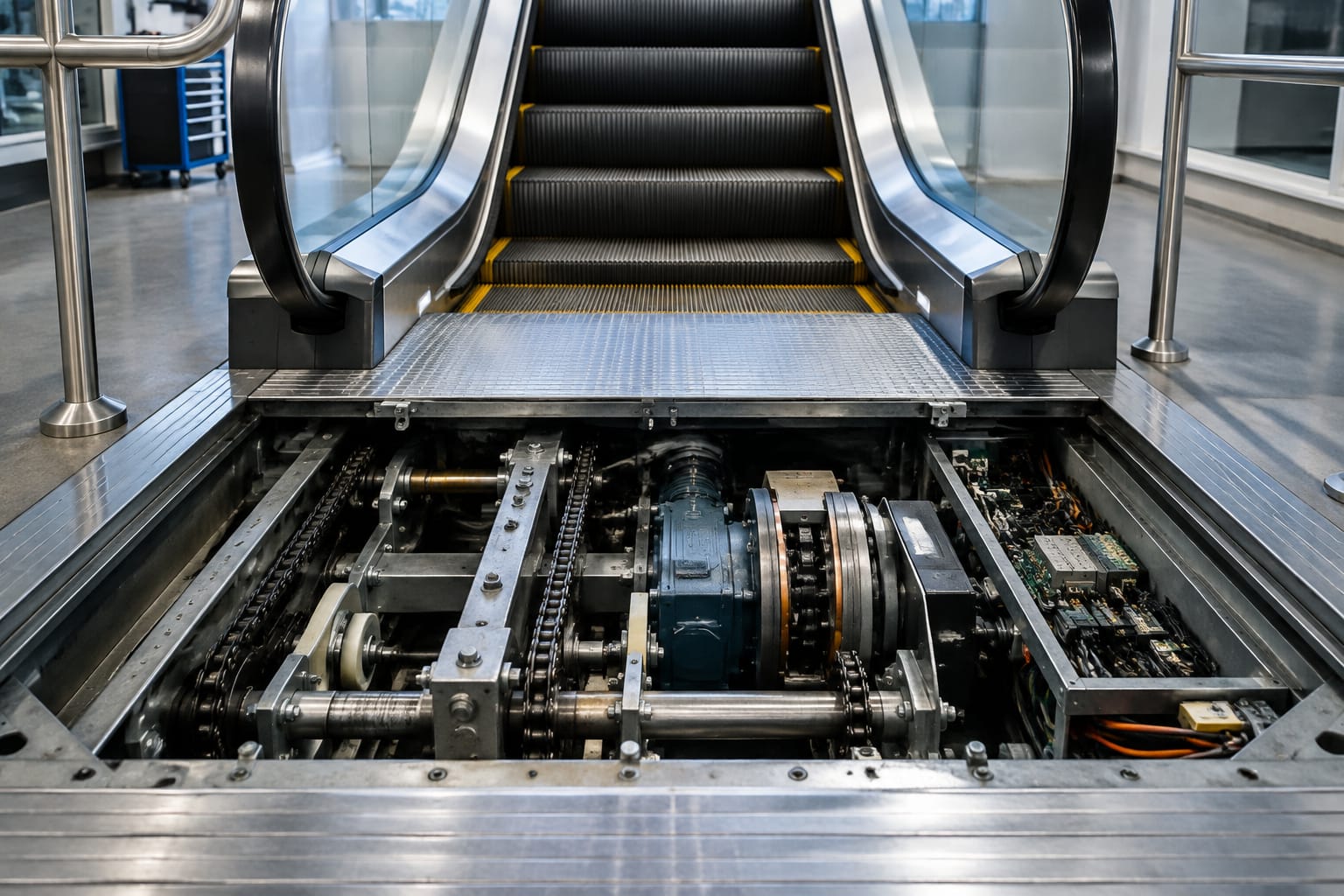
Escalator equipment is the set of mechanical, electrical and safety systems that move passengers safely between floors. Its core assemblies include the step band, chains and tracks, handrail system, drive machine, brakes, controller, sensors and landing interfaces.
For maintenance teams and buyers, the practical priority is not simply identifying a failed part. It is confirming the equipment type, manufacturer-specific design, part number, dimensions, electrical ratings and safety function before fitting a replacement. A visually similar component may not be a compatible one.
Main escalator systems at a glance
An escalator is a coordinated system: a fault in one assembly can affect ride quality, stopping performance or safety monitoring elsewhere. The most important escalator equipment systems are outlined below.
| System | Main components | Primary purpose | Typical maintenance concern |
|---|---|---|---|
| Step band | Steps, step chains, axles, rollers, tracks | Carries passengers between landings | Wear, alignment, loose hardware and damaged rollers |
| Handrail system | Handrail belt, drive rollers, guides, tension carriage | Moves the handrail in step with the steps | Slippage, poor tracking, cracking and incorrect tension |
| Drive system | Motor, gearbox, coupling, drive chain or belts | Provides movement to the step band | Noise, vibration, overheating and lubricant condition |
| Braking system | Main brake, auxiliary brake, brake coils, switches | Stops and holds the escalator safely | Incorrect clearance, worn linings, coil faults and switch issues |
| Control system | Controller, contactors, relays, inverter where fitted | Starts, stops and supervises operation | Electrical faults, loose terminals and parameter errors |
| Safety circuit | Sensors, safety switches, emergency stop devices | Detects unsafe conditions and stops travel | Contamination, damaged actuators, poor adjustment and bypassed devices |
| Landing interfaces | Comb plates, comb segments, skirt panels, entry devices | Manages safe passenger entry and exit | Broken teeth, loose fixing, debris and excessive clearances |
A scheduled inspection should look at these systems as a whole. Replacing a worn chain roller, for example, will not solve repeated roller damage if the track is worn, misaligned or contaminated.
Steps, chains, tracks, and comb plates
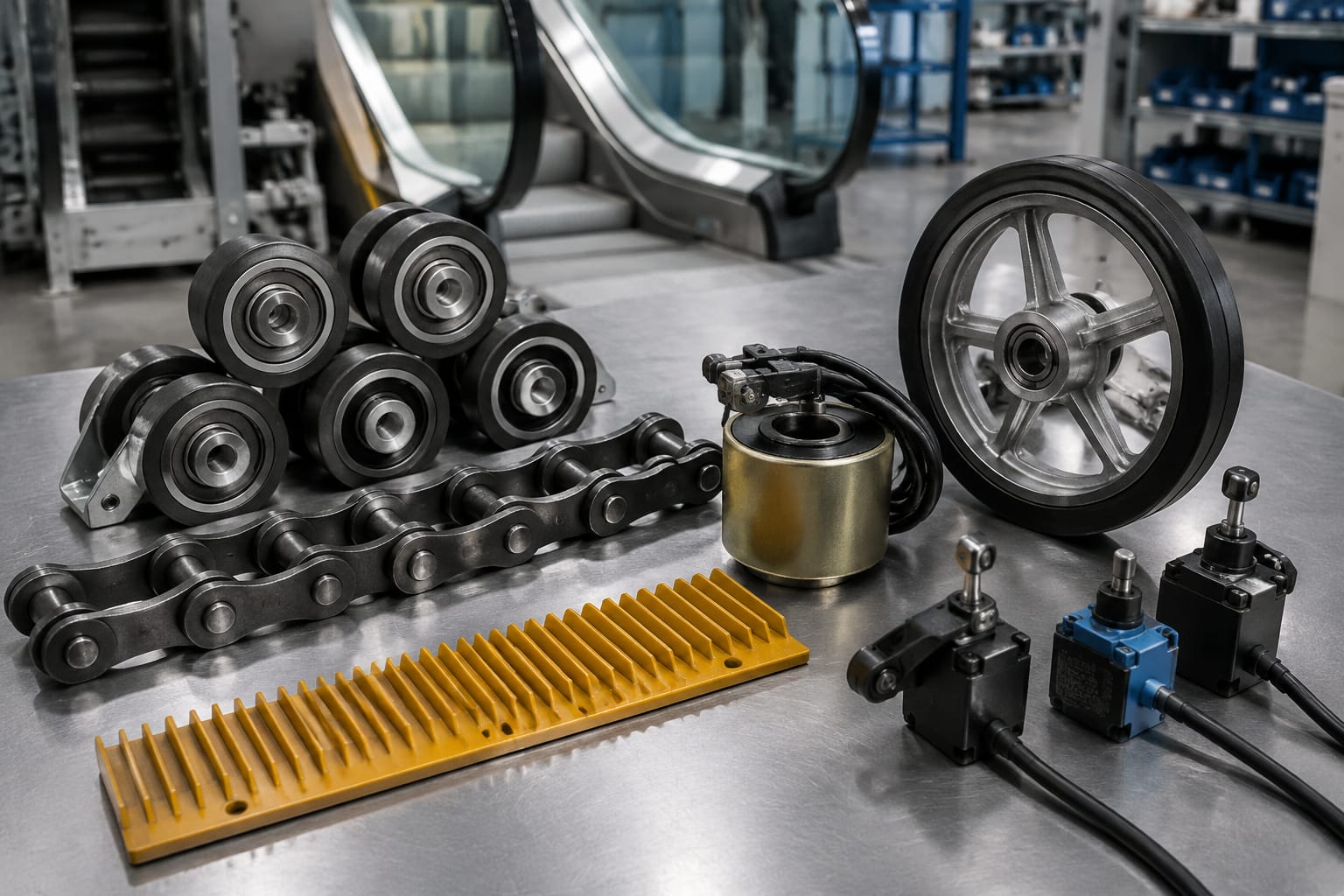
The step band is the visible moving staircase, but its condition depends on components beneath the tread surface. Each step is connected into a continuous chain arrangement and guided by tracks from one landing to the other.
Escalator steps and step axles
Escalator steps must remain level through the incline and transition cleanly into the comb plate at each landing. Cracked step bodies, damaged cleats, worn axle bearings and loose fasteners can create noise, uneven movement or poor engagement at the landing.
Inspect steps for:
- Broken or rounded tread cleats
- Cracks around axle or chain attachment points
- Missing or damaged demarcation inserts
- Excessive side-to-side movement
- Contact between steps, skirt panels or fixed landing components
- Foreign material trapped in the tread or riser area
Step replacement is highly model-specific. Confirm the step width, rise, tread pattern, axle arrangement, chain pitch, material construction and the manufacturer reference. Never assume that a step from a similar-looking escalator will mesh correctly with the existing comb plate.
Step chains, rollers and tracks
The step chain transmits drive force through the step band. Chain elongation, stiff joints, damaged rollers and track wear can lead to poor synchronisation, vibration and uneven step movement. These issues are often more evident near the upper or lower curved sections, where rollers follow tighter track geometry.
Maintenance personnel should check for unusual chain movement, roller flat spots, damaged roller bearings, inconsistent lubrication where specified by the manufacturer, and signs of track damage. Measure and compare chain condition according to the equipment manufacturer's maintenance requirements. Avoid relying only on visual judgement for chain wear.
A chain, roller and track issue may show up as:
- Rhythmic knocking or rumbling at a particular point in travel
- Step bounce or uneven step height
- Increased drive load
- Repeated roller failures
- Noise that changes as passenger load increases
Replacing only the noisy roller may provide a short-term result if the track profile or chain alignment is the underlying cause.
Comb plates and comb segments
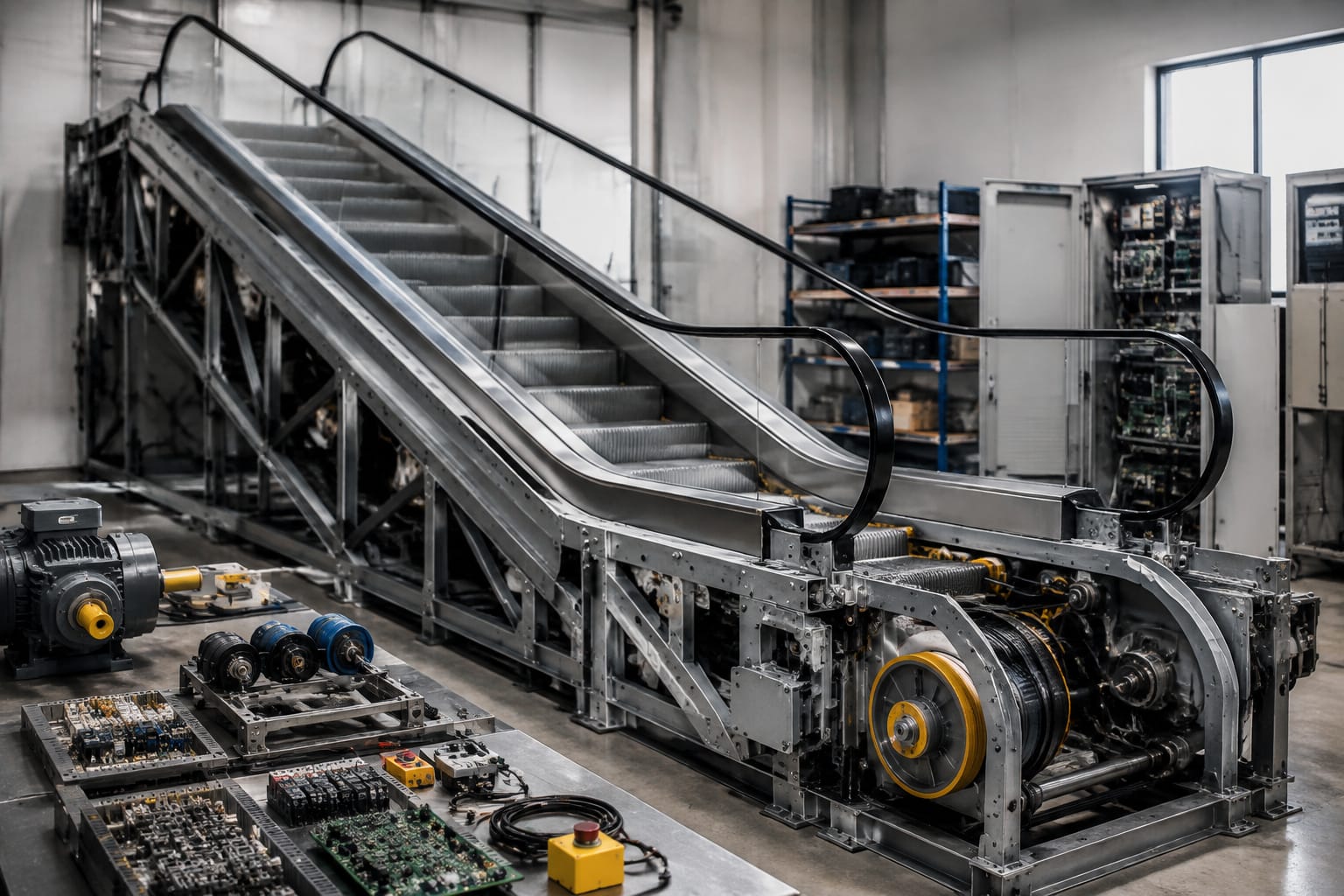
Comb plates guide passengers from the fixed landing floor onto the moving steps. Their teeth mesh with the step cleats, so damage or incorrect positioning can increase the risk of entrapment and step damage.
Inspect comb plates and segments for broken, bent or worn teeth, loose screws or mounting points, debris below the plate, and proper engagement with step cleats. The associated comb impact switch or safety device must also function correctly.
Comb components are not universal. Confirm tooth pitch, segment length, fixing arrangement, colour requirements, material and the specific escalator series before ordering.
Handrail drive and tensioning parts
The handrail should move in the same direction and at a closely matched speed to the step band. A handrail that slips, tracks badly or moves inconsistently reduces passenger confidence and can indicate a developing mechanical issue.
The system typically includes a continuous rubber or synthetic handrail belt, drive wheel or roller, pressure rollers, guide rollers, inlet guides and a tensioning arrangement. Depending on the design, tension may be controlled through a carriage, spring-loaded mechanism, counterweight or other manufacturer-specific arrangement.
Common handrail faults
Handrail problems often develop gradually. Look for:
- Cracks, glazing, hardening or visible damage on the handrail surface
- Excessive handrail speed difference from the steps
- Handrail drift towards one side
- Polished or worn drive rollers
- Dirt, oil or cleaning residue on the drive surface
- Damaged inlet brushes or guide assemblies
- Weak, seized or incorrectly adjusted tensioning parts
Cleaning is important, but the wrong product can damage handrail material or leave a slippery residue. Use cleaning and conditioning products approved for the particular handrail material and escalator manufacturer.
What to verify before ordering handrail parts
For a replacement handrail or its drive and tensioning components, collect the manufacturer, model, serial details, handrail profile, width, thickness, colour, running direction where relevant, roller dimensions and part number. Photographs of the installed arrangement can help a supplier identify differences between revisions, but they do not replace dimensional and technical checks.
Do not over-tension a handrail to correct persistent slipping. Excess tension can place unnecessary load on guide rollers, handrail drive components and the belt itself. First identify whether contamination, drive roller wear, poor pressure adjustment or a degraded handrail is causing the problem.
Main and auxiliary brakes
Brakes are among the most safety-critical items in escalator equipment. Their condition, adjustment and electrical monitoring should be handled according to the original equipment manufacturer's instructions and applicable local safety requirements.
Main brake function
The main brake normally acts on the drive machinery and is used to stop and hold the escalator when power is removed or a stop command is issued. Its construction may include brake shoes or pads, a brake drum or disc, springs, electromagnetic coils, linkages and monitoring contacts.
Routine attention usually includes checking:
- Brake lining or pad condition
- Correct air gap and mechanical clearance
- Spring, linkage and pivot condition
- Coil operation and supply voltage
- Brake switch status
- Oil, grease or contamination on friction surfaces
- Secure mounting and absence of abnormal noise
A brake that releases slowly, drags during operation or does not achieve correct stopping performance requires investigation. Do not compensate for a brake fault by changing controller settings or bypassing a monitoring contact.
Auxiliary or additional brakes
Many escalator designs use an auxiliary, additional or step-band brake as an independent protective measure for specified abnormal conditions. The exact function and triggering arrangement vary by manufacturer and model. It may act directly on the step chain drive, a sprocket, a shaft or another part of the drive train.
Because these devices are design-specific, verify the complete assembly reference and electrical characteristics before sourcing a replacement. Relevant parts may include controllers, brake boards, electromagnetic coils, switches and mechanical brake elements.
For systems using a dedicated controller, review the product details for an escalator auxiliary brake controller against the installed equipment reference. Where the escalator uses the relevant Otis brake control arrangement, a 508 brake board for escalator systems should be matched by exact part number and revision, not by appearance.
Never replace a safety brake part with an unverified equivalent solely because its connector, dimensions or mounting holes look similar.
Motors, drives, and controllers
The drive system converts electrical power into controlled movement of the steps and handrails. Its layout varies: some units use a geared motor and chain drive, while others use different transmission arrangements or variable-speed control.
Motor and gearbox checks
A motor issue may present as tripping, overheating, hum without movement, slow acceleration or abnormal vibration. However, the motor is not always the root cause. Mechanical drag in the step band, brake drag, gearbox trouble or an incorrect controller output can all increase motor load.
Inspect the drive area for:
- Oil leaks or abnormal gearbox noise
- Coupling wear or misalignment
- Loose base bolts and guards
- Drive chain or belt condition, where applicable
- Motor terminal condition and earthing
- Cooling path obstruction
- Signs of overheating or insulation deterioration
- Vibration transmitted through the machine frame
Motor replacement requires more than matching kW rating. Confirm voltage, frequency, phase, speed, duty, mounting arrangement, shaft dimensions, brake integration, thermal protection, encoder or feedback requirements, and compatibility with the existing controller.
Controllers and electrical boards
The escalator controller manages direction, start sequence, braking, safety circuit monitoring and fault indication. Modernised units may also use inverter drives to manage speed and energy-saving modes. Controller faults can be caused by external equipment, wiring, contactor wear, contaminated terminals, a failed sensor or an unstable power supply, not only by the board itself.
Before replacing a controller board, record fault indications, inspect connectors, check incoming supply and test related safety inputs. Replacing boards without diagnosing field devices can result in repeat failures.
When an additional brake coil is identified as faulty, the replacement must match the installed brake design and electrical rating. An electromagnetic coil for an escalator additional brake should be selected only after confirming the applicable equipment and coil reference.
Safety switches and sensors
Escalator safety devices detect conditions that require the machine to stop or prevent it from starting. Depending on the equipment design, the safety circuit can include emergency stop switches, comb impact switches, handrail entry switches, step or chain monitoring devices, skirt obstruction devices, brake monitoring contacts, drive chain monitoring switches and overspeed or unintended movement protection.
These devices must remain accessible, correctly secured and properly adjusted. Their operation should be tested by competent personnel using the manufacturer-approved procedure.
Frequent safety-device problems
Many safety faults result from mechanical condition or contamination rather than electronic failure. Common examples include:
- Debris preventing a comb plate switch from resetting
- A loose actuator failing to engage a limit switch
- Damaged cable insulation near moving equipment
- Misaligned handrail inlet devices
- Oxidised contacts in older electrical assemblies
- Incorrect switch adjustment after mechanical work
- A safety circuit deliberately bypassed during troubleshooting and not restored
Bypassing a safety device is not an acceptable operating condition. If temporary diagnostic work requires an approved test method, restore the circuit and verify operation before returning the escalator to service.
Common wear and inspection points
Inspection frequency and procedures should follow the original manufacturer documentation, site conditions and the service arrangement. High-footfall locations may require closer attention because debris, moisture, abrasive particles and continuous operation accelerate wear.
A practical inspection programme generally covers daily observation, routine preventive maintenance and more detailed periodic examination.
Operational observations
During normal operation, note changes in sound, vibration, step movement and handrail tracking. Check for damaged steps, missing comb teeth, loose skirt brushes, visible debris and fault indications. Passenger-facing defects should be addressed before they lead to a larger mechanical failure.
Routine maintenance checks
During planned maintenance, focus on:
- Step chain and roller condition
- Step-to-skirt and comb plate clearances
- Handrail tracking, tension and speed relationship
- Brake adjustment and monitoring contacts
- Drive machine noise, lubrication and temperature indicators
- Controller terminals, relays, contactors and wiring condition
- Safety switch operation and actuator alignment
- Fasteners, guards and access panels
- Water ingress, dust build-up and foreign material in pits or machinery spaces
Warning signs that need prompt diagnosis
The following conditions should not be treated as cosmetic issues:
- Sudden or progressive abnormal noise
- Repeated tripping without a clear cause
- Step impact at a landing
- Handrail lagging noticeably behind the steps
- Burning smell, overheating or visible electrical damage
- Unusual stopping behaviour
- A safety switch that does not reset reliably
- Recurrent damage to the same component
The limitation of a checklist is that it cannot establish root cause by itself. For example, a noisy gearbox can be related to lubricant, bearing condition, gear wear, misalignment or excessive load from another system. Diagnose the full mechanism before committing to major replacement parts.
Sourcing escalator replacement parts
Escalator spare-part sourcing should combine technical verification with traceable purchasing information. A correct part number is useful, but it may not be enough where the manufacturer has issued revisions, used alternative suppliers or changed the wiring and mounting arrangement.
Information to provide to a supplier
For faster and more accurate identification, prepare:
- Escalator manufacturer, model and serial number
- Exact part number and revision, if available
- Clear photographs of the installed part and its label
- Dimensions, connector type and mounting details where relevant
- Voltage, frequency, coil rating or motor data for electrical parts
- Number of units required
- Description of the fault and whether the part is mechanical, electrical or safety-related
- Equipment manual drawing or spare-parts catalogue reference, where available
For multi-brand procurement, Kelevator supplies elevator spare parts to B2B importers, distributors, maintenance contractors and OEM buyers. For any escalator component, compatibility should still be confirmed against the installed unit before purchase.
Selection criteria by part type
| Part category | Essential checks | Common buying mistake |
|---|---|---|
| Steps and comb plates | Model, width, tooth profile, fixing arrangement, colour and dimensions | Ordering based only on a photograph |
| Chains, rollers and sprockets | Pitch, roller size, chain construction, tooth count and mating parts | Replacing one component without checking the mating wear surface |
| Handrails and rollers | Profile, length, width, material, drive arrangement and tension system | Treating all handrails of similar width as interchangeable |
| Motors and gearboxes | Electrical data, speed, mounting, shaft, brake and controller compatibility | Matching only the power rating |
| Brake coils and boards | Part number, revision, voltage, connector, brake design and safety function | Using a similar-looking electrical component |
| Safety switches and sensors | Actuator style, contact configuration, wiring and mounting position | Ignoring switch adjustment after installation |
Common procurement mistakes to avoid
Do not order a replacement solely from a broad description such as “escalator brake coil” or “step chain roller”. These names cover many designs. Avoid mixing components from different variants without confirming the assembly drawing or manufacturer reference.
Also avoid treating replacement parts as a substitute for corrective maintenance. A new handrail will not solve damaged guide rollers. A new brake coil will not correct a binding mechanical linkage. A new controller board will not remove a fault caused by a damaged field cable.
For critical safety components, retain service records showing the part reference, reason for replacement, checks completed and the person or team responsible for return-to-service testing. This supports future diagnosis and helps prevent unsuitable substitutions.
FAQ
What equipment is needed for an escalator?
The main escalator equipment includes the step band, step chains, tracks, handrail system, drive motor and transmission, main brake, auxiliary brake where fitted, controller, safety switches, sensors, comb plates and skirt interfaces. The precise arrangement depends on the manufacturer and model.
Which escalator parts wear out most often?
Wear commonly affects step chain rollers, handrail drive and guide rollers, handrails, comb segments, brake friction components, drive chains or belts, bearings, switches and electrical contactors. Actual replacement intervals vary widely with usage, maintenance quality and site conditions.
Can escalator spare parts be interchanged between brands?
Usually, no. Some commodity items may appear similar, but dimensions, electrical ratings, mounting points, safety-circuit arrangements and material specifications can differ. Confirm the exact reference and compatibility before using any alternative.
Why does an escalator handrail move slower than the steps?
Possible causes include a worn or contaminated handrail drive roller, incorrect pressure or tension, handrail wear, guide resistance, drive system problems or an issue with the handrail transmission. Check the complete handrail system rather than tightening the belt immediately.
A reliable escalator depends on compatible components and disciplined inspection across the mechanical, electrical and safety systems. When preparing a replacement-part enquiry, start with the machine details, installed part reference and fault evidence, then confirm fitment and function before installation.
Related product references
For practical catalog examples related to this topic, review [Escalator auxiliary brake controller lift parts elevator accessories](/products/escalator-auxiliary-brake-controller-lift-parts-elevator-accessories/), [Escalator 508 Brake Board OTIS elevator parts lift accessories](/products/escalator-508-brake-board-otis-elevator-parts-lift-accessories/), and [Escalator additional brake electromagnetic coil lift accessories elevator spare parts](/products/escalator-additional-brake-electromagnetic-coil-lift-accessories-elevator-spare-parts/). Confirm the exact model, dimensions, ratings, and connectors before ordering.