
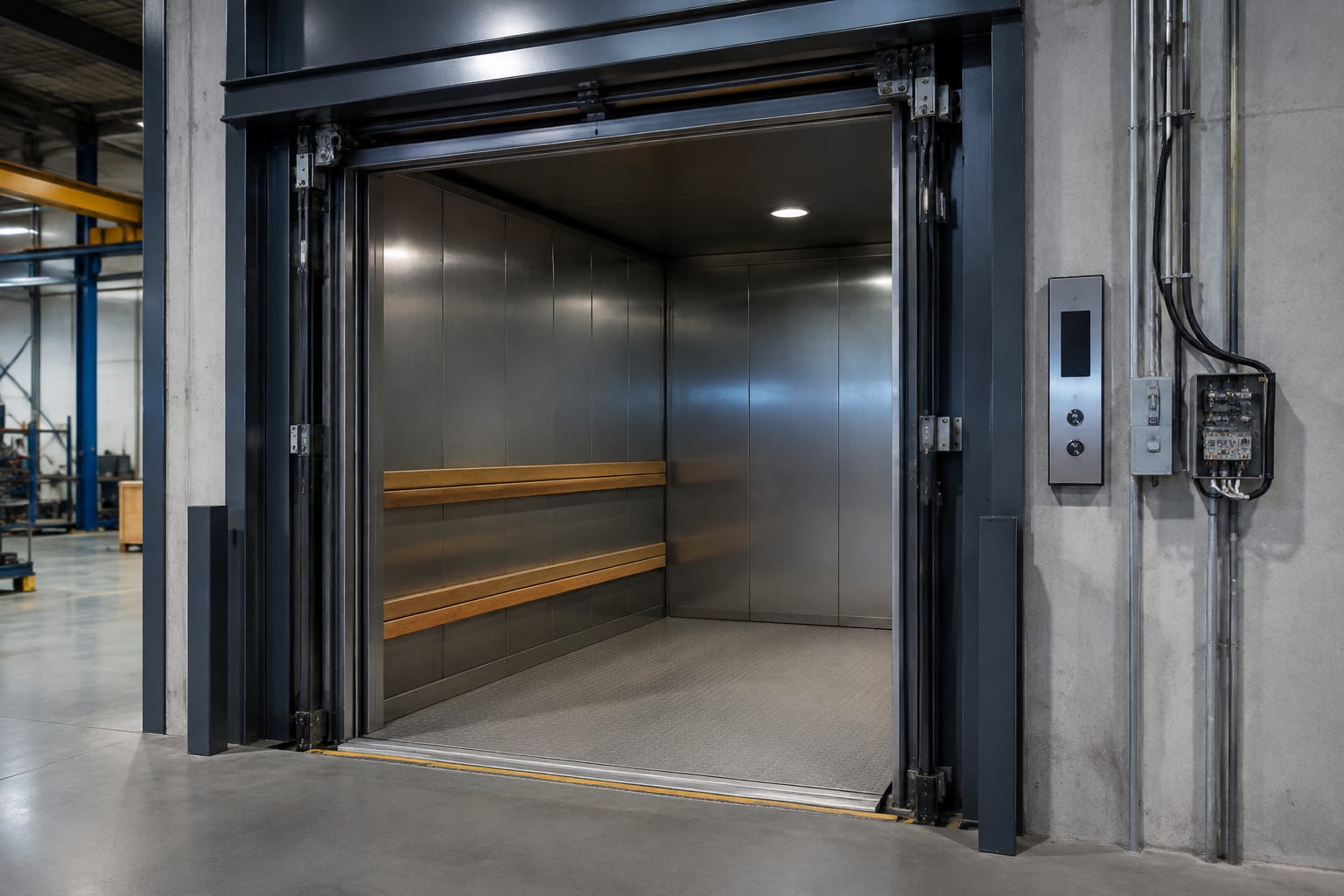
Freight elevator parts must withstand more than normal passenger traffic. Repeated pallet movement, trolley impacts, heavy door cycles and imperfect loading practices place high stress on landing doors, interlocks, rollers, guides and control devices. The right replacement is therefore not simply a part that looks similar; it must match the existing equipment's mechanical fit, electrical function and duty conditions.
For maintenance contractors and sourcing teams, the most reliable approach is to identify the failed component in context. Record the door arrangement, mounting points, electrical ratings, handedness, lock geometry and any markings before ordering. This reduces repeat visits, unsafe substitutions and delays during a breakdown or modernisation project.
How freight elevator duty changes part selection
A freight lift is designed around goods movement, but the actual duty can vary widely. A warehouse lift carrying palletised stock has different operating conditions from a hospital service lift, factory goods lift or vehicle lift. Part selection should reflect the way the lift is used, not only its rated capacity.
Landing and car doors on freight installations often experience:
- Direct impact from hand trolleys, pallet trucks, cages and fork-lift handling errors.
- Frequent opening cycles during dispatch, receiving or production shifts.
- Dirt, packaging debris, moisture or oil entering door tracks and sill channels.
- Door leaves being pushed, pulled or held open by users.
- Uneven loading that creates vibration or movement at the car entrance.
- Long door-open periods while goods are positioned or transferred.
These conditions make rigid mounting, dependable closing action and correct safety-circuit operation particularly important. A lighter-duty component may physically fit but fail earlier if its rollers, contacts, springs or mounting arrangement are unsuitable for the actual door weight and usage.
When comparing freight elevator spare parts, first separate structural wear from electrical failure. A lock may fail to prove closed because the contact is worn, but it may also be reacting to a bent door panel, loose hanger, worn roller or incorrect door clearance. Replacing only the electrical contact in the latter case will not solve the underlying issue.
Freight-door panels and tracks
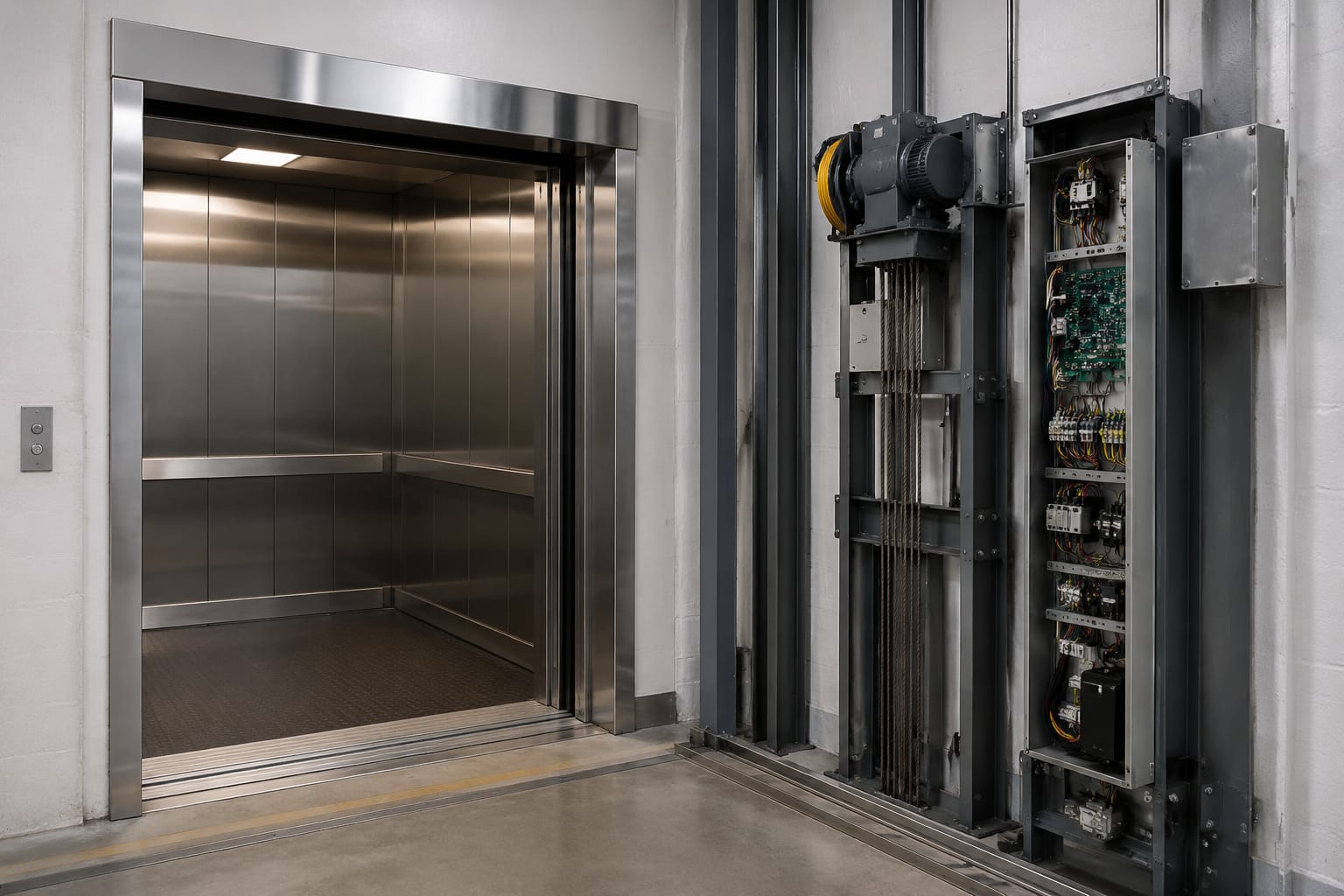
Freight elevator entrance systems may use centre-opening, telescopic, single-slide, two-speed or vertically operated arrangements, depending on the building and application. The replacement panel, track or hanger component must correspond to the existing mechanism rather than the general opening size alone.
Door panels and reinforcement
Door panels used in goods applications can suffer dents, bowed edges, cracked welds and damaged vision-panel areas. A distorted panel may rub against adjacent leaves, fail to align with the lock engaging member or overload rollers and guides.
Before replacing a panel, confirm:
- Clear opening width and height.
- Number of leaves and the opening arrangement.
- Panel width, height, thickness and edge profile.
- Hanger fixing position and hole spacing.
- Sight guard, vision panel, kick plate or protective cladding details where fitted.
- Lock vane, pick-up vane or engaging member position.
- Surface finish requirements where appearance matters.
- Whether the panel is fire-rated or part of a specified building-door assembly.
Do not assume that similar-looking panels from different manufacturers are interchangeable. Hanger profiles, reinforcing channels, sill engagement and interlock interfaces often differ.
Tracks, hangers and sill channels
The header track carries the moving load of horizontal doors. Hangers and rollers run on or within this track, while the sill keeps the panel bottom aligned. Freight use can accelerate track contamination and roller wear, leading to heavy movement, scraping or poor closing.
Inspect the track for dents, corrosion, loose fixings, hardened debris and visibly uneven running surfaces. Check whether the hanger assemblies can be adjusted within their intended range. If a panel has dropped substantially, an adjustment may be insufficient because the roller, hanger plate, track or panel fixing could be worn.
Sill grooves require regular cleaning. Loose wrapping material, grit and metal fragments can obstruct door shoes and cause a door to stop short of the closed position. A poorly cleaned sill is a common reason for intermittent lock engagement.
Door locks, hooks, and contacts
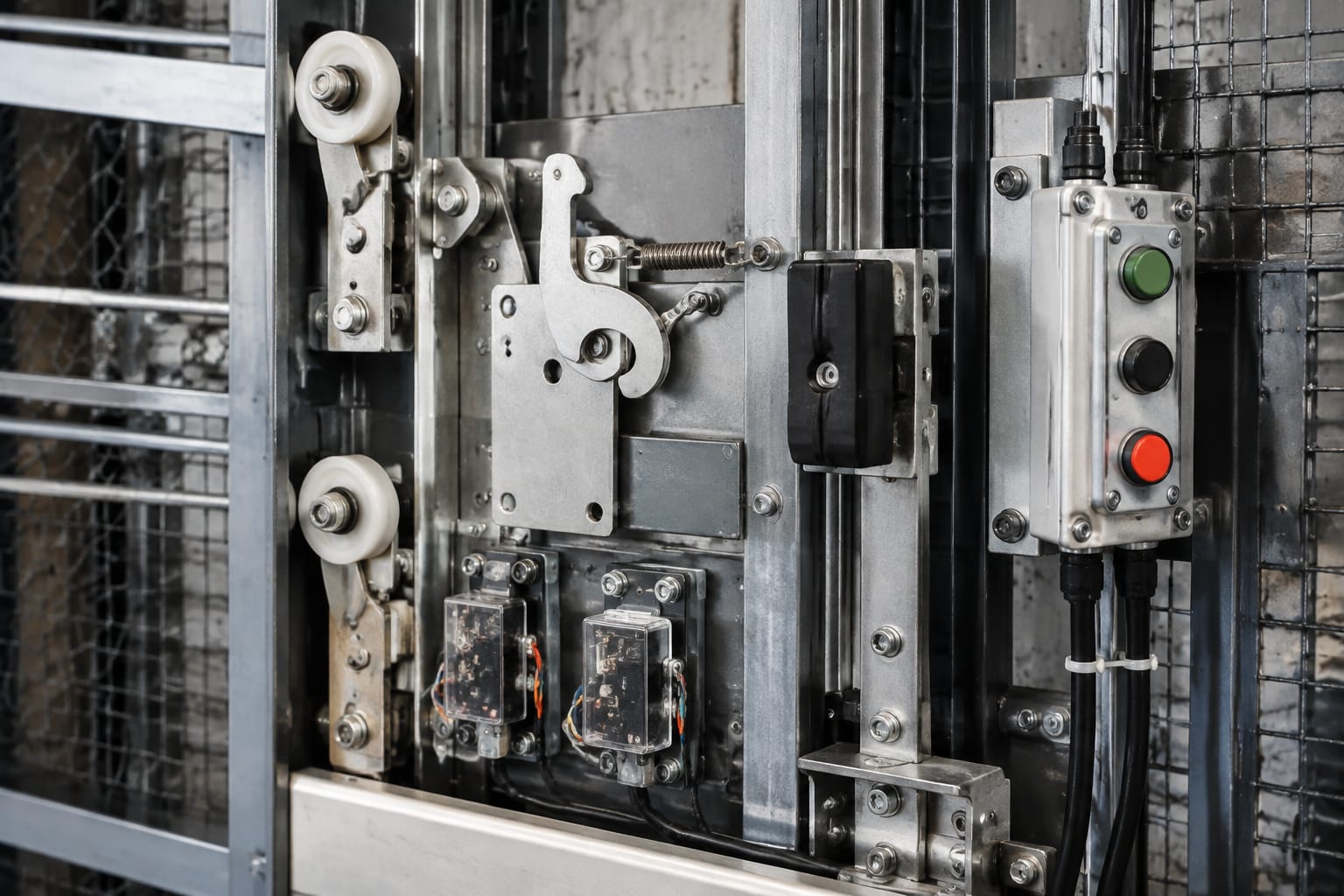
Landing-door locking equipment prevents a door opening when the car is not correctly positioned at that landing. It also provides an electrical proof that the door is closed and locked before the lift is permitted to run. These are safety-critical freight elevator parts and should be selected by exact compatibility, not visual resemblance.
The assembly may include a lock body, hook, lock roller, actuating lever, spring, cam, electrical contact block and mounting bracket. Terminology varies among manufacturers, so photographs and dimensions are often more useful than a generic component name.
What to match when sourcing a door lock
A replacement lock or interlock should be checked against the existing unit for:
| Check point | Why it matters |
|---|---|
| Manufacturer, reference number and visible markings | Gives the strongest starting point for exact identification |
| Lock body dimensions and fixing-hole centres | Determines whether the unit mounts correctly on the jamb or header |
| Hook shape, travel and engagement direction | Ensures secure mechanical locking with the mating part |
| Left-hand or right-hand arrangement | A mirrored unit may not operate on the required side |
| Contact configuration and terminal layout | Must suit the existing safety circuit and wiring method |
| Electrical rating marked on the part | Must be appropriate for the installed circuit |
| Actuating vane or unlocking arrangement | Must work with the car-door or landing-door mechanism |
| Door type and landing application | Helps avoid selecting a passenger-door variant for a freight entrance |
For projects involving worn or damaged mechanisms, a compatible freight elevator door lock contact switch should be evaluated alongside the mating hook, vane and mounting condition. Changing one component while retaining a badly worn mating surface can result in incomplete engagement.
Hooks, cylinders and lock engagement
The hook is the mechanical element that holds the landing door secure. Its engaging face, pivot point and return spring must remain in good condition. Wear at the hook tip or lock keeper can increase play, delay contact operation or prevent consistent locking.
A hall door lock hook for lift doors must match the installed lock body and door arrangement. Check the direction of travel, fixing style and the relation between the hook and the door's engaging vane.
Some arrangements use a triangular lock cylinder or a related unlocking component. Where this is the failed item, compare the cylinder profile, length, operating position and mounting details with the original. A triangular hall-door lock cylinder should not be selected solely by its external shape.
Never bypass, bridge or permanently hold a lock contact closed to keep a freight lift operating. This defeats an essential safety function and can mask a door alignment problem that needs mechanical repair.
Rollers, guides, and closing components
Freight doors rely on several relatively small components to move predictably. Rollers carry or guide the panel, door shoes engage the sill, and closing components return the door to its closed and locked position. Their condition has a direct effect on interlock reliability.
Hanger rollers and bottom guides
Worn hanger rollers may produce noise, stiffness, side-to-side movement or a dropped door panel. Flat spots and seized bearings often develop after prolonged operation with contamination or misalignment. Replace rollers as a matched set where the system and wear condition justify it; fitting one new roller beside heavily worn rollers can leave the door running unevenly.
Bottom guides and door shoes prevent excessive lateral movement. Typical signs of wear include:
- Door leaves rubbing against one another or against the jamb.
- A panel lifting out of the sill groove during movement.
- Scraping sounds near the threshold.
- Inconsistent lock engagement at the end of travel.
- Excessive clearance at the bottom of the door.
Confirm the guide material, groove width, fixing method and panel thickness. A guide that is too tight can make the door difficult to close; one that is too loose may allow enough movement to affect locking.
Closers, chains, ropes and springs
Depending on the entrance design, closing force may come from a spring, weight, chain, rope, belt or door operator. The aim is not simply to make the door shut faster. It is to achieve repeatable closure, correct lock engagement and reasonable resistance to everyday loading-area conditions.
Check for stretched chains, frayed ropes, weak springs, damaged pulleys, loose anchor points and improvised repairs. When changing a spring or closing device, confirm the door weight, travel, mounting points and adjustment range. An overly strong closing arrangement may increase impact and wear; insufficient force may leave doors partly open or unable to lock.
Controls, buttons, and limit switches
Freight lift controls are often exposed to rougher handling than passenger lift fixtures. Car operating panels may have larger buttons, key switches, hold-to-run functions, loading controls, door-open buttons, emergency-stop devices or dedicated service modes. The exact layout depends on the lift's use and installed controller.
Replacement controls should be selected from the electrical and mechanical details of the existing assembly. The appearance of a push button is secondary to its mounting, contact arrangement, illumination type, voltage, legend, environmental protection and controller compatibility.
Buttons and car operating panel components
Before ordering a replacement button or switch, record:
- Cut-out diameter and panel thickness.
- Button head style, colour and legend.
- Momentary, maintained or key-operated action.
- Number and type of contact blocks.
- Voltage and lamp or LED details, where illuminated.
- Terminal style and wire connection method.
- Any markings on the rear of the device.
- Whether the control is part of a proprietary car operating panel.
A damaged button may be only the visible fault. Also inspect loose terminals, cracked panel mounts, damaged wiring insulation and moisture ingress inside the car operating panel.
Limit switches and position devices
Limit switches may be used in door operators, car-top equipment, levelling systems and terminal stopping arrangements. They should be identified by actuator type as well as electrical data. A roller lever, plunger, fork actuator or magnetic sensor may serve different mechanical functions even when the housing looks similar.
For a limit switch replacement, confirm its mounting orientation, actuator travel, normally open or normally closed contact arrangement, connector or terminal style, voltage/current marking and physical clearance through the full movement range. Verify operation after installation with the prescribed maintenance and safety procedure for the equipment.
Wear caused by loading operations
Loading activity creates fault patterns that may not appear in lightly used passenger lifts. The most common issue is impact damage: a trolley strikes the door, jamb or sill, shifting alignment enough to create intermittent door-lock faults. Repeated minor impacts can be as troublesome as one obvious collision.
Other loading-related wear includes:
- Pallets or crates pressing against door leaves while the car is moving or doors are closing.
- Fork-lift forks damaging sill edges or car-threshold components.
- Debris trapped in sills, guides and locks.
- Moisture, dust or chemical residue affecting contacts and moving parts.
- Door leaves being forced manually instead of operated through the intended mechanism.
- Long dwell periods that strain closing components or encourage users to wedge doors open.
The fault reported by site staff may be “lift not moving”, but the cause can originate at an entrance several floors away. Because door locks are typically part of the safety chain, one incomplete lock condition can prevent operation. A systematic inspection of every landing entrance is more effective than replacing controls at random.
Information needed for replacement
A complete identification record improves the chance of receiving suitable freight elevator parts on the first enquiry. It also lets a supplier distinguish between an exact replacement, an equivalent item requiring verification and a component that needs a wider assembly change.
Provide the following information where available:
- Lift manufacturer, controller manufacturer and equipment model details.
- Component name, part number and all labels or stamped references.
- Clear photographs from front, back, side and mounting faces.
- Measurements, including overall size, fixing-hole centres, connector location and moving-part travel.
- Door arrangement: centre-opening, telescopic, single-slide or another configuration.
- Handing or orientation, stated from the same viewing position used in the photographs.
- Electrical data from the original part, including rated voltage and contact markings.
- The fault symptoms and whether the issue is constant or intermittent.
- Photographs of the mating component, particularly for locks, hooks, rollers and guides.
- Quantity required and whether other entrances have similar wear.
Avoid ordering from a blurred photograph alone. Small differences in terminals, hole positions, actuator length or hook geometry can make a part unusable even when the housing appears identical.
For obsolete equipment, an equivalent may be possible, but it should be assessed as a compatibility exercise. It may require a changed bracket, wiring adjustment, mating component replacement or formal verification by the responsible lift professional. Do not describe a substitute as a direct replacement unless its mechanical and electrical fit has been confirmed.
Inspection and maintenance planning
A planned inspection programme helps identify freight-door deterioration before it turns into a shutdown. The frequency should be set by site duty, equipment condition, manufacturer guidance and the maintenance arrangement. High-use goods entrances generally need closer attention than lightly used service doors.
Practical inspection points
During a routine visit, inspect and test as appropriate:
- Door panel alignment, clearance and visible damage.
- Hanger fixings, track condition and roller movement.
- Sill cleanliness and guide engagement.
- Lock body security, hook engagement and spring return.
- Contact condition, terminal tightness and cable routing.
- Closing-device operation and final closing speed.
- Button condition, panel security and switch response.
- Signs of water ingress, dust build-up or corrosion.
- Evidence of impact, forced opening or temporary site repairs.
- Consistent operation at every landing, not only the reported fault location.
Record recurring faults by landing and component type. This can reveal an operational cause, such as a particular loading bay being struck frequently, rather than a succession of unrelated component failures. Where impact damage is recurring, physical protection, revised loading practice or improved threshold housekeeping may be more effective than repeated spare-part replacement.
Maintenance personnel should follow the applicable safety procedures, the equipment manufacturer's instructions and site requirements when inspecting or replacing safety-circuit components. Freight lift door locks, contacts and related controls should be functionally checked after work before the lift is returned to service.
FAQ
Can a passenger lift door lock be used on a freight lift?
Only where the exact lock arrangement, ratings, mounting and door interface have been verified as compatible. Freight use can impose different mechanical demands, and a visually similar lock may have a different hook, contact or actuator arrangement.
Why does a freight lift stop even when the doors look closed?
A door can appear shut while a lock hook has not engaged fully or a contact has not made reliably. Misalignment, worn rollers, a blocked sill, a weak closer or a damaged lock component can all cause this condition.
Should locks be replaced one at a time or across all floors?
Replace the failed component based on inspection findings. However, if multiple entrances have the same age, duty and wear pattern, inspect all of them and consider planned replacement where deterioration is widespread.
For sourcing, prepare a component record with photographs, measurements and fault details before comparing options. Kelevator supplies multi-brand elevator spare parts for B2B importers, distributors, maintenance contractors and OEM buyers; clear identification details help establish whether a requested freight lift component is the correct fit.
Related product references
For practical catalog examples related to this topic, review [freight elevator door lock contact switch lift parts elevator accessories](/products/freight-elevator-door-lock-contact-switch-lift-parts-elevator-accessories/), [Hall door lock hook lift accessories elevator spare parts](/products/hall-door-lock-hook-lift-accessories-elevator-spare-parts/), and [Hall door triangular lock cylinder lift accessories elevator spare parts](/products/hall-door-triangular-lock-cylinder-lift-accessories-elevator-spare-parts/). Confirm the exact model, dimensions, ratings, and connectors before ordering.