
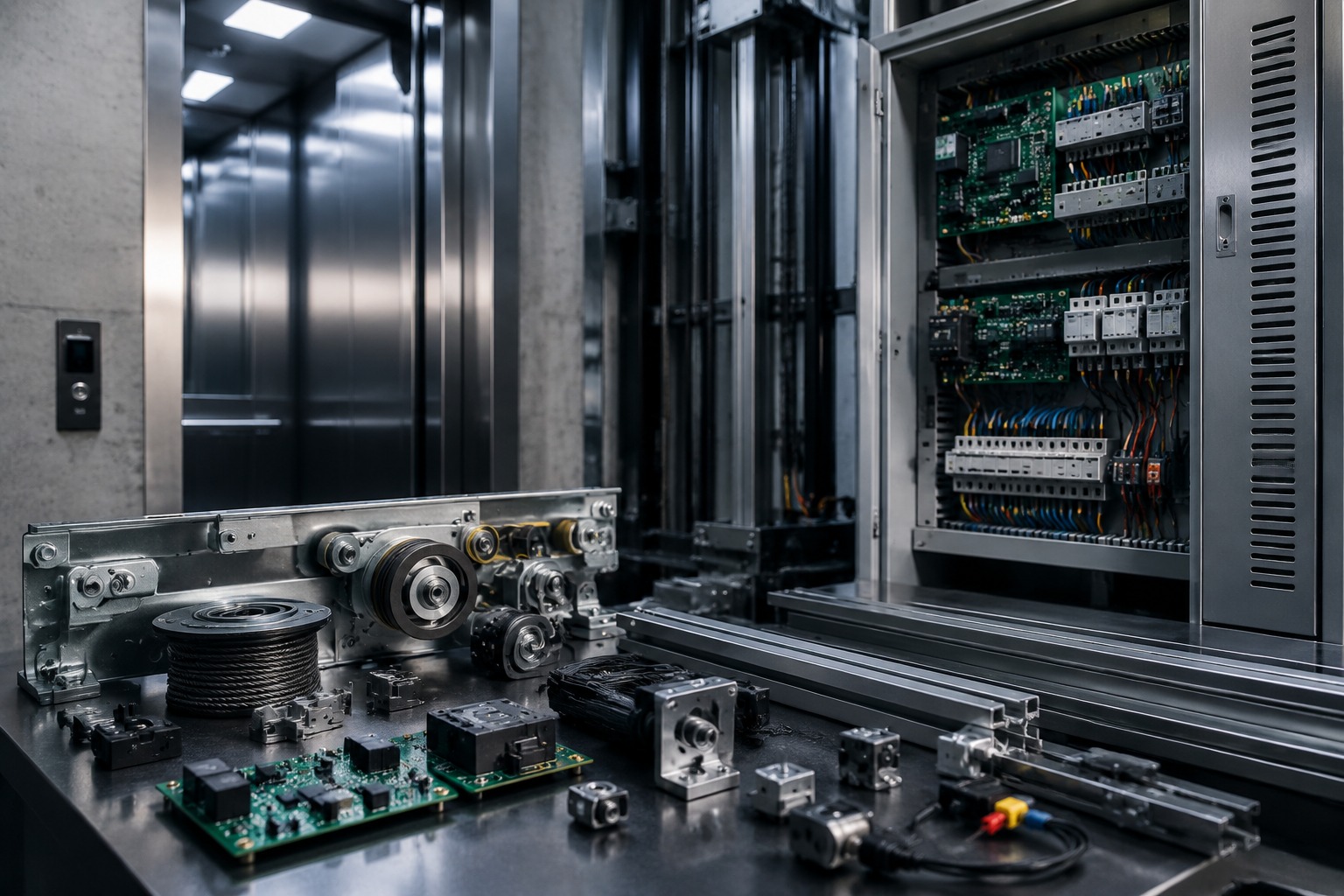
For repair teams, facility managers, distributors, and modernization contractors in India, buying the right Hitachi elevator parts is not only a pricing task. It is a technical matching task, a safety task, and a downtime-control task. The fastest way to reduce repeat visits and avoid installation delays is to confirm the model series, original part code, operating voltage, connector layout, software version, and mechanical dimensions before ordering. This matters even more in active maintenance markets such as Mumbai, Delhi NCR, Bengaluru, Chennai, Hyderabad, Pune, Ahmedabad, and Kolkata, where building traffic is high and lift shutdowns quickly become a tenant issue.
High-demand Hitachi lift accessories in India usually include control boards, encoder units, door motors, emergency power supply modules, sensors, light curtains, guide shoes, brake-related wear items, buttons, COP panels, and door locks. In many cases, the problem is not that the part is rare. The real problem is that the wrong revision or incompatible variant was ordered. A control board may match physically but not by firmware. A door motor may fit the operator frame but fail on torque or communication settings. A guide shoe may seem similar yet have different insert dimensions. For this reason, experienced buyers combine field photos, old labels, lift serial records, and supplier cross-checking before procurement.
India’s elevator service ecosystem is also shaped by logistics and import timing. Teams sourcing through Chennai Port, Nhava Sheva, Mundra, and Kolkata Port often balance urgency against consolidation. A single failed board in a commercial tower in Gurugram or a hospital lift in Hyderabad may justify express shipment, while modernization batches for residential projects in Pune or Noida may allow planned procurement. The best sourcing strategy depends on building type, passenger load, service level agreement, and the risk of extended downtime.
This guide explains which Hitachi elevator replacement parts are most commonly requested, how to identify series and part numbers correctly, what to check for electronics and door systems, how to assess suppliers, which mistakes buyers in India should avoid, and what trends are shaping procurement decisions toward 2026. It is written for practical use by technicians, purchasing teams, and building stakeholders who need dependable sourcing rather than generic catalog information.
Popular Hitachi Elevator Replacement Parts
In the India market, the most frequently sourced Hitachi lift spare parts fall into a few practical categories: controller electronics, door system components, travel and safety sensing devices, traction-related accessories, and interior operating fixtures. Demand is driven by age of equipment, traffic levels, preventive maintenance standards, environmental conditions, and the availability of original documentation.
Among electronic items, control boards remain one of the highest priority categories because failure can stop the elevator completely. Maintenance companies often look for exact or compatible replacements for CPU boards, I/O boards, drive interface boards, and communication boards. For repair planning, it is useful to review a Hitachi elevator control board option only after checking board code, connector type, fault history, and cabinet layout. In older buildings across Chennai and Kolkata, many teams also need power stabilization support because heat, dust, and electrical fluctuation accelerate board fatigue.
Encoders are another commonly replaced item, especially where speed feedback instability causes leveling issues, drive alarms, or irregular travel behavior. If a field team is troubleshooting intermittent errors, they should not rely on appearance alone. Shaft size, pulse specification, cable configuration, and mounting method all matter. A suitable Hitachi encoder replacement should be checked against the machine and drive data before dispatch.
Door systems generate a large share of service calls in India because of heavy daily usage in apartments, offices, hotels, hospitals, and malls. Common replacement requirements include door motors, rollers, belts, couplers, door locks, door vanes, and light curtains. In high-traffic properties in Bengaluru and Mumbai, repeated open-close cycles place continuous stress on operator mechanisms. When performance drops, a permanent magnet synchronous door motor for Hitachi lifts may be considered during repair or modernization if torque, voltage, and installation compatibility are verified.
Emergency backup units are important in regions where power interruptions or voltage instability affect building operation. Hospitals, mixed-use towers, and premium residential complexes increasingly ask for dependable emergency supply arrangements to support safe evacuation or controlled rescue operation. Procurement teams comparing options often review an emergency power supply for Hitachi elevators together with battery condition, rescue logic, and controller compatibility.
Mechanical accessories such as guide shoes, oil cups, brake linings, brake switches, sheave-related items, and damping parts also remain high-volume categories. These may look simpler than boards or drives, but incorrect hardness, size tolerance, or material quality can lead to vibration, noise, or premature wear. Good sourcing therefore requires both dimensional verification and material reliability.
| Part Category | Common Failure Reason | Typical Symptom | Urgency Level | Key Check Before Purchase | Common India Use Case |
|---|---|---|---|---|---|
| Control board | Heat, voltage fluctuation, component aging | Lift out of service, random faults | Very high | Board code, software revision, connector layout | Commercial towers in Mumbai and Gurugram |
| Encoder | Wear, contamination, cable damage | Leveling error, speed alarm | High | Pulse specification, shaft type, mount pattern | High-rise residential projects in Pune |
| Door motor | Cycle fatigue, bearing wear | Door reversal, slow opening, noise | High | Voltage, torque, operator model | Office buildings in Bengaluru |
| Power supply module | Power instability, age | Intermittent restart, controller reset | High | Input/output ratings, cabinet fitment | Hospitals in Hyderabad |
| Guide shoe | Wear, misalignment, poor material | Vibration, ride discomfort | Medium | Dimension, insert material, rail size | Residential towers in Noida |
| Brake component | Wear, contamination, weak spring action | Stopping issue, noise, safety alarm | Very high | Friction material, switch type, spring data | Older lifts in Chennai and Kolkata |
The table above shows why not all “popular” parts should be sourced the same way. Electronics need revision control, while mechanical items need dimensional and material consistency. Teams that build category-specific purchase checklists usually reduce returns and field delays.
How to Identify Model Series and Part Numbers
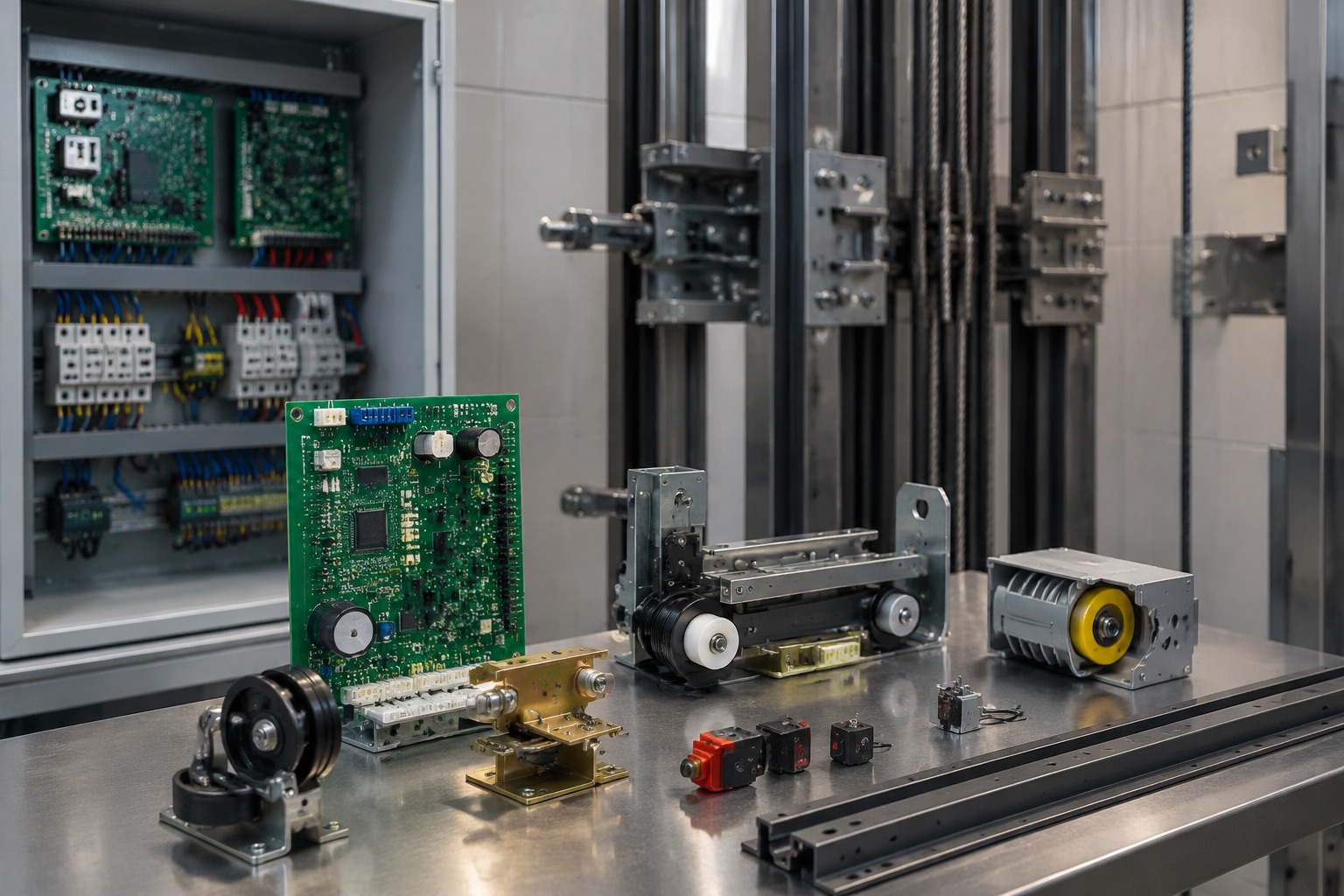
The most important rule in lift parts procurement is simple: never order from memory when exact identification is possible. Hitachi elevator systems may have multiple generations, regional configurations, and cabinet modifications. In India, this complexity is common in mixed portfolios where one maintenance company handles residential towers in Navi Mumbai, hospitals in Chennai, IT parks in Bengaluru, and hotels in Jaipur at the same time.
Start with the machine room or controller cabinet nameplate. Record the model series, installation number, manufacturing date if available, rated speed, capacity, voltage, frequency, and any controller code. Then inspect the failed component itself. Take clear photos of the full assembly, label, terminals, and mounting points. If the label is damaged, collect indirect clues such as plug count, housing dimensions, board print number, or related module references.
For electronic parts, it is best to compare all of the following: original part number, sub-code or suffix, PCB marking, firmware or EPROM identification, hardware revision, and communication port arrangement. For mechanical parts, measure length, width, diameter, mounting hole centers, spring dimensions, rail profile, and wear surface thickness. For door parts, note whether the operator is center opening or side opening, door weight, opening width, travel speed, and whether the setup uses a synchronous motor, asynchronous motor, or another drive type.
Many buyers in India make a basic but costly mistake by ordering from the elevator brand alone. “Hitachi part” is not a sufficient specification. The right process is “Hitachi brand + series + part code + revision + dimensions + operating data.” This is especially true when the same building has undergone modernization or partial retrofit over time.
| Identification Source | What to Record | Why It Matters | Common Risk If Ignored | Recommended Action | Useful for Which Parts |
|---|---|---|---|---|---|
| Controller nameplate | Series, voltage, installation data | Confirms main system family | Wrong controller generation | Photograph full plate clearly | Boards, drives, power modules |
| Old part label | Part number, suffix, date code | Direct replacement matching | Ordering similar but incompatible item | Zoom photo and transcribe label | All categories |
| PCB printing | Board number, hardware revision | Helps when stickers are missing | Firmware mismatch | Capture front and back images | Control boards, I/O boards |
| Connector layout | Pin count and plug arrangement | Confirms physical compatibility | Cannot install in cabinet | Mark each plug position | Electronic modules |
| Mechanical dimensions | Hole distance, length, diameter | Ensures fitment | Rework at site or unusable stock | Use caliper or scale photo | Guide shoes, brakes, rollers |
| Application record | Building type and traffic level | Supports correct quality selection | Short service life | Share lift usage profile | Door parts, wear parts |
The table above helps field staff gather information systematically. In practice, a complete identification package usually includes five photos, one short fault description, and one site data sheet. This improves quotation accuracy and reduces repeated messaging between technician and procurement team.
Control Board and Sensor Replacement Planning
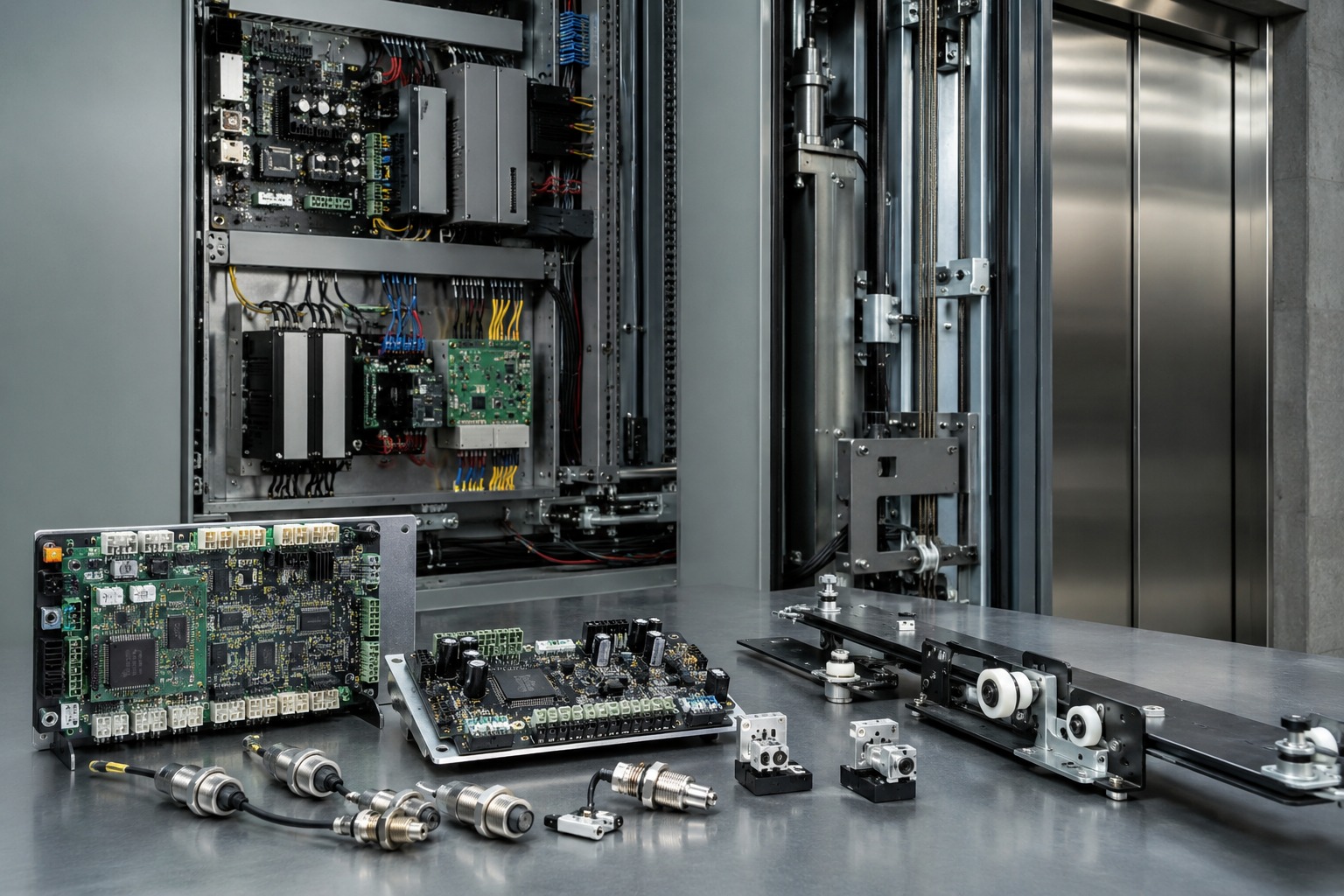
When replacing control boards and sensors, planning must go beyond “remove and install.” The correct approach is to treat the repair as a controlled system intervention. A board may be the visible failed part, but the underlying problem may involve unstable input power, grounding issues, poor ventilation, moisture ingress, or damaged peripheral devices. Similarly, a sensor may fail because of cable damage, contamination, magnet misalignment, or connector stress rather than age alone.
In India’s climate conditions, especially in coastal areas such as Chennai, Kochi, and Visakhapatnam, humidity and corrosion can accelerate deterioration. In industrial zones around Ahmedabad, Faridabad, and Pune, dust and vibration often affect cabinet reliability. Therefore, before changing a board, teams should inspect cabinet cleanliness, fan operation, terminal tightness, earthing quality, surge protection, and previous alarm history.
For sensors, confirm the exact sensing principle: photoelectric, proximity, magnetic, limit, leveling, position, or safety edge related. Match sensing distance, output type, cable length, connector type, voltage, and response characteristics. Where light curtains are involved, beam count, power supply, profile dimensions, and controller compatibility should also be checked. If the site has experienced repeated door safety faults, the issue may be wiring or alignment rather than the curtain module itself.
A good replacement plan includes pre-shipment verification, arrival inspection, anti-static handling, serial tracking, and test procedure after installation. For critical sites such as hospitals, metro-linked commercial complexes, and data center campuses, many buyers in India now prefer to keep one strategic spare control board or sensor kit in local stock.
| Component | Pre-Replacement Check | Critical Matching Point | Installation Risk | Post-Install Test | Stocking Advice |
|---|---|---|---|---|---|
| Main control board | Power quality and fault log | Code and firmware revision | System communication failure | Run, leveling, door sequence | Keep one spare for busy sites |
| I/O board | Input-output status review | Terminal map and function | Wrong signal assignment | Call registration and landing signals | Useful in regional service hubs |
| Encoder | Shaft and cable inspection | Pulse and mount type | Travel instability | Speed feedback and leveling | Stock for high-rise portfolios |
| Door sensor | Alignment and cable condition | Output type and voltage | False obstruction alarms | Door reopen and close cycle | Keep by operator family |
| Leveling sensor | Bracket position and magnet check | Detection range | Floor mis-leveling | Landing accuracy test | Stock in moderate quantity |
| Light curtain | Profile damage and wiring path | Beam count and size | Unsafe door behavior | Passenger obstruction detection | Common spare for apartments |
The explanation from this table is clear: every electronic replacement should be connected to a cause review and a test plan. This is how experienced teams avoid repeated part consumption and protect service margins.
Door Motor and Power Supply Considerations
Door motors and power supplies deserve special attention because they are often replaced under time pressure. A stalled entrance or recurring controller reset can shut down a lift in a busy building, so teams may feel pressure to source quickly. However, fast procurement should still follow a checklist.
For a door motor, confirm the operator model, opening method, rated voltage, current, speed, torque, mounting footprint, pulley or coupling style, wiring method, and any driver interface requirements. If the old motor failed due to heat or overload, inspect the mechanical resistance in the door system. Otherwise, the new motor may be damaged by the same underlying issue. In apartment towers in Thane, Whitefield, and Gurgaon, recurring door motor failure is often linked to roller wear, misaligned tracks, or poor clutch movement rather than a motor defect alone.
For power supplies, match input voltage range, output ratings, number of channels, heat management, cabinet space, and protection requirements. In India, voltage fluctuation remains a practical site issue in certain zones, so stable output performance and proper packaging during transport matter. On older installations, connectors may have changed across revisions, which means installation should be confirmed before dispatch.
Emergency power systems require one more layer of review. Confirm battery status, recharge logic, rescue sequence timing, communication to the controller, and whether the system supports the building’s passenger evacuation procedure. In healthcare and premium residential projects, clients increasingly ask for predictable rescue behavior and maintenance-friendly battery replacement schedules.
| Item | Main Selection Factor | Field Inspection Focus | Failure Pattern | Recommended Buyer Question | Best Use Case |
|---|---|---|---|---|---|
| Door motor | Torque and voltage match | Track resistance and roller condition | Slow or failed opening | Is this matched to my operator family? | Heavy-use office lifts |
| Door controller interface | Signal compatibility | Connector and communication check | Erratic door movement | Does it need setup or parameter review? | Modernized buildings |
| Main power supply | Output stability | Cabinet heat and earthing | Random reboot | What is the exact output rating? | Older control cabinets |
| Emergency power supply | Rescue logic compatibility | Battery health and charger status | No rescue after outage | How is battery backup tested? | Hospitals and premium housing |
| Fuse and protection parts | Correct rating | Cause of blow-out | Repeated trips | What upstream issue should be checked? | All properties |
| Wiring harness | Pin map accuracy | Insulation and crimp quality | Intermittent fault | Is the harness labeled and tested? | Retrofit repair jobs |
This table shows why door and power-related procurement should connect electrical and mechanical inspection. Replacing only the visible failed item may solve the symptom temporarily, but not the cause.
Guide Shoe and Brake Component Checks
Guide shoes and brake components may seem straightforward compared with electronics, yet they directly affect ride quality, wear rate, and safety confidence. Buyers in India often source these parts in recurring batches for preventive maintenance because they are consumable or semi-consumable depending on operating conditions.
For guide shoes, inspect rail size, shoe body dimensions, insert material, lubrication method, and wear pattern. If one side shows abnormal wear, do not just replace the insert. Check rail alignment, car loading pattern, frame condition, and vibration source. In high-rise residential buildings in Mumbai and Noida, ride comfort complaints frequently lead technicians first to guide shoe inspection.
For brake components, buyers should be careful with friction material quality, thickness tolerance, spring force data, coil condition, brake switch function, and mounting dimensions. Never reduce brake sourcing to appearance. In elevators with frequent starts and stops, poor-quality friction material can produce noise, inconsistent stopping, or accelerated wear. Since braking is safety sensitive, traceability and quality inspection are particularly important.
Oil cups and related lubrication accessories should also not be ignored. A low-cost lubrication failure can accelerate guide wear and increase vibration. In dusty environments or where routine maintenance intervals are stretched, a simple accessory can become a larger mechanical problem.
| Mechanical Part | Key Dimension or Property | Wear Sign | Hidden Cause to Check | Quality Risk | Replacement Timing Advice |
|---|---|---|---|---|---|
| Guide shoe insert | Rail profile and insert hardness | Uneven surface wear | Rail misalignment | Poor material causes short life | Change before vibration worsens |
| Guide shoe body | Mounting hole centers | Crack or looseness | Frame stress | Dimensional mismatch | Replace if body integrity drops |
| Oil cup | Fitment and oil flow | Dry rail contact | Missed maintenance | Leakage or poor sealing | Inspect during every service cycle |
| Brake lining | Thickness and friction stability | Noise or poor stopping consistency | Heat buildup or contamination | Unsafe braking performance | Replace by measured wear level |
| Brake switch | Electrical rating and travel | Alarm or no-run fault | Misadjustment | False status signal | Change when switching becomes unstable |
| Brake spring/coil related item | Force and electrical integrity | Delayed release or hold issue | Voltage drop | Inconsistent operation | Check together with full brake assembly |
The explanation here is that mechanical parts should be bought with inspection data, not with visual assumption alone. This helps buyers select the right grade for traffic-heavy lifts and improve lifecycle cost.
How to Inspect Supplier Quality
Supplier quality inspection is where many successful elevator maintenance companies separate themselves from repeated-problem buyers. A reliable supplier should not only quote quickly; they should also verify compatibility, document inspection steps, protect parts in packaging, and respond clearly when site details are incomplete.
Start with product identification support. A capable supplier asks for photos, labels, dimensions, and application data rather than pushing a quick shipment without verification. This is a practical sign of technical discipline. Next, review quality control. For electronics, look for visual inspection, basic functional checks where applicable, anti-static packing, moisture protection, and label traceability. For mechanical items, ask about dimensional checks, material consistency, surface finish, and packaging against transport damage.
Technological capabilities matter because many elevator parts are not purely generic items. A supplier serving maintenance companies across India should understand model matching, board variants, encoder specifications, and door system compatibility. Manufacturing capabilities matter for repeat supply of wear parts and accessories, where stable dimensions and protective packaging help reduce field rejection. Service capabilities matter because urgent repairs often need responsive communication, label review, and status updates during dispatch.
Our own approach is built around those three areas. On the technology side, we support careful model matching for control boards, inverter-related parts, sensors, encoders, door operator components, and other lift accessories so customers can reduce uncertainty before ordering. On the manufacturing side, we focus on stable sourcing channels, inspection routines, and packaging that protects electronic and mechanical parts during long-distance transit to India. On the service side, we work with maintenance firms, distributors, building owners, and modernization contractors to provide responsive quotation support, practical compatibility review, and shipment handling that helps reduce downtime.
| Supplier Checkpoint | What Good Suppliers Provide | Warning Sign | Why It Matters | Buyer Verification Method | Priority Level |
|---|---|---|---|---|---|
| Technical matching | Photo-based and code-based review | Quotes without checking details | Prevents wrong part orders | Send sample site data and judge response | Very high |
| Inspection process | Documented visual and dimensional checks | No quality explanation | Reduces rejection rate | Ask for inspection photos | High |
| Packaging | Anti-static and protective packing | Loose or generic packing only | Protects goods in transit to India | Review packing method before shipment | High |
| Traceability | Clear labels and shipment records | Confusing item descriptions | Supports after-sales clarity | Check invoice and label consistency | High |
| Response speed | Fast but careful communication | Slow reply on urgent technical points | Critical during breakdown repair | Test response on real inquiry | Medium |
| India shipment experience | Understands ports, packaging, and customs docs | No export process familiarity | Helps avoid delay | Ask about delivery routes to Mumbai or Chennai | Medium |
This table explains that supplier inspection is not about low price alone. It is about reducing technical error, transport damage, and project delay. Buyers serving critical buildings should evaluate suppliers as operating partners, not just vendors.
Common Procurement Mistakes
Several mistakes appear repeatedly in elevator parts buying across India. The first is ordering by brand only, without confirming series and revision. The second is relying on old WhatsApp photos that do not show the label or connector side. The third is focusing on unit price while ignoring downtime cost, return cost, and technician revisit cost. The fourth is replacing a failed part without checking upstream causes. The fifth is not planning stock for high-risk items in high-traffic buildings.
Another major mistake is mixing urgent and non-urgent sourcing decisions. For example, a hospital lift in Hyderabad may require immediate dispatch of a verified board or power supply, while a residential modernization package in Pune may be better handled through planned batching. When everything is treated as an emergency, procurement cost rises and accuracy often falls.
Some buyers also underestimate packaging quality. Electronic parts shipped without proper anti-static protection or mechanical parts packed loosely can arrive damaged or degraded, especially on longer routes entering via major trade hubs. Another avoidable mistake is not documenting site installation results. Without that feedback, the purchasing team cannot improve future matching accuracy.
Finally, many teams ignore future readiness. Toward 2026, more buyers are prioritizing sustainable maintenance, lifecycle value, and planned parts availability. This means selecting suppliers who can support stable sourcing, not only one-off emergency orders.
| Procurement Mistake | Immediate Result | Long-Term Cost | How to Prevent It | Who Should Own the Fix | India Example |
|---|---|---|---|---|---|
| Ordering by brand only | Wrong part arrives | Return and extra downtime | Use full identification checklist | Technician and buyer together | Residential service company in Delhi NCR |
| No label photo | Weak matching confidence | More back-and-forth and delay | Standardize site photo process | Field team | Office lift repair in Bengaluru |
| Choosing only the lowest price | Quality inconsistency | Repeat failures | Compare total service cost | Procurement manager | Commercial tower in Mumbai |
| Ignoring root cause | New part fails again | Warranty disputes and reputational loss | Do failure analysis before replacement | Maintenance supervisor | Hospital lift in Hyderabad |
| No strategic spare stock | Long shutdown during urgent failure | SLA penalties | Keep critical parts by portfolio type | Operations manager | IT park in Pune |
| Poor packaging review | Transit damage | Replacement shipping and delay | Confirm protection before dispatch | Supplier and buyer | Import via Chennai Port |
The key lesson from these mistakes is that procurement quality directly shapes service quality. Better data collection, better supplier control, and better planning usually outperform price-only decisions.
FAQ About Hitachi Elevator Parts
Which Hitachi elevator spare parts are most commonly required in India?
Control boards, encoders, door motors, emergency power supplies, door locks, light curtains, guide shoes, oil cups, sensors, buttons, and COP-related accessories are among the most frequently requested categories.
How can I identify the correct part number?
Use the controller nameplate, the old part label, PCB print numbers, connector photos, and measured dimensions. Always combine brand, series, part code, revision, and application details.
Can a visually similar board replace the original?
Not safely by assumption. Boards may differ in firmware, interface logic, terminal mapping, or operating voltage. Always confirm exact matching or technically validated compatibility.
When should I replace an encoder?
If there are speed feedback errors, leveling issues, unstable travel data, or visible wear or cable damage, the encoder should be checked promptly. Confirm pulse and mounting details before purchase.
What should be verified before ordering a door motor?
Check operator type, opening style, voltage, torque, mounting pattern, connector, and whether any related rollers, tracks, or clutch parts are causing overload.
Why do power supply modules fail repeatedly in some buildings?
Repeated failure may come from voltage instability, heat, poor ventilation, grounding issues, or upstream faults. Replace the module only after reviewing the electrical environment.
Are guide shoes and brake parts simple commodity items?
No. They must match dimensions, rail or assembly specification, and material quality. Brake parts especially require careful quality control because they influence safety performance.
How can Indian buyers judge if a supplier is reliable?
Check technical matching discipline, inspection transparency, packaging quality, traceability, response speed, and export experience. A reliable supplier asks the right questions before shipping.
Should maintenance companies in India keep spare stock?
Yes, especially for critical electronics and high-failure items in hospitals, offices, malls, and busy residential towers. Strategic stocking reduces downtime and service penalties.
What trends will shape Hitachi lift parts procurement by 2026?
Planned stocking, stronger traceability, better packaging, compatibility-focused sourcing, energy-conscious rescue systems, and sustainability-driven maintenance decisions will become more important. Buyers will also pay more attention to lifecycle cost, not just purchase price.
India Market Outlook, Applications, and Practical Buying Advice
The Indian elevator service and modernization market continues to expand with urban redevelopment, mixed-use construction, and rising expectations for uptime. This is especially visible in metro regions such as Mumbai Metropolitan Region, Delhi NCR, Bengaluru, Chennai, Hyderabad, and Pune. Demand for replacement parts grows not only because new lifts are added, but because installed fleets are aging and requiring more structured maintenance support.
Applications differ by sector. Residential towers prioritize quick door recovery, smooth ride quality, and low complaint volume. Commercial buildings prioritize uptime and SLA compliance. Healthcare facilities prioritize safe rescue and consistent operation. Hotels prioritize noise reduction and guest experience. Retail environments prioritize reliable door operation under high traffic. Industrial campuses may require stronger contamination control and spare planning because dust and usage cycles are different.
For buyers, the smartest advice is to create a parts strategy by portfolio type. Keep category-specific records, photograph failed items properly, classify urgency, and build relationships with suppliers that understand technical matching. It is also wise to divide purchases into three groups: emergency critical items, recurring wear items, and planned modernization items. This makes budgeting easier and improves dispatch discipline.
By 2026, procurement decisions in India are likely to be influenced by three larger trends. First, technology: more maintenance teams will use digital records, serial tracking, and fault history to improve matching accuracy. Second, policy and compliance: safety expectations and documentation discipline will continue to rise, especially in premium and public-use buildings. Third, sustainability: buyers will prefer durable parts, stable packaging, repair-friendly sourcing, and planned replacement cycles that lower waste and reduce repeat dispatches.
For organizations that manage multiple sites, the best long-term outcome comes from combining technical capability, manufacturing stability, and service responsiveness. That means sourcing from partners who can review model details carefully, maintain dependable product inspection, and support urgent as well as planned orders for India. In practical terms, this helps maintenance teams reduce lift downtime, improve first-time installation success, and keep passengers moving safely.