
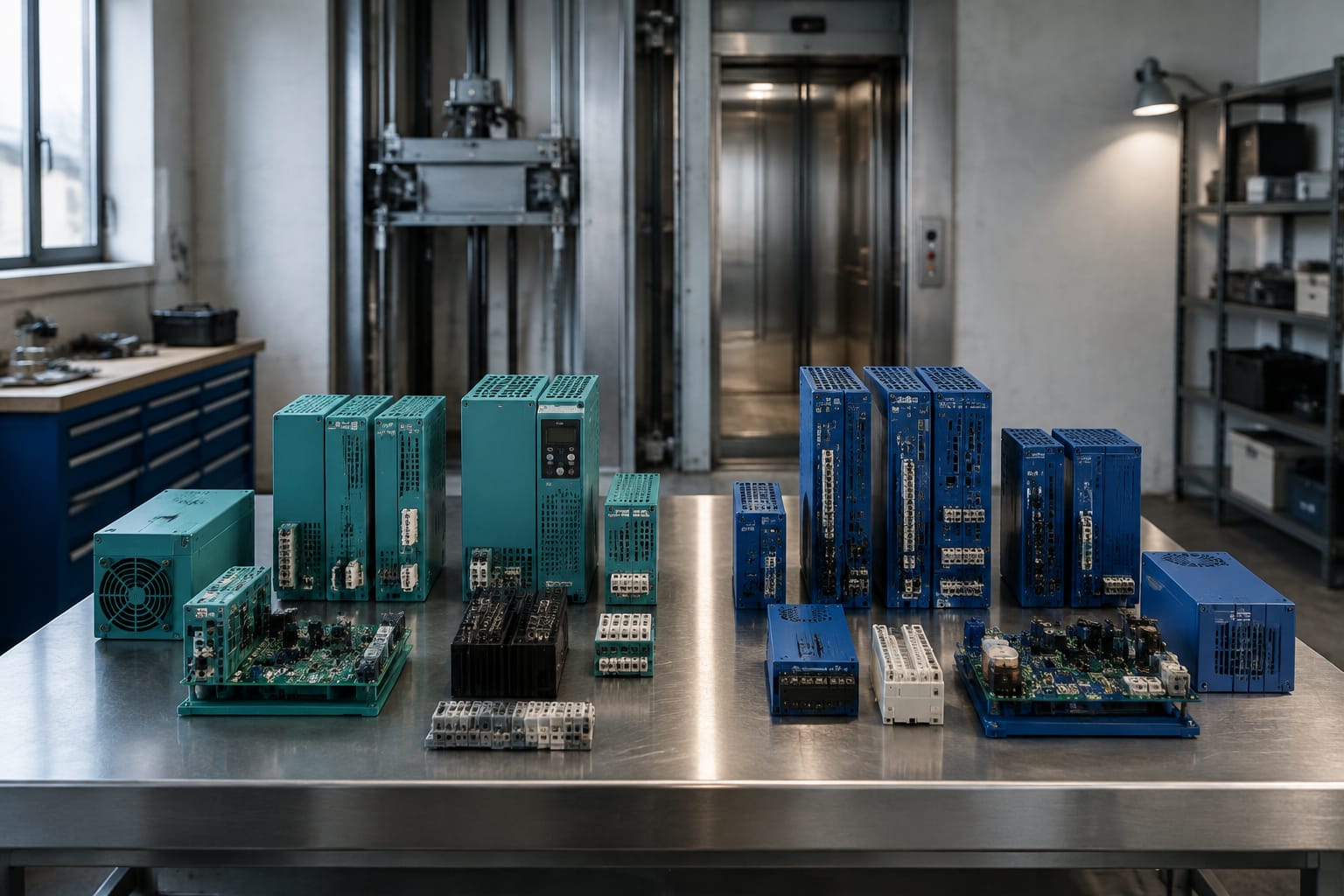
KONE and Sigma elevator parts must be sourced against the exact installed system, not against a broad brand name or a board’s appearance. A controller board, drive board or car communication board may look similar to another unit yet differ in voltage, connector layout, software revision or communication method.
For maintenance contractors and buyers in India, the reliable process is straightforward: identify the elevator and its controller first, capture every label on the failed component, match the board’s function and interfaces, then confirm compatibility before ordering. Treat “KONE Sigma” as a search term, not as proof that one part fits every KONE or Sigma installation.
KONE and Sigma are distinct product families
KONE and Sigma equipment should be handled as distinct product families during identification and sourcing. Their controllers, door systems, drive arrangements, car operating panels and electronic boards can use different part-number formats, connectors, logic and system architecture.
This distinction matters particularly in modernisation projects and maintenance portfolios where a building may have elevators installed in different years. A technician may encounter a KONE-branded installation in one shaft and a Sigma-origin controller or board arrangement in another. A parts team should not assume that common ownership history, similar terminology or a matching physical size means components are interchangeable.
The practical rule is:
The installed controller and original part label take priority over the elevator brand shown in the building or car.
For example, a board described informally as a “Sigma communication card” should be checked against the controller type, board code, revision, connector positions and expected communication role. It should not be substituted with a KONE board merely because both are related to lift control or have a visually similar enclosure.
Why broad brand matching fails
Ordering only by “KONE lift board” or “Sigma PCB” creates several avoidable risks:
- A board may power up but not communicate with the controller.
- A replacement may have the wrong input or output voltage.
- Connector keying and pin arrangements may differ despite similar plug sizes.
- A board revision may need a particular firmware, parameter set or companion board.
- Safety-chain, door, encoder or car communication signals may not be compatible.
- A replacement can delay fault diagnosis when the original problem lies elsewhere.
Use the make and model as the starting point for the enquiry, but never as the final compatibility decision.
Identify the elevator before the component
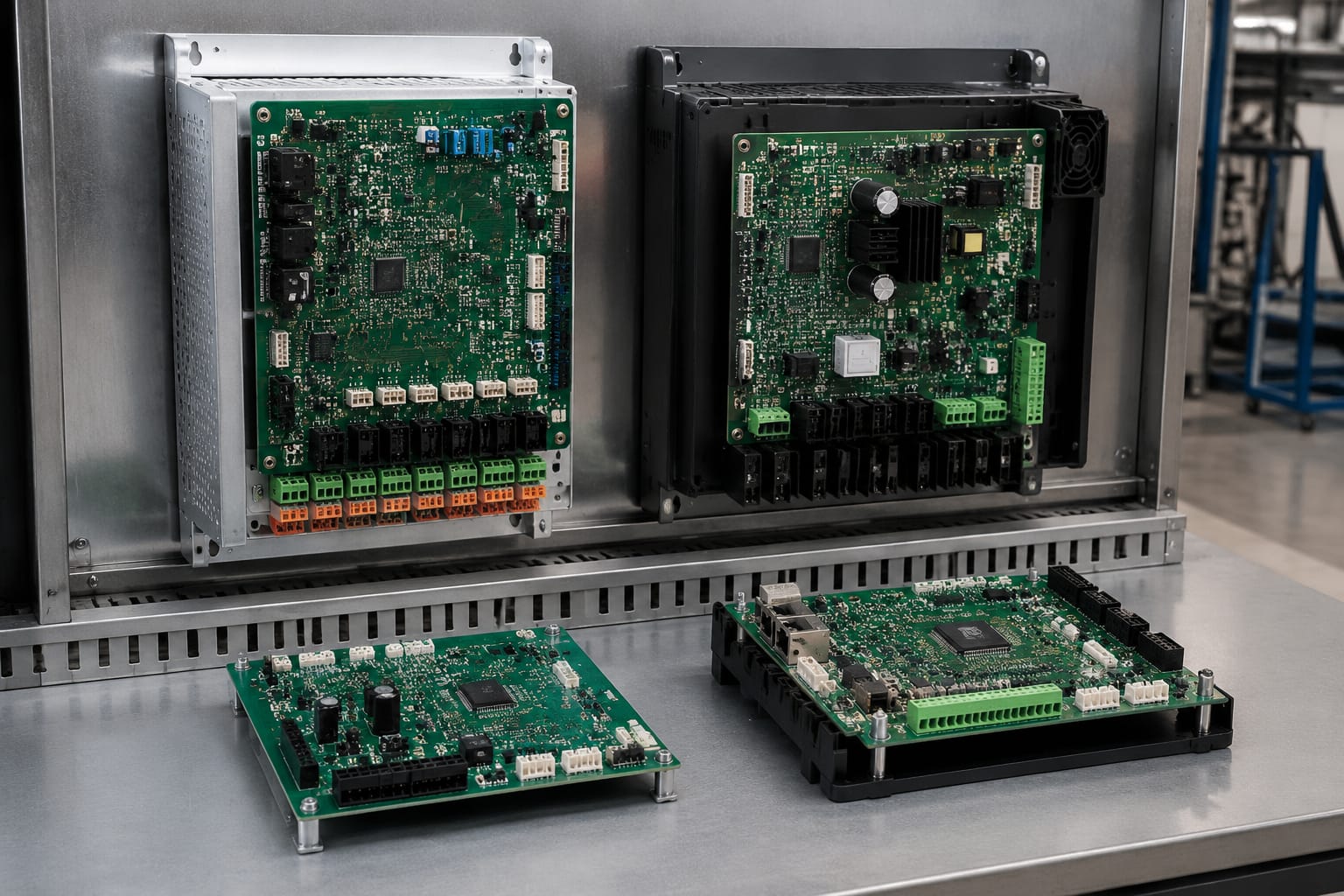
Before removing or requesting an electronic component, build a clear record of the elevator system. This prevents a common sourcing error: accurately identifying the failed board but assigning it to the wrong lift or controller.
Start at the controller, where permitted by site procedures and only with suitable electrical safety precautions. Record the controller cabinet details and compare them with the board fitted inside. The elevator identification plate, controller label and maintenance records can provide useful context, but the actual board label remains essential.
Collect the following information for each lift:
| Item to identify | What to record | Why it matters |
|---|---|---|
| Elevator brand and system | KONE or Sigma identification shown on installed equipment | Narrows the possible product family |
| Controller details | Controller name, code, serial number and cabinet label | Connects the part to its host system |
| Board identity | Full part number, printed board code and barcode where present | Primary basis for matching |
| Board revision | Revision, issue, version or hardware level | Later revisions may not be direct replacements |
| Lift application | Passenger, goods, hospital, service or other application | Helps identify relevant functions and options |
| Location in the system | Controller, car top, car operating panel, landing panel or drive cabinet | Clarifies the board’s role |
| Fault record | Error indication, symptom and events before failure | Helps avoid ordering a board for a different fault |
In India, sites may have undergone partial upgrades over several years. A car operating panel, door operator, drive and controller may not all be from the same original supply. Therefore, identify the system at component level rather than assuming every item in the installation belongs to one family.
Separate the fault from the part number
A fault indication does not automatically identify the failed part. For instance, a communication error can originate from damaged travelling cable cores, loose terminals, incorrect termination, a power-supply issue, a network connection or a failed board. Similarly, a drive fault can result from supply problems, motor wiring, encoder feedback, brake circuits or parameters.
Before sourcing a costly KONE Sigma elevator part, ask:
- What is the exact fault symptom?
- Which checks have already ruled out wiring, supply and peripheral devices?
- Is the existing board visibly damaged, or is replacement based only on a fault code?
- Has the correct board identity been read directly from the component?
- Does the replacement require programming, parameter transfer or commissioning?
This discipline improves first-time ordering accuracy and avoids storing an unsuitable part as dead stock.
Compare board names and functions
Board names are useful, but they are not enough by themselves. Terms such as driver board, power board, communication board, interface board and control board describe a function, not necessarily a compatible part.
The same broad function can be implemented differently across controller families. A board may also combine multiple functions, such as power conversion, input monitoring and communication. Compare the required operational role with the original board’s labels and connection points.
| Board category | Typical role | What to compare before sourcing |
|---|---|---|
| Main control board | Processes lift logic and system inputs | Exact controller family, part number, revision, software and configuration requirements |
| Drive board or drive interface | Controls or interfaces with motor drive operation | Drive model, motor arrangement, feedback type, terminals, voltage and parameters |
| Car communication board | Exchanges signals between car and controller | Bus type, connector count, cable arrangement, address settings and board code |
| Power board | Supplies or distributes power to other circuits | Input/output ratings, fuse positions, terminals, load connections and revision |
| Door operator board | Controls door motor and door protection inputs | Door operator model, motor type, sensor interfaces and supply voltage |
| I/O or relay board | Handles discrete inputs and outputs | Number and type of I/O points, connector pinout, relay ratings and controller interface |
| Display or COP board | Supports indicators, buttons or car operating panel functions | Panel layout, display type, communication connection and mounting arrangement |
A photograph can help compare a board, but it should support rather than replace documented identification. Take clear images of both sides where possible, including stickers, printed codes, terminal markings, jumper positions and connectors. Do not rely on photographs that obscure a suffix, revision marking or barcode.
For Sigma-specific requirements, component categories such as a [Sigma elevator driver board](/products/elevator-driver-board-sigma-elevator-parts-lift-accessories/) should be matched to the original installed board and drive arrangement. The category name alone cannot establish that a particular unit will operate in a given controller.
Record labels, codes and revisions
The most useful sourcing record is a complete transcription of the original component label. Copy every character exactly, including hyphens, spaces, leading zeroes, suffixes and revision identifiers. A single changed character can indicate a different board, hardware issue or application variant.
Record information from more than one location because manufacturers may place identifying details on a barcode sticker, the PCB silkscreen, a housing label and a connector label. These references can differ: one may be an assembly number, another a bare-board number, and another an internal manufacturing code.
A practical component record should include:
- Brand and controller family shown on the installed equipment
- Full part number from the original label
- PCB number printed directly on the board
- Revision, version, issue level or date code
- Serial number, when visible and relevant
- Board function and installed location
- Number and type of connectors
- Terminal labels and fuse ratings
- Any jumper, DIP-switch or address settings
- Clear front and rear photographs
- Fault details and whether the board has been tested
Treat revision codes as compatibility data
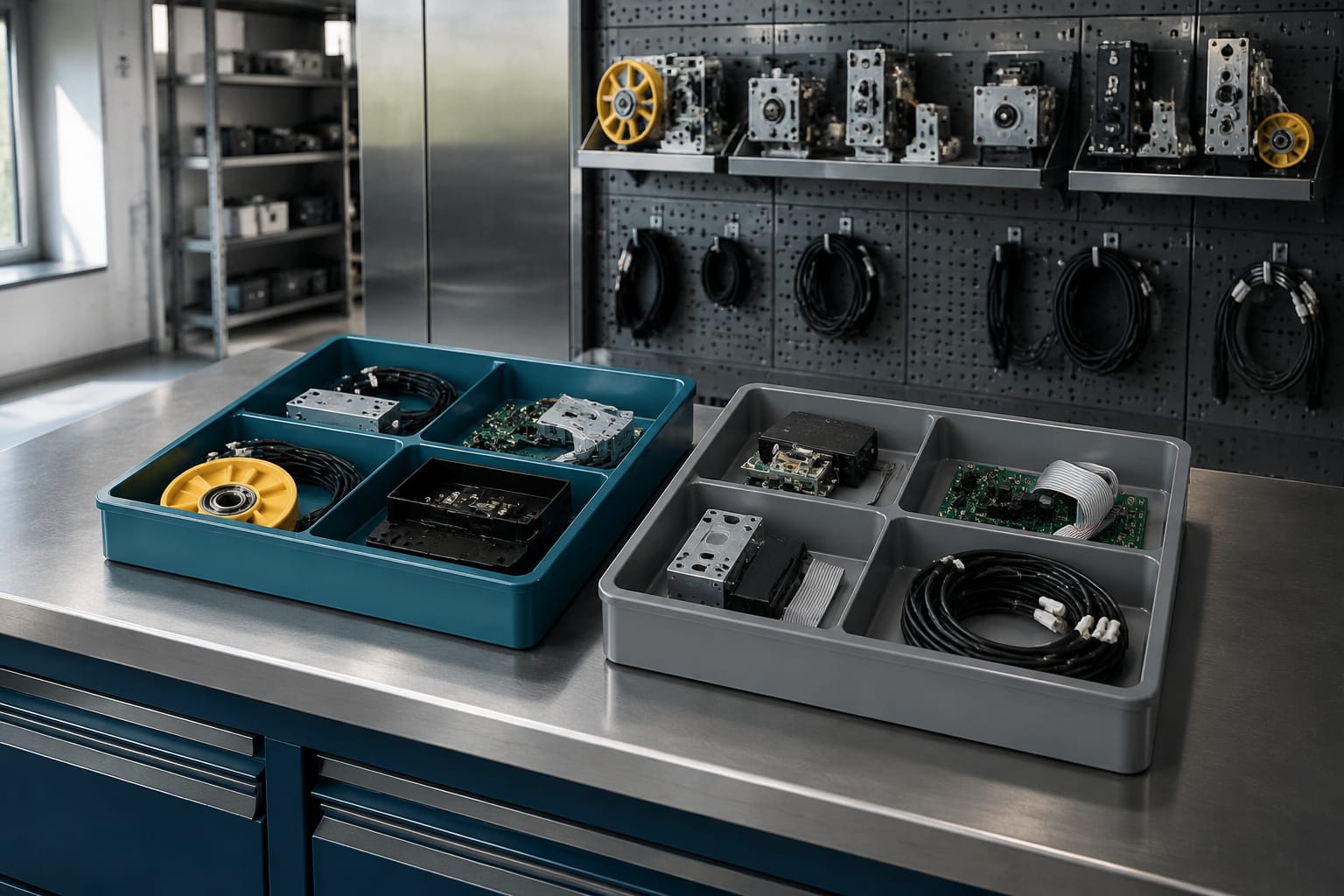
A revision code is not a cosmetic detail. It can reflect a design alteration, component substitution, changed connector allocation, updated software support or a corrected hardware issue. Sometimes a later revision supersedes an earlier part, but that should be confirmed with matching documentation or supplier guidance for the specific system.
Do not make either of these assumptions:
- “The number is nearly the same, so it will work.”
- “A newer revision always replaces the old one.”
When the original board is unavailable, establish whether the proposed substitute is an approved supersession, a functionally verified equivalent or simply a similar-looking item. These are materially different claims.
For car-side faults, use the label data to compare a [Sigma car communication board](/products/car-communication-board-sigma-elevator-parts/) with the car wiring, controller interface and original board identity. Communication boards are especially sensitive to connector and protocol mismatches.
Check voltage, connectors and protocols
A correct part number is the strongest starting point, but electrical and interface checks remain necessary. Replacement boards can be damaged or create secondary faults when their power requirements, connection arrangement or communication method do not match the installed system.
Verify power conditions
Check the voltage and supply type stated on the component, cabinet documentation or associated terminals. Confirm whether the board receives AC or DC supply, the rated voltage range, polarity where applicable, earthing arrangement and the role of any external fuse or power supply.
Never infer a board’s supply rating from the controller’s incoming mains voltage. Many boards operate from lower control voltages supplied internally. Similarly, boards with a similar form factor may be designed for different supply arrangements.
For a power-related replacement, compare the original connection labels, protective devices, input and output paths, and all relevant ratings. A [Sigma elevator power board](/products/power-board-sigma-elevator-parts-lift-accessories-2/) must be selected by its exact function and electrical interface within the installed system.
Inspect connector compatibility
Connectors require more than a quick visual match. Confirm:
- Connector type, orientation and mechanical keying
- Pin count and connector location
- Terminal designations and wire labels
- Ribbon-cable direction and locking method
- Socket versus plug configuration
- Whether the connector carries power, signal, communication or mixed circuits
- Any coding, address plug or termination arrangement
Forcing a connector is never acceptable. Even if it fits mechanically, the pin assignments may be different. Photograph the harness before disconnection and retain wire identification during removal.
Confirm the communication method
Electronic lift systems can use dedicated serial links, bus networks, discrete I/O, analogue signals or other controller-specific arrangements. A communication board therefore has to be compatible with both ends of the connection: the controller side and the car, landing or peripheral side.
Check the board documentation and installed wiring for signs of:
- Bus or network terminal markings
- Shielded or paired communication cabling
- Address selectors or DIP switches
- End-of-line termination
- Particular controller or car module references
- Required software, configuration or parameter settings
Do not replace a communication board solely because it shares the words “car communication” with the original. The applicable protocol and controller family must align.
Source Sigma drive and communication boards
Sigma drive and communication boards should be sourced with the drive or controller context attached to the enquiry. These are not generic electronic modules. Their suitability can depend on the drive family, motor feedback arrangement, cabinet wiring, controller generation and installed software or parameters.
For a drive-related board, provide the drive label, motor details available on site, fault indication, photographs of the original board and the locations of all connectors. Also note whether the board is inside a separate drive unit or located on the main controller assembly. This helps distinguish a drive interface board from a main control board that merely exchanges signals with the drive.
For a communication board, identify its endpoint and purpose. Is it installed in the controller, on the car top, behind the car operating panel, in a landing fixture or within a display assembly? List the connected cables and board settings before removal.
Questions to ask when buying a Sigma board
Ask the supplier to assess the proposed part against these details:
- Does the full part number match the original, including suffix and revision?
- Is the proposed item an identical reference, an identified supersession or another alternative?
- What controller, drive or car communication arrangement is it intended to support?
- Does it have the same voltage and connector configuration?
- Are programming, parameter transfer, firmware or configuration changes required?
- Is the board supplied as a bare replacement, or are associated components needed?
- What condition is being offered: new, repaired, refurbished or removed from service?
The final question is commercially important. Condition should be stated clearly, as each option has different inspection, traceability and commissioning considerations. Buyers should set their own acceptance criteria for labelling, testing records, packaging and return terms.
Source KONE-specific components
KONE-specific components should be identified by the exact KONE system reference and installed part label. The name KONE covers different equipment generations and assemblies, so a generic search for “KONE spare parts” may produce broad results that are not relevant to the controller in front of you.
When sourcing a KONE component, send the controller details, original component number, revision, installation location and clear photographs. Where the item relates to doors, car fixtures, displays or drives, identify the corresponding assembly as well. A display board, for example, may depend on the panel layout and communication arrangement even when the display itself looks familiar.
Be particularly careful with these component types:
- Main controller and processor boards
- Car and landing communication modules
- Door operator controllers and sensors
- Drive interfaces and feedback-related boards
- Car operating panel electronics
- Display and indicator boards
- Power supplies, battery circuits and safety-related interfaces
A cross-brand substitution should be considered only when it is specifically established as compatible for the installed system. “Similar function” is not sufficient evidence for a KONE-specific replacement.
Kelevator supplies multi-brand elevator spare parts to B2B importers, distributors, maintenance contractors and OEM buyers. For a practical quotation or availability check, send the complete identification record rather than only the terms KONE Sigma. That allows the part request to be evaluated against the actual equipment rather than a broad keyword.
Final compatibility checklist
Use this checklist before placing a purchase order or fitting a replacement KONE or Sigma elevator part.
- [ ] I identified the installed controller and elevator system, not just the brand on the car.
- [ ] I copied the complete original part number exactly.
- [ ] I recorded the PCB code, revision and any serial or version label.
- [ ] I confirmed the board’s actual function and installed location.
- [ ] I compared supply voltage, supply type, polarity and fuse arrangement.
- [ ] I checked connector type, pin count, orientation and terminal labels.
- [ ] I identified relevant communication wiring, addressing and termination.
- [ ] I confirmed whether the replacement requires software, parameters or commissioning.
- [ ] I established whether it is an exact match, documented supersession or alternative.
- [ ] I reviewed the fault diagnosis so wiring, power and peripheral causes have not been overlooked.
- [ ] I retained photographs and records for future maintenance and repeat ordering.
- [ ] I confirmed the supplied condition, commercial terms and acceptance requirements.
The safest sourcing decision is usually the one supported by the most complete component record. For recurring maintenance work, keep these records by site, lift number and controller. It reduces repeated identification effort, supports inventory planning and makes future KONE Sigma spare-parts enquiries more accurate.