
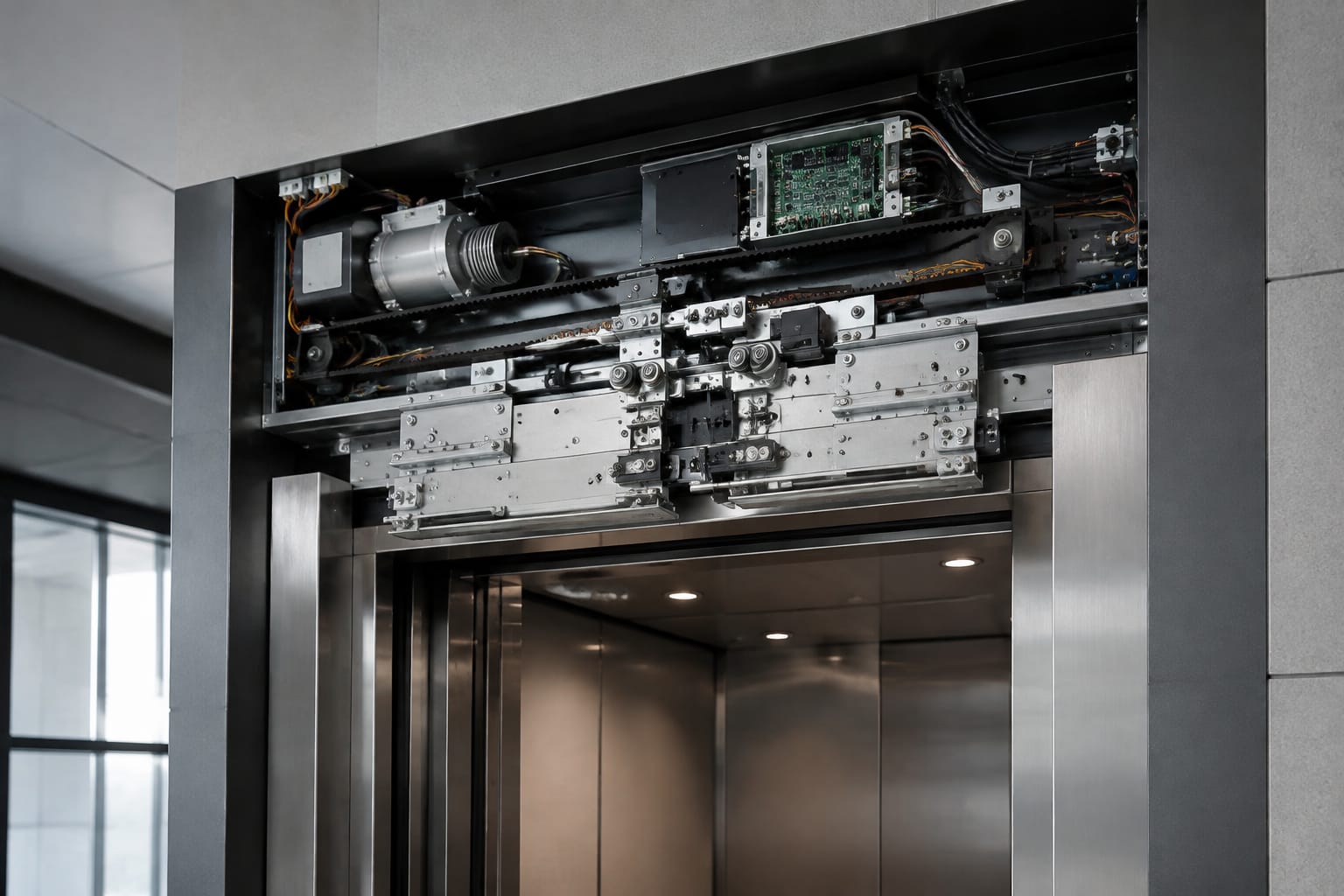
A KONE elevator door is a coordinated safety system, not a collection of interchangeable mechanical parts. A correct replacement depends on the door-operator model, landing-door arrangement, electrical ratings, connector type, software or board revision, and the condition of associated parts. Replacing a suspected failed motor, lock or controller without these checks can leave the original fault unresolved or create a door safety issue.
For maintenance contractors and sourcing teams, the safest approach is to identify the complete door assembly first, diagnose the fault at the component level, and match the replacement against the removed part and machine documentation. This is particularly important during modernisation, where a car may have equipment from different installation or upgrade periods.
How the KONE door system works
An elevator door system has two linked sides:
- The car door, which moves with the lift car.
- The landing door, which remains at each floor and can open only when the car is correctly positioned.
When the lift reaches a landing, the car-door mechanism engages the landing-door mechanism through a door knife or coupling arrangement. The door operator drives the car door, and the car door then draws the landing door open. During closing, both sets of panels return to their closed positions. The landing-door lock must then engage and its safety contacts must confirm a secure condition before the lift is permitted to travel.
A typical system includes:
| Component | Main function | Replacement risk if mismatched |
|---|---|---|
| Door operator | Drives car-door opening and closing | Incorrect travel, speed, force or control compatibility |
| Door motor | Provides mechanical drive to the operator | Wrong voltage, feedback type or pulley arrangement |
| Controller or drive | Controls motor movement and monitors signals | Incompatible parameters, connectors or safety inputs |
| Landing-door lock | Locks the landing door while the car is away | Compromised door locking or circuit continuity |
| Car-door knife | Couples car and landing doors at a floor | Poor engagement, rubbing or failure to unlock |
| Hangers, rollers and guides | Support and guide door panels | Noise, drag, misalignment and premature wear |
| Safety contacts | Verify locked and closed positions | Lift remains out of service or unsafe bypassing risk |
The exact arrangement varies by KONE installation and by the door operator fitted during original installation or later refurbishment. Part naming may also differ between site practice, spare-part catalogues and original equipment documentation. Therefore, a visual resemblance alone is not sufficient evidence of compatibility.
Door locks and safety contacts
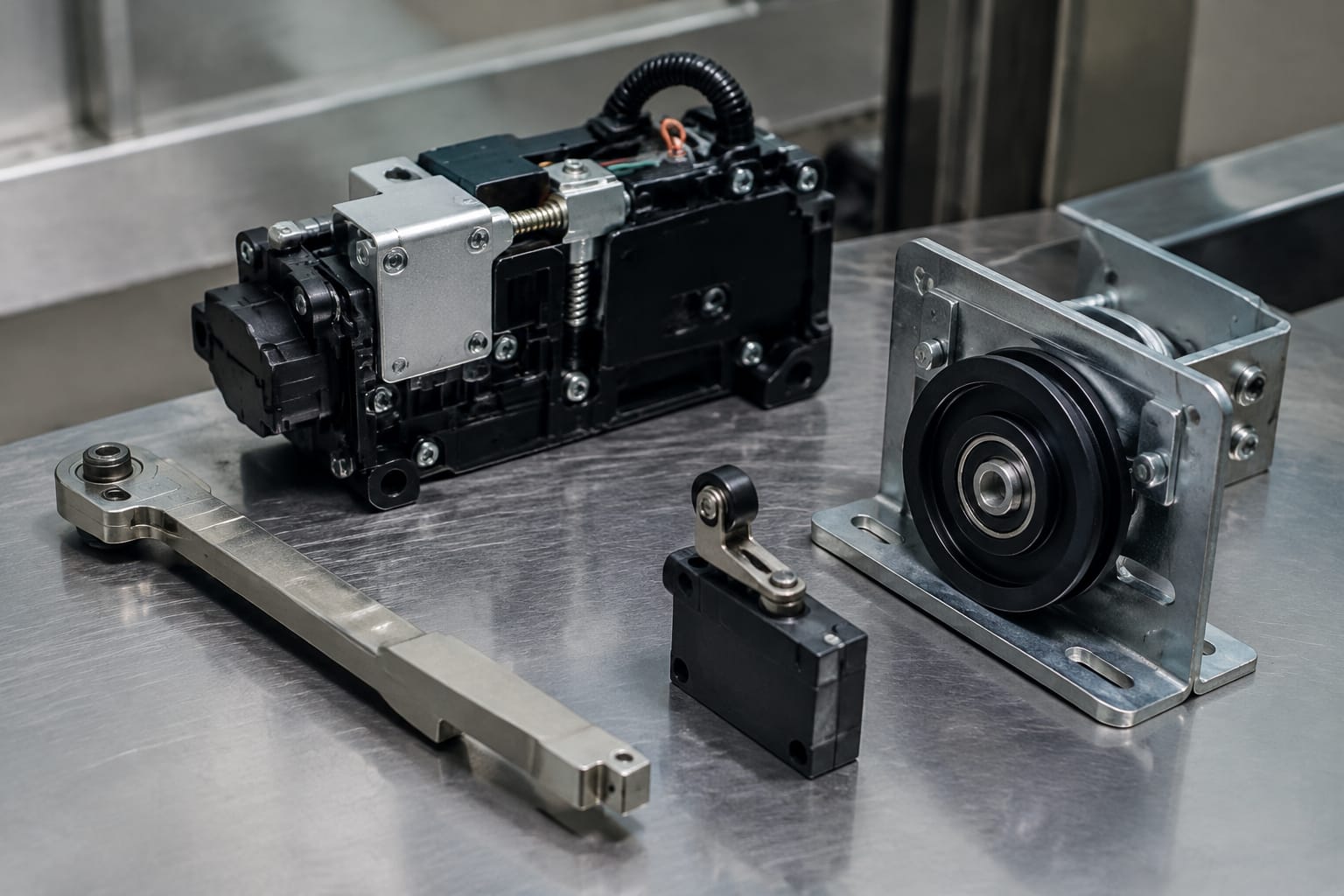
Landing-door locks are critical safety components. Their purpose is to prevent a landing door from being opened when the lift car is not present at that landing. They also provide electrical confirmation through contacts in the door safety circuit.
What a landing-door lock assembly includes
Depending on the design, the assembly may include:
- A mechanical lock body and locking hook or pawl
- An unlocking lever or roller
- Electrical safety contacts
- A lock cover, fixing bracket or mounting plate
- Adjusting hardware
- Associated door-closing or retaining elements
The lock should mechanically engage with adequate overlap when the door panels are closed. Its contacts should change state only when the mechanical locking condition is correctly achieved. A lock that appears to work by hand may still be unsuitable if its contact arrangement, actuation direction, bracket geometry or rated switching characteristics differ from the original.
Common symptoms related to locks
A lock or safety-contact problem may present as:
- The lift will not respond to calls from one landing.
- The car stops at a floor but will not depart.
- A door fault appears intermittently after vibration or temperature changes.
- The landing door needs excessive pressure to close.
- The lift runs only after an engineer manually adjusts a door.
- The controller reports an open-door or safety-chain condition.
These symptoms do not prove that the lock itself has failed. Check the panel alignment, lock engagement, door closer action, wiring terminals and moving contact mechanism before ordering a replacement. A distorted sill, worn hanger roller or poorly adjusted panel can prevent an otherwise healthy lock from reaching its correct position.
For procurement of compatible lock-related hardware, compare the lock body, mounting orientation, actuator style, contact configuration and exact dimensions. Relevant components may include [AMD door locks, wheels, switches and brackets for KONE elevator parts](/products/amd-door-lock-wheel-switch-door-bracket-kone-elevator-parts-lift-accessories/), but compatibility must still be confirmed against the existing assembly.
Do not defeat a safety circuit to keep the lift running
Bridging, shorting or permanently holding a door safety contact closed is not a repair. It can conceal a mechanical locking fault and compromise a safety function. Fault-finding and commissioning should be undertaken by competent elevator personnel using the applicable site procedures and equipment documentation.
Door knives and mechanical linkages
The car-door knife, also called a coupling vane or unlocking device in some contexts, transfers movement between the car door and the landing door. At a landing, it aligns with the landing-door lock mechanism so that the car door can unlock and move the landing door.
A correctly set door knife must provide reliable engagement without excessive rubbing or impact. It must also clear the landing equipment through the full travel of the lift car.
Parts that affect door-knife operation
Door knife faults are often caused by nearby components rather than the knife itself. Inspect:
- Knife blades or arms for bends, looseness and wear
- Mounting bracket rigidity and fasteners
- Landing-lock roller or actuating lever condition
- Car-door panel alignment
- Door hanger rollers and tracks
- Door sill and guide shoe wear
- Vertical and horizontal clearances at every landing
- Effects of car loading, which may alter car position relative to the landing door
A bent or incorrectly adjusted knife can fail to unlock a landing door, strike the lock mechanism, or create inconsistent operation between floors. Repeated mechanical impact can then damage lock rollers, brackets and electrical contacts.
When comparing a replacement, establish whether the removed component is a complete car-door knife device or only one blade, bracket, roller or linkage. The opening direction, blade spacing, mounting-hole pattern and dimensional relationship with the landing lock all matter. [Car door knives and door-lock devices for KONE elevator parts](/products/car-door-knife-door-lock-device-kone-elevator-parts-lift-accessories/) are relevant only where the physical arrangement and application match the installed equipment.
Door motors and controllers
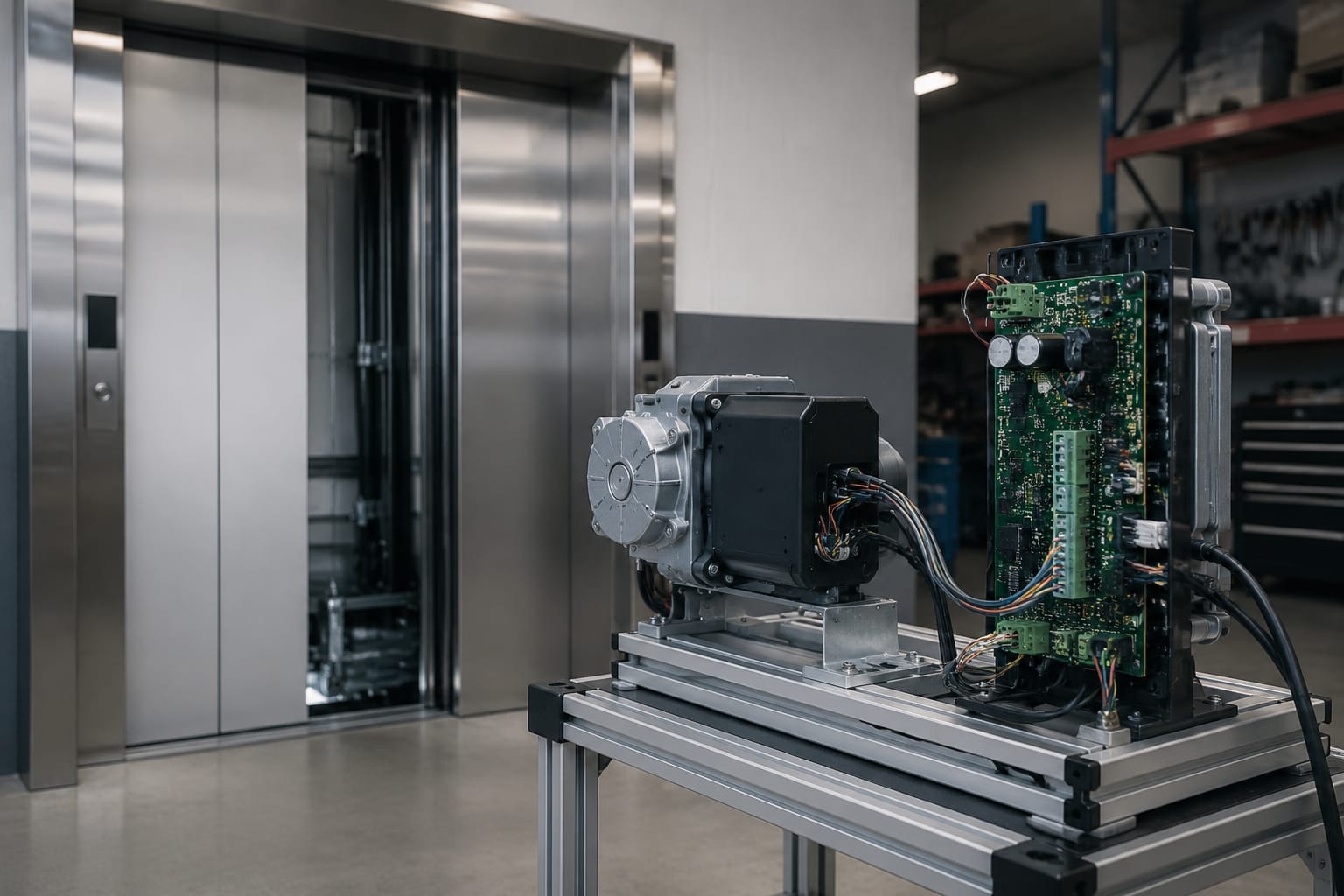
The door motor provides movement; the controller or door drive determines how that movement is controlled. In many systems, the operator also uses feedback from an encoder, sensor or motor monitoring circuit to detect position, speed and obstruction conditions.
It is a mistake to treat the motor and controller as independent in every case. A motor may be mechanically compatible but electrically unsuitable for the existing drive. Equally, a controller may fit physically but require a different motor feedback arrangement, parameter set or safety-input configuration.
Door motor considerations
Before selecting a KONE elevator door motor replacement, confirm:
- Motor part number and manufacturer markings
- Supply voltage and current or power marking
- AC, DC, permanent-magnet or other motor type
- Encoder, tachometer or feedback provision
- Shaft diameter, length, keyway and pulley or belt arrangement
- Rotation requirements, if specified
- Mounting face, fixing centres and cable exit direction
- Cable and connector type
- Operator model and door opening type
A noisy motor is not necessarily defective. Noise may originate from a loose belt, worn bearing, damaged gearbox, poor roller condition or a door panel dragging in the sill. Measure or observe the complete operator before condemning the motor.
Controller and drive considerations
Door controllers receive inputs from door-open and door-close commands, limit or position devices, safety sensors, and the lift control system. They command motor direction and torque while managing opening and closing behaviour.
A replacement controller should be matched for:
- Door operator family and application
- Input and output connector layout
- Power supply rating
- Motor type and feedback type
- Door width, mass and opening arrangement where parameters apply
- Interface with the main lift controller
- Firmware, hardware or board revision
- Safety-device connections, including light curtains or reopening devices
- Parameter transfer, setup and commissioning method
Do not assume that boards with similar housings, connector counts or partial part-number matches can be swapped. Revisions may alter pin assignments, communication behaviour or supported motor types.
For sourcing, start with the [KONE elevator door motor and controller range](/products/kone-elevator-parts-door-motor-controller/) and provide the operator identification, photos of all labels, complete part number, connector images and the reported fault. This gives a supplier enough information to assess the requested component rather than relying on a generic description such as “KONE door PCB” or “door motor”.
Identify the door-operator model
The door-operator identification is normally the most useful starting point for a KONE elevator door part enquiry. Look for labels on the operator cover, motor, drive board, mounting plate or door header. Record all markings, including suffixes and revision codes.
Build an identification record before removal
A useful record contains:
- Lift site reference and landing or car position of the failed part.
- Door operator model and full serial or part number where present.
- Door opening arrangement: centre opening, side opening, single panel or telescopic.
- Clear photographs of the installed component and its label.
- Photos of each electrical connector before disconnection.
- Mechanical measurements where a component has no readable part number.
- The specific symptom, fault code and when it occurs.
- Details of earlier door work, replacements or modernisation.
For landing-door parts, identify the door manufacturer or lock type where marked. The lift brand alone may not identify every door component, especially in installations that have received partial upgrades over their service life.
Where labels are damaged, compare the physical part with documentation and measurements. Avoid matching solely from an online image. Small differences in bracket offset, connector keying, roller diameter or actuator position can make a part unsuitable.
Match ratings, connectors and revisions
The exact part number is the preferred matching method, but it should be supported by physical and electrical verification. This is particularly important when sourcing discontinued, superseded or alternative spare parts.
Compatibility checklist
| Check | Why it matters | What to record |
|---|---|---|
| Full part number | Identifies the intended component version | Every prefix, suffix and revision mark |
| Operator application | Confirms mechanical and control compatibility | Operator model and door arrangement |
| Electrical rating | Prevents supply or motor mismatch | Voltage, current, frequency and power markings |
| Connector layout | Avoids incorrect pin connection | Connector type, pin count, keying and wire colours |
| Motor feedback | Enables controlled movement and monitoring | Encoder type, plug and cable details |
| Mechanical interface | Ensures correct fitting and travel | Shaft, pulley, brackets, mounting centres and dimensions |
| Firmware or revision | Avoids board-level incompatibility | PCB revision, software label and date code where available |
| Handing and opening type | Ensures correct geometry | Left/right arrangement and centre/side opening |
| Safety circuit arrangement | Preserves intended safety monitoring | Contact type, terminal identifiers and wiring diagram |
A superseded part may be a valid replacement only when the supplier or manufacturer documentation identifies it as such, including any required harness, bracket, firmware or setup change. Do not infer supersession from similar nomenclature.
For B2B importers, distributors and maintenance businesses, part traceability also matters. Keep the removed part, labels, order reference and installation notes linked to the site record. This reduces repeat identification work and helps distinguish recurring door faults from isolated component failures.
Diagnose before replacing a part
Door faults can be electrical, mechanical or adjustment-related. Replacing the first component that looks worn can increase downtime and cost without fixing the cause.
A practical fault-isolation sequence
- Make the equipment safe. Follow authorised isolation, access and maintenance procedures before working on the lift or door system.
- Read the fault indication. Record controller messages, LED states and fault codes before cycling power or disconnecting parts.
- Observe the door cycle. Note whether the fault occurs when opening, closing, locking, reopening or at a particular floor.
- Inspect mechanical movement. Check panel alignment, sill cleanliness, guides, rollers, belts, pulleys, fixings and knife engagement.
- Check the landing-door condition. Compare the affected floor with a correctly operating floor where appropriate. Look for closing resistance, misalignment and incomplete lock engagement.
- Verify electrical connections. Check for damaged cables, loose terminals, water ingress, heat damage and connector seating. Do not probe or alter safety circuits outside approved procedures.
- Test the suspected component using the correct documentation. Electrical tests should be performed with suitable instruments and reference values for that model.
- Replace only after the evidence supports it. Confirm that the replacement part matches all required identifiers before installation.
Common misdiagnoses
A door operator can repeatedly reopen because of a misaligned panel, worn roller or sensor issue, not because its controller is faulty. A lift that will not move may have a landing-door lock alignment issue, even when the visible contact appears intact. A motor that stalls may be responding to excessive mechanical resistance rather than failing electrically.
Similarly, a failed controller can be damaged by a defective motor cable, connector problem or unsuitable incoming supply condition. Inspect the surrounding circuit before fitting a replacement board, otherwise the new part may experience the same fault.
Commission and test the repaired door
A replacement is not complete when the part is fitted. The repaired door must be commissioned and tested as an integrated system. Settings should follow the applicable operator documentation and be performed by personnel competent to work on that equipment.
Post-repair checks
Verify at minimum:
- Secure mechanical mounting and correct fastener tightening
- Free, smooth movement through the full door travel
- Correct coupling and release between car and landing doors
- Landing-door lock engagement at each affected floor
- Correct operation of safety contacts and the door safety circuit
- Door open and close response from normal controls
- Reopening behaviour and protective-device operation where fitted
- Absence of rubbing, striking, abnormal vibration or repeated reversal
- Correct levelling and engagement conditions under relevant operating conditions
- Fault memory review after functional testing
Test the door over repeated cycles and at every landing affected by the work. A setting that works at one floor may not work reliably elsewhere because of landing-door alignment, car position or local mechanical wear.
Do not leave altered force, timing or bypass settings as a substitute for correcting mechanical resistance or a safety fault. Record the part fitted, settings changed, fault symptoms and test results in the maintenance log.
FAQ
Can any KONE door motor be used with a similar-looking operator?
No. The motor must match the operator's mechanical interface, supply rating, feedback arrangement and controller requirements. Similar appearance does not establish compatibility.
Should a landing-door lock be replaced when the door circuit opens intermittently?
Not automatically. First inspect lock engagement, panel alignment, actuator wear, contact movement, wiring and terminal condition. Replace the lock or contact assembly when diagnosis confirms it is defective or mechanically unreliable.
Is it enough to match the main number on a controller board?
The main number is important, but revision, connector layout, firmware markings and operator application should also be checked. Some replacements need associated setup or parameter configuration.
Why does a newly installed door part still cause a fault?
The replaced part may not have been the root cause. Mechanical drag, damaged wiring, incorrect adjustment, incompatible revisions or an unaddressed fault in another component can remain after replacement.
For a KONE elevator door replacement, prepare the operator details, full label photos, connector views and fault information before sourcing. Kelevator supplies multi-brand elevator spare parts for B2B importers, distributors, maintenance contractors and OEM buyers; a complete identification record helps ensure the requested lock, knife, motor or controller is evaluated against the actual installation.