
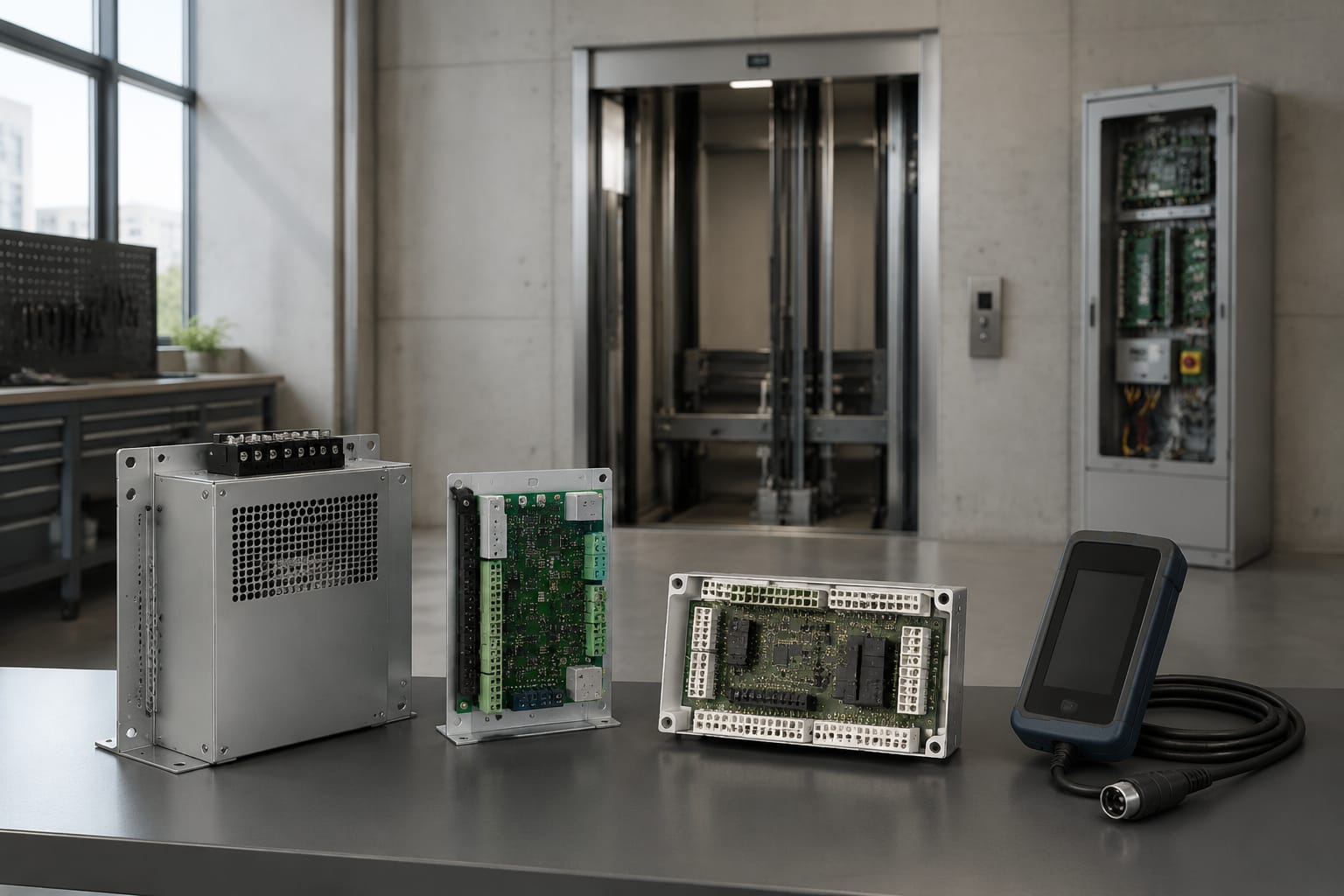
Selecting KONE spare parts starts with identification, not with a product photograph or a broad description such as “KONE board” or “lift power supply”. The elevator model, the original part number, board revision, electrical rating and connectors together determine whether a replacement is likely to fit and communicate correctly.
For maintenance contractors and sourcing teams in India, a clear technical record also reduces back-and-forth with suppliers and helps avoid receiving a similar-looking but unsuitable component. This guide explains what to capture, what to compare and how to request KONE elevator spare parts with fewer compatibility risks.
Start with the KONE elevator model
The elevator model is the first filter for KONE spare parts. It gives the supplier and technician context about the controller family, equipment generation, installation arrangement and likely component range. However, a model reference alone is rarely enough to establish interchangeability.
Record information from the controller cabinet, car top equipment, landing stations and the failed part itself. Use a clear photograph where a plate or label is difficult to read.
Useful details include:
- Elevator model or equipment family shown on the original label
- Controller or control-panel designation
- Lift serial number, where available
- Installation type: passenger, goods, hospital, service or home lift
- Number of floors, doors and cars served by the controller
- Door operator make and model, where the item relates to door operation
- The exact location of the failed component, such as machine room, controller cabinet, car top or shaft
- Any fault code or observed failure symptom
A controller board used in one KONE system may not be suitable for another installation simply because the enclosure, plug layout or application software differs. For example, an interface board can share a similar physical profile with another board but use a different pin assignment or communication protocol.
For a modernisation project, identify both the existing equipment and the intended retained equipment. A replacement selected for the old controller may not support a new landing fixture, door system or communication arrangement being installed during the upgrade.
Do not rely on the lift brand alone
“KONE spare parts” is a useful starting search term, but it is not a technical specification. KONE equipment has different generations and configurations, while a lift may also contain components from other manufacturers after earlier repairs or upgrades.
Treat the brand as the first sorting field. Confirm suitability only after matching the exact item information and required interface details.
Find and record the part number
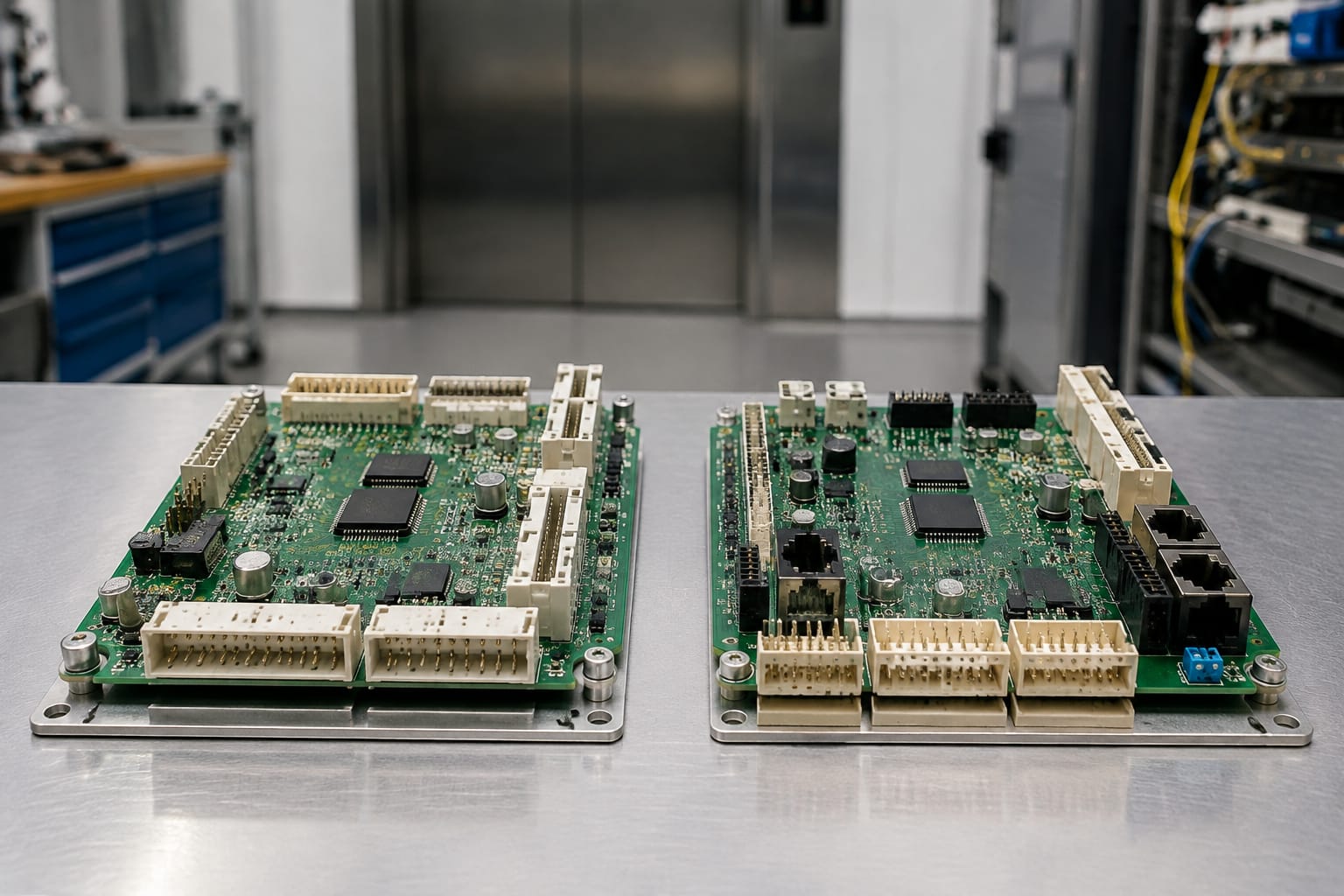
The original manufacturer part number is usually the strongest identifier for a replacement. It may be printed on a label, etched onto a housing, displayed on a barcode sticker or marked directly on a printed circuit board (PCB).
Record the complete number exactly as shown, including letters, prefixes, hyphens, dots, suffixes and revision markings. A missing character can lead to a different component being quoted.
When documenting a part, capture:
- Full part number
- Product or board code
- Hardware revision and software or firmware label, if shown
- Manufacturer name and manufacturing label details
- Input and output voltage or current ratings
- Serial number or date code, where relevant
- Clear front, rear and side photographs
- Connector labels and terminal markings
- The part’s position in the electrical diagram, if available
A PCB may carry more than one number. One can be the board artwork number, another a manufacturing code and another the orderable assembly number. The label on the complete assembly is generally more useful for sourcing than a number printed on the bare board, but include both when uncertain.
Read labels carefully
Common recording errors include confusing 0 with O, 1 with I, and 5 with S. Glare, low-resolution images and partially damaged labels make these errors more likely.
Where a label cannot be read fully, do not guess the missing characters. Send a sharp image and state which characters are unclear. A supplier can then compare the visible format against its product records, while making clear that a visual match is not a compatibility confirmation.
Keep the old part until the replacement is verified
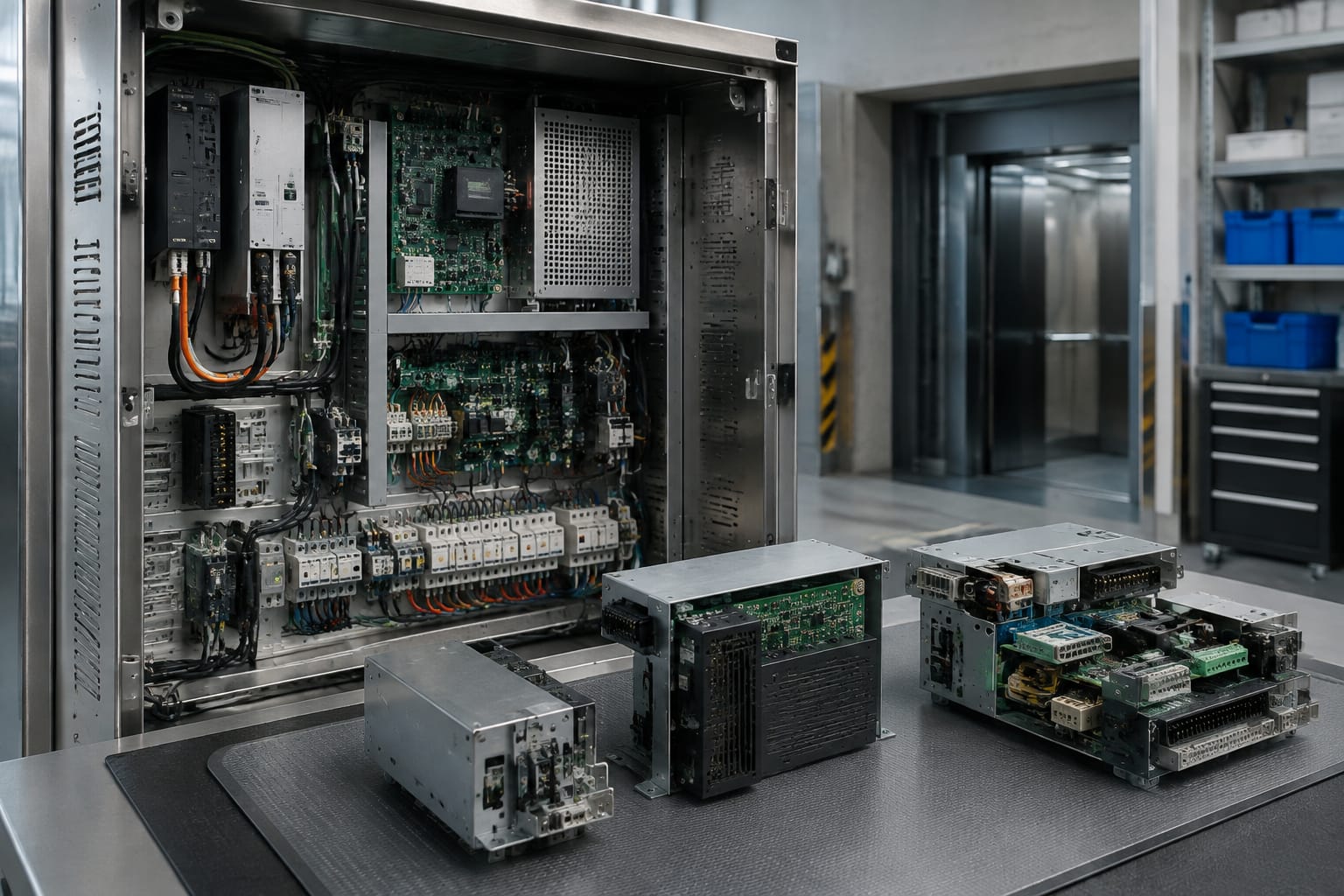
Retain the removed component, its labels and its connectors until the replacement has been installed and checked by a competent technician. The original part remains the best reference when a question arises over orientation, jumper setting, plug type or mounting arrangement.
Common KONE spare-part categories
KONE elevator spare parts cover electrical, electronic, mechanical and door-system items. The checks needed vary by category. Electronics normally require closer attention to revisions, ratings and software; mechanical parts require close dimensional and application matching.
| Spare-part category | Typical examples | Key information to match | Common risk |
|---|---|---|---|
| Control and interface boards | Main boards, I/O boards, shaft communication boards | Part number, board revision, connectors, controller family, software label | Board powers up but does not communicate correctly |
| Power equipment | Power supplies, network power boxes, transformers, rectifiers | Input supply, output ratings, terminals, load requirement, physical mounting | Incorrect voltage or insufficient output capacity |
| Brake and drive-related controls | Brake control modules, relay assemblies, drive interfaces | Part number, coil and supply ratings, drive/controller application, terminals | Unsafe or unreliable brake operation from an incorrect match |
| Door-system components | Door controllers, sensors, rollers, belts, locks, cables | Door operator model, dimensions, connector type, handedness where applicable | Mechanical fit or door timing mismatch |
| Shaft and landing equipment | Floor boards, displays, call buttons, communication modules | System family, address method, wiring, display type, connector layout | Landing device fails to communicate or address correctly |
| Safety and switching items | Relays, contactors, switches, limit devices | Approved application, contact arrangement, ratings, mounting and wiring | Safety circuit behaviour changes if incorrectly specified |
| Mechanical lift parts | Pulleys, rollers, guides, brackets, fasteners | Dimensions, material, mounting, load application and drawing reference | Premature wear or incorrect installation fit |
For a board operating in the hoistway, the board code and connector layout should be compared alongside the stated function. A KONE shaft FCB communication board is relevant only when its identifiers and interfaces match the installation requirement.
Similarly, a KONE brake control module and power supply box should be assessed against the original unit’s ratings, terminals and control application rather than selected by appearance.
Compare board revisions and connectors
Electronic boards with the same basic description can differ materially between revisions. A later revision may be intended to replace an earlier one, but that is not automatic. It may have altered firmware, changed connectors, different jumper positions or a revised power requirement.
Compare the following before accepting a replacement board:
- Original assembly part number and proposed assembly part number
- PCB code, hardware revision and visible revision suffix
- Firmware or software identification label, if fitted
- Number, position and keying of connectors
- Connector pin count and connector labels
- Terminal block arrangement and markings
- Jumper, dip-switch or rotary-address settings
- Mounting hole locations, enclosure and heat-sink position
- Presence of relays, fuses, batteries or removable modules
- Damage, corrosion, repaired tracks or modified components
Connector matching is more than pin count
Two connectors can have the same number of pins and still be incompatible. The connector housing may be keyed differently, the pin order can change, or the attached wiring harness may use different signals.
Compare the connector face, locking mechanism, key position, cable direction and label designation. Photograph both the replacement unit and the original with their connectors visible. Do not force a plug into a socket that does not engage normally.
If a supplier proposes a superseding part number, ask what documentation supports the substitution. Useful information includes the original and offered part numbers, revision, connector confirmation and any known installation conditions. Where a software version or parameter transfer is involved, that should be identified before ordering.
Avoid unsupported board substitution
A board that looks close enough is not necessarily a replacement. Unverified substitution can cause faults that are intermittent and time-consuming to diagnose, including missing landing calls, door-control problems, communication errors or unavailable lift functions.
When an exact part is unavailable, establish whether there is a documented equivalent or repair path. Do not assume a component from another controller family is interchangeable based on its shape or broad function.
Check voltage and communication compatibility
Electrical compatibility is essential for KONE elevator spares, especially power units, relay assemblies, interface modules and PCBs. Match the information printed on the original unit and confirm the role it performs in the circuit.
Check these items:
- Input voltage type and range: AC or DC
- Nominal supply voltage and frequency, where applicable
- Output voltage, current and polarity
- Fuse type and rating, if specified for the assembly
- Load or device controlled by the component
- Earthing and terminal arrangement
- Communication bus or network interface
- Addressing method and termination requirement
- Controller generation and configuration
India commonly has 50 Hz AC electrical supply, but the site supply, controller design and component requirements must always be confirmed from the equipment labels and drawings. Do not choose a power component solely because it is described as suitable for a particular mains voltage. Its output circuits, terminals and system role must also match.
A KONE network power box may be relevant to a networked lift system, but the correct selection still depends on the original part number, input/output details and network arrangement.
Communication compatibility needs evidence
A communication board may use an identifiable connector but still require a particular controller, bus configuration, address or software version. Before buying, determine:
- What equipment communicates through the board
- Whether the board has an address, termination or configuration setting
- Whether the replacement needs commissioning or parameter loading
- Whether related equipment must remain at a compatible hardware or software level
- Whether the fault has been traced to the board rather than wiring, power supply or another module
Replacing a board without checking field wiring and supply conditions can damage the replacement or leave the original fault unresolved. Basic diagnostic work should include inspecting terminals, connectors, fuses, supply readings and visible cable damage according to safe maintenance procedures.
Verify condition and test information
Condition has a direct effect on sourcing decisions, particularly for electronic KONE spare parts. The listing term alone, such as new, used, refurbished or repaired, does not explain what has been done to the item.
Ask for a precise condition statement and test information appropriate to the component type.
| Condition description | What to clarify before purchase |
|---|---|
| New | Whether it is in original packaging, its exact part number and revision, and whether storage conditions could affect batteries or electronics |
| Used | Operational history if known, physical condition, missing covers or connectors, and what functional test was performed |
| Refurbished | What work was completed, whether components were replaced, how the unit was tested and which original specifications were checked |
| Repaired | Reported original fault, repaired area, replacement components used, test scope and any limitations |
| Unused old stock | Label condition, storage period, packaging condition, revision and whether age-sensitive items need inspection |
For an electronic board, useful test information can include confirmation that it was powered under the required conditions, visual inspection findings and any functional checks actually performed. This should not be confused with proof of suitability for every site configuration. A bench test can confirm limited operation; it cannot reproduce every field condition.
For mechanical parts, ask about dimensions, wear surfaces, deformation, corrosion and included hardware. For safety-related or brake-related equipment, selection and installation need particular care because an incorrect component can affect critical lift functions.
Be clear about the limits of testing
No supplier’s general description can replace installation-specific verification by a competent lift technician. The technician must check the electrical drawings, safe isolation requirements, parameters and operational behaviour after fitting.
A component may be technically sound but unsuitable because it is the wrong revision, lacks a necessary plug-in module or belongs to a different controller configuration. Build this limitation into your purchasing process rather than treating a basic functional test as final compatibility approval.
Package sensitive KONE components safely
Many elevator electronic components are vulnerable to electrostatic discharge (ESD), moisture, vibration and bent connectors during transport. Good packaging is part of preserving a usable part, especially for control boards, display modules, sensors and power electronics.
For sensitive electronic parts, request or use:
- An anti-static bag suitable for the item
- Protective foam or non-static cushioning that prevents movement
- A rigid carton sized to avoid crushing
- Separate protection for connector pins and terminal blocks
- Moisture protection where transit or storage conditions warrant it
- Clear labels showing the part number and fragile electronic handling requirement
- Documentation placed in a separate pouch, not taped over connectors
Do not place a PCB loose inside a carton with cables, screws or metal hardware. Avoid ordinary plastic bags as the only protection for static-sensitive electronics. Do not stack heavy components directly on a board or display module.
For heavy items such as power supplies or brake modules, secure the unit so its weight cannot shift onto delicate terminals. Where a part is supplied with removable plugs, covers or accessories, pack them separately but identify them as belonging to the same item.
On receipt, inspect packaging before disposal. Photograph crushed cartons, broken seals, bent pins, moisture marks or missing accessories promptly. Compare the delivered label and revision against the purchase request before installation begins.
KONE sourcing request checklist
A complete request lets a supplier identify the correct KONE spare part more efficiently and gives your technical team a better basis for comparison. It also creates a useful audit trail for maintenance planning and repeat procurement.
Include the following in a sourcing request:
- Required quantity
- Exact original part number
- Board code and hardware revision, where applicable
- KONE elevator model and controller designation
- Clear label and connector photographs
- Electrical ratings from the original component
- Location and function of the part in the lift system
- Description of the observed fault or reason for replacement
- Requirement for new, used, refurbished or repaired condition
- Required test information or documentation
- Whether an exact match is mandatory or an evidenced alternative may be considered
- Any required included accessories, plugs, covers, harnesses or mounting hardware
- Delivery destination and procurement reference
- Technical contact who can answer installation-specific queries
A practical request format
Use a structured request rather than a short message containing only a broad product name:
Need: 1 unit Original part number: [record exactly] Board/revision: [record exactly] Lift/controller: [record exactly] Electrical rating: [record exactly] Function/location: [for example, controller cabinet communication board] Evidence attached: label, front, rear and connector photographs Condition required: [state requirement] Please confirm: exact part number, revision, connector match, condition and available test information.
This format makes it easier to distinguish an exact match from a proposed alternative. It also prevents a quotation from being evaluated only on price while essential compatibility information remains unknown.
Common mistakes when buying KONE spare parts
The most expensive mistakes usually occur before installation. Avoid these recurring issues:
- Ordering from a blurred image without recording the complete label
- Treating a PCB artwork code as the orderable assembly number
- Ignoring a revision suffix or firmware label
- Matching a connector by pin count only
- Assuming an item from another KONE controller generation will communicate correctly
- Selecting a power unit without verifying outputs, polarity and terminal arrangement
- Replacing a board before checking supply, fuse, wiring and connector condition
- Accepting “tested” without asking what was actually tested
- Omitting plugs, harnesses, mounting parts or accessories from the request
- Installing or configuring equipment without appropriate technical competence and safe isolation procedures
A disciplined identification process may take longer at the start, but it reduces repeat orders, site downtime and disputes over whether the delivered part matches the requirement.
FAQ
Can KONE spare parts be identified from a photograph?
A photograph can help identify the part, especially when it clearly shows the label, board code, connectors and full assembly. It should support, not replace, an exact part-number and compatibility check. Include images of both sides of a board and all connector faces.
Is a higher board revision always a replacement for an older revision?
No. A later revision may be an approved replacement, but that depends on the controller application, connector arrangement, firmware and any required configuration. Request evidence of the proposed substitution before proceeding.
What should be checked before replacing a KONE power supply?
Match the original part number, input specification, output voltage and current, terminal layout, fuse arrangement and physical mounting. Also check the site supply and downstream wiring, because a fault elsewhere can cause a replacement unit to fail.
Can a used KONE control board be installed directly?
It may require inspection, compatibility confirmation and site-specific configuration before it can operate correctly. The necessary process depends on the board and lift system. A competent technician should check the equipment documentation and complete functional checks after installation.
When is an exact KONE part number essential?
An exact match is particularly important for control boards, communication modules, power electronics, brake-related controls and safety-related parts. An alternative should only be considered when its compatibility is supported by reliable technical information.
For KONE spare parts, start with the original model and part number, then verify revision, connectors, electrical ratings, communication requirements and condition. Kelevator supplies multi-brand elevator spare parts for B2B buyers; a complete sourcing request with clear labels and photographs gives its team the information needed to assess the requirement accurately.
Related product references
For practical catalog examples related to this topic, review [Brake Control Module Power Supply Box KONE elevator parts lift accessories](/products/brake-control-module-power-supply-box-kone-elevator-parts-lift-accessories/), [Shaft FCB Communication Board KONE elevator parts](/products/shaft-fcb-communication-board-kone-elevator-parts/), and [Network Power Box KONE elevator parts lift accessories](/products/network-power-box-kone-elevator-parts-lift-accessories/). Confirm the exact model, dimensions, ratings, and connectors before ordering.